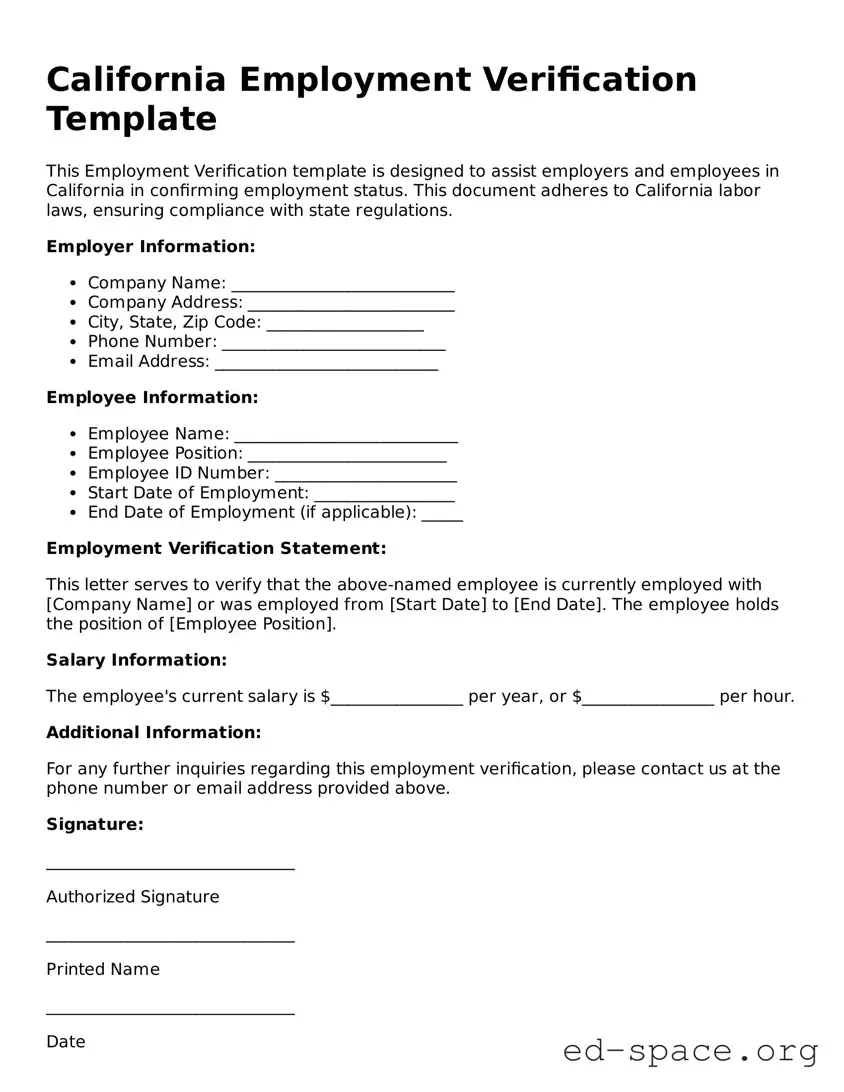
When navigating the complexities of employment in California, understanding the Employment Verification form is crucial for both employers and employees. This form serves as an essential tool in confirming an individual's work history and eligibility for employment. It typically includes important details such as the employee's name, job title, dates of employment, and the employer's contact information. Additionally, the form may require verification of the employee's eligibility to work in the United States, ensuring compliance with federal regulations. Employers utilize this document not only to validate the credentials of prospective hires but also to maintain accurate records for existing staff. For employees, the form can play a pivotal role in securing new job opportunities, as it provides a reliable reference for their past work experiences. Understanding the nuances of this form can empower both parties to engage in a transparent and efficient hiring process.
California Employment Verification Template
This Employment Verification template is designed to assist employers and employees in California in confirming employment status. This document adheres to California labor laws, ensuring compliance with state regulations.
Employer Information:
Employee Information:
Employment Verification Statement:
This letter serves to verify that the above-named employee is currently employed with [Company Name] or was employed from [Start Date] to [End Date]. The employee holds the position of [Employee Position].
Salary Information:
The employee's current salary is $________________ per year, or $________________ per hour.
Additional Information:
For any further inquiries regarding this employment verification, please contact us at the phone number or email address provided above.
Signature:
______________________________
Authorized Signature
______________________________
Printed Name
______________________________
Date
This template is intended for use in California and should be filled out completely to ensure accuracy and compliance with state laws.
| Fact Name | Description |
|---|---|
| Purpose | The California Employment Verification form is used to confirm an employee's identity and eligibility to work in the United States. |
| Governing Law | This form is governed by California Labor Code Section 226 and federal laws regarding employment verification. |
| Form Requirement | Employers are required to complete this form for all new hires to comply with federal and state regulations. |
| Employee Information | It collects essential information about the employee, including name, address, and Social Security number. |
| Employer Responsibilities | Employers must retain completed forms for at least three years after the employee's termination. |
| Verification Process | Employers must verify the identity and work eligibility of employees through documents listed on the form. |
| Privacy Considerations | Employers must ensure that the information collected is kept confidential and secure. |
| Submission | The form does not need to be submitted to any government agency but must be available for inspection if requested. |
| Language Accessibility | Employers are encouraged to provide the form in multiple languages to accommodate non-English speaking employees. |
| Updates | The form may be updated periodically to reflect changes in laws or regulations; always use the most current version. |
After obtaining the California Employment Verification form, you will need to complete it accurately to ensure your employment information is verified correctly. Follow these steps to fill out the form properly.
Once completed, submit the form as instructed, ensuring it reaches the appropriate party for verification.
What is the California Employment Verification form?
The California Employment Verification form is a document used by employers to confirm the employment status of an individual. This form is often requested by lenders, landlords, or other entities that require proof of income or job stability. It typically includes details such as the employee's job title, dates of employment, and salary information. By providing this form, employers help ensure that the verification process is straightforward and efficient for all parties involved.
Who needs to complete the Employment Verification form?
Generally, the employer completes the Employment Verification form. However, the employee may need to request it if they are applying for a loan, renting an apartment, or seeking other services that require proof of employment. In some cases, the employee might provide the form to their employer to fill out. This collaborative approach helps streamline the verification process and ensures that accurate information is shared.
How is the Employment Verification form submitted?
What should I do if my employer refuses to complete the form?
If an employer declines to fill out the Employment Verification form, it's important to understand their reasons. Some employers may have policies in place that restrict them from providing specific information. In such cases, it can be helpful to discuss the situation directly with your employer or HR department. If necessary, you may also consider providing alternative documentation, such as pay stubs or tax returns, to demonstrate your employment status.
Inaccurate Information: Providing incorrect details about employment dates, job titles, or salary can lead to delays or complications in the verification process. It is essential to ensure that all information reflects the actual employment history accurately.
Missing Signatures: Failing to sign the form can render it invalid. Both the employee and the employer must provide their signatures where required to confirm the information is true and correct.
Omitting Required Fields: Leaving out necessary sections, such as contact information or specific job duties, can result in incomplete submissions. Each section should be carefully reviewed to ensure all required fields are filled in.
Not Using the Correct Form: Submitting an outdated version of the Employment Verification form can cause confusion. Always check for the most recent version of the form to ensure compliance with current requirements.
When an employer needs to verify a potential employee's work history, the California Employment Verification form is often used. However, there are several other forms and documents that can accompany this verification process to ensure a comprehensive understanding of an individual's employment background. Below is a list of these commonly used documents.
Each of these documents plays a vital role in the employment verification process. Together, they help employers make informed decisions while ensuring that candidates are accurately represented in their job applications.
The Employment Verification form is a crucial document used to confirm an individual's employment status, job title, and duration of employment. Several other documents serve similar purposes in verifying employment or income. Here are six documents that share similarities with the Employment Verification form:
When filling out the California Employment Verification form, it’s essential to approach the task with care. Here’s a list of things you should and shouldn’t do to ensure the process goes smoothly.
Understanding the California Employment Verification form is essential for both employers and employees. However, several misconceptions can lead to confusion. Here are six common misconceptions:
By addressing these misconceptions, individuals can better navigate the employment verification process and understand its significance.
Filling out the California Employment Verification form can seem straightforward, but there are important details to keep in mind. Here are some key takeaways to ensure the process goes smoothly: