The California Earthquake Authority (CEA) form serves as a crucial document for individuals seeking earthquake insurance coverage in the state of California. This application form gathers essential information about the applicant, including their name, contact details, and the physical location of the property to be insured. It also requires details about any co-applicants, if applicable. One of the key components of the form is the companion policy information, where applicants must provide specifics about their existing insurance policy, such as the name of the participating insurer and the policy number. The form outlines various types of coverage options available, including limits for dwelling coverage, personal property, and loss of use. Additionally, applicants must address important safety features of their property, such as whether the dwelling is secured to its foundation or if it has been inspected for prior earthquake damage. The form also allows for the selection of deductibles and additional coverage options, ensuring that applicants can tailor their insurance to meet their unique needs. Finally, the form concludes with a section for premium calculations and payment options, guiding applicants on how to manage their insurance costs effectively. Overall, the CEA form is designed to facilitate a smooth application process while ensuring that applicants are well-informed about their coverage choices.
|
Earthquake Insurance Application |
Effective Date |
|
Expiration Date |
|
|||
Applicant Information |
|
|
|
|
|
|
|
|
Applicant |
|
|
|
|
Telephone Numbers |
|
|
|
Last Name |
First Name |
|
Middle I nitial |
Home |
|
Work |
|
|
|
|
|
|
Telephone Numbers |
|
|
|
|
Last Name |
First Name |
|
Middle I nitial |
Home |
|
Work |
|
|
Street Address of Physical Location of I nsured Property |
|
|
Mailing Address (if different) |
|
|
|
|
|
Number and Street Address |
|
|
Unit |
Number and Street Address |
|
|
|
Unit |
City |
State |
ZI P Code |
County |
City |
|
State |
ZI P Code |
Country |
|
|
|
|
|
|
|
|
|
Companion Policy Information |
|
|
|
|
|
|
|
|
Participating I nsurer |
Companion Policy Number |
|
Dwelling — Coverage A Limit |
|
Expiration Date (must be same as CEA policy) |
|||
Type of Policy |
|
|
|
|
|
|
|
|
Homeowner |
Mobilehome / Manufactured Home |
Condominium |
|
|
Renters |
|
||
Dwelling Fire |
Other (explain in remarks) |
|
|
|
|
|
|
|
Homeowner / Dwelling Fire
Mobilehome / Manufactured Home
CondominiumRenters
Rating Territory
Year Built
Number of Stories,
I ncluding Basement
Construction Type |
|
Frame |
Other |
|
|
|
|
||
Number of Chimneys |
|
|
||
|
|
|
|
|
Square Footage |
|
|
|
|
|
|
|
|
|
Foundation Type |
Raised |
Slab |
Other |
|
|
|
|
||
Roof Type |
Composition |
Tile |
||
|
Wood Shake |
Other |
||
|
|
|
||
Property I nspected? |
Yes |
No |
||
Date |
|
|
|
|
|
|
|
||
I s there unrepaired prior |
Yes |
No |
||
earthquake damage to |
||||
|
|
|||
the dwelling? |
|
|
|
|
I f yes, DO NOT BI ND and explain in Remarks |
||||
|
|
|
|
|
Dwelling secured to |
|
Yes |
No |
|
foundation? |
|
|||
|
|
|
||
|
|
|
||
Cripple walls braced with |
Yes |
No |
||
plywood or equivalent? |
||||
|
|
|||
|
|
|
||
Water heater secured to |
Yes |
No |
||
building frame? |
|
|||
|
|
|
||
Dwelling — Coverage A |
|
|||
Dwelling Limit |
$ |
|
|
|
|
|
|
||
Rating Territory
Construction Type |
Mobile or Manufactured |
|||
|
|
|
||
Property I nspected? |
Yes |
No |
||
Date |
|
|
|
|
|
|
|
||
I s there unrepaired prior |
Yes |
No |
||
earthquake damage to |
||||
|
|
|||
the dwelling? |
|
|
|
|
I f yes, DO NOT BI ND and explain in Remarks |
||||
|
|
|
||
Is the home reinforced by |
Yes |
No |
||
an earthquake resistant |
||||
|
|
|||
bracing system certified by |
|
|
||
the California Department |
|
|
||
of Housing and Community |
|
|
||
Development? |
|
|
|
|
I f yes, attach a copy of the certification |
||||
Dwelling — Coverage A |
|
|||
Dwelling Limit |
$ |
|
|
|
|
|
|
||
Same as Companion Policy |
|
|
||
Deductible |
15% |
|
10% |
|
Personal Property — Coverage C |
||||
$5,000 |
$25,000 |
|
$50,000 |
|
$75,000 |
$100,000 |
|
|
|
No deductible for this coverage if Coverage A deductible is met. No coverage if Coverage A deductible is not met
Loss of Use — Coverage D
$1,500 |
$10,000 |
$15,000 |
|
No deductible for this coverage |
|
Rating Territory
Number of Stories in building
Choose any combination of one or more
of the following options
Option One
Building Property — Coverage A
Real Property — $25,000
There is a $3,750 deductible for this coverage
Option Two
Personal Property — Coverage C
$5,000 |
$25,000 |
$50,000 |
$75,000 |
$100,000 |
|
There is a $750 deductible for this coverage
«AND »
Loss of Use — Coverage D
$1,500 |
$10,000 |
$15,000 |
No deductible for this coverage
Option Three
Loss Assessment — Coverage E
$25,000
$3,750 deductible
Only available if value of property is $135,000 or less
$50,000
$7,500 deductible
$75,000
$11,250 deductible
Rating Territory
Personal Property — Coverage C
$5,000 |
$25,000 |
$50,000 |
$75,000 |
$100,000 |
|
There is a $750 deductible for this coverage
Loss of Use — Coverage D
$1,500 |
$10,000 |
$15,000 |
|
No deductible for this coverage |
|
Remarks
Same as Companion Policy |
|
|
Deductible |
15% |
10% |
Personal Property — Coverage C |
||
$5,000 |
$25,000 |
$50,000 |
$75,000 |
$100,000 |
|
No deductible for this coverage if Coverage A deductible is met. No coverage if Coverage A deductible is not met
Loss of Use — Coverage D
$1,500 |
$10,000 |
$15,000 |
No deductible for this coverage
Additional Limited Building Code Upgrade
— optional —
I ncrease Limited Building Code Upgrade coverage from $10,000 to a total limit of $20,000
No deductible for this coverage if Coverage A deductible is met. No coverage if Coverage A deductible is not met
Premium Calculation |
|
|
|
Payment Options |
Base Premium |
Increased Limits Premium |
Hazard Reduction Discount |
Total Premium |
Annual |
|
|
|
|
|
+ |
|
− |
= |
I nstallments |
|
|
|
|
|
|
|
Homeowner and Mobilehome only |
|
|
|
|
- if qualifications are met |
|
|
Additional Interests |
|
|
Send Bill To |
||
|
Name |
Loan Number |
|
|
|
Mortgagee |
|
|
|
I nsured |
|
|
|
|
|
|
|
Additional I nsured |
Address |
|
|
Mortgagee |
|
|
|
|
|||
Loss Payee |
|
|
|
|
|
City |
State |
ZI P Code |
|||
|
|||||
|
Name |
Loan Number |
|
|
|
2nd Mortgagee |
|
|
|
I nsured |
|
|
|
|
|
|
|
Additional I nsured Address |
|
|
Mortgagee |
||
Loss Payee |
|
|
|
|
|
City |
State |
ZI P Code |
|||
|
|||||
I am applying for the insurance indicated, and the information on this application is correct
X
Applicant Signature |
Producer Name and Address |
Application Date and Time |
Earthquake Application
Attachment A – Page 2
CALIFORNIA EARTHQUAKE AUTHORITY
EARTHQUAKE INSURANCE APPLICATION – 05/09 Edition
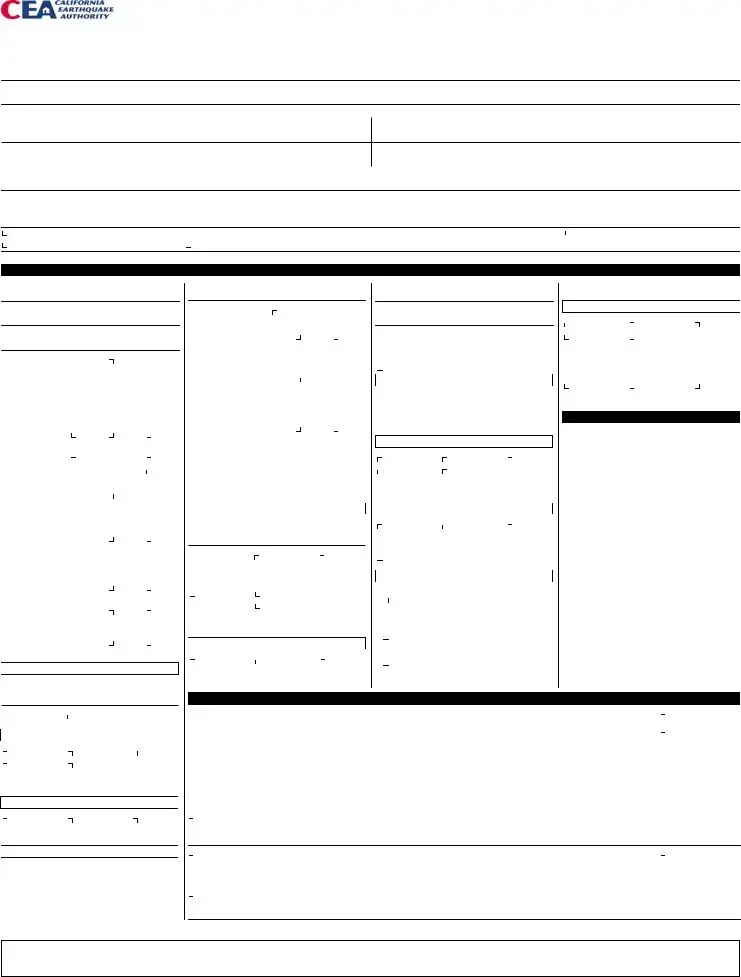
INSTRUCTIONS
POLICY EFFECTIVE DATE AND EXPIRATION DATE
Provide CEA policy effective date and expiration date. Expiration date MUST be the same as the expiration date of the companion policy.
APPLICANT
Complete all requested information for applicant(s) including: Name(s)
Telephone number(s)
Street address of physical location of insured property
Mailing address (if different from street address of property’s physical location)
COMPANION POLICY INFORMATION
Complete all requested information for companion policy including: Name of Participating Insurer
Policy number of companion policy
Dwelling limit (i.e., Coverage A) of companion policy (if companion policy has dwelling limit) Expiration date of companion policy
Type of companion policy
POLICY TYPE
•Homeowner (Companion policy must be either a Homeowners
O MOBILEHOME/MANUFACTURED HOME (Written on CEA Homeowner Policy form; however, requires unique rating information.)
Condominium (i.e. Common Interest Development) (Companion policy must be a Condominium Unit Owners
Renters (Companion policy must be a Renters
Complete all information requested under the applicable CEA policy type. Answer all questions and select desired CEA policy limits and coverage options.
PREMIUM CALCULATION
Provide premium calculations.
PAYMENT OPTIONS
Select payment option:
Annual; or
Installments
SEND BILL TO
Select who should receive the bill:
Insured; or
Mortgagee
ADDITIONAL INTERESTS
Complete information requested for each additional interest, including:
Type:
OMortgagee;
OAdditional insured; or
OLoss payee
Name and address
Loan number (if applicable)
REMARKS
Include any additional remarks as needed.
SIGNATURE
Secure the applicant’s signature on the application.
Provide the producer’s name and address.
Provide the date and time the application is completed.
| Fact Name | Description |
|---|---|
| Governing Law | The California Earthquake Authority operates under California Insurance Code Sections 10089-10089.16, which govern earthquake insurance policies in the state. |
| Application Purpose | This form is used to apply for earthquake insurance coverage through the California Earthquake Authority, ensuring protection against earthquake-related damages. |
| Companion Policy Requirement | Applicants must provide details of a companion policy, which is typically a homeowner's insurance policy that covers the dwelling. |
| Coverage Options | The application allows for various coverage options, including personal property coverage and loss of use, with specific limits and deductibles outlined. |
| Inspection Requirement | Property inspections may be required to assess the earthquake resilience of the dwelling, particularly if there is prior earthquake damage. |
Filling out the California Earthquake Authority form requires careful attention to detail. Make sure to provide accurate information to ensure your application is processed smoothly. Follow these steps to complete the form correctly.
What information do I need to provide on the California Earthquake Authority form?
You will need to fill out several key pieces of information. Start with your personal details, including your name, phone numbers, and address of the property you want to insure. If you have a co-applicant, their information is also required. Additionally, you must provide details about any existing companion policy, such as the insurer's name, policy number, and coverage limits. Be prepared to answer questions regarding the property's condition, including any prior earthquake damage and safety measures in place.
What types of coverage are available through the California Earthquake Authority?
The California Earthquake Authority offers various coverage options. You can choose coverage for the dwelling, personal property, and loss of use. Coverage limits vary, with options for personal property ranging from $5,000 to $100,000. You can also select a deductible amount for these coverages. Additional options, like Limited Building Code Upgrade coverage, can be included for extra protection. It's important to carefully review these options to select what best fits your needs.
How do I calculate the premium for my earthquake insurance?
To calculate your premium, start with the base premium and add any increased limits you may choose. You may also qualify for a hazard reduction discount, which can lower your total premium. The final amount will be the sum of these components. You can opt to pay the premium annually or in installments, depending on your preference. Make sure to review your calculations to ensure accuracy before submitting the form.
What should I do if there is unrepaired earthquake damage to my property?
If your property has unrepaired earthquake damage, you should not bind the insurance. Instead, you must explain the situation in the remarks section of the application. This is crucial because the presence of unrepaired damage can affect your coverage eligibility. It’s advisable to address any damage before applying to ensure you meet the requirements for coverage.
Incomplete Applicant Information: Failing to provide all necessary details about the applicant and co-applicant, such as names, phone numbers, and addresses, can lead to processing delays.
Incorrect Policy Dates: Not ensuring that the effective date and expiration date match the companion policy can result in coverage issues.
Missing Companion Policy Details: Omitting information about the companion policy, including the insurer's name and policy number, is a common mistake that can complicate the application.
Improper Coverage Selection: Selecting the wrong type of policy or coverage limits can lead to inadequate protection. It’s important to carefully choose based on the type of property.
Ignoring Prior Damage: Not disclosing any unrepaired earthquake damage can be detrimental. If there is prior damage, the application should not be bound until explained in the remarks.
Neglecting Inspection Questions: Failing to answer whether the property was inspected or if it has an earthquake-resistant bracing system can lead to misunderstandings about coverage eligibility.
Signature and Date Omission: Forgetting to sign the application or provide the date can halt the processing. Always ensure that the application is fully signed and dated before submission.
When applying for earthquake insurance through the California Earthquake Authority, several other forms and documents may be required to ensure comprehensive coverage. Below is a list of commonly used documents that accompany the California Earthquake Authority form. Each document plays a significant role in the insurance process, helping to clarify coverage details and ensure that all necessary information is accurately provided.
Each of these documents plays a crucial role in the earthquake insurance application process. Having them prepared and submitted alongside the California Earthquake Authority form can help streamline the approval process and ensure that all aspects of coverage are adequately addressed.
Understanding the California Earthquake Authority (CEA) form can be easier when you compare it to other similar documents. Here’s a list of seven documents that share similarities with the CEA form, along with explanations of how they relate:
By recognizing these similarities, you can better appreciate the importance of the CEA form and how it fits into the broader context of insurance documentation. Each of these forms plays a crucial role in protecting individuals and properties from various risks, including the significant threat of earthquakes in California.
When filling out the California Earthquake Authority form, there are important guidelines to follow. Here’s a helpful list of what to do and what to avoid:
By following these guidelines, you can help ensure that your application process goes smoothly. Make sure to double-check your information before submitting the form.
This is incorrect. The CEA form is applicable to various types of properties, including mobile homes, condominiums, and rental units. It accommodates different policy types, ensuring that all property owners can apply for earthquake insurance.
Completing the form does not automatically secure coverage. The application must be reviewed and approved by the insurance provider. Factors such as property condition and prior damage can affect eligibility.
This is false. If there is any unrepaired earthquake damage, it must be disclosed on the application. Failure to do so can lead to denial of coverage or claims in the future.
The CEA form has specific requirements and questions tailored to earthquake insurance. It differs from standard homeowner insurance applications and requires additional details about the property’s seismic safety features.
This is misleading. The CEA form offers specific deductible options based on the type of coverage selected. Understanding these limits is essential for making an informed decision about the policy.
Here are some key takeaways for filling out and using the California Earthquake Authority form:
By following these steps, you can ensure that your application is complete and accurate, helping to facilitate the process of obtaining earthquake insurance.