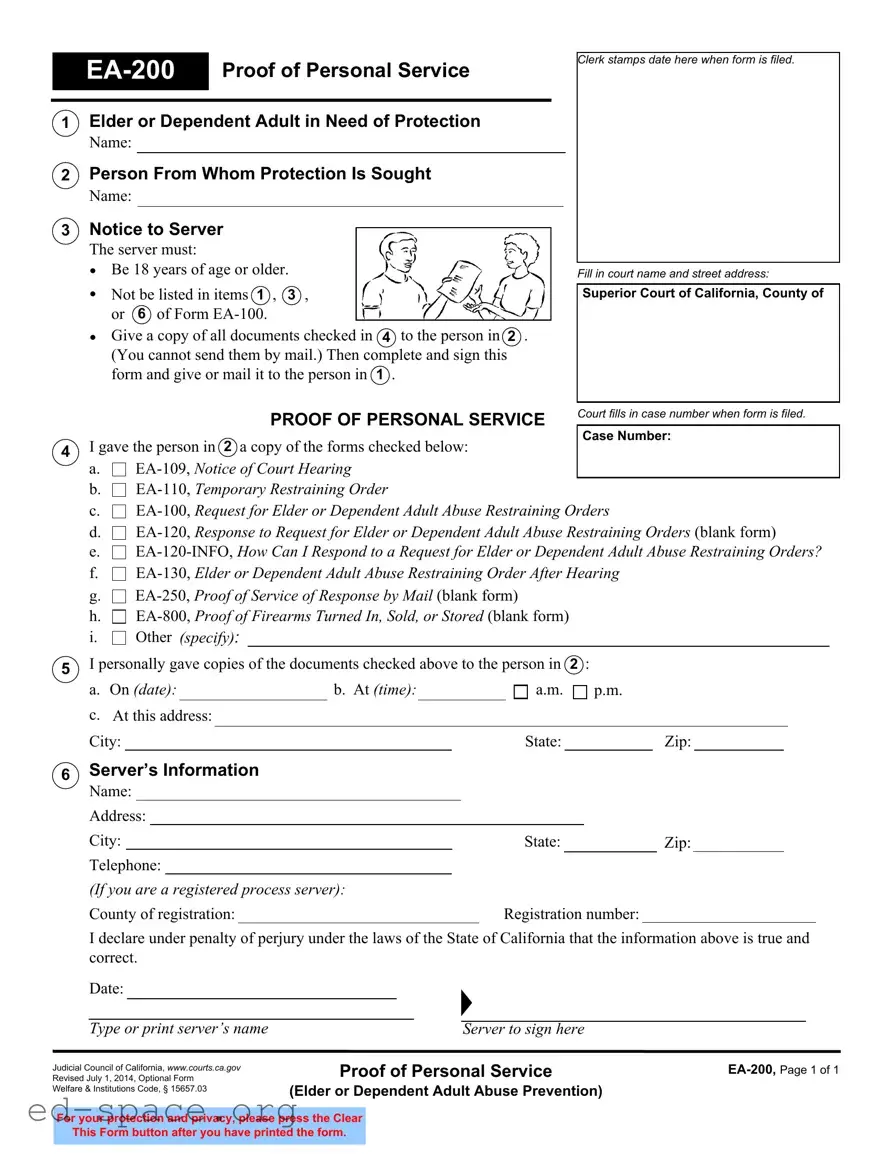
The California EA-200 form, known as the Proof of Personal Service, plays a critical role in the process of seeking protection for elders or dependent adults who may be at risk of abuse. This form is essential for documenting that the required legal documents have been delivered directly to the individual from whom protection is sought. It outlines specific requirements for the server, including that they must be at least 18 years old and not be involved in the case. The server is responsible for providing copies of various documents, such as the Notice of Court Hearing and the Temporary Restraining Order, ensuring that the individual is fully informed of the proceedings. After serving the documents, the server must complete and sign the EA-200 form, which is then submitted to the court. This process is designed to uphold the rights of vulnerable adults while maintaining a clear record of service. Accurate completion of this form is vital, as it affirms the server's compliance with legal standards and helps facilitate the protection process.
Proof of Personal Service |
|
|
|
|
|
1Elder or Dependent Adult in Need of Protection
Name:
2Person From Whom Protection Is Sought
Name:
3Notice to Server
The server must:
•Be 18 years of age or older.
•Not be listed in items 1 , 3 , or 6 of Form
•Give a copy of all documents checked in 4 to the person in 2 . (You cannot send them by mail.) Then complete and sign this form and give or mail it to the person in 1 .
Clerk stamps date here when form is filed.
Fill in court name and street address:
Superior Court of California, County of
PROOF OF PERSONAL SERVICE |
Court fills in case number when form is filed. |
|
Case Number:
4I gave the person in 2 a copy of the forms checked below:
a.
b.
c.
d.
e.
f.
g.
h.
i. Other (specify):
5I personally gave copies of the documents checked above to the person in 2 :
a. |
On (date): |
|
b. At (time): |
|
|
a.m. |
p.m. |
|||||
c. |
At this address: |
|
|
|
|
|
|
|
|
|
||
City: |
|
|
|
|
State: |
|
Zip: |
|
|
|||
6 Server’s Information
Name: |
|
|
|
|
|
|
|
|
|
||||||
Address: |
|
|
|
|
|
|
|
|
|
||||||
City: |
|
|
|
State: |
|
Zip: |
|||||||||
Telephone: |
|
|
|
|
|
|
|
|
|
|
|||||
|
|
|
|
|
|
|
|
||||||||
(If you are a registered process server): |
|
|
|
|
|
|
|
|
|||||||
County of registration: |
|
|
Registration number: |
|
|
|
|
||||||||
I declare under penalty of perjury under the laws of the State of California that the information above is true and correct.
Date:
Type or print server’s name
Judicial Council of California, www.courts.ca.gov Revised July 1, 2014, Optional Form
Welfare & Institutions Code, § 15657.03
Server to sign here
Proof of Personal Service |
(Elder or Dependent Adult Abuse Prevention)
For your protection and privacy, please press the Clear
This Form button after you have printed the form.
| Fact Name | Details |
|---|---|
| Purpose | The EA-200 form is used to prove that personal service has been completed for elder or dependent adult abuse cases. |
| Eligibility of Server | The server must be at least 18 years old and cannot be listed in specific sections of Form EA-100. |
| Delivery Method | Documents must be personally delivered to the individual seeking protection; mail delivery is not allowed. |
| Governing Law | This form is governed by the Welfare & Institutions Code, § 15657.03 of the State of California. |
| Filing Requirement | The completed form must be filed with the court, which will stamp the date upon filing. |
Filling out the California EA-200 form is an important step in the legal process for protecting an elder or dependent adult. This form serves as proof that the necessary documents have been personally delivered to the individual from whom protection is sought. Below are the steps to accurately complete the form.
What is the purpose of the California EA-200 form?
The California EA-200 form, known as the Proof of Personal Service, is used to document that specific legal documents have been personally delivered to an individual seeking protection for an elder or dependent adult. This form ensures that the person from whom protection is sought receives all necessary documents regarding court hearings and restraining orders.
Who is eligible to serve the documents listed on the EA-200 form?
The individual serving the documents must be at least 18 years old and cannot be involved in the case. Specifically, they must not be listed in items 1, 3, or 6 of Form EA-100. This requirement helps maintain the integrity of the legal process by ensuring that the server is impartial.
What documents need to be served along with the EA-200 form?
The server must deliver copies of all documents checked in section 4 of the EA-200 form. These may include notices of court hearings, temporary restraining orders, requests for elder or dependent adult abuse restraining orders, and responses to those requests, among others. A complete list of these documents is provided on the form itself.
Can the documents be sent by mail instead of being personally served?
No, the documents cannot be sent by mail. The server must personally deliver the documents to the individual from whom protection is sought. This requirement ensures that the recipient is properly informed and has received the necessary legal information.
What information must be included in the EA-200 form?
The form requires several key pieces of information, including the names of the elder or dependent adult in need of protection and the person from whom protection is sought. Additionally, the server must provide their own contact information, the date and time of service, and the address where the service took place. This information is crucial for verifying that the service was completed correctly.
What happens after the EA-200 form is completed?
Once the EA-200 form is completed and signed by the server, it must be filed with the court. The court will then stamp the date when the form is filed. This filing serves as official proof that the required documents were served to the individual in question.
Is there a penalty for providing false information on the EA-200 form?
Yes, the server declares under penalty of perjury that the information provided on the form is true and correct. If the information is found to be false, the server may face legal consequences, including potential criminal charges. This underscores the importance of accuracy when filling out the form.
Where can I find more information about the EA-200 form?
Additional information about the EA-200 form can be found on the Judicial Council of California's website. The website offers resources and guidance related to elder and dependent adult abuse prevention, including instructions for completing and filing the form.
Omitting Required Information: One common mistake is failing to fill out all necessary fields. Ensure that every section, especially the names and addresses of the parties involved, is complete. Missing information can lead to delays or rejection of the form.
Incorrectly Identifying the Recipient: It is crucial to accurately identify the person from whom protection is sought. Errors in this section can result in significant legal complications and may undermine the purpose of the form.
Not Following Service Requirements: The server must meet specific criteria, such as being at least 18 years old and not being listed in certain sections of Form EA-100. Failing to adhere to these guidelines can invalidate the service.
Improper Delivery of Documents: The form requires that documents be personally delivered. Sending them by mail is not permissible. Ensure that the server hands over the documents directly to the individual in question.
Missing Signatures: Both the server and the person completing the form must sign it. Neglecting to include these signatures can render the form incomplete and ineffective.
Incorrect Date and Time: When documenting the date and time of service, accuracy is essential. Errors here can lead to disputes about when the service occurred, potentially affecting court proceedings.
Failure to Provide Accurate Server Information: The server’s details, including name, address, and registration number (if applicable), must be correct. Inaccuracies can create confusion and hinder the legal process.
The California EA-200 form, known as the Proof of Personal Service, is an important document in cases involving elder or dependent adult abuse. It is used to confirm that the required legal documents have been properly served to the individual from whom protection is sought. Along with this form, several other documents are often utilized in the legal process to ensure comprehensive protection and compliance with court procedures.
Understanding these associated forms can help individuals navigate the legal landscape surrounding elder and dependent adult abuse cases. Each document plays a vital role in ensuring that the rights and safety of vulnerable individuals are upheld throughout the legal process.
The California EA-200 form, which is used to provide proof of personal service in elder or dependent adult abuse cases, shares similarities with several other legal documents. Each of these documents serves a specific purpose in the legal process related to elder or dependent adult protection. Below is a list of documents that are similar to the EA-200 form, along with a brief explanation of their functions:
Each of these documents plays a crucial role in the legal framework designed to protect vulnerable individuals from abuse, ensuring that their rights are upheld throughout the process.
When filling out the California EA-200 form, it’s essential to approach the task with care. Here are six important dos and don’ts to keep in mind:
Following these guidelines can help ensure that your form is filled out correctly, reducing the chance of delays or issues in your case.
Here are four common misconceptions about the California EA 200 form:
When filling out and using the California EA-200 form, consider the following key takeaways: