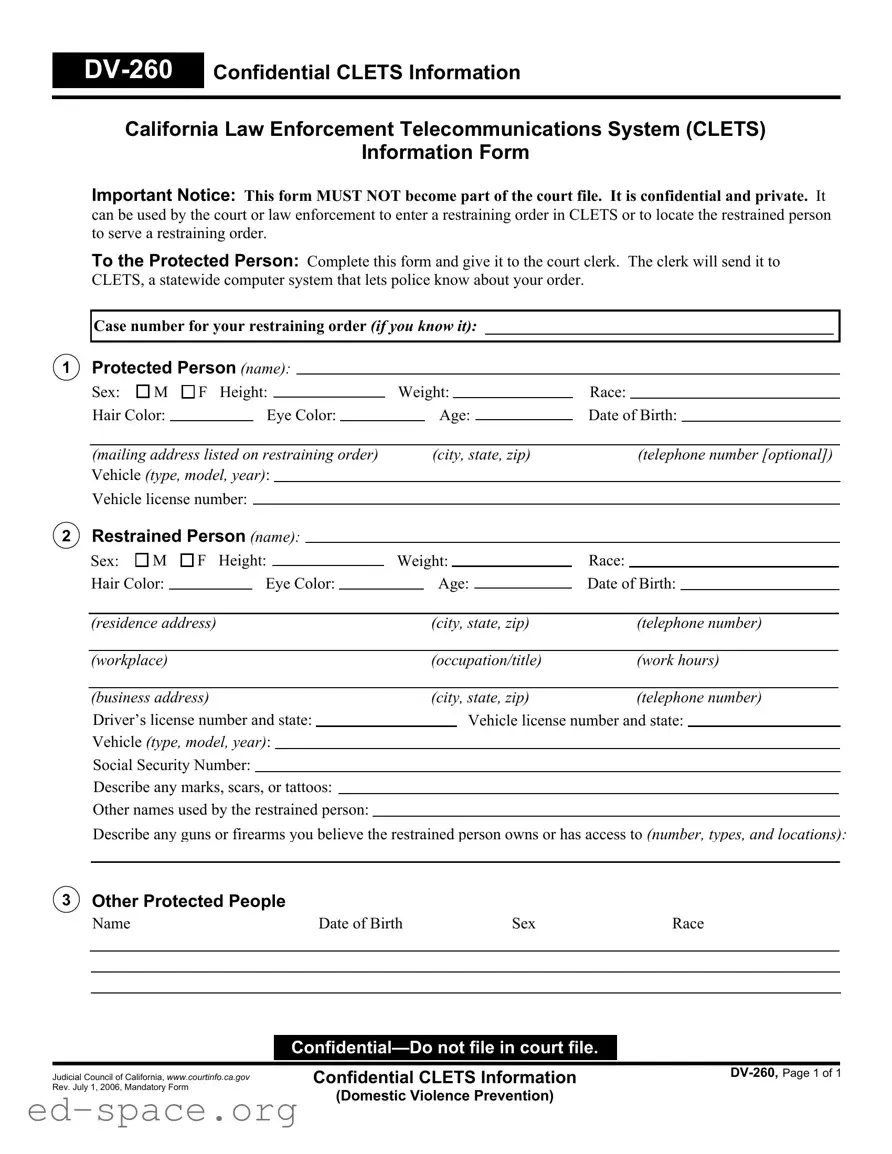
The California DV-260 form plays a crucial role in the protection of individuals facing domestic violence. This confidential document is not meant to be part of the court file, ensuring the privacy of those involved. By filling out this form, a protected person provides essential information that allows law enforcement to effectively enter a restraining order into the California Law Enforcement Telecommunications System (CLETS). This system enables police to be alerted to the existence of the order and assists in locating the restrained individual for proper service of the order. The DV-260 requires detailed information about both the protected and restrained persons, including physical characteristics, contact details, and any known vehicles. It also asks for descriptions of firearms that the restrained person may possess, which is critical for assessing potential risks. Completing this form accurately and submitting it to the court clerk is a vital step in the legal process aimed at ensuring safety and security for those in vulnerable situations.
California Law Enforcement Telecommunications System (CLETS)
Information Form
Important Notice: This form MUST NOT become part of the court file. It is confidential and private. It can be used by the court or law enforcement to enter a restraining order in CLETS or to locate the restrained person to serve a restraining order.
To the Protected Person: Complete this form and give it to the court clerk. The clerk will send it to CLETS, a statewide computer system that lets police know about your order.
Case number for your restraining order (if you know it):
1Protected Person (name):
Sex: |
M |
F Height: |
|
|
Weight: |
|
|
Race: |
|
|||||
Hair Color: |
|
|
Eye Color: |
|
|
Age: |
|
|
Date of Birth: |
|
||||
|
|
|
|
|
|
|
|
|
|
|
||||
(mailing address listed on restraining order) |
|
(city, state, zip) |
|
|
(telephone number [optional]) |
|||||||||
Vehicle (type, model, year): |
|
|
|
|
|
|
|
|
||||||
Vehicle license number: |
|
|
|
|
|
|
|
|
|
|
|
|||
2Restrained Person (name):
Sex: |
M |
F |
Height: |
|
|
Weight: |
|
|
Race: |
|
|
|||
Hair Color: |
|
|
Eye Color: |
|
|
Age: |
|
|
Date of Birth: |
|
||||
|
|
|
|
|
|
|
|
|
|
|
|
|||
(residence address) |
|
|
|
|
|
(city, state, zip) |
|
|
(telephone number) |
|||||
|
|
|
|
|
|
|
|
|
|
|
|
|||
(workplace) |
|
|
|
|
|
|
(occupation/title) |
|
|
(work hours) |
||||
(business address)
Driver’s license number and state:
Vehicle (type, model, year):
Social Security Number:
Describe any marks, scars, or tattoos:
Other names used by the restrained person:
Describe any guns or firearms you believe the restrained person owns or has access to (number, types, and locations):
3Other Protected People
Name |
Date of Birth |
Sex |
Race |
|
|
|
|
|
|
|
|
|
|
|
|
|
|
|
|
Judicial Council of California, www.courtinfo.ca.gov Rev. July 1, 2006, Mandatory Form
Confidential CLETS Information
(Domestic Violence Prevention)
| Fact Name | Description |
|---|---|
| Confidentiality Requirement | The DV-260 form is confidential and must not be included in the court file. This ensures the privacy of the protected person. |
| Purpose of the Form | This form is used to provide information to the California Law Enforcement Telecommunications System (CLETS) for the purpose of entering a restraining order and locating the restrained person. |
| Completion Instructions | The protected person must complete the form and submit it to the court clerk, who will then send it to CLETS. |
| Governing Law | The DV-260 form is governed by California Family Code Section 6220, which pertains to domestic violence prevention. |
After completing the California DV-260 form, you will submit it to the court clerk. The clerk will then send it to the California Law Enforcement Telecommunications System (CLETS). This system helps law enforcement access important information regarding your restraining order.
What is the purpose of the California DV-260 form?
The California DV-260 form is used to provide confidential information to the court and law enforcement regarding a restraining order. This form helps to ensure that the order is entered into the California Law Enforcement Telecommunications System (CLETS), allowing police to access the information when needed.
Who should complete the DV-260 form?
The protected person, who is the individual seeking the restraining order, should complete the DV-260 form. It is important for the protected person to provide accurate and detailed information to facilitate the enforcement of the restraining order.
What kind of information is required on the DV-260 form?
The form requires personal information about both the protected person and the restrained person. This includes names, physical characteristics (such as height, weight, and hair color), and details about vehicles owned by either party. Additionally, it asks for information about any firearms the restrained person may have access to.
Why is the DV-260 form confidential?
The DV-260 form is confidential to protect the privacy and safety of the individuals involved. It should not become part of the public court file, ensuring that sensitive information is not accessible to the general public.
How is the information on the DV-260 form used?
The information provided on the DV-260 form is used by the court and law enforcement to enter the restraining order into CLETS. This allows law enforcement officers to quickly access the details of the order and take appropriate action if necessary.
What should be done with the completed DV-260 form?
Once the DV-260 form is completed, it should be submitted to the court clerk. The clerk will then send the form to CLETS, ensuring that the information is properly recorded and accessible to law enforcement.
Can the DV-260 form be amended after submission?
If any information on the DV-260 form changes after submission, it is important to notify the court as soon as possible. Updates may be necessary to ensure that law enforcement has the most accurate information regarding the restraining order.
What happens if the DV-260 form is not submitted?
Failing to submit the DV-260 form may result in law enforcement not being aware of the restraining order. This could jeopardize the safety of the protected person, as the order would not be entered into the CLETS system for police access.
Is there a fee to file the DV-260 form?
There is typically no fee associated with filing the DV-260 form as it is part of the process for obtaining a restraining order. However, it is advisable to check with the local court for any specific policies or requirements.
Failing to provide accurate personal information. It is crucial to ensure that the names, addresses, and other identifying details of both the protected person and the restrained person are correct. Any inaccuracies can lead to delays or complications in the issuance of the restraining order.
Neglecting to include the case number if known. If a restraining order already exists, omitting the case number can create confusion and hinder the court's ability to process the request effectively.
Not specifying the relationship between the protected and restrained persons. This information helps the court understand the context of the situation and can influence the urgency and type of protective measures taken.
Providing incomplete or vague descriptions of marks, scars, or tattoos. The more specific the details, the easier it will be for law enforcement to identify the restrained person. Avoiding generalities is essential.
Omitting information about any firearms owned by the restrained person. This detail is vital for ensuring the safety of the protected person and should be included thoroughly.
Using incorrect terminology or abbreviations. Clarity is key. Using terms that are not universally understood can lead to misunderstandings or misinterpretations of the information provided.
Forgetting to include contact information for the restrained person. Providing a phone number or workplace details can assist law enforcement in locating the individual if necessary.
Not ensuring that the form is submitted confidentially. Remember that this form must not become part of the court file. It is essential to follow the instructions carefully to maintain confidentiality.
Failing to double-check for signature and date. The form must be signed and dated appropriately before submission. A missing signature can render the form invalid.
The California DV-260 form is an essential document used in domestic violence cases. It provides confidential information to law enforcement regarding restraining orders. Alongside this form, several other documents may be necessary for a comprehensive legal process. Below is a list of commonly used forms and documents that often accompany the DV-260.
Understanding these documents can significantly aid individuals navigating the complexities of domestic violence cases in California. Each form plays a specific role in ensuring that the rights and safety of all parties are considered throughout the legal process.
The California DV-260 form is a crucial document used in domestic violence cases. It serves to provide confidential information to law enforcement about individuals involved in restraining orders. Several other documents share similarities with the DV-260 form in terms of purpose and usage. Here are four such documents:
When filling out the California DV-260 form, it’s essential to be careful and thorough. Here’s a list of things to keep in mind:
Following these guidelines will help ensure that your DV-260 form is filled out correctly and processed efficiently.
Misconceptions about the California DV-260 form can lead to confusion and missteps in the process of obtaining a restraining order. Here are ten common misunderstandings clarified:
When filling out and using the California DV-260 form, it's important to understand its purpose and the information required. Here are some key takeaways:
By keeping these points in mind, you can ensure that the DV-260 form is filled out correctly and serves its intended purpose effectively.