In the realm of personal finance and healthcare decisions, the California Durable Power of Attorney (DPOA) form serves as a vital tool for individuals seeking to ensure their wishes are respected even when they are unable to communicate them. This legal document empowers a trusted person, often referred to as an agent or attorney-in-fact, to make decisions on behalf of the principal, the individual granting this authority. One of the key features of the DPOA is its durability; it remains effective even if the principal becomes incapacitated, providing peace of mind during uncertain times. The form can be tailored to encompass a wide range of responsibilities, from managing financial affairs to making healthcare decisions, depending on the principal's needs. Moreover, California law outlines specific requirements for executing this document, including the necessity for the principal to be of sound mind and the need for signatures from witnesses or a notary. Understanding the nuances of the DPOA is essential for anyone considering this important legal safeguard, as it not only facilitates the management of personal affairs but also ensures that one’s values and preferences are honored in critical moments.
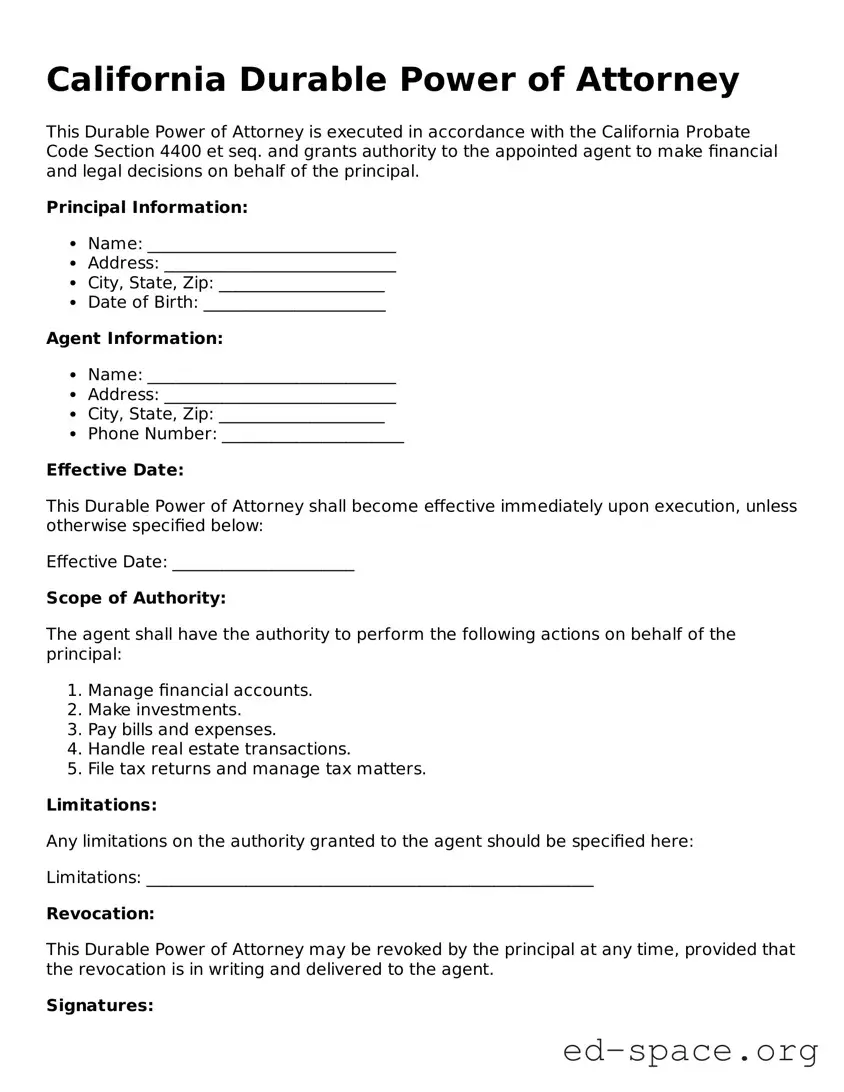
California Durable Power of Attorney
This Durable Power of Attorney is executed in accordance with the California Probate Code Section 4400 et seq. and grants authority to the appointed agent to make financial and legal decisions on behalf of the principal.
Principal Information:
Agent Information:
Effective Date:
This Durable Power of Attorney shall become effective immediately upon execution, unless otherwise specified below:
Effective Date: ______________________
Scope of Authority:
The agent shall have the authority to perform the following actions on behalf of the principal:
Limitations:
Any limitations on the authority granted to the agent should be specified here:
Limitations: ______________________________________________________
Revocation:
This Durable Power of Attorney may be revoked by the principal at any time, provided that the revocation is in writing and delivered to the agent.
Signatures:
By signing below, the principal affirms that they understand the contents of this Durable Power of Attorney and are executing it voluntarily.
Principal's Signature: ___________________________ Date: ____________
Agent's Signature: _____________________________ Date: ____________
Witnesses:
Two witnesses are required for this document. Their signatures must be below:
Witness 1 Signature: _________________________ Date: ____________
Witness 2 Signature: _________________________ Date: ____________
Notary Acknowledgment:
This document must be notarized to be valid. The notary should complete the acknowledgment below:
State of California, County of ________________
Subscribed and sworn before me on this ______ day of __________, 20__.
Notary Public Signature: ______________________
| Fact Name | Description |
|---|---|
| Definition | A California Durable Power of Attorney allows someone to act on your behalf in financial matters. |
| Durability | This document remains effective even if you become incapacitated. |
| Governing Law | California Probate Code Sections 4000-4545 govern the Durable Power of Attorney. |
| Principal and Agent | The person creating the document is the principal, and the person designated to act is the agent. |
| Scope of Authority | It can grant broad or limited powers, depending on your preferences. |
| Signing Requirements | The form must be signed by the principal and witnessed or notarized. |
| Revocation | You can revoke the Durable Power of Attorney at any time, as long as you are competent. |
| Agent's Duties | The agent must act in the best interest of the principal and follow their wishes. |
| Healthcare Decisions | This form does not cover healthcare decisions; a separate document is needed for that. |
| Use in Emergencies | Having this document can help manage your affairs quickly during emergencies. |
Filling out the California Durable Power of Attorney form is an important step in planning for your future. This document allows you to designate someone to make financial decisions on your behalf if you become unable to do so. Follow these steps to complete the form accurately.
Once you have filled out the form, it’s essential to communicate with your chosen agent about your wishes and any specific instructions you may have. This will help ensure that your intentions are clear and understood.
What is a Durable Power of Attorney in California?
A Durable Power of Attorney is a legal document that allows an individual, known as the principal, to appoint someone else, called the agent or attorney-in-fact, to make decisions on their behalf. The term "durable" indicates that the authority granted to the agent remains in effect even if the principal becomes incapacitated. This can be crucial for managing financial and legal matters when the principal is unable to do so themselves.
How do I create a Durable Power of Attorney in California?
To create a Durable Power of Attorney in California, you need to complete a specific form that meets state requirements. You can find templates online or consult with an attorney for assistance. The document should clearly state that it is a Durable Power of Attorney and specify the powers granted to the agent. Once completed, the principal must sign the document, and it is recommended to have it notarized for added validity. While notarization is not strictly required, it can help prevent disputes about the document's authenticity.
What powers can I grant to my agent in a Durable Power of Attorney?
The powers granted can be broad or limited, depending on the principal's wishes. Common powers include managing bank accounts, paying bills, handling real estate transactions, and making investment decisions. The principal can also specify certain limitations or conditions under which the agent can act. It is essential to be clear about what decisions the agent can make to avoid any confusion in the future.
Can I revoke a Durable Power of Attorney once it is created?
Yes, a principal can revoke a Durable Power of Attorney at any time, as long as they are mentally competent. To revoke the document, the principal should create a written notice of revocation and inform the agent and any relevant institutions or parties that may rely on the original document. It is advisable to keep a copy of the revocation for personal records. Once revoked, the agent no longer has the authority to act on behalf of the principal.
What happens if I become incapacitated and do not have a Durable Power of Attorney?
If a person becomes incapacitated without having a Durable Power of Attorney in place, their loved ones may need to go through a legal process called conservatorship. This can be time-consuming and costly, as it requires court approval to appoint someone to manage the incapacitated person's affairs. Establishing a Durable Power of Attorney beforehand can help avoid this situation and ensure that the principal's wishes are honored.
Is it necessary to have an attorney to create a Durable Power of Attorney?
While it is not legally required to have an attorney to create a Durable Power of Attorney in California, seeking legal advice can be beneficial. An attorney can help ensure that the document complies with state laws and accurately reflects the principal's intentions. They can also provide guidance on the best practices for selecting an agent and specifying the powers granted.
Failing to specify the powers granted. It's crucial to clearly outline what powers the agent will have. Without this, the document may not serve its intended purpose.
Not signing the form in front of a notary. California law requires that the Durable Power of Attorney be notarized to be valid. Skipping this step can lead to complications.
Choosing the wrong agent. Selecting someone who may not act in your best interest can lead to disputes. Ensure the agent is trustworthy and understands your wishes.
Neglecting to update the document. Life changes, such as marriage, divorce, or the death of an agent, necessitate updates to the Durable Power of Attorney.
Using outdated forms. Legal requirements can change. Always use the most current version of the Durable Power of Attorney form to ensure compliance.
Not discussing the document with the agent. Communication is key. The appointed agent should be aware of their responsibilities and your expectations.
Overlooking alternate agents. Designating a backup agent can prevent issues if the primary agent is unavailable or unable to serve.
Failing to provide copies. After signing and notarizing, distribute copies of the document to your agent and relevant parties to ensure they are informed.
Ignoring state-specific requirements. Each state has its own rules regarding Durable Power of Attorney forms. Make sure to follow California’s specific guidelines to avoid invalidation.
A California Durable Power of Attorney (DPOA) is a vital document that allows an individual, known as the principal, to designate another person, referred to as the agent, to make decisions on their behalf. While the DPOA is essential for managing financial and legal matters, several other documents often accompany it to provide a comprehensive approach to planning for future needs. Here are four important forms and documents that are commonly used alongside the DPOA:
Having these documents in place, alongside a California Durable Power of Attorney, can provide peace of mind and clarity regarding personal and financial matters. Each form plays a unique role in ensuring that an individual’s wishes are respected and upheld, particularly during times when they may not be able to advocate for themselves.
When filling out the California Durable Power of Attorney form, it's important to approach the task with care. This document allows you to appoint someone to make financial decisions on your behalf if you become unable to do so. Here are some essential dos and don'ts to keep in mind:
When it comes to the California Durable Power of Attorney (DPOA), many people hold misconceptions that can lead to confusion or poor decision-making. Understanding these misunderstandings is crucial for anyone considering this important legal document. Below are eight common misconceptions about the California Durable Power of Attorney form, along with explanations to clarify each point.
This is not true. While many people associate DPOAs with aging, anyone over the age of 18 can create one. Life is unpredictable, and having a DPOA can protect your interests regardless of your age.
In reality, a DPOA allows you to designate someone you trust to act on your behalf when you cannot. You maintain control as long as you are capable of making your own decisions.
Your agent can be anyone you trust, such as a family member or friend. While it’s beneficial for your agent to have some understanding of financial matters, they do not need to be a professional.
This is incorrect. A Durable Power of Attorney becomes effective immediately upon signing, unless you specify otherwise. It remains valid even if you become incapacitated.
You can revoke a DPOA at any time, as long as you are mentally competent. Simply creating a new DPOA or providing written notice to your agent can effectively revoke the previous one.
These documents serve different purposes. A DPOA grants someone authority to manage your financial and legal affairs, while a living will outlines your wishes regarding medical treatment.
This is false. You can modify or update your DPOA as your circumstances or preferences change. Regular reviews of your DPOA are advisable to ensure it reflects your current wishes.
While an agent has significant authority, they are legally obligated to act in your best interest. Misusing the DPOA for personal gain can lead to serious legal consequences.
Understanding these misconceptions can help you make informed decisions regarding your Durable Power of Attorney in California. It's always wise to consult with a legal professional to ensure your documents align with your intentions and protect your interests.
When filling out and using the California Durable Power of Attorney form, keep these key points in mind:
By following these guidelines, you can create a Durable Power of Attorney that effectively meets your needs and protects your interests.