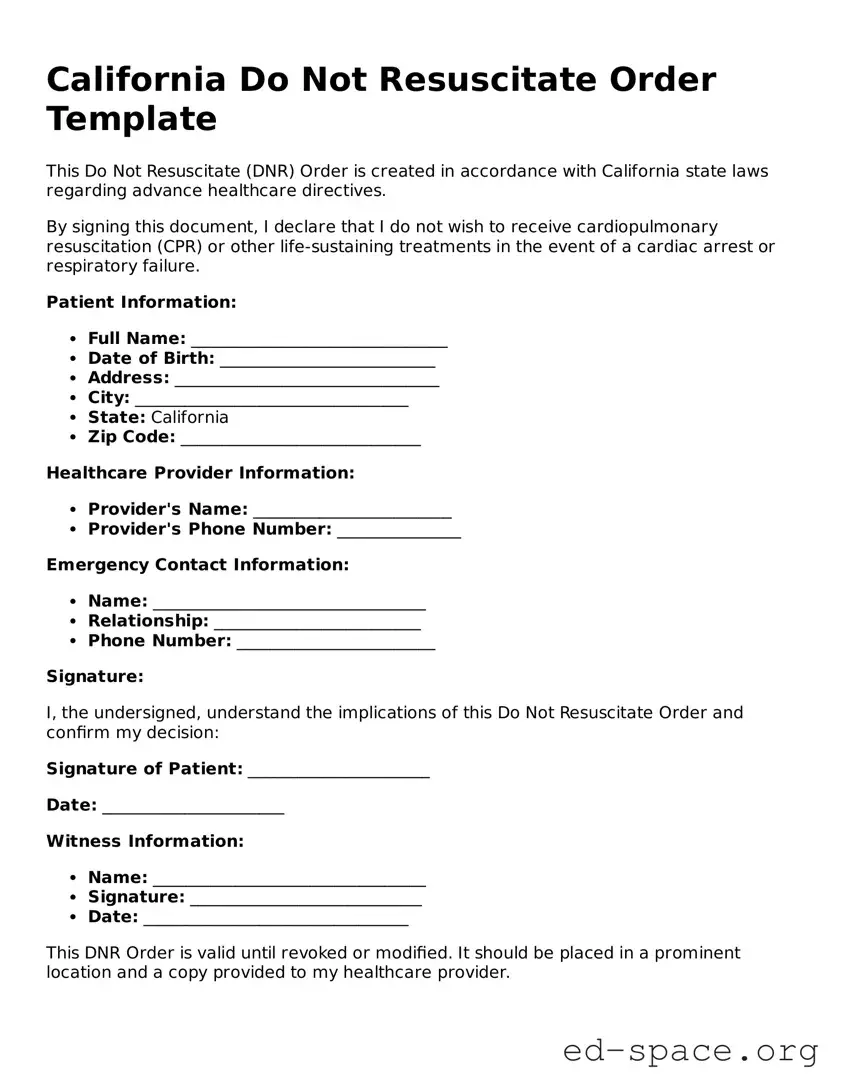
In California, the Do Not Resuscitate (DNR) Order form serves as a crucial document for individuals wishing to express their preferences regarding medical interventions in the event of a life-threatening situation. This form allows patients to communicate their desire not to receive cardiopulmonary resuscitation (CPR) or other life-saving measures if their heart stops beating or they stop breathing. It is essential for patients to discuss their wishes with family members and healthcare providers to ensure that everyone understands their decisions. The DNR Order must be completed and signed by the patient or their authorized representative, and it requires a physician's signature to be valid. Additionally, the form is designed to be easily recognizable, typically featuring a bright yellow color, which helps medical personnel identify the patient's wishes quickly in emergencies. Understanding the implications of a DNR Order is vital, as it not only reflects personal values but also provides peace of mind for both patients and their loved ones during challenging times.
California Do Not Resuscitate Order Template
This Do Not Resuscitate (DNR) Order is created in accordance with California state laws regarding advance healthcare directives.
By signing this document, I declare that I do not wish to receive cardiopulmonary resuscitation (CPR) or other life-sustaining treatments in the event of a cardiac arrest or respiratory failure.
Patient Information:
Healthcare Provider Information:
Emergency Contact Information:
Signature:
I, the undersigned, understand the implications of this Do Not Resuscitate Order and confirm my decision:
Signature of Patient: ______________________
Date: ______________________
Witness Information:
This DNR Order is valid until revoked or modified. It should be placed in a prominent location and a copy provided to my healthcare provider.
| Fact Name | Description |
|---|---|
| Legal Basis | The California Do Not Resuscitate Order (DNR) form is governed by the California Health and Safety Code, Section 7180-7183. |
| Purpose | This form allows individuals to express their wish not to receive cardiopulmonary resuscitation (CPR) in the event of cardiac arrest. |
| Eligibility | Any adult who is capable of making medical decisions can complete a DNR form. It requires the signature of the individual or their legal representative. |
| Implementation | Healthcare providers must honor a valid DNR order, ensuring that the patient's wishes are respected in emergency situations. |
Filling out the California Do Not Resuscitate Order form requires careful attention to detail. This document is essential for individuals who wish to express their preferences regarding resuscitation in a medical emergency. Once completed, the form should be shared with healthcare providers and kept in a readily accessible location.
Once you have completed these steps, the form will be ready for use. It is important to communicate your wishes to family members and healthcare providers to ensure that your preferences are understood and respected.
What is a California Do Not Resuscitate Order (DNR)?
A California Do Not Resuscitate Order (DNR) is a legal document that allows a person to refuse resuscitation efforts in the event of cardiac arrest. This means that if the heart stops beating, medical personnel will not perform CPR or use other life-saving measures. It is a way for individuals to express their wishes about end-of-life care and ensure that their preferences are respected in medical emergencies.
Who can complete a DNR in California?
In California, any adult who is capable of making their own medical decisions can complete a DNR order. This includes individuals who are facing a terminal illness or have a serious medical condition. Additionally, a legally authorized representative, such as a healthcare proxy or power of attorney, can also complete a DNR on behalf of someone who is unable to do so.
How do I obtain a DNR form in California?
To obtain a DNR form in California, you can request one from your healthcare provider or download it from the California Department of Public Health website. The form must be completed and signed by both the patient (or their representative) and a physician. It is essential to ensure that all required information is filled out accurately to avoid any confusion during a medical emergency.
Is a DNR order valid in all healthcare settings?
Yes, a DNR order is generally valid in all healthcare settings in California, including hospitals, nursing homes, and at home. However, it is crucial to ensure that the DNR form is properly completed and that copies are provided to all relevant parties, including family members and healthcare providers. Having the order readily available can help ensure that your wishes are honored in any situation.
Can a DNR order be revoked?
Yes, a DNR order can be revoked at any time. The individual who created the DNR, or their authorized representative, can simply inform their healthcare provider of the decision to revoke it. It is also advisable to destroy any copies of the original DNR form to prevent confusion. Clear communication with healthcare providers and family members about the change in wishes is essential.
What should I discuss with my family before completing a DNR?
Before completing a DNR, it is important to have open and honest discussions with your family about your wishes regarding end-of-life care. Talk about your values, beliefs, and any specific medical situations you want to address. Ensure that your loved ones understand your decision and the reasons behind it. This conversation can help avoid misunderstandings and ensure that your preferences are respected during critical moments.
Not understanding the implications: Many people fill out the form without fully grasping what a Do Not Resuscitate (DNR) order means. It’s crucial to know that this order prevents medical staff from performing CPR or other life-saving measures. Without this understanding, individuals might make a choice they later regret.
Inaccurate information: Filling out the form with incorrect personal details can lead to confusion. Names, dates of birth, and other identifying information must be accurate. Errors can cause delays in honoring the DNR order when it's needed most.
Not discussing with family: Failing to talk about the decision with family members can lead to misunderstandings or conflict. It’s important that loved ones are aware of your wishes and support your decisions. Open communication can prevent emotional distress during a difficult time.
Neglecting to update the form: A DNR order is not a one-time task. Life circumstances change, and so might your wishes. Regularly reviewing and updating the form ensures that it reflects your current desires. Forgetting to do this can lead to situations where your wishes are not honored.
A California Do Not Resuscitate (DNR) Order form is an important document that communicates a person's wishes regarding resuscitation efforts in the event of a medical emergency. When preparing a DNR, several other forms and documents may be beneficial to ensure comprehensive planning for healthcare decisions. Below are four commonly used documents that often accompany a DNR Order.
Having these documents in place alongside a California Do Not Resuscitate Order can help ensure that a person's healthcare preferences are clearly communicated and honored. It is essential to review and update these documents regularly to reflect any changes in personal wishes or health status.
A Do Not Resuscitate Order (DNR) form is an important document that outlines a person's wishes regarding resuscitation efforts in the event of a medical emergency. Several other documents serve similar purposes in guiding healthcare decisions. Here are seven documents that share similarities with the DNR form:
Understanding these documents can help individuals make informed decisions about their healthcare preferences and ensure that their wishes are respected in critical situations.
When filling out the California Do Not Resuscitate (DNR) Order form, it's important to approach the task with care. Here are some key dos and don'ts to keep in mind:
Understanding the California Do Not Resuscitate (DNR) Order form is crucial for making informed healthcare decisions. However, several misconceptions can create confusion. Here are eight common misconceptions about the DNR form:
This is not true. A DNR specifically addresses resuscitation efforts, such as CPR. Other medical treatments and care can still be provided.
While many individuals with terminal illnesses choose a DNR, it is not limited to them. Anyone can request a DNR based on their personal healthcare preferences.
This misconception is incorrect. A DNR can be revoked or modified at any time by the patient or their authorized representative.
While most healthcare providers are familiar with DNR orders, it's essential to ensure that your DNR is properly documented and communicated to all involved in your care.
A DNR can be effective in various settings, including homes and nursing facilities. It is important to communicate your wishes wherever you receive care.
This is a misconception. A DNR does not hasten death; it simply indicates that resuscitation efforts should not be attempted if the heart stops or breathing ceases.
Individuals who are unable to make decisions may have a DNR established by a legally authorized representative, ensuring that their wishes are respected.
While both documents address end-of-life care, a DNR specifically relates to resuscitation, whereas a living will outlines broader healthcare preferences.
By clarifying these misconceptions, individuals can better navigate their healthcare options and ensure their wishes are respected.
When considering the California Do Not Resuscitate (DNR) Order form, it is essential to understand its implications and the process involved. Here are some key takeaways:
Understanding these aspects can help ensure that your healthcare preferences are respected in critical situations.