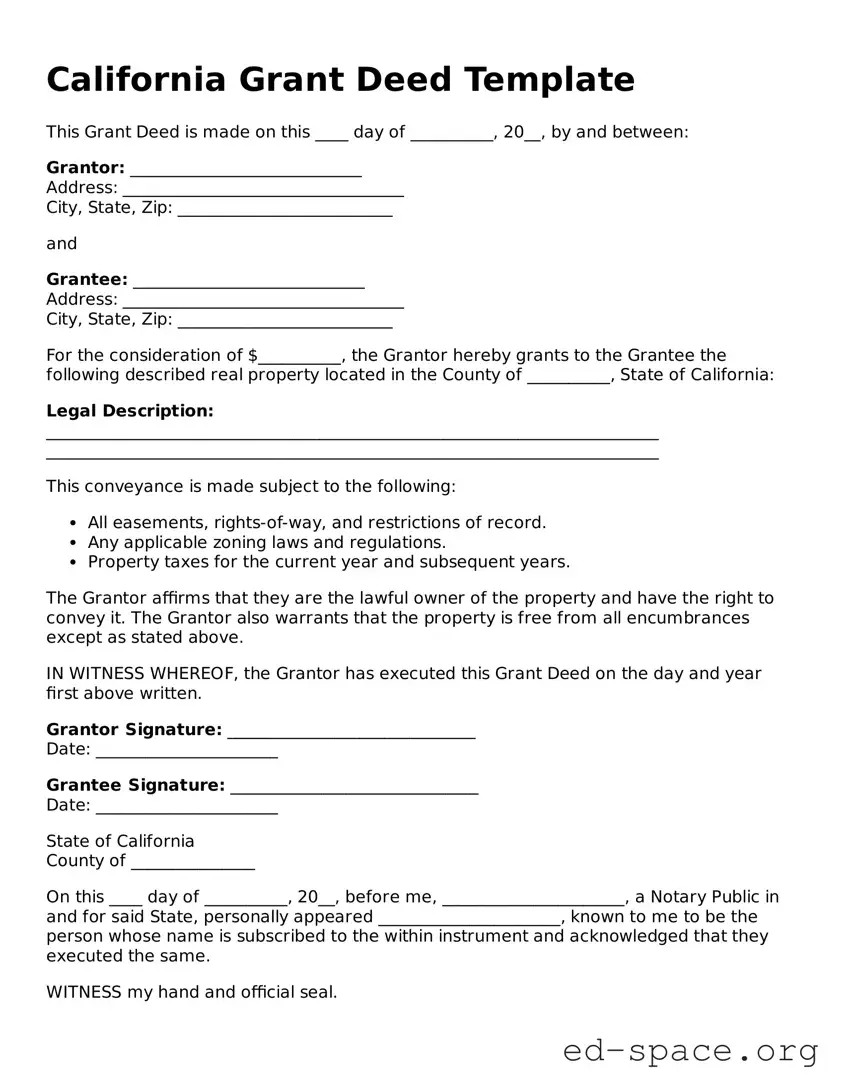
When it comes to transferring property ownership in California, understanding the California Deed form is essential. This legal document serves as a formal way to convey real estate from one party to another, ensuring that the transaction is recognized by the state. The form typically includes important details such as the names of the parties involved, a description of the property being transferred, and any relevant terms and conditions. Notably, California recognizes various types of deeds, including grant deeds and quitclaim deeds, each serving different purposes and offering varying levels of protection to the buyer. Additionally, the form must be signed and notarized to be valid, making the process of executing a deed a critical step in real estate transactions. Familiarity with the California Deed form not only facilitates smoother property transfers but also helps to avoid potential disputes down the line.
California Grant Deed Template
This Grant Deed is made on this ____ day of __________, 20__, by and between:
Grantor: ____________________________
Address: __________________________________
City, State, Zip: __________________________
and
Grantee: ____________________________
Address: __________________________________
City, State, Zip: __________________________
For the consideration of $__________, the Grantor hereby grants to the Grantee the following described real property located in the County of __________, State of California:
Legal Description:
__________________________________________________________________________
__________________________________________________________________________
This conveyance is made subject to the following:
The Grantor affirms that they are the lawful owner of the property and have the right to convey it. The Grantor also warrants that the property is free from all encumbrances except as stated above.
IN WITNESS WHEREOF, the Grantor has executed this Grant Deed on the day and year first above written.
Grantor Signature: ______________________________
Date: ______________________
Grantee Signature: ______________________________
Date: ______________________
State of California
County of _______________
On this ____ day of __________, 20__, before me, ______________________, a Notary Public in and for said State, personally appeared ______________________, known to me to be the person whose name is subscribed to the within instrument and acknowledged that they executed the same.
WITNESS my hand and official seal.
______________________________
Notary Public
My Commission Expires: ________________
| Fact Name | Description |
|---|---|
| Definition | A California deed is a legal document used to transfer ownership of real property in California. |
| Types of Deeds | Common types include Grant Deeds, Quitclaim Deeds, and Warranty Deeds. |
| Governing Law | The California Civil Code governs the creation and execution of deeds. |
| Signature Requirement | All parties involved in the transfer must sign the deed for it to be valid. |
| Notarization | Deeds must be notarized to be recorded with the county recorder’s office. |
| Recording | Recording the deed provides public notice of the property transfer. |
| Transfer Tax | California may impose a documentary transfer tax on the transfer of real property. |
| Legal Description | A precise legal description of the property must be included in the deed. |
Once you have the California Deed form in hand, it is essential to fill it out accurately to ensure that the transfer of property is legally recognized. After completing the form, it will need to be signed and notarized before being submitted to the appropriate county office for recording.
What is a California Deed form?
A California Deed form is a legal document used to transfer ownership of real property in California. It outlines the details of the transfer, including the names of the parties involved, a description of the property, and the date of the transfer. This document is essential for ensuring that the transfer is recognized by the state and is legally binding.
What types of Deeds are available in California?
California recognizes several types of Deeds, including Grant Deeds, Quitclaim Deeds, and Warranty Deeds. A Grant Deed provides some guarantees about the property, while a Quitclaim Deed transfers whatever interest the grantor has without any warranties. A Warranty Deed offers the highest level of protection to the buyer, ensuring that the seller has clear title to the property.
Do I need a lawyer to complete a Deed in California?
While it is not legally required to have a lawyer when completing a Deed in California, consulting one can be beneficial. A lawyer can help ensure that the Deed is filled out correctly, complies with state laws, and addresses any specific concerns related to the property transfer.
How do I fill out a California Deed form?
To fill out a California Deed form, start by entering the names of the grantor (the person transferring the property) and the grantee (the person receiving the property). Include a clear description of the property, such as its address and parcel number. Be sure to sign the document in front of a notary public, as notarization is required for the Deed to be valid.
Is there a fee to record a Deed in California?
Yes, there is a fee to record a Deed in California. The fee varies by county, so it’s important to check with the local recorder’s office for the exact amount. Recording the Deed is crucial, as it provides public notice of the property transfer and protects the rights of the new owner.
What happens if a Deed is not recorded?
If a Deed is not recorded, the transfer of ownership may not be recognized by third parties. This could lead to disputes regarding property ownership. Additionally, the new owner may face challenges in proving their ownership rights, especially if the previous owner sells the property to someone else.
Can I revoke a Deed after it has been executed?
Once a Deed has been executed and recorded, it generally cannot be revoked. However, you may be able to create a new Deed to transfer the property back to the original owner or to another party. This process can be complex, so it is advisable to seek legal guidance if you need to reverse a property transfer.
What is the difference between a Deed and a title?
A Deed is the document that transfers ownership of property, while a title refers to the legal right to own and use that property. The Deed serves as proof of the transfer, whereas the title indicates who has legal ownership and the rights associated with that ownership.
Are there any tax implications when transferring property with a Deed?
Yes, transferring property can have tax implications. For example, the transfer may trigger property taxes or capital gains taxes. It’s important to consult with a tax professional to understand any potential tax liabilities associated with the property transfer.
Where can I obtain a California Deed form?
You can obtain a California Deed form from various sources, including online legal service providers, local county recorder’s offices, and legal stationery stores. Ensure that you use the correct form for the type of Deed you wish to create, as each type has different requirements and implications.
Failing to include all necessary parties. It is crucial to ensure that all individuals or entities involved in the transaction are named on the deed. Omitting a party can lead to complications in property ownership.
Incorrectly identifying the property. The legal description of the property must be precise. Errors in the address or description can result in disputes or challenges to ownership.
Not signing the deed. A deed must be signed by the grantor (the person transferring the property). Without a signature, the deed is considered invalid.
Neglecting to have the deed notarized. In California, a deed typically requires notarization to be legally effective. Failure to obtain a notary's acknowledgment can invalidate the deed.
Overlooking recording requirements. After completing the deed, it must be recorded with the county recorder's office. Not doing so can lead to issues with proving ownership in the future.
When dealing with property transactions in California, several forms and documents often accompany the Deed form. Each of these documents serves a specific purpose and helps ensure a smooth transfer of property ownership. Here’s a list of commonly used forms:
Understanding these documents is essential for anyone involved in a property transaction in California. Each plays a crucial role in ensuring that the transfer is legally sound and that all parties are protected throughout the process.
The Deed form is a legal document that serves to transfer ownership or rights from one party to another. Several other documents share similarities with the Deed form in terms of their purpose and function. Here are five such documents:
When filling out a California Deed form, attention to detail is paramount. Here’s a list of ten essential dos and don’ts to guide you through the process.
Following these guidelines can help ensure that your deed is processed smoothly and without unnecessary complications. Taking the time to do it right can save you from potential headaches down the road.
Many people have misunderstandings about California Deed forms. Here are six common misconceptions:
Not all deeds serve the same purpose. For example, a grant deed transfers ownership, while a quitclaim deed relinquishes any claim to property without guaranteeing ownership.
While notarization is often recommended, it is not always required for a deed to be valid in California. However, having a deed notarized can help prevent disputes in the future.
Recording a deed with the county is essential to protect ownership rights. If a deed is not recorded, others may claim ownership or rights to the property.
Deeds can be amended or revoked, but the process can be complex. It’s important to follow the correct legal procedures to ensure any changes are valid.
While it’s wise to consult a lawyer, many individuals can prepare a deed themselves using templates or forms available online, provided they understand the requirements.
Some property transfers, like those between spouses or family members, may not require a new deed. However, it’s essential to check local laws to ensure compliance.
Filling out and using the California Deed form requires careful attention to detail and an understanding of the implications involved in property transfer. Here are some key takeaways to consider: