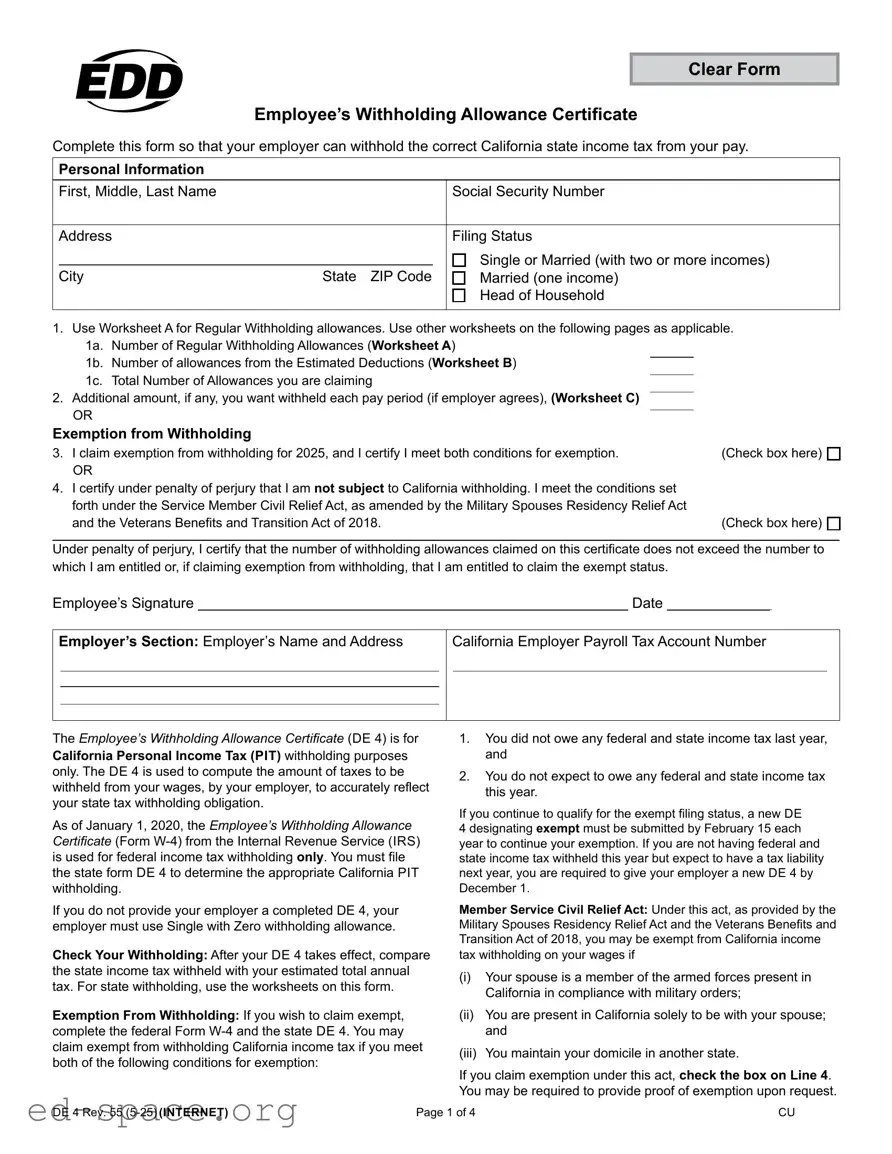
The California DE 4 form, officially known as the Employee’s Withholding Allowance Certificate, plays a crucial role in determining how much state income tax is withheld from your paycheck. This form allows employees to provide their personal information, including their name, Social Security number, and address, while also specifying their filing status—options include single, married with two or more incomes, married with one income, or head of household. One of the primary functions of the DE 4 is to help employees calculate their withholding allowances, which can significantly impact the amount of tax withheld. The form includes worksheets to assist in determining regular withholding allowances, additional withholding amounts, and even exemptions from withholding if certain criteria are met. For instance, if you did not owe any federal or state income tax in the previous year and do not expect to owe any this year, you may qualify for an exemption. Moreover, service members and their spouses may also find specific provisions that apply to their unique situations. It's important to submit this form accurately to avoid under-withholding, which could lead to tax liabilities down the line. By understanding the nuances of the DE 4, employees can better manage their tax withholding and ensure compliance with California tax laws.
Clear Form
Employee’s Withholding Allowance Certificate
Complete this form so that your employer can withhold the correct California state income tax from your pay.
Personal Information
First, Middle, Last Name |
|
|
Social Security Number |
||
|
|
|
|
|
|
Address |
|
|
Filing Status |
||
|
|
|
|
Single or Married (with two or more incomes) |
|
City |
State ZIP Code |
||||
Married (one income) |
|||||
|
|
|
|
Head of Household |
|
|
|
|
|
|
|
1.Use Worksheet A for Regular Withholding allowances. Use other worksheets on the following pages as applicable. 1a. Number of Regular Withholding Allowances (Worksheet A)
1b. Number of allowances from the Estimated Deductions (Worksheet B)
1c. Total Number of Allowances you are claiming
2.Additional amount, if any, you want withheld each pay period (if employer agrees), (Worksheet C)
OR
Exemption from Withholding
3. I claim exemption from withholding for 2025, and I certify I meet both conditions for exemption. |
(Check box here) |
OR |
|
4.I certify under penalty of perjury that I am not subject to California withholding. I meet the conditions set forth under the Service Member Civil Relief Act, as amended by the Military Spouses Residency Relief Act
and the Veterans Benefits and Transition Act of 2018. |
(Check box here) |
Under penalty of perjury, I certify that the number of withholding allowances claimed on this certificate does not exceed the number to which I am entitled or, if claiming exemption from withholding, that I am entitled to claim the exempt status.
Employee’s Signature |
|
Date |
Employer’s Section: Employer’s Name and Address
California Employer Payroll Tax Account Number
The Employee’s Withholding Allowance Certificate (DE 4) is for
California Personal Income Tax (PIT) withholding purposes only. The DE 4 is used to compute the amount of taxes to be withheld from your wages, by your employer, to accurately reflect your state tax withholding obligation.
As of January 1, 2020, the Employee’s Withholding Allowance Certificate (Form
If you do not provide your employer a completed DE 4, your employer must use Single with Zero withholding allowance.
Check Your Withholding: After your DE 4 takes effect, compare the state income tax withheld with your estimated total annual tax. For state withholding, use the worksheets on this form.
Exemption From Withholding: If you wish to claim exempt, complete the federal Form
1.You did not owe any federal and state income tax last year, and
2.You do not expect to owe any federal and state income tax this year.
If you continue to qualify for the exempt filing status, a new DE 4 designating exempt must be submitted by February 15 each year to continue your exemption. If you are not having federal and state income tax withheld this year but expect to have a tax liability next year, you are required to give your employer a new DE 4 by December 1.
Member Service Civil Relief Act: Under this act, as provided by the Military Spouses Residency Relief Act and the Veterans Benefits and Transition Act of 2018, you may be exempt from California income tax withholding on your wages if
(i)Your spouse is a member of the armed forces present in California in compliance with military orders;
(ii)You are present in California solely to be with your spouse; and
(iii)You maintain your domicile in another state.
If you claim exemption under this act, check the box on Line 4. You may be required to provide proof of exemption upon request.
DE 4 Rev. 55 |
Page 1 of 4 |
CU |

The California Employer’s Guide (DE 44) (edd.ca.gov/pdf_pub_ctr/de44.pdf) provides the income tax withholding tables. This publication can be found by visiting Payroll Taxes - Forms and Publications (edd.ca.gov/Payroll_Taxes/Forms_and_ Publications.htm). To assist you in calculating your tax liability, visit the Franchise Tax Board (FTB) (ftb.ca.gov).
If you need information on your last California Resident Income Tax Return (FTB Form 540), visit the FTB (ftb.ca.gov).
Notification: The burden of proof rests with the employee to show the correct California income tax withholding. Pursuant to section
Penalty: You may be fined $500 if you file, with no reasonable basis, a DE 4 that results in less tax being withheld than is properly allowable. Criminal penalties apply for willfully supplying false or fraudulent information or failing to supply information requiring an increase in withholding. This is provided by section 13101 of the California Unemployment Insurance Code (leginfo. legislature.ca.gov/faces/codes.xhtml) and section 19176 of the Revenue and Taxation Code (leginfo.legislature.ca.gov/ faces/codes.xhtml).
DE 4 Rev. 55 |
Page 2 of 4 |
Worksheets
Instructions — 1 — Allowances*
When determining your withholding allowances, you must consider your personal situation:
—Do you claim allowances for dependents or blindness?
—Will you itemize your deductions?
—Do you have more than one income coming into the household?
Do not claim the same allowances with more than one employer. Your withholding will usually be most accurate when all allowances are claimed on the DE 4 filed for the highest paying job and zero allowances are claimed for the others.
Married But Not Living With Your Spouse: You may check the “Head of Household” marital status box if you meet all of the following:
(1)Your spouse will not live with you at any time during the year;
(2)You will furnish over half of the cost of maintaining a home for the entire year for yourself and your child or stepchild who qualifies as your dependent; and
(3)You will file a separate return for the year.
Head of Household: To qualify, you must be unmarried or legally separated from your spouse and pay more than 50 percent of the costs of maintaining a home for the entire year for yourself and your dependent(s) or other qualifying individuals. Cost of maintaining the home includes such items as rent, property insurance, property taxes, mortgage interest, repairs, utilities, and cost of food. It does not include the individual’s personal expenses or any amount which represents value of services performed by a member of the household of the taxpayer.
Worksheet A |
Regular Withholding Allowances |
|
|
|
|
|
|
|
|
|
|
(A) Allowance for yourself — enter 1 |
|
(A) |
|
|
|
(B) Allowance for your spouse (if not separately claimed by your spouse) — enter 1 |
(B) |
|
|
||
(C) |
Allowance for blindness — yourself — enter 1 |
|
(C) |
|
|
(D) |
Allowance for blindness — your spouse (if not separately claimed by your spouse) — enter 1 |
(D) |
|
|
|
(E) Allowance(s) for dependent(s) — do not include yourself or your spouse |
(E) |
|
|
||
(F) |
Total — add lines (A) through (E) above and enter on line 1a of the DE 4 |
(F) |
|
|
|
Instructions — 2 — Additional Withholding Allowances (Optional)
If you expect to itemize deductions on your California income tax return, you can claim additional withholding allowances. Use Worksheet B to determine whether your expected estimated deductions may entitle you to claim one or more additional withholding allowances. Use last year’s FTB Form 540 as a model to calculate this year’s withholding amounts.
Do not include deferred compensation, qualified pension payments, or flexible benefits, etc., that are deducted from your gross pay but are not taxed on this worksheet.
You may reduce the amount of tax withheld from your wages by claiming one additional withholding allowance for each $1,000, or fraction of $1,000, by which you expect your estimated deductions for the year to exceed your allowable standard deduction.
Worksheet B |
Estimated Deductions |
Use this worksheet only if you plan to itemize deductions, claim certain adjustments to income, or have a large amount of nonwage income not subject to withholding.
1. |
Enter an estimate of your itemized deductions for California taxes for this tax year as listed in the schedules in the FTB Form 540 |
|
1. |
2. |
Enter $11,080 if married filing joint with two or more allowances, unmarried head of household, or qualifying widow(er) |
|
|
|
with dependent(s) or $5,540 if single or married filing separately, dual income married, or married with multiple employers |
– |
2. |
3. |
Subtract line 2 from line 1, enter difference |
= |
3. |
4. |
Enter an estimate of your adjustments to income (alimony payments, IRA deposits) |
+ |
4. |
5. |
Add line 4 to line 3, enter sum |
= |
5. |
6. |
Enter an estimate of your nonwage income (dividends, interest income, alimony receipts) |
– |
6. |
7. |
If line 5 is greater than line 6 (if less, see below [go to line 9]); |
|
|
|
Subtract line 6 from line 5, enter difference |
= |
7. |
8. |
Divide the amount on line 7 by $1,000, round any fraction to the nearest whole number |
|
8. |
|
enter this number on line 1b of the DE 4. Complete Worksheet C, if needed, otherwise stop here. |
|
|
9. |
If line 6 is greater than line 5; |
|
|
|
Enter amount from line 6 (nonwage income) |
|
9. |
10. Enter amount from line 5 (deductions) |
|
10. |
|
11. |
Subtract line 10 from line 9, enter difference. Then, complete Worksheet C. |
|
11. |
*Wages paid to registered domestic partners will be treated the same for state income tax purposes as wages paid to spouses for California PIT withholding and PIT wages. This law does not impact federal income tax law. A registered domestic partner means an individual partner in a domestic partner relationship within the meaning of section 297 of the Family Code. For more information, call our Taxpayer Assistance Center at
DE 4 Rev. 55 |
Page 3 of 4 |

Worksheet C |
Additional Tax Withholding and Estimated Tax |
|
|
|
|
|
|
|
|
|
|
1. |
Enter estimate of total wages for tax year 2025. |
1. |
|
|
|
2. |
Enter estimate of nonwage income (line 6 of Worksheet B). |
2. |
|
|
|
3. |
Add line 1 and line 2. Enter sum. |
|
3. |
|
|
4. |
Enter itemized deductions or standard deduction (line 1 or 2 of Worksheet B, whichever is largest). |
4. |
|
|
|
5. |
Enter adjustments to income (line 4 of Worksheet B). |
5. |
|
|
|
6. |
Add line 4 and line 5. Enter sum. |
|
6. |
|
|
7. |
Subtract line 6 from line 3. Enter difference. |
|
7. |
|
|
8. |
Figure your tax liability for the amount on line 7 by using the 2025 tax rate schedules below. |
8. |
|
|
|
9. |
Enter personal exemptions (line F of Worksheet A x $163.90). |
9. |
|
|
|
10. |
Subtract line 9 from line 8. Enter difference. |
|
10. |
|
|
11. |
Enter any tax credits. (See FTB Form 540). |
|
11. |
|
|
12. |
Subtract line 11 from line 10. Enter difference. This is your total tax liability. |
12. |
|
|
|
13.Calculate the tax withheld and estimated to be withheld during 2025. Contact your employer to request the amount that will be withheld on your wages based on the marital status and number of withholding allowances you will claim for 2025. Multiply the estimated amount to be withheld by the number of pay
|
periods left in the year. Add the total to the amount already withheld for 2025. |
13. |
14. |
Subtract line 13 from line 12. Enter difference. If this is less than zero, you do not need to have additional |
|
|
taxes withheld. |
14. |
15. |
Divide line 14 by the number of pay periods remaining in the year. Enter this figure on line 2 of the DE 4. |
15. |
Note: Your employer is not required to withhold the additional amount requested on line 2 of your DE 4. If your employer does not agree to withhold the additional amount, you may increase your withholdings as much as possible by using the “single” status with “zero” allowances. If the amount withheld still results in an underpayment of state income taxes, you may need to file quarterly estimates on Form
These Tables Are for Calculating Worksheet C and for 2025 Only
Single Persons, Dual Income Married or Married With Multiple Employers
IF THE TAXABLE INCOME IS |
COMPUTED TAX IS |
|||
|
|
|
|
|
OVER |
BUT NOT |
OF AMOUNT OVER... |
PLUS |
|
|
OVER |
|
|
|
$0 |
$10,756 |
1.100% |
$0 |
$0.00 |
$10,756 |
$25,499 |
2.200% |
$10,756 |
$118.32 |
$25,499 |
$40,245 |
4.400% |
$25,499 |
$442.67 |
$40,245 |
$55,866 |
6.600% |
$40,245 |
$1,091.49 |
$55,866 |
$70,606 |
8.800% |
$55,866 |
$2,122.48 |
$70,606 |
$360,659 |
10.230% |
$70,606 |
$3,419.60 |
$360,659 |
$432,787 |
11.330% |
$360,659 |
$33,092.02 |
$432,787 |
$721,314 |
12.430% |
$432,787 |
$41,264.12 |
$721,314 |
$1,000,000 |
13.530% |
$721,314 |
$77,128.03 |
$1,000,000 |
and over |
14.630% |
$1,000,000 |
$114,834.25 |
Unmarried/Head of Household
IF THE TAXABLE INCOME IS |
COMPUTED TAX IS |
|||
OVER |
BUT NOT |
OF AMOUNT OVER... |
PLUS |
|
|
OVER |
|
|
|
$0 |
$21,527 |
1.100% |
$0 |
$0.00 |
$21,527 |
$51,000 |
2.200% |
$21,527 |
$236.80 |
$51,000 |
$65,744 |
4.400% |
$51,000 |
$885.21 |
$65,744 |
$81,364 |
6.600% |
$65,744 |
$1,533.95 |
$81,364 |
$96,107 |
8.800% |
$81,364 |
$2,564.87 |
$96,107 |
$490,493 |
10.230% |
$96,107 |
$3,862.25 |
$490,493 |
$588,593 |
11.330% |
$490,493 |
$44,207.94 |
$588,593 |
$980,987 |
12.430% |
$588,593 |
$55,322.67 |
$980,987 |
$1,000,000 |
13.530% |
$980,987 |
$104,097.24 |
$1,000,000 |
and over |
14.630% |
$1,000,000 |
$106.669.70 |
Married Persons
IF THE TAXABLE INCOME IS |
COMPUTED TAX IS |
|||
|
|
|
|
|
OVER |
BUT NOT |
OF AMOUNT OVER... |
PLUS |
|
|
OVER |
|
|
|
$0 |
$21,512 |
1.100% |
$0 |
$0.00 |
$21,512 |
$50,998 |
2.200% |
$21,512 |
$236.63 |
$50,998 |
$80,490 |
4.400% |
$50,998 |
$885.32 |
$80,490 |
$111,732 |
6.600% |
$80,490 |
$2,182.97 |
$111,732 |
$141,212 |
8.800% |
$111,732 |
$4,244.94 |
$141,212 |
$721,318 |
10.230% |
$141,212 |
$6,839.18 |
$721,318 |
$865,574 |
11.330% |
$721,318 |
$66,184.02 |
$865,574 |
$1,000,000 |
12.430% |
$865,574 |
$82.528.22 |
$1,000,000 |
$1,442,628 |
13.530% |
$1,000,000 |
$99,237.37 |
$1,442,628 |
and over |
14.630% |
$1,442,628 |
$159.124.94 |
If you need information on your last California Resident Income Tax Return, FTB Form 540, visit FTB (ftb.ca.gov).
The DE 4 information is collected for purposes of administering the PIT law and under the authority of Title 22, CCR, section
DE 4 Rev. 55 |
Page 4 of 4 |
| Fact Name | Details |
|---|---|
| Purpose | The DE 4 form is used to determine the correct California state income tax withholding from an employee's paycheck. |
| Governing Law | The form is governed by the California Revenue and Taxation Code, specifically section 18624. |
| Exemption Criteria | Employees may claim exemption from withholding if they did not owe any federal or state income tax last year and do not expect to owe any this year. |
| Filing Requirement | Employees must submit a new DE 4 by February 15 each year to maintain exempt status if they continue to qualify. |
Completing the California DE 4 form is a straightforward process. This form helps ensure that your employer withholds the correct amount of state income tax from your paycheck. Follow the steps below to fill it out accurately.
What is the purpose of the California DE 4 form?
The California DE 4 form, also known as the Employee's Withholding Allowance Certificate, is essential for determining the correct amount of state income tax to withhold from your paycheck. By completing this form, you help ensure that your employer withholds the right amount of California Personal Income Tax (PIT) based on your individual circumstances. Without it, your employer will default to a Single status with zero allowances, which may not accurately reflect your tax situation.
Who needs to fill out the DE 4 form?
Anyone working in California who wants to ensure accurate state tax withholding should complete the DE 4 form. This includes employees who have recently started a job, experienced a change in their financial situation, or wish to adjust their withholding allowances. If you do not submit this form, your employer will automatically withhold taxes as if you are single with no allowances, which might lead to over-withholding or under-withholding of taxes.
How do I determine the number of withholding allowances to claim?
To determine the number of withholding allowances you can claim, consider factors such as your marital status, number of dependents, and whether you expect to itemize deductions. The DE 4 form provides worksheets to help you calculate your allowances based on your unique financial situation. For example, if you have dependents or plan to itemize deductions, you may be eligible for additional allowances that can reduce your tax withholding.
What if I want to claim exemption from withholding?
You can claim exemption from California income tax withholding if you meet specific criteria. To qualify, you must not have owed any federal or state income tax in the previous year and do not expect to owe any this year. If you meet these conditions, you can check the exemption box on the DE 4 form. Remember, this exemption is valid for one year, so you will need to submit a new DE 4 by February 15 each year to maintain your exempt status.
What should I do if my tax situation changes during the year?
If your financial situation changes—such as a new job, marriage, or the birth of a child—you should submit a new DE 4 form to your employer. This will allow them to adjust your withholding allowances accordingly. It's important to keep your withholding up to date to avoid owing taxes at the end of the year or receiving a large refund. Regularly reviewing your withholding can help you manage your finances more effectively.
What are the consequences of providing incorrect information on the DE 4 form?
Providing inaccurate information on your DE 4 form can lead to penalties. If you file a DE 4 that results in less tax being withheld than what is legally allowable, you may face a fine of up to $500. Additionally, if you knowingly supply false information, you could face criminal penalties. It’s crucial to be honest and accurate when filling out the form to avoid these potential issues.
Incorrect Personal Information: Failing to accurately enter your full name, Social Security number, or address can lead to processing delays or errors in tax withholding.
Wrong Filing Status: Selecting the incorrect filing status, such as "Single" instead of "Married" or "Head of Household," can significantly affect the amount of tax withheld from your paycheck.
Neglecting to Use Worksheets: Not utilizing the worksheets provided for calculating withholding allowances can result in either over-withholding or under-withholding of taxes.
Claiming Excess Allowances: Claiming more allowances than you are entitled to can lead to a tax liability at the end of the year, potentially resulting in penalties.
Missing Signature and Date: Failing to sign and date the form invalidates it, which means your employer will not have the necessary information to adjust your withholding.
Not Updating the Form Annually: If you qualify for exemption from withholding, not submitting a new DE 4 by February 15 each year can result in taxes being withheld when they shouldn't be.
Incorrectly Reporting Additional Withholding: Entering an incorrect amount for additional withholding can lead to unexpected changes in your paycheck, affecting your financial planning.
Failure to Review Withholding: Not comparing the amount withheld after submitting the DE 4 with your estimated tax liability can result in underpayment or overpayment of taxes throughout the year.
The California DE 4 form, known as the Employee’s Withholding Allowance Certificate, is essential for determining the correct amount of state income tax to withhold from an employee's paycheck. Along with this form, several other documents may be necessary to ensure proper tax withholding and compliance with California tax laws. Below are some commonly used forms and documents that may accompany the DE 4.
Understanding these forms and documents can help employees navigate their tax obligations more effectively. By completing the DE 4 and any necessary accompanying forms accurately, individuals can ensure they meet their tax responsibilities while avoiding potential penalties or under-withholding issues.
The California DE 4 form serves a specific purpose in the realm of income tax withholding. It is not the only document used for this type of tax calculation. Several other forms share similarities with the DE 4, each designed to help individuals report their tax withholding preferences. Below are four documents that are comparable to the California DE 4 form:
When filling out the California DE 4 form, there are important guidelines to follow to ensure accuracy and compliance. Here is a list of things you should and shouldn't do:
By adhering to these guidelines, individuals can ensure that their California state income tax withholding is accurate and compliant with regulations.
This is not true. The DE 4 form is essential for all California employees to ensure that the correct amount of state income tax is withheld from their paychecks, regardless of their tax situation.
In reality, you can update your DE 4 form whenever your financial situation changes. This includes changes in marital status, number of dependents, or any other factors that affect your tax situation.
Actually, if you qualify for exemption from withholding, you must complete and submit the DE 4 form to claim that status. This ensures that your employer is aware of your exemption and can adjust your withholding accordingly.
This is incorrect. If you do not submit a DE 4 form, your employer is required to withhold taxes as if you are single with zero allowances. This may lead to higher withholding than necessary.
This is a common misunderstanding. You can and should review your DE 4 form throughout the year, especially if your financial circumstances change. It's important to ensure that your withholding remains accurate to avoid underpayment or overpayment of taxes.
Here are some key takeaways about filling out and using the California DE 4 form: