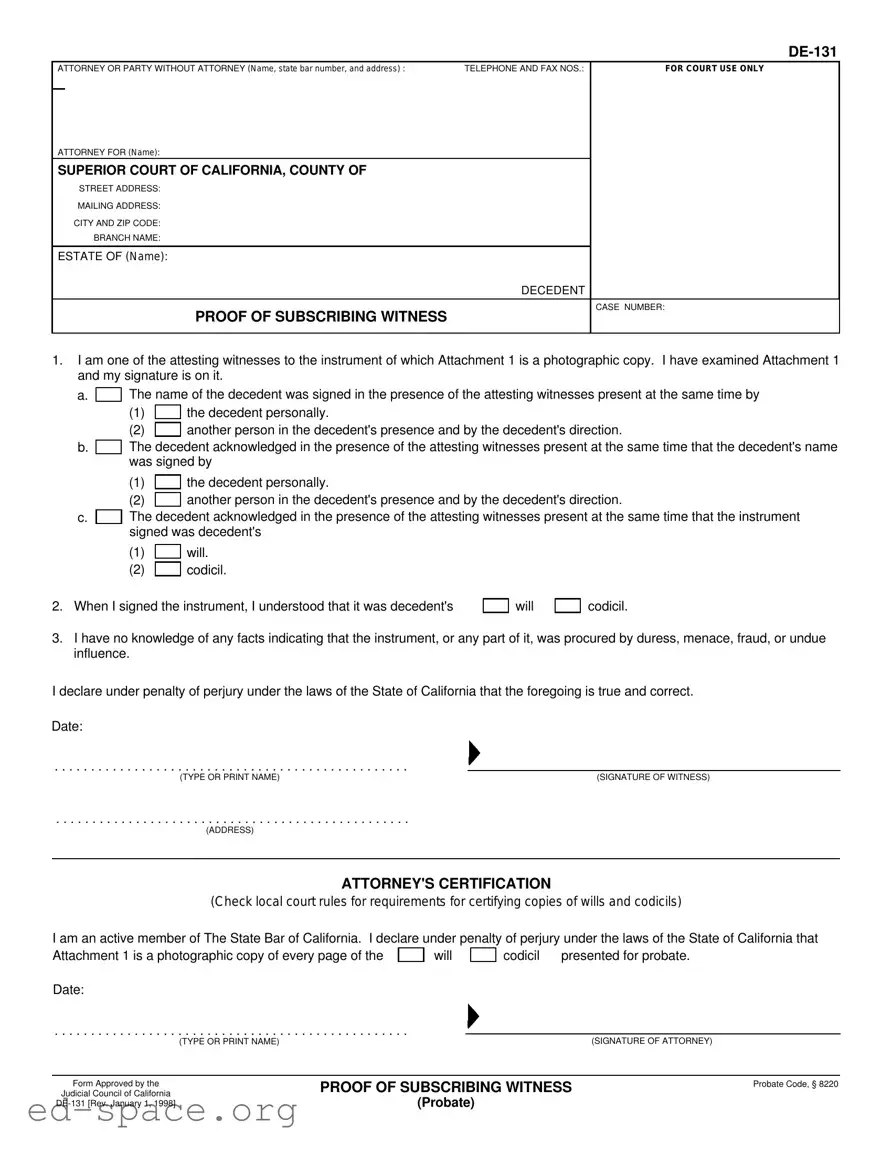
The California DE-131 form plays a crucial role in the probate process, specifically when it comes to validating a will or codicil after a person's death. This form is designed to provide proof from subscribing witnesses, ensuring that the decedent's intentions are honored and legally recognized. It requires the witness to confirm their presence during the signing of the will, affirming that the decedent either signed it personally or directed another person to do so in their presence. The form also includes sections where the witness must declare that they have no knowledge of any coercion or fraudulent circumstances surrounding the signing of the document. Additionally, an attorney's certification is included, verifying that the submitted attachment is a true photographic copy of the will or codicil. By completing the DE-131, individuals help establish the legitimacy of the decedent's wishes, facilitating a smoother probate process for the estate. This form is not just a piece of paper; it serves as a safeguard for the rights of the deceased and the beneficiaries alike.
ATTORNEY OR PARTY WITHOUT ATTORNEY (Name, state bar number, and address) : |
TELEPHONE AND FAX NOS.: |
FOR COURT USE ONLY |
ATTORNEY FOR (Name):
SUPERIOR COURT OF CALIFORNIA, COUNTY OF
STREET ADDRESS:
MAILING ADDRESS:
CITY AND ZIP CODE:
BRANCH NAME:
ESTATE OF (Name):
DECEDENT
CASE NUMBER:
PROOF OF SUBSCRIBING WITNESS
1.I am one of the attesting witnesses to the instrument of which Attachment 1 is a photographic copy. I have examined Attachment 1 and my signature is on it.
a. |
|
The name of the decedent was signed in the presence of the attesting witnesses present at the same time by |
||
|
(1) |
|
the decedent personally. |
|
|
|
|||
|
(2) |
|
another person in the decedent's presence and by the decedent's direction. |
|
|
|
|||
|
|
The decedent acknowledged in the presence of the attesting witnesses present at the same time that the decedent's name |
||
b. |
|
|||
|
|
was signed by |
||
|
(1) |
|
the decedent personally. |
|
|
|
|||
|
(2) |
|
another person in the decedent's presence and by the decedent's direction. |
|
|
|
|||
c. |
|
The decedent acknowledged in the presence of the attesting witnesses present at the same time that the instrument |
||
|
||||
|
|
signed was decedent's |
||
|
(1) |
|
will. |
|
|
|
|||
|
(2) |
|
codicil. |
|
|
|
|||
2. When I signed the instrument, I understood that it was decedent's
will
codicil.
3.I have no knowledge of any facts indicating that the instrument, or any part of it, was procured by duress, menace, fraud, or undue influence.
I declare under penalty of perjury under the laws of the State of California that the foregoing is true and correct.
Date:
. . . . . . . . . . . . . . . . . . . . . . . . . . . . . . . . . . . . . . . . . . . . . . . . .
(TYPE OR PRINT NAME) |
(SIGNATURE OF WITNESS) |
. . . . . . . . . . . . . . . . . . . . . . . . . . . . . . . . . . . . . . . . . . . . . . . . .
(ADDRESS)
ATTORNEY'S CERTIFICATION
(Check local court rules for requirements for certifying copies of wills and codicils)
I am an active member of The State Bar of California. I declare under penalty of perjury under the laws of the State of California that
Attachment 1 is a photographic copy of every page of the |
|
|
will |
|
codicil presented for probate. |
|
||
Date: |
|
|
|
|
|
|
|
|
. . . . . . . . . . . . . . . . . . . . . . . . . . . . . . . . . . . . . . . . . . . . . . . . . |
|
|
|
|
|
|
||
|
|
|
|
(SIGNATURE OF ATTORNEY) |
|
|||
|
(TYPE OR PRINT NAME) |
|
|
|
|
|
||
|
|
|
|
|
|
|
|
|
Form Approved by the |
PROOF OF SUBSCRIBING WITNESS |
Probate Code, § 8220 |
||||||
Judicial Council of California |
|
|||||||
|
|
(PROBATE) |
|
|
||||
|
|
|
|
|||||
| Fact Name | Description |
|---|---|
| Form Purpose | The DE-131 form is used to provide proof of subscribing witnesses for a will or codicil in California probate cases. |
| Governing Law | This form is governed by the California Probate Code, specifically Section 8220. |
| Who Uses It | Attesting witnesses who signed the will or codicil use this form to affirm their signatures and the circumstances of the signing. |
| Attorney Certification | An attorney must certify that the attached document is a true photographic copy of the original will or codicil. |
| Submission Requirement | The completed form must be submitted to the Superior Court of California in the appropriate county for probate proceedings. |
| Form Revision Date | The current version of the DE-131 form was approved for use on January 1, 1998. |
Completing the California DE-131 form is essential for proving the validity of a will or codicil. This process requires careful attention to detail to ensure all necessary information is accurately provided. Follow the steps below to fill out the form correctly.
What is the purpose of the California DE-131 form?
The California DE-131 form is used to provide proof of subscribing witnesses for a decedent's will or codicil. It verifies that the witnesses who signed the document were present when the decedent acknowledged the will or codicil, ensuring the validity of the estate documents during probate proceedings.
Who needs to fill out the DE-131 form?
The DE-131 form must be completed by individuals who witnessed the signing of the decedent's will or codicil. This includes anyone who can confirm that they were present when the decedent acknowledged their signature on the document. The form is typically filled out by the witnesses themselves.
What information is required on the DE-131 form?
The form requires the names and addresses of the witnesses, along with their signatures. It also includes details about the decedent, such as their name and the case number. Witnesses must confirm that they have no knowledge of any circumstances that could invalidate the will or codicil, such as duress or fraud.
How do I submit the DE-131 form?
The completed DE-131 form should be submitted to the Superior Court of California in the county where the decedent's estate is being probated. It is essential to follow local court rules regarding submission, as these may vary by location. Ensure that all necessary signatures are obtained before submission.
What happens if the DE-131 form is not submitted?
If the DE-131 form is not submitted, the probate process may be delayed. The court may require additional evidence to validate the will or codicil, which could complicate the proceedings. Timely submission of this form helps ensure a smoother probate process and adherence to legal requirements.
Missing Information: Individuals often forget to fill in critical details, such as the decedent's name or case number. Each section must be completed accurately to avoid delays.
Incorrect Signatures: The form requires signatures from witnesses. If these signatures are missing or incorrect, the court may reject the submission.
Failure to Date: Not dating the form can lead to confusion about when the document was completed. This is essential for establishing timelines in probate matters.
Inaccurate Declaration: The declaration under penalty of perjury must be truthful. If any statement is found to be false, it could have serious legal consequences.
Not Following Local Rules: Each county may have specific requirements. Ignoring these can result in the form being rejected or delayed.
Improper Attachment: The form requires an attachment that is a photographic copy of the will or codicil. If this attachment is missing or not clear, it can lead to complications.
The California DE-131 form is a crucial document used in probate proceedings, particularly for proving the validity of a will through subscribing witnesses. However, several other forms and documents often accompany it to ensure a smooth process in the probate court. Below is a list of these documents, along with brief descriptions of each.
These forms collectively facilitate the probate process in California, ensuring that the decedent's wishes are honored and that the estate is managed according to the law. Understanding these documents can help individuals navigate the complexities of probate more effectively.
The California DE-131 form, known as the Proof of Subscribing Witness, serves a specific purpose in the probate process, particularly in validating a will or codicil. Several other documents share similarities with the DE-131 form, often addressing the authentication or validation of legal documents. Below is a list of eight documents that are comparable to the DE-131 form, along with explanations of their similarities.
In summary, while each of these documents serves its unique purpose within the legal framework, they all emphasize the importance of witness testimony, accurate representation, and adherence to legal standards in the probate process. Understanding these similarities can aid individuals in navigating the complexities of estate management and validation.
When filling out the California DE-131 form, it is essential to follow certain guidelines to ensure accuracy and compliance. Below are seven things to do and avoid during the process.
Following these guidelines will help streamline the process and reduce the likelihood of delays or complications in the probate proceedings.
Misconceptions about the California DE-131 form can lead to confusion. Here are seven common misunderstandings:
Understanding these points can help clarify the purpose and requirements of the DE-131 form in California probate proceedings.
The California DE-131 form is an important document in the probate process. Here are some key takeaways to keep in mind when filling it out and using it: