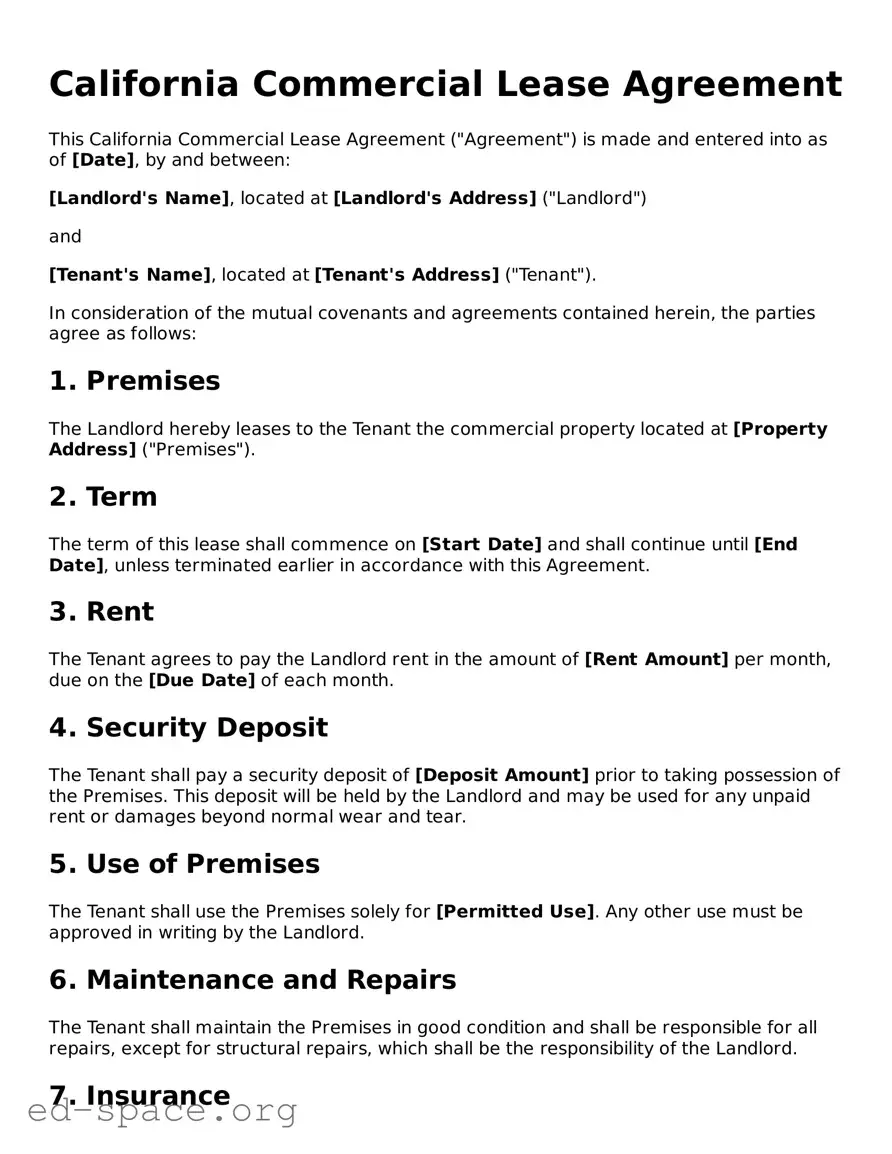
The California Commercial Lease Agreement is a vital document that outlines the terms and conditions under which a commercial property is leased. This form serves as a binding contract between the landlord and tenant, detailing essential aspects such as the rental amount, lease duration, and property description. It addresses the responsibilities of both parties, including maintenance obligations and permissible uses of the property. Additionally, the agreement includes provisions for security deposits, insurance requirements, and renewal options. Understanding this form is crucial for both landlords and tenants, as it helps prevent disputes and ensures that both parties are clear on their rights and obligations throughout the lease term. By carefully reviewing the terms laid out in the California Commercial Lease Agreement, stakeholders can navigate the complexities of commercial leasing with confidence and clarity.
California Commercial Lease Agreement
This California Commercial Lease Agreement ("Agreement") is made and entered into as of [Date], by and between:
[Landlord's Name], located at [Landlord's Address] ("Landlord")
and
[Tenant's Name], located at [Tenant's Address] ("Tenant").
In consideration of the mutual covenants and agreements contained herein, the parties agree as follows:
1. Premises
The Landlord hereby leases to the Tenant the commercial property located at [Property Address] ("Premises").
2. Term
The term of this lease shall commence on [Start Date] and shall continue until [End Date], unless terminated earlier in accordance with this Agreement.
3. Rent
The Tenant agrees to pay the Landlord rent in the amount of [Rent Amount] per month, due on the [Due Date] of each month.
4. Security Deposit
The Tenant shall pay a security deposit of [Deposit Amount] prior to taking possession of the Premises. This deposit will be held by the Landlord and may be used for any unpaid rent or damages beyond normal wear and tear.
5. Use of Premises
The Tenant shall use the Premises solely for [Permitted Use]. Any other use must be approved in writing by the Landlord.
6. Maintenance and Repairs
The Tenant shall maintain the Premises in good condition and shall be responsible for all repairs, except for structural repairs, which shall be the responsibility of the Landlord.
7. Insurance
The Tenant shall obtain and maintain insurance coverage for the Premises, including general liability insurance with a minimum coverage of [Coverage Amount].
8. Termination
Either party may terminate this Agreement by providing [Notice Period] written notice to the other party.
9. Governing Law
This Agreement shall be governed by and construed in accordance with the laws of the State of California.
10. Signatures
IN WITNESS WHEREOF, the parties have executed this Agreement as of the date first above written.
______________________________
Landlord's Signature
[Landlord's Name]
______________________________
Tenant's Signature
[Tenant's Name]
| Fact Name | Description |
|---|---|
| Governing Law | The California Commercial Lease Agreement is governed by California state law. |
| Parties Involved | The agreement typically involves a landlord (lessor) and a tenant (lessee). |
| Property Description | The lease must include a detailed description of the commercial property being leased. |
| Lease Term | The duration of the lease is specified, often ranging from one year to multiple years. |
| Rent Payment Terms | The agreement outlines the rent amount, payment schedule, and acceptable payment methods. |
| Security Deposit | Details about the security deposit, including amount and conditions for its return, are included. |
| Maintenance Responsibilities | The lease specifies which party is responsible for property maintenance and repairs. |
| Termination Clauses | Conditions under which the lease can be terminated by either party are clearly defined. |
Filling out the California Commercial Lease Agreement form requires attention to detail. Each section of the form is designed to capture specific information about the lease terms, the parties involved, and the property itself. Properly completing this form is essential for establishing a clear understanding between the landlord and tenant.
What is a California Commercial Lease Agreement?
A California Commercial Lease Agreement is a legal document that outlines the terms and conditions under which a property owner (landlord) leases commercial property to a business (tenant). This agreement specifies the rights and responsibilities of both parties, including rent, lease duration, and maintenance obligations.
What key terms should be included in the lease agreement?
Essential terms include the lease duration, rent amount, payment due dates, security deposit requirements, and maintenance responsibilities. Additionally, the agreement should address permitted uses of the property, renewal options, and conditions for terminating the lease.
How long does a typical commercial lease last?
Commercial leases can vary widely in duration. They often last from one to five years, but some can extend for much longer, depending on the needs of the tenant and the landlord's preferences. It is important to negotiate a term that suits both parties.
What is a security deposit, and how is it handled?
A security deposit is a sum of money paid by the tenant to the landlord at the start of the lease. It serves as a safeguard against potential damages or unpaid rent. In California, landlords can generally charge up to two months' rent for unfurnished properties and three months for furnished ones. The landlord must return the deposit, minus any deductions for damages, within 21 days after the lease ends.
Can a commercial lease be modified after it is signed?
Yes, a commercial lease can be modified after signing, but both parties must agree to any changes. Modifications should be documented in writing and signed by both the landlord and tenant to ensure clarity and enforceability.
What happens if a tenant fails to pay rent?
If a tenant fails to pay rent, the landlord has several options. They may issue a notice to pay rent or quit, which gives the tenant a specific time frame to pay the overdue rent or vacate the property. If the tenant does not comply, the landlord may begin eviction proceedings. It's crucial for tenants to communicate with landlords if they are experiencing financial difficulties.
Are there any laws that protect tenants in California?
Yes, California has various laws that protect tenants, including regulations on rent control, habitability standards, and anti-discrimination laws. Tenants have the right to a safe and well-maintained property. If issues arise, tenants can seek legal remedies or report violations to local authorities.
Not Reading the Entire Agreement: Many individuals rush through the lease agreement, failing to read it thoroughly. This can lead to misunderstandings about important terms and conditions.
Leaving Blank Spaces: Some people leave sections of the form blank, thinking that it won’t matter. However, incomplete forms can create confusion and may even invalidate the agreement.
Misunderstanding Lease Terms: It's common for individuals to misinterpret key terms, such as "net lease" or "triple net lease." This misunderstanding can affect financial obligations significantly.
Neglecting to Include Necessary Details: Failing to provide essential information, like the exact address of the property or the start and end dates of the lease, can lead to disputes later on.
Ignoring Maintenance Responsibilities: Some tenants overlook the sections detailing maintenance responsibilities. Understanding who is responsible for repairs and upkeep is crucial to avoid future conflicts.
Not Considering the Renewal Terms: Many people forget to review the renewal terms of the lease. This oversight can lead to unexpected changes in rent or lease conditions at the end of the term.
Failing to Seek Legal Advice: Skipping the step of consulting with a legal expert can be a costly mistake. Having a professional review the lease can help identify potential issues before signing.
When entering into a commercial lease agreement in California, several other forms and documents often accompany the main lease. These documents help clarify terms, protect the interests of both parties, and ensure compliance with local laws. Here’s a list of common forms used alongside the California Commercial Lease Agreement.
These documents play a crucial role in the leasing process, providing clarity and security for both landlords and tenants. Ensuring that all necessary forms are completed and understood can lead to a smoother leasing experience.
The Commercial Lease Agreement is a key document in the world of real estate, particularly for businesses. It has similarities with several other documents. Here are seven documents that share characteristics with a Commercial Lease Agreement:
When filling out the California Commercial Lease Agreement form, attention to detail is crucial. Here are six important dos and don'ts to consider:
Understanding the California Commercial Lease Agreement form is crucial for both landlords and tenants. However, several misconceptions can lead to confusion. Here are eight common misconceptions:
By addressing these misconceptions, both landlords and tenants can better navigate the complexities of commercial leasing in California.
When engaging in a commercial lease agreement in California, several key points should be considered to ensure a smooth process. Below are essential takeaways for filling out and using the California Commercial Lease Agreement form:
By keeping these points in mind, both landlords and tenants can navigate the complexities of commercial leasing more effectively.