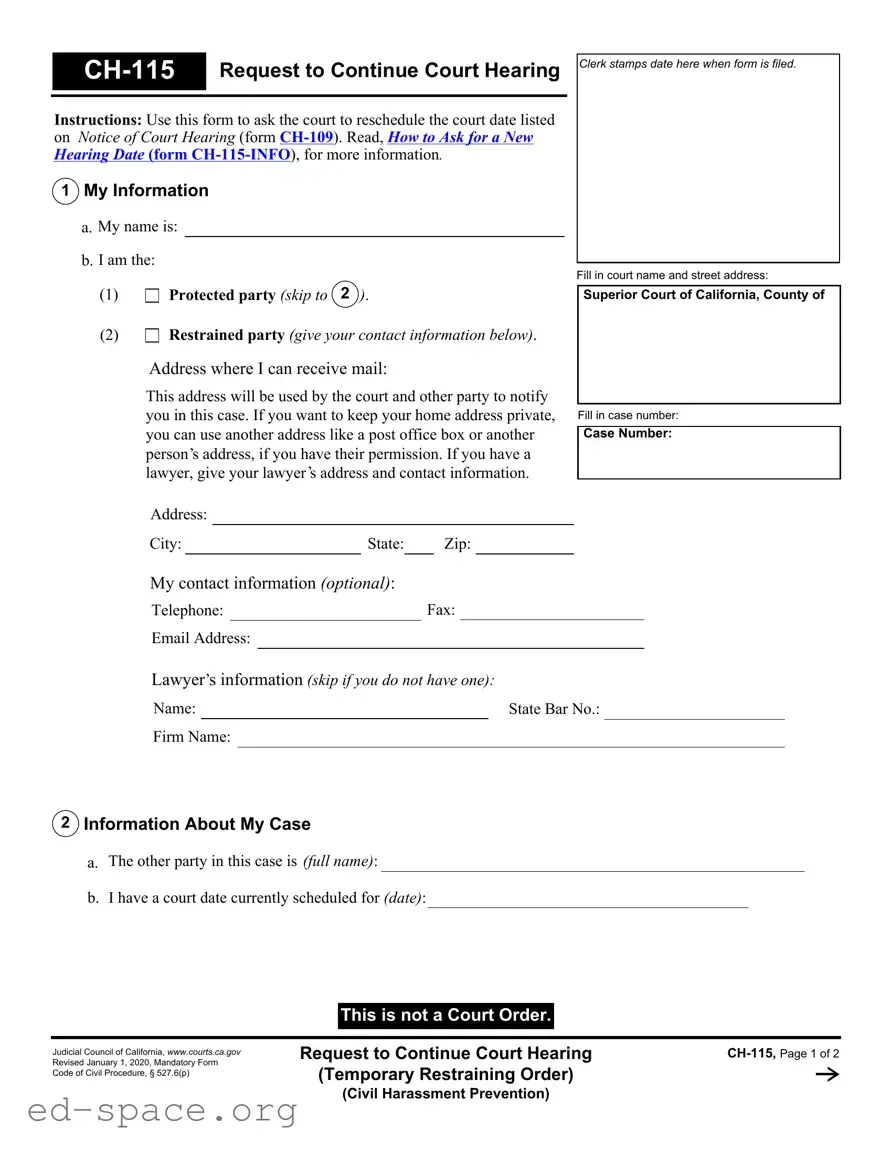
The California CH-115 form is a crucial tool for individuals involved in legal proceedings related to temporary restraining orders. This form allows you to request a new court date if you cannot attend the originally scheduled hearing. Whether you are the protected party seeking assistance or the restrained party needing to reschedule, the CH-115 form provides a straightforward way to communicate your needs to the court. It requires basic information about yourself, the other party involved, and the details of your case, including the current court date. If a temporary restraining order is in effect, this form also clarifies that the order remains valid until the new court date, ensuring continuous protection. Additionally, the form prompts you to explain why you need to reschedule, whether it's to allow more time for service of process or for other valid reasons. Understanding how to properly fill out this form is essential for navigating the legal system and ensuring your rights are protected.
Request to Continue Court Hearing |
|
|
|
|
|
Instructions: Use this form to ask the court to reschedule the court date listed on Notice of Court Hearing (form
1My Information
a.My name is:
b.I am the:
Clerk stamps date here when form is filed.
Fill in court name and street address:
(1)
(2)
Protected party (skip to 2 ).
Restrained party (give your contact information below).
Address where I can receive mail:
This address will be used by the court and other party to notify you in this case. If you want to keep your home address private, you can use another address like a post office box or another person’s address, if you have their permission. If you have a lawyer, give your lawyer’s address and contact information.
Address:
City: |
|
State: |
|
Zip: |
My contact information (optional):
Telephone:Fax:
Email Address:
Superior Court of California, County of
Fill in case number:
Case Number:
Lawyer’s information (skip if you do not have one):
Name: |
|
State Bar No.: |
Firm Name:
2Information About My Case
a.The other party in this case is (full name):
b.I have a court date currently scheduled for (date):
This is not a Court Order.
Judicial Council of California, www.courts.ca.gov Revised January 1, 2020, Mandatory Form Code of Civil Procedure, § 527.6(p)
Request to Continue Court Hearing
(Temporary Restraining Order)
(Civil Harassment Prevention)
Case Number:
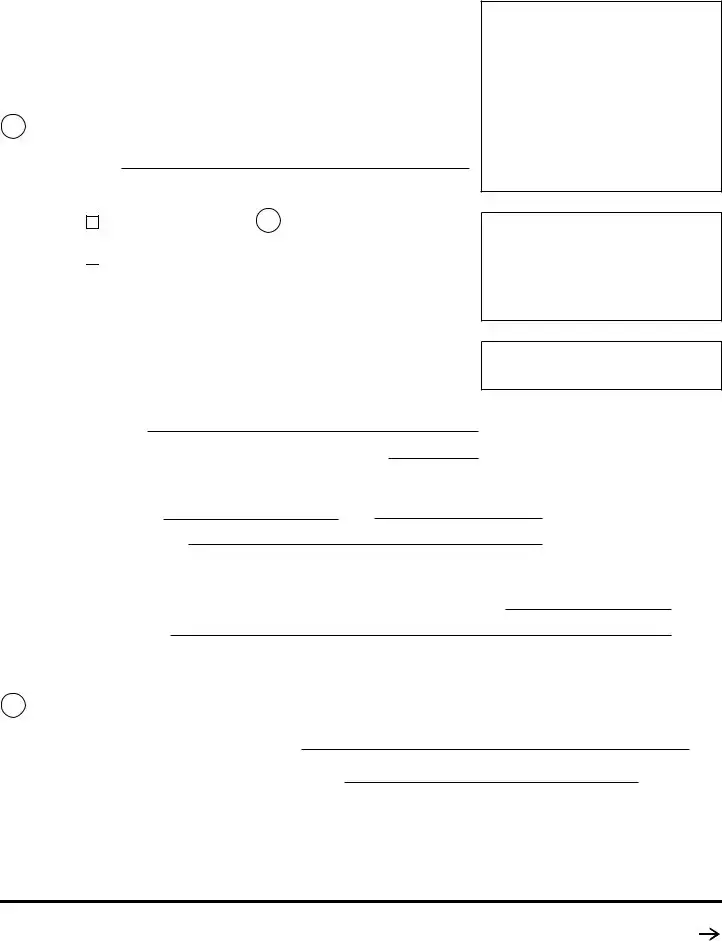
3Is a Temporary Restraining Order in effect?
Yes. Date the order was made, if known:
Please attach a copy of the order if you have one.
No.
I don’t know.
Notice: If the court date is rescheduled, the Temporary Restraining Order (form
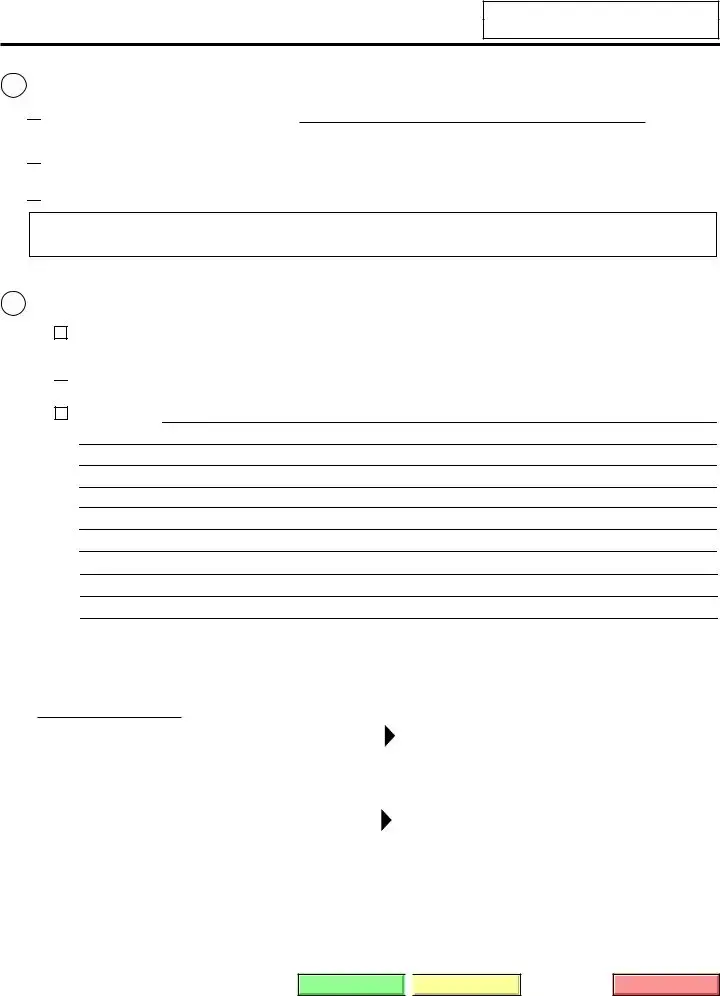
4Why does the court date need to be rescheduled?
a.
I am the person asking for protection, and I need more time to have the restrained party personally served.
b. I am the restrained party, and this is my first request to reschedule the court date.
c.
Other reason:
I declare under penalty of perjury under the laws of the State of California that the information above is true and correct.
Date:
|
Type or print your name |
|
|
|
Sign your name |
|
||||
|
Date: |
|
|
|
|
|
|
|
||
|
|
|
|
|
|
|
|
|
|
|
|
Lawyer’s name, if you have one |
|
Lawyer’s signature |
|||||||
|
|
|
|
|
|
|
|
|
|
|
|
|
|
|
This is not a Court Order. |
|
|
|
|||
|
|
|
|
|
|
|
|
|
|
|
|
|
|
|
|
|
|
|
|
|
|
Judicial Council of California, www.courts.ca.gov Revised January 1, 2020, Mandatory Form Code of Civil Procedure, § 527.6(p)
Request to Continue Court Hearing |
|
(Temporary Restraining Order) |
|
(Civil Harassment Prevention) |
|
For your protection and privacy, please press the Clear This Form button after you have printed the form.
Print this form Save this form
Clear this form
| Fact Name | Details |
|---|---|
| Purpose | The CH-115 form is used to request a rescheduling of a court date listed on the Notice of Court Hearing (form CH-109). |
| Governing Law | This form is governed by the Code of Civil Procedure, § 527.6(p) in California. |
| Filing Process | The court clerk will stamp the form with the filing date once it is submitted. |
| Privacy Options | Individuals can use alternative addresses, like a P.O. Box, to keep their home address private. |
| Temporary Restraining Order | If a Temporary Restraining Order (TRO) is in effect, it remains valid until the new court date unless the court orders otherwise. |
| Information Required | Users must provide their contact information, case number, and details about the other party involved in the case. |
| Reasons for Rescheduling | Common reasons include needing more time for service or being the restrained party making a first request to reschedule. |
| Declaration | The form requires a declaration under penalty of perjury, affirming the truthfulness of the provided information. |
After completing the California CH-115 form, you will need to file it with the appropriate court. This process is essential for requesting a new hearing date. Ensure that you have all necessary information ready, as it will facilitate a smoother filing experience.
Once you have completed these steps, ensure that you print the form and clear any sensitive information before submission. It is crucial to keep a copy for your records.
What is the purpose of the California CH-115 form?
The California CH-115 form, known as the Request to Continue Court Hearing, is used to ask the court to reschedule a court date that has been previously set. This form is particularly relevant in cases involving temporary restraining orders, where timing can be crucial. If you find yourself needing more time—whether to prepare your case, gather evidence, or ensure that all parties have been properly notified—this form is your go-to option. It's essential to follow the instructions carefully and provide the necessary information to ensure your request is processed smoothly.
Who should fill out the CH-115 form?
The form can be filled out by either party involved in the case. If you are the protected party seeking protection, you can use this form to request additional time for serving the restrained party. Conversely, if you are the restrained party and this is your first request to reschedule, you also have the right to submit this form. It’s important to remember that the information provided must be accurate, as you are declaring under penalty of perjury that the details are true.
What happens after I submit the CH-115 form?
Once you submit the CH-115 form to the court, the court will review your request. If the court approves the rescheduling, they will set a new date for the hearing. It's crucial to note that if there is a temporary restraining order in effect, it will remain valid until the new court date unless the court decides otherwise. Therefore, it’s important to keep track of the new date and any further instructions provided by the court.
Can I keep my address private when filling out the CH-115 form?
Yes, you can maintain your privacy when submitting the CH-115 form. If you are concerned about your home address being disclosed, you have the option to provide an alternative mailing address. This could be a post office box or another person's address, provided you have their permission. This is particularly useful for individuals who may feel unsafe or wish to keep their location confidential during the legal process.
Omitting Required Information: One common mistake is failing to fill out all necessary fields. For example, forgetting to include the case number or the date of the scheduled court hearing can lead to delays. Each section is important for the court to process your request effectively.
Using Incorrect Contact Information: Providing outdated or incorrect contact details can create significant problems. If the court or the other party cannot reach you, it may jeopardize your case. Always double-check that the address and phone number are current and accurate.
Neglecting to Explain the Reason for Rescheduling: Simply stating "I need more time" is often not enough. The court wants to understand your specific circumstances. Whether you need more time for service or have another valid reason, be clear and concise in your explanation.
Failing to Sign the Form: It may seem trivial, but not signing the form can render it invalid. Always remember to sign and date the form before submission. This simple step is crucial to ensure that your request is considered by the court.
When dealing with court proceedings in California, especially in matters involving Temporary Restraining Orders (TROs), several forms and documents can accompany the CH-115 form, which is a request to continue a court hearing. Each of these documents serves a specific purpose and helps ensure that the legal process runs smoothly. Below is a list of commonly used forms alongside the CH-115.
Understanding these documents can make the process of navigating court hearings more manageable. Each form plays a vital role in ensuring that all parties are informed and that the legal protections are upheld. It is advisable to familiarize yourself with these forms to ensure that you are adequately prepared for your court hearing.
The California CH-115 form, used to request a continuation of a court hearing, shares similarities with several other legal documents. Each of these forms serves a specific purpose in court proceedings. Below are five documents that are comparable to the CH-115 form:
When filling out the California CH-115 form, there are several important things to keep in mind. Here’s a helpful list of dos and don’ts to guide you through the process.
By following these guidelines, you can ensure that your request to continue the court hearing is properly submitted and considered.
Understanding the California CH-115 form can be challenging. Here are seven common misconceptions about this form, along with clarifications to help you navigate the process more effectively.
By addressing these misconceptions, individuals can better understand the purpose and process of the CH-115 form, ensuring they make informed decisions regarding their court hearings.
When using the California CH-115 form, there are several important points to consider to ensure the process goes smoothly. Here are key takeaways:
Following these steps will help ensure that the request is processed correctly and efficiently by the court.