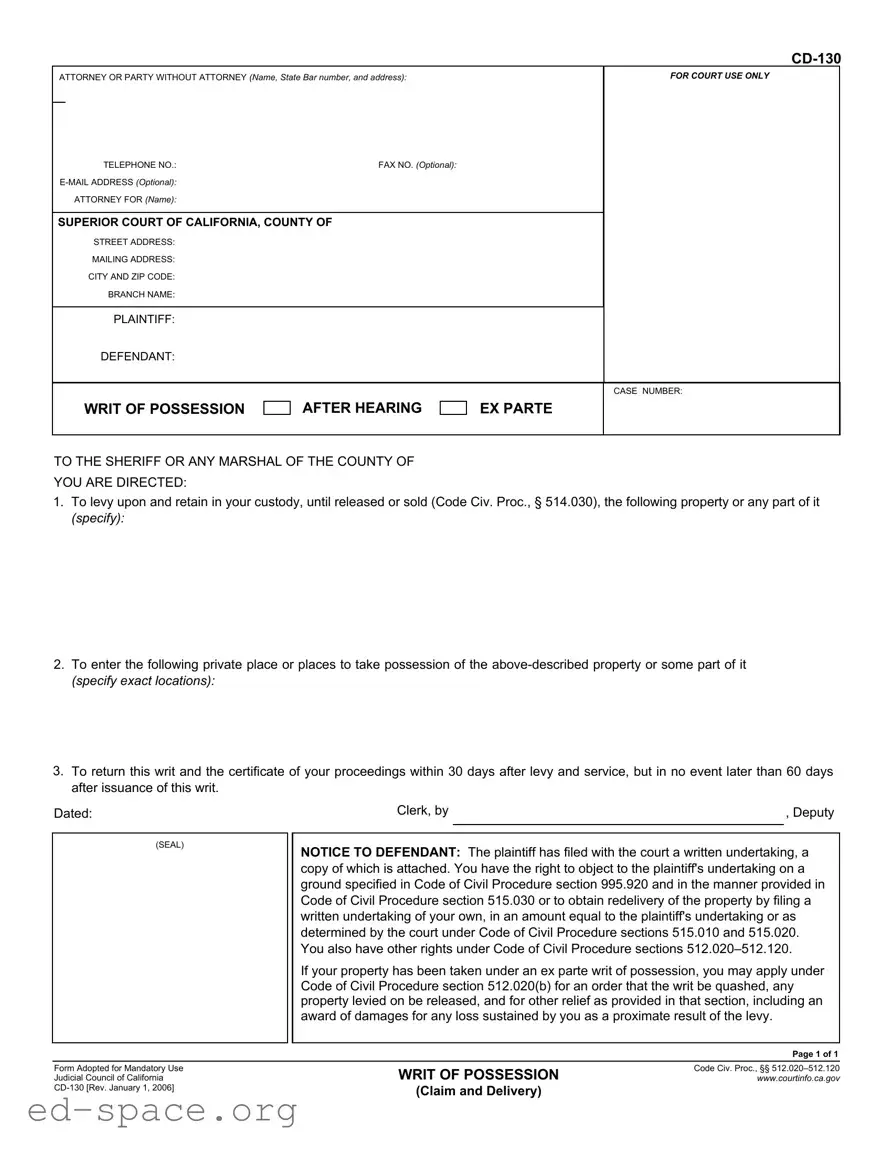
The California CD-130 form plays a crucial role in the legal process surrounding the enforcement of judgments, specifically in cases involving the writ of possession. This form is utilized by plaintiffs to request the sheriff or a marshal to seize property after a court hearing. It outlines essential details such as the names and contact information of the attorney or party involved, the court’s address, and the case number. The CD-130 directs law enforcement to take custody of specified property and provides instructions for entering private locations to retrieve it. Importantly, the form includes a notice to defendants, informing them of their rights to object to the plaintiff's undertaking and the procedures to follow if they wish to regain possession of their property. It emphasizes the need for timely action, as defendants must respond within specified timeframes to protect their interests. Understanding the nuances of the CD-130 is vital for anyone involved in a possession dispute in California.
ATTORNEY OR PARTY WITHOUT ATTORNEY (Name, State Bar number, and address):
TELEPHONE NO.: |
FAX NO. (Optional): |
|
|
ATTORNEY FOR (Name): |
|
SUPERIOR COURT OF CALIFORNIA, COUNTY OF
STREET ADDRESS:
MAILING ADDRESS:
CITY AND ZIP CODE:
BRANCH NAME:
PLAINTIFF:
DEFENDANT:
WRIT OF POSSESSION |
|
AFTER HEARING |
|
EX PARTE |
TO THE SHERIFF OR ANY MARSHAL OF THE COUNTY OF
YOU ARE DIRECTED:
FOR COURT USE ONLY
CASE NUMBER:
1.To levy upon and retain in your custody, until released or sold (Code Civ. Proc., § 514.030), the following property or any part of it (specify):
2.To enter the following private place or places to take possession of the
3.To return this writ and the certificate of your proceedings within 30 days after levy and service, but in no event later than 60 days after issuance of this writ.
Dated:
(SEAL)
Clerk, by |
|
, Deputy |
|
|
|
NOTICE TO DEFENDANT: The plaintiff has filed with the court a written undertaking, a copy of which is attached. You have the right to object to the plaintiff's undertaking on a ground specified in Code of Civil Procedure section 995.920 and in the manner provided in Code of Civil Procedure section 515.030 or to obtain redelivery of the property by filing a written undertaking of your own, in an amount equal to the plaintiff's undertaking or as determined by the court under Code of Civil Procedure sections 515.010 and 515.020. You also have other rights under Code of Civil Procedure sections
If your property has been taken under an ex parte writ of possession, you may apply under Code of Civil Procedure section 512.020(b) for an order that the writ be quashed, any property levied on be released, and for other relief as provided in that section, including an award of damages for any loss sustained by you as a proximate result of the levy.
|
|
Page 1 of 1 |
Form Adopted for Mandatory Use |
WRIT OF POSSESSION |
Code Civ. Proc., §§ |
Judicial Council of California |
www.courtinfo.ca.gov |
|
(Claim and Delivery) |
|
|
|
|
| Fact Name | Details |
|---|---|
| Form Purpose | The CD-130 form is used to request a writ of possession after a hearing in California. |
| Governing Laws | The form is governed by California Code of Civil Procedure sections 512.020–512.120. |
| Property Description | The form requires a detailed description of the property to be levied upon. |
| Timeframe for Return | The sheriff or marshal must return the writ and certificate of proceedings within 30 days after levy and service. |
| Defendant's Rights | The defendant has the right to object to the plaintiff's undertaking and may file a written undertaking for redelivery of the property. |
| Form Revision | The CD-130 form was last revised on January 1, 2006, and is adopted for mandatory use. |
Completing the California CD-130 form is essential for initiating a legal process regarding property possession. After filling out the form, it will need to be submitted to the appropriate court, where further actions will follow based on the court's instructions.
What is the purpose of the California CD-130 form?
The California CD-130 form is a legal document used to request a writ of possession after a hearing. This writ allows a plaintiff to reclaim property that they believe is wrongfully held by a defendant. The form is submitted to the Superior Court of California and instructs the sheriff or marshal to take possession of the specified property.
Who can file the CD-130 form?
The CD-130 form can be filed by an attorney representing a plaintiff or by a plaintiff acting on their own behalf. It is essential that the individual filing the form has a valid case number and has complied with all necessary legal procedures prior to submission.
What information is required on the CD-130 form?
The form requires detailed information, including the names and addresses of the parties involved, the case number, and a description of the property to be seized. Additionally, the form must include the attorney’s contact information if applicable. Accurate completion of this information is crucial for the court's processing of the writ.
What rights does a defendant have regarding the CD-130 form?
A defendant has several rights under California law. They can object to the plaintiff's undertaking, which is a financial guarantee that the plaintiff must file. The defendant can also file their own undertaking to obtain the return of the property. Furthermore, if the property has been wrongfully taken, the defendant may apply to have the writ quashed and seek damages for any losses incurred due to the levy.
What is the time frame for the sheriff or marshal to act on the CD-130 form?
The sheriff or marshal is directed to levy upon and retain the specified property within a certain time frame. They must return the writ and a certificate of their proceedings within 30 days after the levy and service, but no later than 60 days after the writ is issued. This ensures a timely resolution of the matter.
Where can I find more information about the CD-130 form?
More information about the CD-130 form can be found on the Judicial Council of California's website. This resource provides additional details about the form, its use, and related legal procedures. It is advisable to consult this site or seek legal assistance for further clarification on the process.
Incomplete Information: Failing to fill out all required fields can lead to delays. Ensure that every section is completed, including the attorney's name, address, and contact details.
Incorrect Case Number: Using the wrong case number can cause confusion. Double-check the number to make sure it matches the court's records.
Missing Signatures: Not signing the form can render it invalid. Make sure to sign where indicated, and if applicable, have the necessary parties sign as well.
Improper Property Description: Vague or unclear descriptions of the property can lead to issues. Clearly specify the property you wish to levy upon, including exact locations.
Ignoring Deadlines: Failing to return the writ within the specified time frame can have serious consequences. Be aware of the 30-day and 60-day deadlines for returning the writ.
Not Including Contact Information: Omitting contact details can hinder communication. Include a telephone number and email address, even if optional.
Neglecting Defendant's Rights: Not informing the defendant of their rights can lead to complications. Ensure that the notice to the defendant is clear and complete.
The California CD-130 form is a writ of possession used in legal proceedings to direct a sheriff or marshal to take possession of property after a court hearing. Several other forms and documents are commonly utilized alongside the CD-130 to facilitate the legal process. Below is a list of these documents, each described briefly for clarity.
These forms and documents play critical roles in the legal process surrounding the CD-130 writ of possession. Each serves a specific function, ensuring that the rights of all parties are respected and that the legal proceedings are conducted fairly.
The California CD-130 form, which is used for a writ of possession after a hearing, shares similarities with several other legal documents. Below are five such documents, each accompanied by a brief explanation of how they are similar to the CD-130 form.
When filling out the California CD-130 form, it is essential to approach the task with care. Below are some important dos and don'ts to keep in mind.
Understanding the California CD-130 form is crucial for anyone involved in legal proceedings related to property possession. Here are some common misconceptions about this form:
Clarifying these misconceptions can help individuals navigate the legal process more effectively. Always seek advice if you have specific questions about your situation.
When dealing with the California CD-130 form, it's important to understand its purpose and how to complete it effectively. Here are some key takeaways to keep in mind: