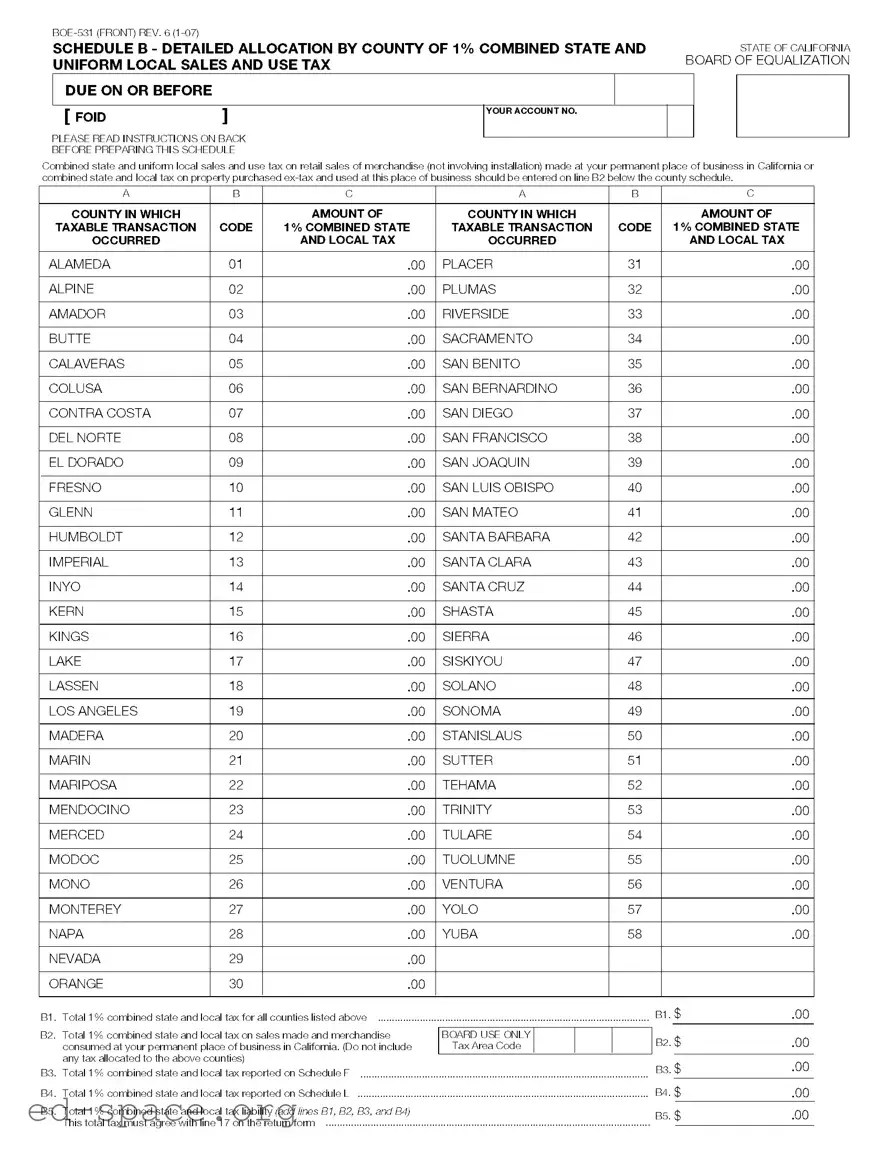
The California BOE 531 form serves as a crucial tool for businesses operating within the state, facilitating the accurate allocation of sales and use tax across various counties. This form is primarily utilized to report the combined state and local sales tax due on retail sales of merchandise, particularly those transactions that occur at a permanent business location in California. The form requires businesses to detail the amount of tax collected, categorized by county, ensuring compliance with state regulations. Specific sections of the form allow for the allocation of taxes based on different business activities, including auctioneering, vending machine operations, and out-of-state sales. Each county is assigned a unique code, which simplifies the reporting process and aids in the precise calculation of tax liabilities. Additionally, businesses must sum their total tax obligations from various schedules, ultimately providing a comprehensive overview of their tax responsibilities. The BOE 531 form not only streamlines the tax reporting process but also ensures that local jurisdictions receive their fair share of revenue, reinforcing the importance of accurate and timely submissions.
| Fact Name | Details |
|---|---|
| Purpose of Form | The California BOE 531 form is used to report the 1% combined state and local sales and use tax for retail sales made at a permanent place of business in California. |
| Applicable Tax | This form specifically deals with the 1% combined state and uniform local sales and use tax due on or before the specified date. |
| Governing Law | The regulations governing the use of this form are primarily found in California Revenue and Taxation Code Sections 6001-6079 and related regulations. |
| County Allocation | The form requires businesses to allocate sales tax amounts by county, ensuring compliance with local tax regulations across California's diverse regions. |
| Reporting Requirements | Businesses must report total sales tax amounts on specific lines, including totals for each county and overall tax liability, which must match the return form. |
Completing the California BOE-531 form requires careful attention to detail. This form is essential for reporting combined state and local sales and use tax, and it involves a few key steps to ensure accuracy. After filling out the form, you will be submitting it to the California Board of Equalization along with your tax return.
After completing these steps, review the form for any errors or omissions. Ensure that all amounts are accurate and that you have included all necessary information. Once verified, the form is ready for submission along with your tax return to the California Board of Equalization.
What is the purpose of the California BOE-531 form?
The California BOE-531 form is used to report the allocation of combined state and local sales and use tax for retail sales of merchandise made at a permanent place of business in California. It helps businesses ensure they are correctly reporting the tax due based on where taxable transactions occur within various counties.
Who needs to file the BOE-531 form?
Any business that sells merchandise in California and is subject to the combined state and local sales and use tax must file the BOE-531 form. This includes auctioneers, out-of-state retailers, and vending machine operators, among others. Each entity must report their taxable sales accurately according to the specific guidelines provided in the form's instructions.
How do I complete the BOE-531 form?
To complete the BOE-531 form, begin by entering your account number and following the instructions on the back of the form. Report the total 1% combined state and local tax for each county where taxable transactions occurred. Use the designated codes for each county and ensure that all amounts are accurately calculated and totaled. It is crucial that the total tax reported matches the total tax liability on your return form.
What happens if I do not file the BOE-531 form?
Failure to file the BOE-531 form can lead to penalties, interest on unpaid taxes, and potential audits. The California Board of Equalization expects timely and accurate reporting of sales and use tax. Not filing can also result in inaccurate tax assessments, which may complicate your business's financial standing and compliance status.
Where can I find additional information or assistance regarding the BOE-531 form?
For more information, businesses can visit the California Board of Equalization's website, where detailed instructions and resources are available. Additionally, reaching out to a tax professional or contacting the Board directly can provide further clarification and assistance with completing the form correctly.
Incorrect County Codes: One common mistake is entering the wrong county codes. Each county has a specific code that must be used. Double-check your entries to ensure accuracy.
Missing Tax Amounts: Some people forget to fill in the amounts of tax owed for each county. Make sure to complete all relevant fields to avoid delays in processing.
Not Following Instructions: Ignoring the instructions provided on the back of the form can lead to errors. Take the time to read and understand the guidelines to ensure you fill out the form correctly.
Inaccurate Total Calculation: When calculating the total tax liability, it’s easy to make mistakes. Ensure that the total on line B5 matches the sum of lines B1, B2, B3, and B4.
Omitting Necessary Schedules: Failing to include required schedules, such as Schedule F or Schedule L, can result in incomplete submissions. Always check if additional documentation is needed.
Not Signing the Form: Forgetting to sign the form is a frequent oversight. A signature is necessary for the form to be considered valid, so don’t skip this crucial step.
The California BOE-531 form is essential for businesses to report their sales and use tax allocations across various counties. When filling out this form, you may also need to reference or submit several other documents. Each of these forms serves a specific purpose in ensuring compliance with California's tax regulations.
Understanding these forms and their purposes can help businesses navigate the complexities of tax reporting in California. Properly completing the BOE-531 and its related documents ensures compliance and helps avoid potential penalties.
The California BOE-531 form is used for reporting the allocation of combined state and local sales and use tax. Several other documents serve similar purposes in the realm of tax reporting and compliance. Below are four documents that are comparable to the BOE-531 form, along with their similarities:
When filling out the California BOE-531 form, it is essential to follow specific guidelines to ensure accuracy and compliance. Here are four important dos and don'ts to consider:
There are several misconceptions about the California BOE 531 form that can lead to confusion. Understanding these misconceptions can help ensure accurate reporting and compliance. Here are four common misunderstandings:
Clarifying these misconceptions can help businesses navigate their tax obligations more effectively and avoid potential penalties.
Filling out the California BOE-531 form requires attention to detail. Here are key takeaways to keep in mind: