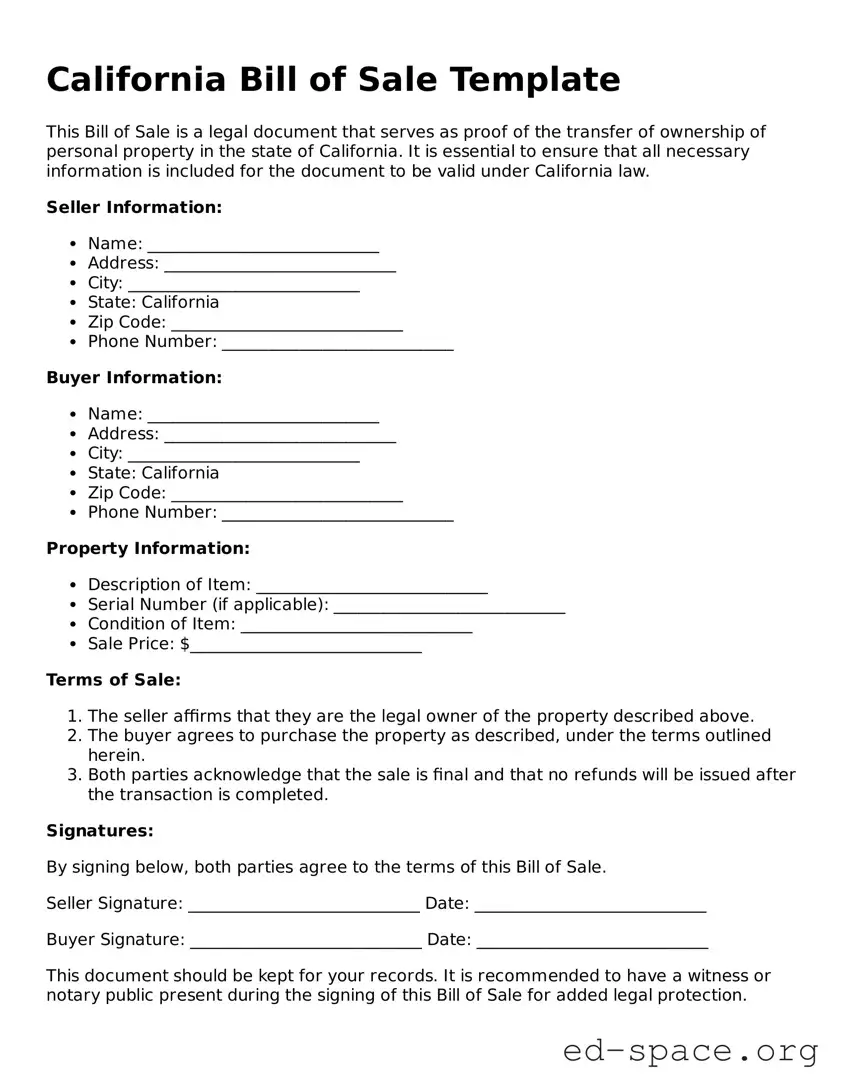
The California Bill of Sale form is an essential document for anyone involved in the buying or selling of personal property within the state. This form provides a clear record of the transaction, detailing the items sold, their condition, and the agreed-upon price. It serves as proof of ownership transfer, protecting both the buyer and seller. The form typically includes important information such as the names and addresses of both parties, a description of the item or items being sold, and the date of the sale. In some cases, it may also require notarization to enhance its legal standing. Understanding how to correctly complete this form is vital for ensuring a smooth transaction and safeguarding your rights. Whether you are selling a vehicle, furniture, or other personal items, having a properly executed Bill of Sale can prevent disputes and provide peace of mind.
California Bill of Sale Template
This Bill of Sale is a legal document that serves as proof of the transfer of ownership of personal property in the state of California. It is essential to ensure that all necessary information is included for the document to be valid under California law.
Seller Information:
Buyer Information:
Property Information:
Terms of Sale:
Signatures:
By signing below, both parties agree to the terms of this Bill of Sale.
Seller Signature: ____________________________ Date: ____________________________
Buyer Signature: ____________________________ Date: ____________________________
This document should be kept for your records. It is recommended to have a witness or notary public present during the signing of this Bill of Sale for added legal protection.
| Fact Name | Description |
|---|---|
| Purpose | The California Bill of Sale form serves as a legal document that records the transfer of ownership of personal property from one party to another. |
| Governing Law | The Bill of Sale in California is governed by the California Civil Code, specifically sections related to the sale of goods. |
| Types of Property | This form can be used for various types of personal property, including vehicles, boats, and equipment. |
| Notarization | While notarization is not always required, having the document notarized can provide additional legal protection and verification. |
| Parties Involved | The form typically includes the names and addresses of both the seller and the buyer, ensuring clarity in the transaction. |
| Consideration | The Bill of Sale should state the purchase price or consideration exchanged for the property, which is essential for legal validity. |
| As-Is Clause | Often, the Bill of Sale includes an "as-is" clause, indicating that the buyer accepts the property in its current condition without warranties from the seller. |
| Record Keeping | Both parties should keep a copy of the Bill of Sale for their records, as it serves as proof of the transaction. |
| Transfer of Title | For vehicles, the Bill of Sale is often used in conjunction with the title transfer process to the Department of Motor Vehicles (DMV). |
Filling out the California Bill of Sale form is a straightforward process. This document is essential for transferring ownership of personal property, such as a vehicle or equipment. Once you have completed the form, you'll be able to provide proof of the transaction to both the buyer and seller.
What is a California Bill of Sale?
A California Bill of Sale is a legal document that serves as proof of the transfer of ownership of personal property from one individual to another. It outlines the details of the transaction, including the buyer's and seller's information, a description of the item being sold, and the sale price. This document is particularly important for transactions involving vehicles, boats, or other significant assets, as it helps protect both parties in case of disputes.
Do I need a Bill of Sale for every transaction?
While a Bill of Sale is not legally required for every transaction in California, it is highly recommended for significant purchases, especially vehicles and other high-value items. Having a Bill of Sale can provide legal protection and clarity for both the buyer and seller. In some cases, such as vehicle transfers, a Bill of Sale may be necessary for registration purposes with the Department of Motor Vehicles (DMV).
What information should be included in a Bill of Sale?
A comprehensive Bill of Sale should include the following information: the full names and addresses of both the buyer and seller, a detailed description of the item being sold (including make, model, year, and VIN for vehicles), the sale price, and the date of the transaction. Additionally, it is beneficial to include any warranties or disclaimers related to the item. Both parties should sign the document to validate the agreement.
Is it necessary to have the Bill of Sale notarized?
Notarization is not a requirement for a Bill of Sale in California, but having the document notarized can add an extra layer of authenticity and security. If there are any concerns about the legitimacy of the transaction or if the item has a high value, both parties may choose to have the document notarized. This can help prevent disputes in the future.
Where can I obtain a California Bill of Sale form?
California Bill of Sale forms can be easily obtained online through various legal websites, or they can be created using templates available for download. Many local offices, such as the DMV, may also provide specific forms tailored for vehicle sales. Ensure that any form you use meets the requirements of California law and includes all necessary information to protect both parties involved in the transaction.
Incomplete Information: One common mistake is leaving out essential details. All fields must be filled out completely, including names, addresses, and item descriptions. Omitting even one piece of information can lead to complications.
Incorrect Item Description: Providing an inaccurate description of the item being sold can cause disputes later. It’s important to include the make, model, year, and any identifying numbers, such as VIN for vehicles.
Failure to Sign: Both the buyer and seller must sign the Bill of Sale. Forgetting to sign can render the document invalid, leading to legal issues down the line.
Not Including the Date: The date of the transaction is crucial. Without it, there may be confusion about when the sale occurred, which can affect warranties or other legal matters.
Not Notarizing the Document: While notarization is not always required, it can add an extra layer of protection. Failing to have the document notarized may weaken its credibility in case of disputes.
Ignoring Local Regulations: Different counties or cities may have specific requirements for a Bill of Sale. Not checking local laws can lead to issues with the document’s acceptance.
Using Inappropriate Language: The language used in the Bill of Sale should be clear and straightforward. Using vague terms can lead to misunderstandings between the parties involved.
Not Keeping Copies: After completing the Bill of Sale, both parties should keep a copy for their records. Failing to do so can lead to problems if questions arise later about the transaction.
A Bill of Sale is an important document used to transfer ownership of personal property in California. However, it often works in conjunction with several other forms and documents to ensure a smooth transaction. Below is a list of commonly used documents that may accompany the California Bill of Sale.
Using these documents alongside the California Bill of Sale can help facilitate a clear and legally sound transaction. Each form plays a vital role in protecting the interests of both the buyer and the seller, ensuring a smooth transfer of ownership.
A Bill of Sale is a document used to transfer ownership of an item from one party to another. It shares similarities with several other documents, each serving a specific purpose in transactions. Below is a list of eight documents that are similar to a Bill of Sale, along with a brief explanation of how they relate:
When filling out the California Bill of Sale form, it's important to follow certain guidelines to ensure the document is accurate and valid. Here are ten things you should and shouldn't do:
Following these guidelines will help ensure that the transaction is documented properly and can prevent potential issues in the future.
The California Bill of Sale form is often misunderstood. Here are four common misconceptions:
Many people believe that a Bill of Sale is only necessary when selling a vehicle. In reality, this form can be used for various types of transactions, including the sale of personal property, boats, trailers, and even certain types of equipment.
Some individuals think that a Bill of Sale holds no legal weight. However, when properly completed and signed, it serves as a legally binding document that can protect both the buyer and the seller by providing proof of the transaction.
There is a misconception that a Bill of Sale can be a simple note with minimal details. In fact, it should include essential information such as the names of the buyer and seller, a description of the item, the sale price, and the date of the transaction to be effective.
Some believe that they can forgo a Bill of Sale without consequences. However, not having this document can lead to disputes over ownership and can complicate future sales or transfers of the item.
When completing the California Bill of Sale form, it is important to keep the following key takeaways in mind: