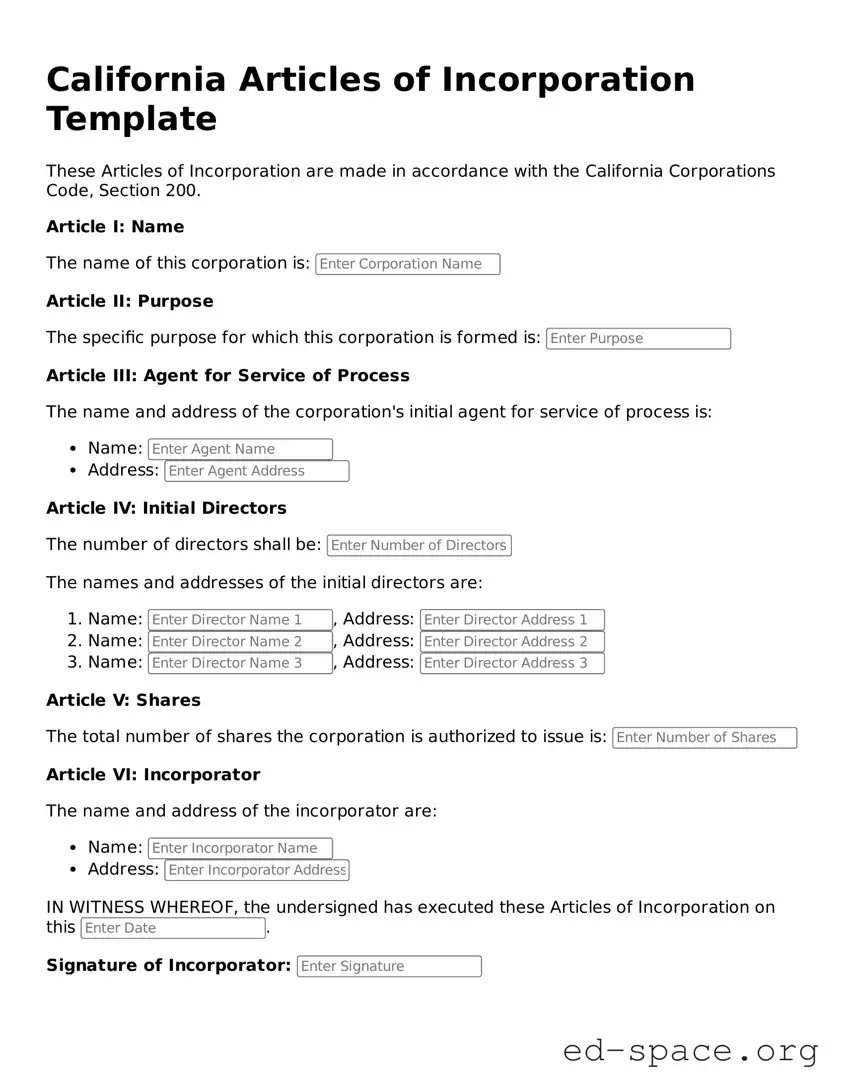
In the vibrant landscape of California's business environment, the Articles of Incorporation form serves as a foundational document for anyone looking to establish a corporation. This essential form outlines key details such as the corporation's name, its purpose, and the address of its principal office. Additionally, it requires the identification of the initial agent for service of process, ensuring that there is a designated individual or entity to receive legal documents on behalf of the corporation. Shareholder information, including the number of shares the corporation is authorized to issue, must also be provided, giving clarity on ownership structure. Furthermore, the form may include provisions for the management structure, detailing whether the corporation will be managed by directors or members. Understanding these components is crucial for entrepreneurs and business owners, as they lay the groundwork for compliance with state regulations and set the stage for future growth and success.
California Articles of Incorporation Template
These Articles of Incorporation are made in accordance with the California Corporations Code, Section 200.
Article I: Name
The name of this corporation is:
Article II: Purpose
The specific purpose for which this corporation is formed is:
Article III: Agent for Service of Process
The name and address of the corporation's initial agent for service of process is:
Article IV: Initial Directors
The number of directors shall be:
The names and addresses of the initial directors are:
Article V: Shares
The total number of shares the corporation is authorized to issue is:
Article VI: Incorporator
The name and address of the incorporator are:
IN WITNESS WHEREOF, the undersigned has executed these Articles of Incorporation on this .
Signature of Incorporator:
| Fact Name | Description |
|---|---|
| Governing Law | The California Corporations Code governs the Articles of Incorporation. |
| Purpose | Articles of Incorporation establish a corporation's existence in California. |
| Filing Requirement | Corporations must file Articles of Incorporation with the California Secretary of State. |
| Information Needed | Key information includes the corporation's name, purpose, and agent for service of process. |
| Filing Fee | A filing fee is required, which varies based on the type of corporation. |
| Duration | Corporations are typically formed to exist perpetually unless stated otherwise. |
| Amendments | Changes to the Articles of Incorporation can be made through an amendment process. |
| Registered Agent | A registered agent must be designated for legal correspondence. |
| Compliance | Ongoing compliance with state regulations is necessary to maintain corporate status. |
Filling out the California Articles of Incorporation form is a crucial step in establishing your business as a corporation. After completing this form, you will submit it to the California Secretary of State, which will then process your application. This step is essential for legally recognizing your corporation and obtaining the benefits that come with it.
What is the California Articles of Incorporation form?
The California Articles of Incorporation form is a legal document required to establish a corporation in California. It outlines essential information about the corporation, such as its name, purpose, and the address of its principal office. Filing this form with the California Secretary of State is the first step in the incorporation process.
Who needs to file the Articles of Incorporation?
Anyone looking to start a corporation in California must file the Articles of Incorporation. This includes individuals, groups, or businesses planning to operate as a corporation. It's important to note that different types of corporations, such as nonprofit and for-profit, may have specific requirements.
What information is required on the form?
The form requires several key pieces of information. You will need to provide the corporation's name, the purpose of the corporation, the address of the principal office, and the name and address of the initial agent for service of process. Additionally, you may need to include details about the number of shares the corporation is authorized to issue.
How do I file the Articles of Incorporation?
Filing can be done online, by mail, or in person. If you choose to file online, visit the California Secretary of State's website. For mail or in-person filings, download the form, fill it out, and send it to the appropriate office along with the required filing fee. Ensure all information is accurate to avoid delays.
What is the filing fee for the Articles of Incorporation?
The filing fee varies based on the type of corporation you are forming. As of October 2023, the fee for a standard for-profit corporation is typically around $100. Nonprofit corporations may have different fees. Always check the California Secretary of State's website for the most current fee schedule.
Can I amend the Articles of Incorporation after filing?
Yes, you can amend the Articles of Incorporation after they have been filed. If there are changes to the corporation's name, purpose, or other details, you will need to file an amendment with the California Secretary of State. This process also requires a fee, so be sure to check the current regulations.
How long does it take for the Articles of Incorporation to be processed?
The processing time can vary. Generally, if filed online, you may receive confirmation within a few days. Mail filings can take longer, often several weeks. If you need expedited processing, the Secretary of State offers options for faster service, usually for an additional fee.
What happens after my Articles of Incorporation are approved?
Once your Articles of Incorporation are approved, your corporation is officially formed. You will receive a stamped copy of the Articles, which serves as proof of your corporation's existence. Following this, you should obtain any necessary business licenses and permits, and set up your corporate records and governance structure.
Failing to provide a specific business purpose. Many applicants write vague descriptions, which can lead to delays or rejections.
Incorrectly stating the name of the corporation. The name must be unique and comply with California naming regulations. Common mistakes include using restricted words or failing to include the required suffix (e.g., Inc., Corporation).
Not including the registered agent’s information. Every corporation must designate a registered agent with a physical address in California. Omitting this information can cause complications.
Omitting the number of shares the corporation is authorized to issue. This detail is crucial for defining ownership and investment opportunities.
Providing incomplete or incorrect contact information. Accurate contact details are essential for communication with state authorities.
Neglecting to sign the form. All incorporators must sign the Articles of Incorporation. A missing signature can invalidate the submission.
Submitting the form without the required filing fee. Each submission requires a payment, and failure to include it will result in rejection.
The California Articles of Incorporation form is a key document for establishing a corporation in the state. However, several other forms and documents are often necessary to complete the incorporation process and ensure compliance with state regulations. Below is a list of these essential documents.
Each of these documents plays a crucial role in the formation and operation of a corporation in California. Ensuring that all necessary forms are completed and filed correctly can help facilitate a smoother incorporation process and ongoing compliance with state laws.
The Articles of Incorporation form is an important document for establishing a corporation. It shares similarities with several other legal documents. Here are four documents that are comparable to the Articles of Incorporation:
When filling out the California Articles of Incorporation form, attention to detail is crucial. Here are four important do's and don'ts to consider:
Understanding the California Articles of Incorporation form is crucial for anyone looking to start a business. However, several misconceptions can lead to confusion. Here are nine common misunderstandings:
Being aware of these misconceptions can help you navigate the process more effectively. Make sure to gather accurate information before proceeding with your incorporation.
When filling out and using the California Articles of Incorporation form, there are several important points to keep in mind:
Following these guidelines can help streamline the incorporation process and ensure compliance with California regulations.