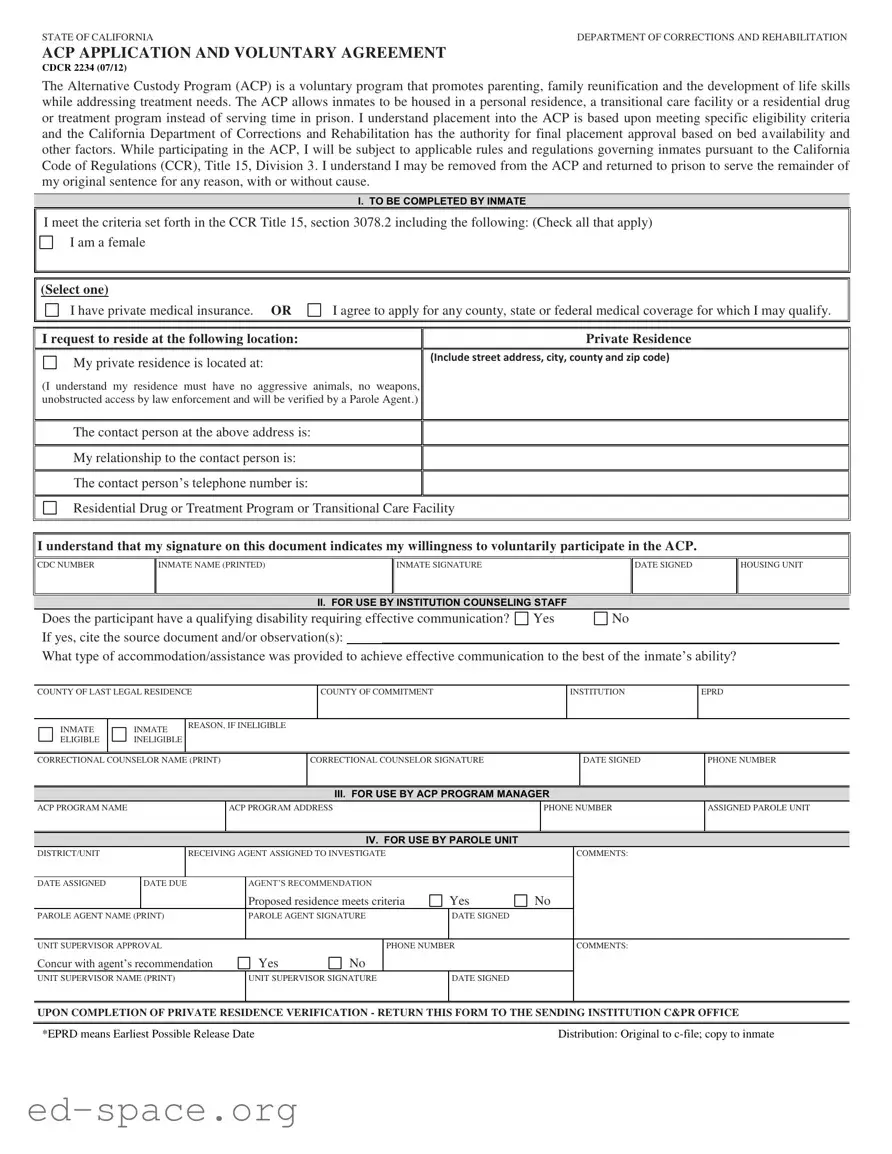
The California Alternative Custody Program (ACP) offers a unique opportunity for eligible inmates to serve their time outside of traditional prison settings. This voluntary program is designed to support parenting, family reunification, and the development of essential life skills while also addressing individual treatment needs. Through the ACP, inmates can reside in a personal home, a transitional care facility, or a residential drug or treatment program, rather than remaining incarcerated. However, participation in the program is contingent upon meeting specific eligibility criteria set forth by the California Department of Corrections and Rehabilitation (CDCR). It is important to note that the final approval for placement lies with the CDCR, which considers factors such as bed availability. While engaged in the ACP, participants must adhere to the rules and regulations outlined in the California Code of Regulations, Title 15, Division 3. Additionally, inmates should be aware that they can be returned to prison to complete their original sentence for various reasons, with or without cause. The application process requires inmates to provide personal information, including their intended residence and a contact person, as well as to confirm their understanding of the program's requirements and conditions.

STATE OF CALIFORNIA |
DEPARTMENT OF CORRECTIONS AND REHABILITATION |
ACP APPLICATION AND VOLUNTARY AGREEMENT
CDCR 2234 (07/12)
The Alternative Custody Program (ACP) is a voluntary program that promotes parenting, family reunification and the development of life skills while addressing treatment needs. The ACP allows inmates to be housed in a personal residence, a transitional care facility or a residential drug or treatment program instead of serving time in prison. I understand placement into the ACP is based upon meeting specific eligibility criteria and the California Department of Corrections and Rehabilitation has the authority for final placement approval based on bed availability and other factors. While participating in the ACP, I will be subject to applicable rules and regulations governing inmates pursuant to the California Code of Regulations (CCR), Title 15, Division 3. I understand I may be removed from the ACP and returned to prison to serve the remainder of my original sentence for any reason, with or without cause.
I. TO BE COMPLETED BY INMATE
I meet the criteria set forth in the CCR Title 15, section 3078.2 including the following: (Check all that apply)
I am a female
(Select one) |
|
|
I have private medical insurance. OR |
I agree to apply for any county, state or federal medical coverage for which I may qualify. |
|
|
|
|
|
|
|
I request to reside at the following location: |
|
Private Residence |
My private residence is located at: |
|
(Include street address, city, county and zip code) |
|
|
|
(I understand my residence must have no aggressive animals, no weapons, unobstructed access by law enforcement and will be verified by a Parole Agent.)
The contact person at the above address is:
My relationship to the contact person is:
The contact person’s telephone number is:
Residential Drug or Treatment Program or Transitional Care Facility
I understand that my signature on this document indicates my willingness to voluntarily participate in the ACP.
CDC NUMBER
INMATE NAME (PRINTED)
INMATE SIGNATURE
DATE SIGNED
HOUSING UNIT
II. FOR USE BY INSTITUTION COUNSELING STAFF
Does the participant have a qualifying disability requiring effective communication? |
Yes |
No |
|
If yes, cite the source document and/or observation(s): |
___________________________________________________________________ |
||
What type of accommodation/assistance was provided to achieve effective communication to the best of the inmate’s ability?
COUNTY OF LAST LEGAL RESIDENCE
COUNTY OF COMMITMENT
INSTITUTION
EPRD
INMATE |
INMATE |
REASON, IF INELIGIBLE |
|
|
|
|
|
|
|
||
ELIGIBLE |
INELIGIBLE |
|
|
|
|
|
|
|
|
|
|
CORRECTIONAL COUNSELOR NAME (PRINT) |
CORRECTIONAL COUNSELOR SIGNATURE |
DATE SIGNED |
PHONE NUMBER |
||
|
|
|
|
|
|
III. FOR USE BY ACP PROGRAM MANAGER
ACP PROGRAM NAME
ACP PROGRAM ADDRESS
PHONE NUMBER
ASSIGNED PAROLE UNIT
IV. FOR USE BY PAROLE UNIT
DISTRICT/UNIT |
|
RECEIVING AGENT ASSIGNED TO INVESTIGATE |
|
|
|
COMMENTS: |
|||
|
|
|
|
|
|
|
|
|
|
DATE ASSIGNED |
DATE DUE |
AGENT’S RECOMMENDATION |
|
|
|
|
|||
|
|
|
Proposed residence meets criteria |
Yes |
No |
|
|||
PAROLE AGENT NAME (PRINT) |
PAROLE AGENT SIGNATURE |
|
DATE SIGNED |
|
|
||||
|
|
|
|
|
|
|
|
||
UNIT SUPERVISOR APPROVAL |
|
|
|
PHONE NUMBER |
|
COMMENTS: |
|||
Concur with agent’s recommendation |
Yes |
No |
|
|
|
|
|
||
UNIT SUPERVISOR NAME (PRINT) |
UNIT SUPERVISOR SIGNATURE |
|
DATE SIGNED |
|
|
||||
|
|
|
|
||||||
UPON COMPLETION OF PRIVATE RESIDENCE VERIFICATION - RETURN THIS FORM TO THE SENDING INSTITUTION C&PR OFFICE |
|||||||||
|
|
|
|
|
|
||||
*EPRD means Earliest Possible Release Date |
|
|
|
|
Distribution: Original to |
||||
| Fact Name | Details |
|---|---|
| Program Overview | The Alternative Custody Program (ACP) is a voluntary initiative aimed at supporting parenting, family reunification, and life skills development. |
| Housing Options | Inmates may reside in a personal residence, a transitional care facility, or a residential drug treatment program instead of serving time in prison. |
| Eligibility Criteria | Placement in the ACP requires meeting specific eligibility criteria as outlined in the California Code of Regulations (CCR), Title 15, Section 3078.2. |
| Authority | The California Department of Corrections and Rehabilitation (CDCR) holds the authority for final placement approval based on bed availability and other factors. |
| Rules and Regulations | Participants must adhere to rules and regulations governing inmates as specified in the California Code of Regulations (CCR), Title 15, Division 3. |
| Removal from Program | Inmates may be removed from the ACP and returned to prison to serve their original sentence for any reason, with or without cause. |
| Contact Information | Inmates are required to provide the address of their proposed residence and a contact person, ensuring that the residence meets safety criteria. |
After you complete the California Alternative Custody form, it will be reviewed by the appropriate authorities. They will assess your eligibility and make a decision based on the information you provide. It is important to fill out the form accurately and completely to avoid delays in processing.
What is the California Alternative Custody Program (ACP)?
The California Alternative Custody Program (ACP) is a voluntary initiative designed to support inmates in their journey toward rehabilitation. It focuses on parenting, family reunification, and developing essential life skills. Instead of serving time in prison, eligible inmates may reside in a personal residence, a transitional care facility, or a residential drug or treatment program. This approach aims to address the treatment needs of participants while allowing them to maintain connections with their families and communities.
Who is eligible to participate in the ACP?
Eligibility for the ACP is determined by specific criteria outlined in the California Code of Regulations (CCR), Title 15, section 3078.2. Generally, participants must be female inmates who either have private medical insurance or agree to apply for available medical coverage. Additionally, the chosen residence must meet certain conditions, such as having no aggressive animals or weapons and allowing unobstructed access for law enforcement. Final placement approval rests with the California Department of Corrections and Rehabilitation, considering factors like bed availability.
Can participants be removed from the ACP? If so, why?
Yes, participants can be removed from the ACP and returned to prison to serve the remainder of their original sentence. This can happen for various reasons, including non-compliance with program rules or regulations. The ACP operates under strict guidelines, and adherence is crucial for continued participation. Removal can occur with or without cause, emphasizing the importance of understanding and following the program's requirements.
What does the application process entail?
The application process for the ACP begins with the inmate completing the ACP Application and Voluntary Agreement form (CDCR 2234). This form requires personal information, including the proposed residence and a contact person. Once submitted, the form is reviewed by institution counseling staff, who determine eligibility. If approved, the application is forwarded to the ACP Program Manager and the assigned parole unit for further investigation and final placement. Communication and cooperation with all parties involved are essential throughout this process.
What are the responsibilities of participants while in the ACP?
Participants in the ACP must adhere to all applicable rules and regulations governing inmates as outlined in the California Code of Regulations (CCR), Title 15, Division 3. This includes maintaining a stable residence, following any treatment plans, and reporting to designated parole agents. It is crucial for participants to stay engaged with the program and fulfill their responsibilities to ensure a successful transition back into the community.
Incomplete Information: One common mistake is failing to provide all necessary details. Each section of the form requires specific information, such as the address of the proposed residence and contact person. Omitting this information can delay the process or result in rejection.
Incorrect Selection of Eligibility Criteria: Applicants sometimes check boxes that do not apply to their situation. It’s essential to carefully review the eligibility criteria outlined in the form. Misunderstanding or misrepresenting one’s circumstances can lead to disqualification.
Neglecting to Verify Residence Requirements: The form states that the proposed residence must meet specific conditions, such as having no aggressive animals or weapons. Failing to ensure that the residence complies with these requirements can result in denial of the application.
Not Seeking Assistance When Needed: Some individuals hesitate to ask for help when filling out the form. If there are questions or uncertainties, it’s important to reach out for guidance. Assistance can prevent errors and ensure a smoother application process.
The California Alternative Custody Program (ACP) form is just one piece of a larger puzzle when it comes to navigating the corrections system. To fully understand the process and ensure compliance with all necessary regulations, several other documents may come into play. Here’s a look at some of the key forms that are often used alongside the ACP form, providing a clearer picture of the requirements and procedures involved.
Understanding these additional forms and documents can significantly enhance the chances of a successful application to the California Alternative Custody Program. Each document plays a unique role in the process, ensuring that the inmate's rights are respected while also adhering to the requirements set forth by the California Department of Corrections and Rehabilitation. Being well-prepared and informed can make a world of difference in navigating this complex system.
The California Alternative Custody Program (ACP) form shares similarities with several other legal documents that facilitate alternative arrangements for individuals in the correctional system. Here are four documents that are comparable to the ACP form:
When filling out the California Alternative Custody form, it’s important to approach the process thoughtfully. Here are seven things to keep in mind—both what you should do and what you should avoid.
By following these guidelines, you can enhance your chances of a smooth application process for the California Alternative Custody Program.
Here are nine misconceptions about the California Alternative Custody form:
Key Takeaways for Filling Out the California Alternative Custody Form