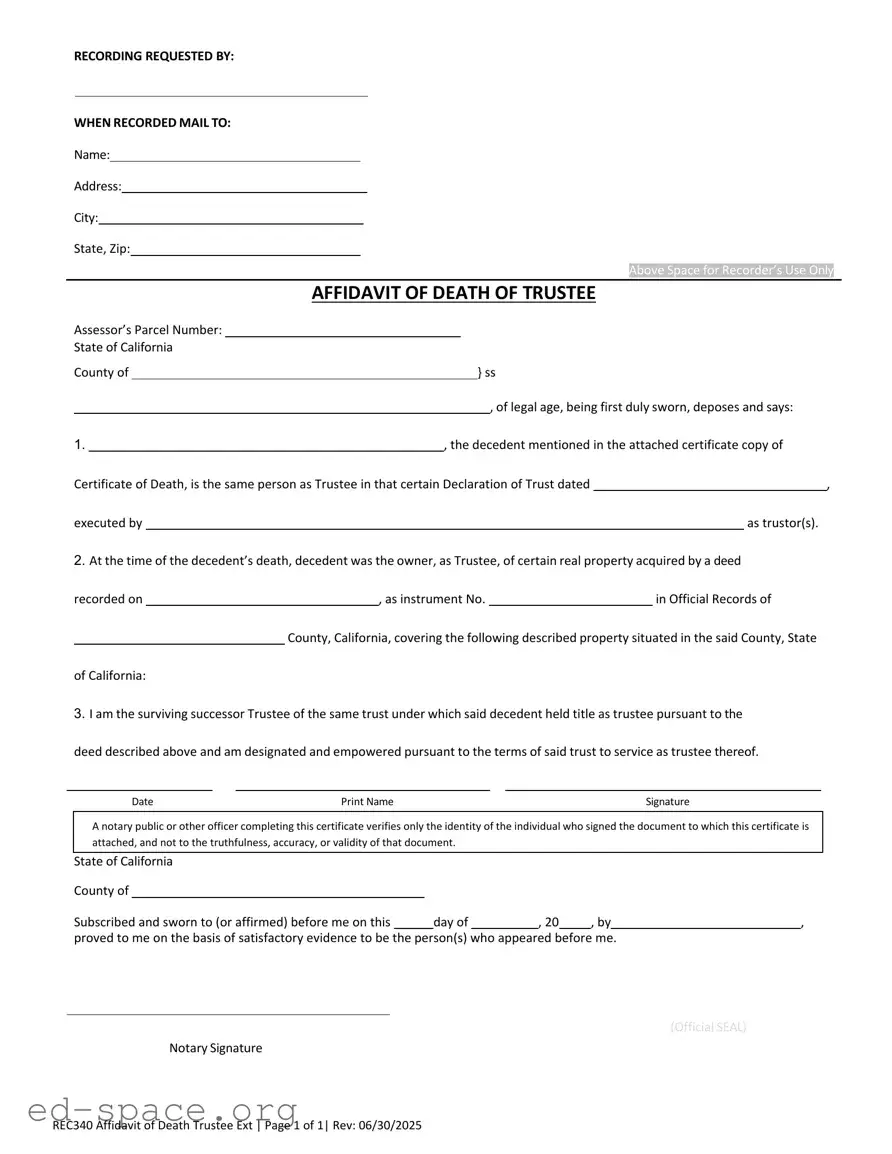
The California Affidavit of Death of a Trustee form serves a crucial role in the administration of a trust when a trustee passes away. This legal document allows the successor trustee or another interested party to officially declare the death of the trustee, ensuring a smooth transition of responsibilities and assets within the trust. By providing essential details such as the deceased trustee's name, date of death, and relevant trust information, this affidavit helps to clarify the status of the trust and its management. It must be properly executed and may require notarization to be valid. Completing this form is an important step in maintaining the integrity of the trust and protecting the interests of the beneficiaries. Understanding its components and implications can facilitate the process of trust administration during a challenging time.

Above Space for Recorder’s Use Only
|
|
|
|
AFFIDAVIT OF DEATH OF TRUSTEE |
|
||||||
Assessor’s Parcel Number: |
|
|
|
|
|
|
|
|
|||
State of California |
|
|
|
|
|
|
|
|
|||
County of |
|
|
|
} ss |
|
||||||
|
|
|
|
|
|
|
|
, of legal age, being first duly sworn, deposes and says: |
|
||
1. |
|
|
|
|
, the decedent mentioned in the attached certificate copy of |
|
|||||
Certificate of Death, is the same person as Trustee in that certain Declaration of Trust dated |
, |
||||||||||
executed by |
|
|
|
|
|
|
|
as trustor(s). |
|
||
2.At the time of the decedent’s death, decedent was the owner, as Trustee, of certain real property acquired by a deed
recorded on, as instrument No.in Official Records of
County, California, covering the following described property situated in the said County, State
of California:
3.I am the surviving successor Trustee of the same trust under which said decedent held title as trustee pursuant to the
deed described above and am designated and empowered pursuant to the terms of said trust to service as trustee thereof.
Date |
Print Name |
Signature |
A notary public or other officer completing this certificate verifies only the identity of the individual who signed the document to which this certificate is attached, and not to the truthfulness, accuracy, or validity of that document.
State of California
County of |
|
|
|
|
|
|
|
|
|
|
|
Subscribed and sworn to (or affirmed) before me on this |
|
|
day of |
, 20 |
, by |
, |
|||||
proved to me on the basis of satisfactory evidence to be |
|
|
|
|
|
|
|
|
|
||
the person(s) who appeared before me. |
|
|
|||||||||
(Official SEAL)
Notary Signature
REC340 Affidavit of Death Trustee Ext | Page 1 of 1| Rev: 06/30/2025
| Fact Name | Description |
|---|---|
| Purpose | The California Affidavit of Death of a Trustee is used to formally notify relevant parties of the death of a trustee, allowing for the transfer of responsibilities and management of the trust. |
| Governing Law | This form is governed by the California Probate Code, specifically sections related to trusts and the duties of trustees. |
| Who Can File | Typically, the successor trustee or a beneficiary of the trust can file the affidavit to ensure proper administration of the trust after the trustee's death. |
| Required Information | The affidavit must include the name of the deceased trustee, the date of death, and a statement confirming the trust's existence. |
| Filing Location | The affidavit should be filed with the county recorder's office in the county where the trust property is located. |
| Effect on Trust | Filing the affidavit allows the successor trustee to assume control over the trust assets and carry out the trust's terms without delay. |
| Additional Documentation | Supporting documents, such as a death certificate and trust documents, may be required to accompany the affidavit when filed. |
After completing the California Affidavit of Death of a Trustee form, the next step involves submitting it to the appropriate county recorder's office. This ensures that the death of the trustee is officially recognized and that any necessary changes to the trust can be made. Follow these steps carefully to fill out the form correctly.
What is the California Affidavit of Death of a Trustee form?
The California Affidavit of Death of a Trustee form is a legal document used to officially declare the death of a trustee of a trust. This form helps to ensure that the trust can continue to be managed properly and that the successor trustee can take over their duties without delay.
Who needs to file this form?
This form is typically filed by the successor trustee or any interested party after the death of the trustee. It is essential for those who need to manage or distribute the trust assets to have a clear record of the trustee's death.
What information is required on the form?
The form requires basic information such as the name of the deceased trustee, the date of their death, and details about the trust itself. It may also ask for information about the successor trustee who will take over the responsibilities.
Where do I file the Affidavit of Death of a Trustee?
Is there a fee to file this form?
Yes, there is usually a fee associated with filing the Affidavit of Death of a Trustee. The exact amount can vary by county, so it’s a good idea to check with your local county recorder's office for the specific fee schedule.
Can I complete this form myself?
Yes, you can complete the form yourself. However, it is advisable to consult with a legal professional if you have questions or if the trust is complex. They can provide guidance and ensure that everything is filled out correctly.
What happens after I file the form?
After filing the form, the successor trustee can begin managing the trust according to its terms. This includes distributing assets and fulfilling any obligations outlined in the trust document.
Do I need to notify anyone after filing the form?
Yes, it’s important to notify beneficiaries of the trust about the change in trustees. Keeping everyone informed helps to maintain transparency and trust among all parties involved.
Can the form be challenged?
While the form itself is a declaration of fact, it can potentially be challenged in court if there are disputes regarding the trust or the validity of the trustee's death. In such cases, legal advice may be necessary to navigate any complications.
Inaccurate Information: Providing incorrect details about the deceased trustee, such as their full name or date of death, can lead to complications.
Missing Signatures: Failing to obtain necessary signatures from all required parties can invalidate the affidavit.
Not Including Supporting Documents: Omitting essential documents, such as the trust agreement or death certificate, may delay the process.
Improper Notarization: If the affidavit is not properly notarized, it may not be accepted by financial institutions or courts.
Incorrect Notary Information: Providing inaccurate details about the notary, such as their commission expiration date, can cause issues.
Failure to Update Trust Records: Not updating the trust records after the trustee's death can lead to confusion about the trust's management.
Ignoring State-Specific Requirements: Each state has unique rules. Not adhering to California's specific requirements may result in rejection of the affidavit.
Not Keeping Copies: Failing to retain copies of the completed affidavit and supporting documents can complicate future reference.
Delaying Submission: Taking too long to submit the affidavit can hinder the timely transfer of trust assets and management.
The California Affidavit of Death of a Trustee form is an important document used in the process of transferring trust property after a trustee has passed away. Along with this form, several other documents may be required to ensure a smooth transition of trust assets. Below is a list of commonly used forms and documents that accompany the California Affidavit of Death of a Trustee.
Understanding these documents can help ensure that the process following the death of a trustee is handled efficiently and in accordance with the trust's terms. Each document plays a vital role in facilitating the transition and protecting the interests of the beneficiaries.
When filling out the California Affidavit of Death of a Trustee form, attention to detail is crucial. Here are four important dos and don'ts to keep in mind:
There are several misconceptions regarding the California Affidavit of Death of a Trustee form. Understanding these misconceptions can help individuals navigate the process more effectively. Below are six common misunderstandings:
Clarifying these misconceptions can help individuals approach the process with a better understanding, ultimately leading to a smoother transition in trust management.
When filling out and using the California Affidavit of Death of a Trustee form, there are several important points to consider. This form is crucial for the proper management of a trust after the death of a trustee. Here are five key takeaways:
Understanding these key points can help streamline the process of managing a trust after the loss of a trustee. Properly completing the affidavit is essential for the ongoing administration of the trust.