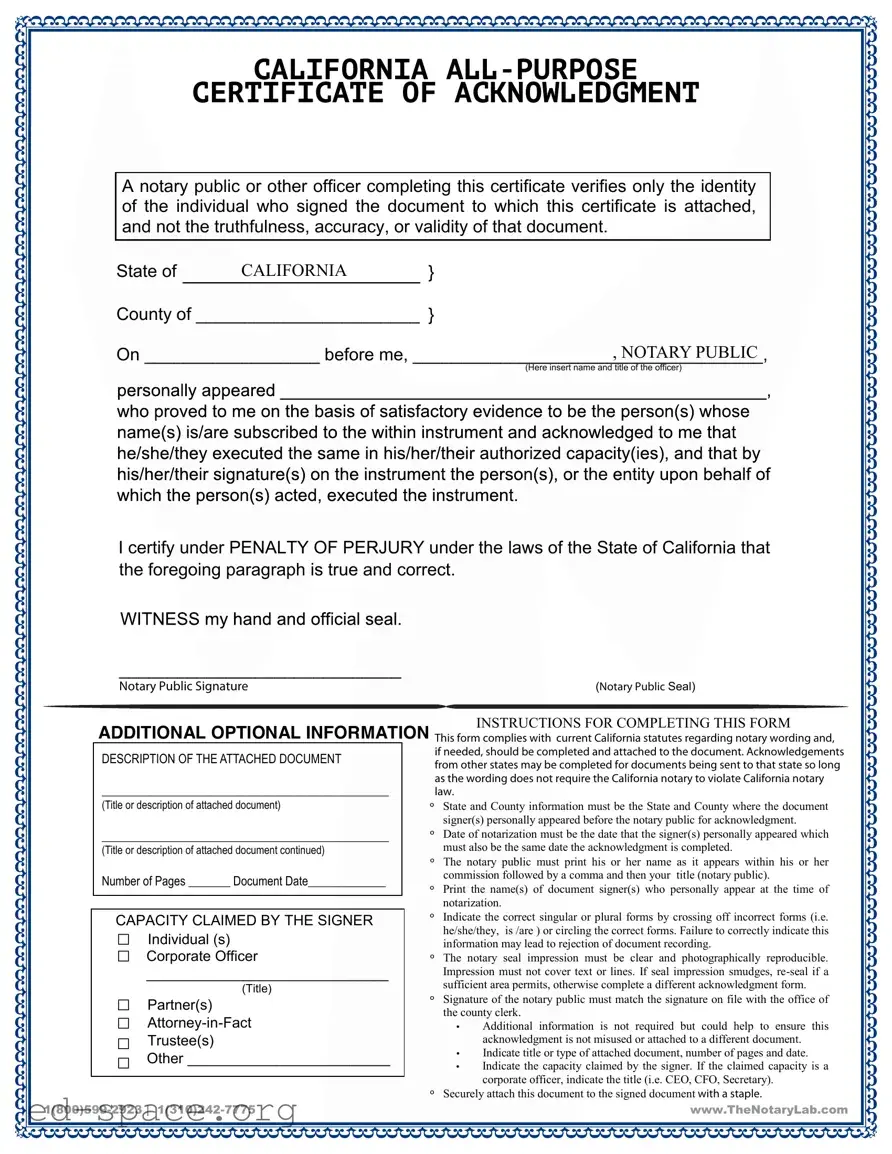
The California Acknowledgment Certificate form is an essential document used in the notarization process. It serves as proof that a notary public has verified the identity of the individual signing a document. Importantly, the notary does not confirm the accuracy or validity of the document itself. This form includes key details such as the state and county where the acknowledgment takes place, the date of notarization, and the names of the signers. Additionally, it requires the notary to provide their signature and official seal, ensuring that the acknowledgment is legitimate. The form also offers space for optional information, such as a description of the attached document, which can help clarify the purpose of the notarization. Following specific instructions is crucial for proper completion, as any errors may lead to the rejection of the document. By adhering to these guidelines, individuals can ensure that their documents are properly acknowledged and accepted in legal contexts.
CALIFORNIA
CERTIFICATE OF ACKNOWLEDGMENT
A notary public or other officer completing this certificate verifies only the identity of the individual who signed the document to which this certificate is attached, and not the truthfulness, accuracy, or validity of that document.
State of |
CALIFORNIA |
|
County of _______________________ |
|
|
On __________________ before me, |
, NOTARY PUBLIC , |
|
|
|
(Here insert name and title of the officer) |
the
I certify under PENALTY OF PERJURY under the laws of the State of California that the foregoing paragraph is true and correct.
_____________________________
Notary Public Signature |
(Notary Public Seal) |
ADDITIONAL OPTIONAL INFORMATION
DESCRIPTION OF THE ATTACHED DOCUMENT
________________________________________________
(Title or description of attached document)
________________________________________________
(Title or description of attached document continued)
Number of Pages _______ Document Date_____________
CAPACITY CLAIMED BY THE SIGNER
□Individual (s)
□Corporate Officer
______________________________
□Partner(s)
□
□Trustee(s)
□Other _________________________(Title)
INSTRUCTIONS FOR COMPLETING THIS FORM
This form complies with current California statutes regarding notary wording and, if needed, should be completed and attached to the document. Acknowledgements from other states may be completed for documents being sent to that state so long as the wording does not require the California notary to violate California notary law.
ºState and County information must be the State and County where the document signer(s) personally appeared before the notary public for acknowledgment.
ºDate of notarization must be the date that the signer(s) personally appeared which must also be the same date the acknowledgment is completed.
ºThe notary public must print his or her name as it appears within his or her commission followed by a comma and then your title (notary public).
ºPrint the name(s) of document signer(s) who personally appear at the time of notarization.
ºIndicate the correct singular or plural forms by crossing off incorrect forms (i.e. he/she/they, is /are ) or circling the correct forms. Failure to correctly indicate this information may lead to rejection of document recording.
ºThe notary seal impression must be clear and photographically reproducible. Impression must not cover text or lines. If seal impression smudges,
ºSignature of the notary public must match the signature on file with the office of the county clerk.
•Additional information is not required but could help to ensure this acknowledgment is not misused or attached to a different document.
•Indicate title or type of attached document, number of pages and date.
•Indicate the capacity claimed by the signer. If the claimed capacity is a corporate officer, indicate the title (i.e. CEO, CFO, Secretary).
ºSecurely attach this document to the signed document with a staple. www.TheNotaryLab.com
| Fact Name | Fact Description |
|---|---|
| Purpose | The California Acknowledgment Certificate verifies the identity of the individual who signed a document, not the document's truthfulness or validity. |
| Governing Law | This form is governed by California Civil Code Section 1185. |
| Notary Requirement | A notary public or authorized officer must complete the acknowledgment. |
| Date of Notarization | The date of notarization must match the date the signer personally appeared before the notary. |
| Signature Matching | The notary's signature must match the signature on file with the county clerk. |
| Seal Requirements | The notary seal impression must be clear and reproducible, and it must not cover any text. |
| Capacity Claimed | The signer must indicate their claimed capacity, such as individual, corporate officer, or attorney-in-fact. |
| Attachment Instructions | This certificate must be securely attached to the signed document, typically with a staple. |
After you have gathered the necessary information and documents, you can proceed to fill out the California Acknowledgement Certificate form. This form is essential for verifying the identity of the signer and ensuring the document is properly acknowledged. Follow these steps to complete the form accurately.
What is a California Acknowledgment Certificate?
A California Acknowledgment Certificate is a form used by a notary public to verify the identity of individuals who sign a document. It confirms that the signers acknowledged their signatures but does not verify the truthfulness or accuracy of the document itself. This certificate is often attached to legal documents to ensure proper notarization.
Who can complete a California Acknowledgment Certificate?
A notary public or another authorized officer is responsible for completing the California Acknowledgment Certificate. The officer must witness the signing of the document and confirm the identity of the signers based on satisfactory evidence.
What information is required to complete the form?
To complete the form, the following information is needed: the state and county where the signing takes place, the date of notarization, the name and title of the notary public, the names of the signers, and the title or description of the attached document. It is essential to ensure that all information is accurate to avoid any issues with document recording.
What happens if the form is not filled out correctly?
If the California Acknowledgment Certificate is not filled out correctly, it may lead to the rejection of the document during recording. Common mistakes include incorrect identification of the signer’s capacity or failure to provide a clear notary seal impression. It is crucial to double-check all entries before submitting the document.
Can acknowledgments from other states be used?
Yes, acknowledgments from other states can be used for documents intended for those states, provided that the wording does not violate California notary laws. However, it is important to ensure that the acknowledgment form meets the requirements of the state where the document will be recorded.
What is the significance of the notary seal?
The notary seal is a critical element of the acknowledgment process. It must be clear and photographically reproducible. If the seal is smudged or unclear, the notary should re-seal if possible or complete a new acknowledgment form. The seal verifies the authenticity of the notarization.
Is additional information necessary on the form?
While additional information is not mandatory, providing details such as the title or type of the attached document, the number of pages, and the document date can help prevent misuse of the acknowledgment. Including this information can also facilitate smoother processing during recording.
How should the acknowledgment certificate be attached to the document?
The California Acknowledgment Certificate should be securely attached to the signed document, typically with a staple. This ensures that the certificate remains with the document and is not misplaced or misused.
Incorrect State and County Information: It is essential to provide the correct State and County where the signer personally appeared before the notary. Failing to do so can result in the acknowledgment being deemed invalid.
Improper Date of Notarization: The date of notarization must match the date the signer appeared. If these dates differ, it may lead to complications in the document's acceptance.
Missing Notary Name and Title: The notary public must print their name and title clearly. Omitting this information can lead to questions about the legitimacy of the notarization.
Failure to Indicate Capacity: It is important to correctly indicate the capacity claimed by the signer. Not doing so may result in the document being rejected during recording.
Unclear Notary Seal Impression: The notary seal must be clear and not cover any text. If the seal is smudged or unclear, it may require completing a new acknowledgment form.
Neglecting to Attach the Document Securely: This certificate should be securely attached to the signed document. Failing to do so can lead to confusion about which document the acknowledgment pertains to.
The California Acknowledgment Certificate is an essential document used in various legal and real estate transactions to verify the identity of signers. However, it is often accompanied by several other forms and documents that play crucial roles in the process. Below is a list of some common documents that you may encounter alongside the California Acknowledgment Certificate.
Understanding these documents can help you navigate the complexities of property transactions and legal agreements. Each form serves a specific purpose, and together they create a comprehensive framework for ensuring that all parties are protected and informed throughout the process.
The California Acknowledgment Certificate form serves a specific purpose in verifying the identity of individuals who sign documents. There are several other documents that share similarities with this form. Here are four of them:
When filling out the California Acknowledgment Certificate form, there are important guidelines to follow. Here’s a list of things you should and shouldn’t do to ensure accuracy and compliance.
Following these guidelines will help ensure that your acknowledgment is valid and accepted without issues. Accuracy is key!
Understanding the California Acknowledgment Certificate form is crucial for anyone involved in notarization. However, several misconceptions can lead to confusion. Here are nine common misunderstandings:
By clarifying these misconceptions, individuals can better navigate the notarization process and ensure their documents are handled correctly.
When using the California Acknowledgment Certificate form, it is essential to understand its purpose and the proper way to fill it out. Here are key takeaways to consider:
Understanding these key points will help ensure that the acknowledgment process is completed correctly and efficiently, minimizing the risk of errors or rejections during document recording.