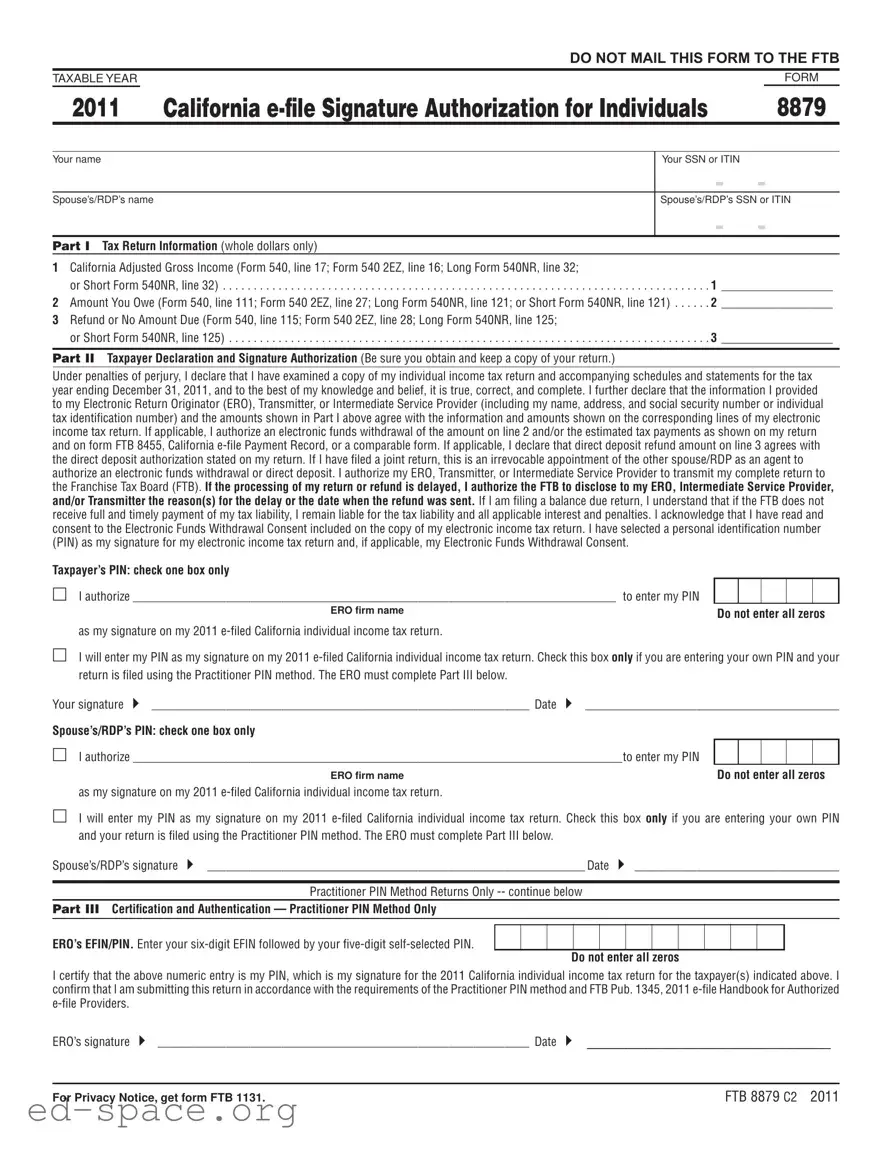
The California 8879 form, also known as the California e-file Signature Authorization for Individuals, plays a crucial role in the electronic filing process for individual income tax returns. This form is essential when taxpayers choose to e-file their returns using the Practitioner PIN method. It allows taxpayers to authorize their Electronic Return Originator (ERO) to enter their personal identification number (PIN) on their e-filed tax return. The form requires the taxpayer's name, Social Security Number (SSN) or Individual Taxpayer Identification Number (ITIN), and details from their tax return, such as California Adjusted Gross Income and any amounts owed or refunded. Notably, it is a one-time authorization specific to that tax return and does not serve as proof of filing. Instead, the acknowledgment from the Franchise Tax Board (FTB) confirming acceptance of the tax return provides that proof. Taxpayers must ensure they review their tax return for accuracy, provide their PIN, and sign the form before submitting it to their ERO. Understanding the California 8879 form is vital for ensuring a smooth e-filing experience and compliance with state tax regulations.
DO NOT MAIL THIS FORM TO THE FTB
TAXABLE YEAR |
|
FORM |
2011 |
California |
8879 |
YOUR NAME
SPOUSE’S/RDP’S NAME
YOUR SSN OR ITIN
- -
SPOUSE’S/RDP’S SSN OR ITIN
- -
Part I Tax Return Information (whole dollars only)
1California Adjusted Gross Income (Form 540, line 17; Form 540 2EZ, line 16; Long Form 540NR, line 32;
|
or Short Form 540NR, line 32) |
1 __________________ |
2 |
Amount You Owe (Form 540, line 111; Form 540 2EZ, line 27; Long Form 540NR, line 121; or Short Form 540NR, line 121) |
2 __________________ |
3 |
Refund or No Amount Due (Form 540, line 115; Form 540 2EZ, line 28; Long Form 540NR, line 125; |
|
|
or Short Form 540NR, line 125) |
3 __________________ |
|
|
|
Part II Taxpayer Declaration and Signature Authorization (Be sure you obtain and keep a copy of your return.)
Under penalties of perjury, I declare that I have examined a copy of my individual income tax return and accompanying schedules and statements for the tax year ending December 31, 2011, and to the best of my knowledge and belief, it is true, correct, and complete. I further declare that the information I provided to my Electronic Return Originator (ERO), Transmitter, or Intermediate Service Provider (including my name, address, and social security number or individual tax identification number) and the amounts shown in Part I above agree with the information and amounts shown on the corresponding lines of my electronic income tax return. If applicable, I authorize an electronic funds withdrawal of the amount on line 2 and/or the estimated tax payments as shown on my return and on form FTB 8455, California
Taxpayer’s PIN: check one box only |
|
|
|
|
|
|
|
m I authorize ______________________________________________________________________________ |
to enter my PIN |
|
|
|
|
|
|
|
ERO firm name |
|
Do not enter all zeros |
||||
as my signature on my 2011 |
|
|
|
|
|
|
|
m I will enter my PIN as my signature on my 2011
Your signature _____________________________________________________________ Date _________________________________________
Spouse’s/RDP’s PIN: check one box only
m
m
I authorize _______________________________________________________________________________to enter my PIN |
|
|
|
|
|
ERO firm name |
Do not enter all zeros |
||||
as my signature on my 2011 |
|
|
|
|
|
I will enter my PIN as my signature on my 2011
Spouse’s/RDP’s signature _____________________________________________________________ Date _________________________________
Practitioner PIN Method Returns Only
Part III Certiication and Authentication — Practitioner PIN Method Only
ERO’s EFIN/PIN. Enter your
Do not enter all zeros
I certify that the above numeric entry is my PIN, which is my signature for the 2011 California individual income tax return for the taxpayer(s) indicated above. I confirm that I am submitting this return in accordance with the requirements of the Practitioner PIN method and FTB Pub. 1345, 2011
ERO’s signature ____________________________________________________________ Date _________________________
For Privacy Notice, get form FTB 1131. |
FTB 8879 C2 2011 |

Instructions for Form FTB 8879
California
DO NOT MAIL THIS FORM TO FTB
General Information
A Purpose of Form FTB 8879
Form FTB 8879, California
Form FTB 8879 does not serve as proof of filing – the acknowledgement containing the date of acceptance for the accepted tax return is that proof.
Do not use form FTB 8879 if the taxpayer(s) will sign form FTB 8453, California
B Practitioner PIN Method
The Practitioner PIN method is an electronic signature option for taxpayers
For taxpayers who are married or RDPs filing jointly, it is acceptable for one spouse/RDP to authorize the ERO to enter his or her PIN and the other to choose to enter his or her own PIN. In this scenario, the spouse/ RDP entering his or her own PIN must also provide the correct shared secret. It is not acceptable for one spouse/RDP to enter both PINs.
C Taxpayer Responsibilities
Before you can
•Inspect a copy of your individual income tax return and ensure the information is correct. Reconfirm your routing and account numbers entered into the tax preparation software.
•Review and approve the sworn statements and disclosure statements.
•Indicate or verify the
•Receive and review the information on form FTB 8455, California
•Sign and date form FTB 8879 and submit it to your ERO (fax is acceptable).
Your tax return will not be transmitted to the Franchise Tax Board (FTB) until the ERO receives your signed form FTB 8879.
After your tax return is
•Original Forms
•A copy of Form 540, Form 540 2EZ, Long, or Short Form 540NR.
•A copy of form FTB 8455, California
•A copy of your federal tax return.
•A copy of your other state income tax return if you claimed the California Other State Tax Credit. Refer to California Schedule S.
The California statute of limitations is the later of four years from the due date of the tax return or four years from the date the tax return is filed. (Exception: An extended statute of limitations period may apply for California or federal tax returns that are related to or subject to a federal audit.)
D ERO Responsibilities
Before you can
•Confirm the identity of the taxpayer(s) per FTB Pub. 1345, Section 6.
•Complete form FTB 8879 through Part I with information from the taxpayer’s tax return.
•Complete form FTB 8455, California
•Enter the ERO firm name (not the name of the individual preparing the tax return) in Part II.
•Review the taxpayer’s tax return, plus banking information.
•Provide the taxpayer (in electronic or paper format):
oForm FTB 8879.
oA complete copy of their tax return.
oForm FTB 8455, California
•Obtain each taxpayer’s signature after the tax return is prepared but before you transmit it.
•Record the
•Sign and date form FTB 8879.
After the tax return is
•Retain form FTB 8879 for four years from the due date of the tax return or four years from the date the tax return is filed, whichever is later.*
•Retain all required
•Upon request, provide a copy of form FTB 8879 to the taxpayer or the FTB.
*Exception: For VITA/TCE/Not for Profit Sites, the taxpayer must retain these documents.
E Banking Information
Using direct deposit or electronic funds withdrawal is voluntary and ap- plies only to the tax return you are filing at this time. Be sure the account information entered in the tax preparation software as shown on your tax return is correct. If the bank or financial institution rejects the electronic funds withdrawal due to an error in the routing number or account number, we will send you a notice that may include penalties and interest.
To cancel an electronic funds withdrawal or a scheduled estimated tax payment, you must call the FTB at 916.845.0353 at least two working days before the date of the withdrawal.
Caution: Check with your financial institution to make sure your deposit will be accepted and to get the correct routing and account numbers. The FTB is not responsible for a lost refund due to incorrect account information entered by you or your representative.
Do not mail form FTB 8879 to the FTB.
FTB 8879 Instructions 2011
| Fact Name | Details |
|---|---|
| Purpose | Form FTB 8879 is used for California e-file signature authorization for individuals, allowing taxpayers to authorize an Electronic Return Originator (ERO) to enter their PIN on their e-filed tax return. |
| Governing Law | This form is governed by California Revenue and Taxation Code Section 18621.5. |
| Tax Year | The form is specifically for the tax year ending December 31, 2011. |
| Signature Method | Taxpayers can use the Practitioner PIN method, allowing the ERO to enter the taxpayer's PIN without requiring a shared secret. |
| Retention Requirement | Taxpayers must retain a copy of Form FTB 8879 for four years from the due date of the tax return or four years from the date the return is filed. |
| Electronic Funds Withdrawal | Taxpayers may authorize electronic funds withdrawal for amounts owed, but must ensure their bank account information is accurate. |
| Filing Instructions | Form FTB 8879 should not be mailed to the FTB; it must be submitted to the ERO for e-filing. |
| Taxpayer Responsibilities | Taxpayers must review their tax return for accuracy and approve all information before signing Form FTB 8879. |
Completing the California 8879 form is a straightforward process that requires attention to detail. This form serves as a signature authorization for individuals e-filing their tax returns. Once the form is filled out and signed, it must be submitted to your Electronic Return Originator (ERO) before your tax return can be transmitted to the Franchise Tax Board (FTB).
After submitting the form, your ERO will use it to e-file your tax return. It's important to keep a copy of this form for your records, as well as any related documents, in case they are needed for future reference or audits.
What is the purpose of the California 8879 form?
The California 8879 form, officially known as the California e-file Signature Authorization for Individuals, is essential for taxpayers who are e-filing their tax returns through an Electronic Return Originator (ERO). This form allows taxpayers to authorize the ERO to enter their personal identification number (PIN) on their e-filed tax return. It serves as a one-time authorization specific to the tax return being filed. However, it is important to note that this form does not serve as proof of filing; the acknowledgment from the Franchise Tax Board (FTB) containing the acceptance date is the official proof.
Who needs to sign the California 8879 form?
Both taxpayers and their spouses or Registered Domestic Partners (RDPs) must sign the California 8879 form if they are filing jointly. Each individual has the option to either authorize the ERO to enter their PIN or to enter their own PIN. If one spouse or RDP chooses to authorize the ERO, the other must enter their own PIN. It is crucial that both signatures are obtained before the tax return can be transmitted to the FTB.
What are the responsibilities of the taxpayer when using the California 8879 form?
Taxpayers have several responsibilities when using the California 8879 form. They must first review their tax return to ensure all information is accurate. This includes confirming routing and account numbers for any direct deposits or withdrawals. Taxpayers must also select a five-digit PIN to be used as their signature and sign the form before submitting it to the ERO. After filing, they should retain copies of important documents, such as Forms W-2 and their tax return, for at least four years, as required by California law.
What happens if there is an error in the banking information provided on the California 8879 form?
If there is an error in the banking information, such as an incorrect routing or account number, the FTB may reject the electronic funds withdrawal. This can lead to penalties and interest. Taxpayers should verify their banking information carefully before submission. If a withdrawal needs to be canceled, it is necessary to contact the FTB at least two working days prior to the scheduled date. The FTB is not liable for lost refunds due to incorrect account details provided by the taxpayer or their representative.
Incorrect Personal Information: Failing to accurately enter your name or Social Security Number (SSN) can lead to significant delays or issues with your tax return. Always double-check these details.
Missing Signatures: Both taxpayers must sign the form. If either signature is missing, the form will be considered incomplete, causing complications in processing your return.
Wrong Tax Year: Ensure you are using the correct form for the tax year you are filing. Using an outdated form can result in errors and potential penalties.
Incorrect PIN Entry: The Personal Identification Number (PIN) must be unique and should not consist of all zeros. Using an invalid PIN can lead to rejection of your e-filed return.
Omitting Important Information: Always fill out all required fields in Part I, including your California Adjusted Gross Income and amounts owed or refunded. Missing this information can delay processing.
Not Keeping Copies: Failing to retain a copy of the signed form and your tax return can create problems if you need to reference them later. It’s essential to keep these documents for your records.
Ignoring Bank Information: If you opt for direct deposit or electronic funds withdrawal, ensure that your bank account details are correct. Incorrect information can lead to lost refunds or failed withdrawals.
Mailing the Form: Remember, do not mail the FTB 8879 form to the Franchise Tax Board (FTB). This form is only for electronic filing and should be submitted to your Electronic Return Originator (ERO).
The California 8879 form, known as the California e-file Signature Authorization for Individuals, is essential for those filing their tax returns electronically. This form allows taxpayers to authorize an Electronic Return Originator (ERO) to enter their personal identification number (PIN) on their e-filed tax return. Several other documents often accompany the 8879 form to ensure compliance with tax regulations and to facilitate the electronic filing process. Below is a list of these commonly used forms and documents.
In summary, the California 8879 form is part of a broader set of documents necessary for electronic tax filing in California. Each form plays a specific role in ensuring that taxpayers can accurately report their income and comply with state tax laws. Understanding these documents can help facilitate a smoother filing process and ensure all necessary information is submitted correctly.
The California 8879 form is an important document for individuals filing their state income tax electronically. It serves as a signature authorization for the electronic return originator (ERO) to submit the tax return on behalf of the taxpayer. Several other forms share similarities with the California 8879, primarily in their purpose of authorizing electronic filing or confirming taxpayer information. Here are eight documents that are similar to the California 8879 form:
When filling out the California 8879 form, there are important guidelines to follow. Here’s a list of things you should and shouldn't do:
Following these guidelines will help ensure a smoother e-filing process for your tax return.
This form is not meant to be mailed. It is simply a signature authorization for e-filing your tax return. Keep it for your records instead.
Signing the 8879 does not mean your taxes are filed. The actual filing occurs only after your Electronic Return Originator (ERO) submits your tax return.
The 8879 is not proof of filing. The acknowledgment from the FTB that confirms acceptance of your return serves as the official proof.
The 8879 form is specific to the tax year you are filing for. Each year requires its own version of the form.
When using the Practitioner PIN method, a shared secret is generally not required. This method allows for flexibility in how signatures are provided.
In a joint filing, one spouse can authorize their PIN while the other enters their own. They do not need to authorize on the same form.
Taxpayers must verify their information and ensure everything is correct before signing the form. This includes confirming their PIN.
Do not send the 8879 to the FTB at all. It is meant for your ERO, and they will handle the submission of your tax return.
The ERO must retain the signed form for four years, but it is the taxpayer's responsibility to keep copies of their tax documents for the same period.
Filling out and using the California 8879 form is crucial for taxpayers who e-file their returns. Here are key takeaways to keep in mind: