Homepage Blank California 8454 PDF Form
Article Guide

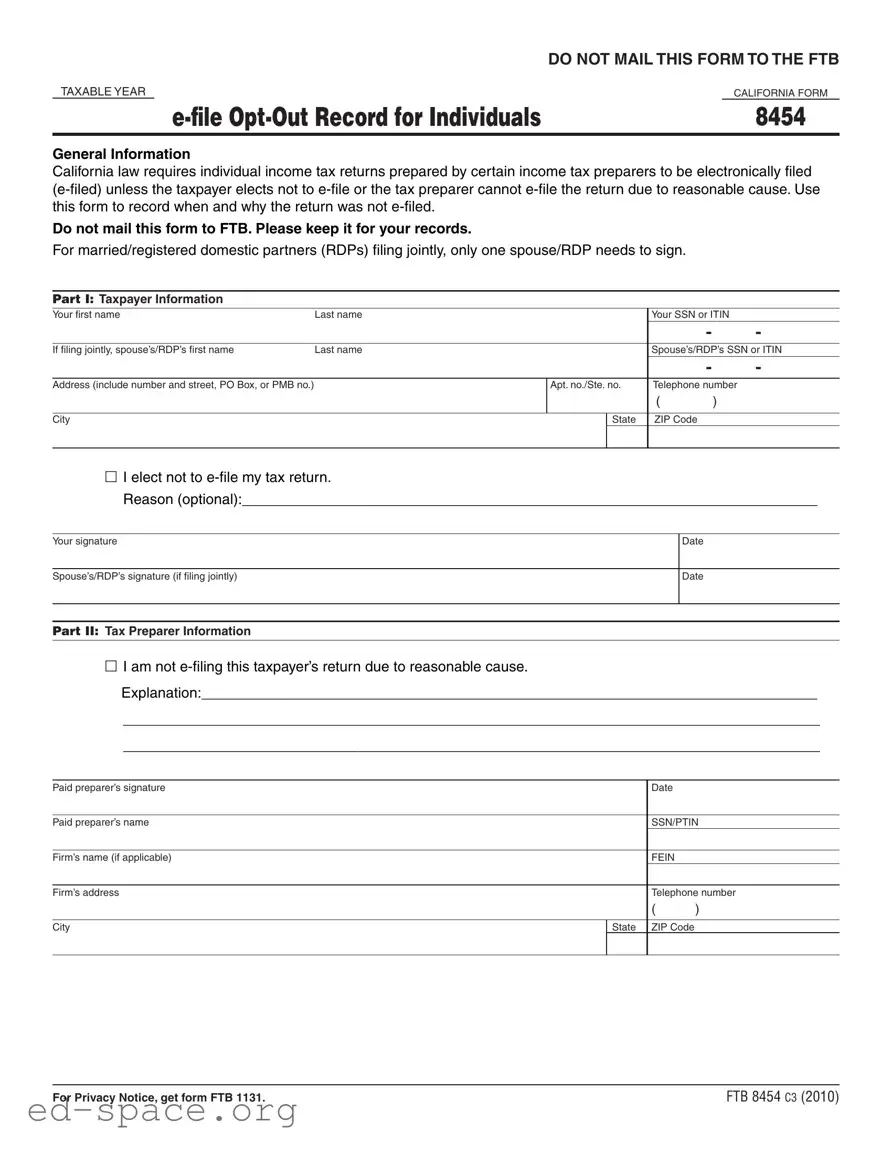
The California 8454 form serves as a crucial document for individuals who choose not to electronically file their income tax returns. Under California law, certain tax preparers are required to e-file returns unless the taxpayer opts out or the preparer has a valid reason for not e-filing. This form is essential for documenting the decision to opt out, providing a clear record of the taxpayer's choice and the rationale behind it. It is important to note that this form should not be mailed to the Franchise Tax Board (FTB); instead, it should be retained for personal records. For those filing jointly, only one signature is necessary, simplifying the process for married couples or registered domestic partners. The form includes sections for taxpayer information, such as names, Social Security numbers, and contact details, as well as a section for the tax preparer to provide their information and any explanations for not e-filing. By understanding the California 8454 form, taxpayers can ensure compliance with state regulations while exercising their right to choose their filing method.

Document Preview


DO NOT MAIL THIS FORM TO THE FTB

TAXABLE YEAR


CALIFORNIA FORM


e-file Opt-Out Record for Individuals

8454


General Information

California law requires individual income tax returns prepared by certain income tax preparers to be electronically filed (e-filed) unless the taxpayer elects not to e-file or the tax preparer cannot e-file the return due to reasonable cause. Use this form to record when and why the return was not e-filed.

Do not mail this form to FTB. Please keep it for your records.

For married/registered domestic partners (RDPs) filing jointly, only one spouse/RDP needs to sign.

Part I: Taxpayer Information

Your first name

Last name


Your SSN or ITIN


-

-

If filing jointly, spouse’s/RDP’s first name

Last name


Spouse’s/RDP’s SSN or ITIN


-

-

Address (include number and street, PO Box, or PMB no.)


Apt. no./Ste. no.

Telephone number


(

)


City


State

ZIP Code


I elect not to e-file my tax return.

Reason (optional):_______________________________________________________________________

Your signature

Date

Spouse’s/RDP’s signature (if filing jointly)

Date

Part II: Tax Preparer Information

I am not e-filing this taxpayer’s return due to reasonable cause.

Explanation:____________________________________________________________________________

______________________________________________________________________________________

______________________________________________________________________________________

Paid preparer’s signature


Date


Paid preparer’s name


SSN/PTIN


Firm’s name (if applicable)


FEIN


Firm’s address


Telephone number


(

)


City

State

ZIP Code


For Privacy Notice, get form FTB 1131.

FTB 8454 C3 (2010)

Form Specifications

Fact Name Description
Purpose The California Form 8454 is used to record an individual's decision not to e-file their tax return.
Governing Law This form is governed by California Revenue and Taxation Code Section 18621.5.
Filing Requirement California law mandates that certain individual income tax returns be electronically filed unless an election is made not to e-file.
Retention Taxpayers must keep this form for their records; it should not be mailed to the Franchise Tax Board (FTB).
Joint Filers If married or registered domestic partners are filing jointly, only one signature is required on the form.
Tax Preparer's Role Tax preparers can indicate reasonable cause for not e-filing the return on this form.
Optional Reason Taxpayers may provide an optional reason for choosing not to e-file.
Signature Requirement The taxpayer must sign the form, and if filing jointly, the spouse or registered domestic partner must also sign.
Contact Information Taxpayers must provide their address and telephone number on the form for identification purposes.
Privacy Notice For information on privacy, taxpayers can refer to Form FTB 1131.

California 8454: Usage Guidelines

After completing the California 8454 form, it is important to retain a copy for your records. This form serves to document the decision not to e-file an individual income tax return. Follow the steps below to accurately fill out the form.

  1. Begin with Part I: Taxpayer Information. Enter your first name and last name in the designated fields.
  2. Input your Social Security Number (SSN) or Individual Taxpayer Identification Number (ITIN) in the appropriate section.
  3. If you are filing jointly, provide your spouse's or registered domestic partner's (RDP's) first name and last name.
  4. Enter your spouse's or RDP's SSN or ITIN.
  5. Fill in your address, including the street number, street name, PO Box, or PMB number. Include the apartment or suite number if applicable.
  6. Provide your telephone number in the specified format.
  7. Complete the city, state, and ZIP code fields.
  8. If you choose not to e-file your tax return, check the box indicating your election.
  9. Optionally, provide a reason for not e-filing in the space provided.
  10. Sign and date the form in the designated areas. If filing jointly, your spouse or RDP must also sign and date the form.
  11. Proceed to Part II: Tax Preparer Information. Indicate whether you are not e-filing due to reasonable cause by checking the corresponding box.
  12. Provide an explanation for the reasonable cause in the space provided.
  13. The paid preparer must sign and date the form in the designated areas.
  14. Enter the paid preparer’s name and their SSN or Preparer Tax Identification Number (PTIN).
  15. If applicable, include the firm’s name and Federal Employer Identification Number (FEIN).
  16. Complete the firm’s address, including telephone number, city, state, and ZIP code.

Your Questions, Answered

What is the purpose of the California 8454 form?

The California 8454 form is used to record the decision not to electronically file (e-file) an individual income tax return. California law generally requires certain tax returns to be e-filed. However, taxpayers can opt out of e-filing for specific reasons. This form captures that choice and the rationale behind it.

Who needs to fill out the California 8454 form?

What should I do with the California 8454 form after completing it?

You should keep the completed California 8454 form for your records. It is important not to mail this form to the Franchise Tax Board (FTB). Retaining it will provide documentation of your decision not to e-file if any questions arise in the future.

What information is required on the form?

The form requires personal information such as your name, Social Security Number (SSN) or Individual Taxpayer Identification Number (ITIN), and your address. If you are filing jointly, you will also need to provide your spouse's or registered domestic partner's information. Additionally, you must indicate your reason for opting out of e-filing, although providing a reason is optional.

What if my tax preparer cannot e-file my return?

If your tax preparer cannot e-file your return due to reasonable cause, they will need to indicate this on the California 8454 form. They must provide an explanation for the inability to e-file. This ensures that there is a record of the circumstances that led to the decision not to e-file.

Common mistakes

  1. Failing to provide complete taxpayer information. This includes your first name, last name, and Social Security Number (SSN) or Individual Taxpayer Identification Number (ITIN).

  2. Not including the spouse's or registered domestic partner's information when filing jointly. Remember to provide their first name, last name, and SSN or ITIN.

  3. Leaving out the address details. Ensure you include the complete address, including the street number, city, state, and ZIP code.

  4. Overlooking the telephone number. It is important to provide a contact number for any follow-up questions.

  5. Not indicating your decision to opt-out of e-filing. You must check the box if you choose not to e-file your tax return.

  6. Failing to sign the form. Both you and your spouse or registered domestic partner must sign the form if filing jointly.

  7. Neglecting to provide a reason for opting out of e-filing. While optional, it can be helpful to include an explanation.

  8. Not providing tax preparer information if applicable. If a paid preparer is involved, their name, signature, and PTIN must be included.

  9. Forgetting to include the firm’s address and contact number if a tax preparer is used. This information is necessary for verification.

  10. Mailing the form to the Franchise Tax Board (FTB). This form is not to be sent to the FTB; keep it for your records instead.

Documents used along the form

The California 8454 form is essential for individuals opting out of electronic filing for their tax returns. Alongside this form, several other documents may be necessary to ensure compliance with tax regulations. Below is a list of commonly used forms and documents that often accompany the California 8454 form.

  • California Form 540: This is the standard individual income tax return form for California residents. It reports income, deductions, and credits to determine the tax owed or refund due.
  • California Form 540NR: Non-residents and part-year residents use this form to report their California income. It helps in calculating the tax liability based on the income earned within the state.
  • California Schedule CA (540): This form is used to adjust federal income to California income. It accounts for differences in deductions and credits between federal and state tax laws.
  • California Form 1099: This form reports various types of income, such as interest, dividends, and non-employee compensation. Taxpayers must include this information when filing their returns.
  • California Form W-2: Employers provide this form to employees, detailing their annual wages and the taxes withheld. It is crucial for accurately reporting income on tax returns.
  • California Form FTB 1131: This privacy notice outlines how the Franchise Tax Board handles personal information. It is essential for understanding data protection related to tax filings.
  • California Form 8879: This form serves as an e-file signature authorization. It allows taxpayers to approve their electronically filed returns, although it is not needed when opting out.
  • California Form 3506: This is the form for claiming the California Earned Income Tax Credit. It helps low-income taxpayers receive a credit that reduces their tax liability.

Understanding these forms can help taxpayers navigate the complexities of California tax regulations. Each document plays a critical role in ensuring that tax returns are accurate and compliant with state requirements.

Similar forms

The California Form 8454 is designed for individuals who choose not to e-file their tax returns. It serves as a record of this decision and the reasons behind it. Several other documents share similar purposes or functions in tax filing and record-keeping. Below is a list of nine documents that are similar to the California 8454 form:

  • IRS Form 8948: This form is used by tax preparers to indicate when they are filing a return that does not meet e-filing requirements. It documents the reasons for opting out of e-filing.
  • IRS Form 8862: This form is filed by taxpayers who previously claimed the Earned Income Tax Credit and need to show eligibility again. It records the taxpayer's reasons for not qualifying in prior years.
  • California Form 540: This is the standard individual income tax return for California residents. It can also include a section where taxpayers indicate their filing method, similar to the e-file opt-out process.
  • IRS Form 1040: This is the standard federal income tax return form. Taxpayers can indicate their filing preferences and methods, including whether they are e-filing or not.
  • IRS Form 8822: This form is used to notify the IRS of a change of address. Taxpayers can also use it to clarify their filing preferences, akin to the California 8454.
  • California Form 3519: This form is used for making a payment for an extension to file. It can also include information about filing preferences, similar to the opt-out documentation.
  • IRS Form 4868: This is the application for an automatic extension of time to file a U.S. individual income tax return. It allows taxpayers to indicate their filing method and intentions.
  • California Form FTB 3514: This form is used to claim the California Earned Income Tax Credit. It includes options for filing methods, similar to how the California 8454 records e-filing decisions.
  • IRS Form 9465: This form is used to request a payment plan for taxes owed. It can also include indications of filing methods, paralleling the California 8454's purpose.

Dos and Don'ts

When filling out the California 8454 form, it is essential to follow specific guidelines to ensure accuracy and compliance. Below is a list of important dos and don'ts to consider:

  • Do provide complete and accurate taxpayer information, including names and Social Security Numbers (SSNs) or Individual Taxpayer Identification Numbers (ITINs).
  • Do indicate whether you elect not to e-file your tax return by checking the appropriate box.
  • Do keep a copy of the completed form for your records, as it should not be mailed to the Franchise Tax Board (FTB).
  • Do ensure that only one spouse or registered domestic partner (RDP) signs the form if filing jointly.
  • Don't forget to include your current address and contact information, as this may be necessary for future correspondence.
  • Don't leave any required fields blank; incomplete forms may lead to processing delays or complications.

Following these guidelines will help streamline the process and ensure that the form is filled out correctly. Proper attention to detail can prevent unnecessary issues down the line.

Misconceptions

Here are seven common misconceptions about the California 8454 form, along with clarifications for each:

  • It must be mailed to the FTB. Many believe this form needs to be submitted to the Franchise Tax Board (FTB). In reality, you should keep it for your records and not mail it.
  • Only one signature is required for joint filers. Some think both spouses or registered domestic partners (RDPs) must sign the form. However, only one signature is necessary when filing jointly.
  • It is required for all tax returns. There is a misconception that this form is mandatory for every tax return. It is only needed if the taxpayer chooses not to e-file or if the tax preparer cannot e-file for a valid reason.
  • Filing this form means you owe taxes. Some assume that submitting the 8454 indicates a tax liability. This form simply records the choice not to e-file; it does not imply any tax owed.
  • It can be used for any tax preparer. People often think this form applies to all tax preparers. It is specifically for those who prepare individual income tax returns that are required to be e-filed under California law.
  • The reason for not e-filing must be provided. Many feel they must give a reason for opting out. While it is optional to explain the reason, it is not a requirement to complete the form.
  • This form is only for individuals. Some believe the 8454 is limited to individual taxpayers. However, it can also apply to married couples or registered domestic partners filing jointly.

Key takeaways

When filling out the California 8454 form, keep these key takeaways in mind:

  • Purpose: The form is used to record your decision not to e-file your tax return.
  • Filing Requirement: California law mandates that certain tax returns be e-filed unless you opt out.
  • Record Keeping: Do not mail the form to the Franchise Tax Board (FTB). Keep it for your records instead.
  • Joint Filers: If you are married or in a registered domestic partnership, only one signature is required on the form.
  • Taxpayer Information: Fill in your personal details, including your Social Security Number (SSN) or Individual Taxpayer Identification Number (ITIN).
  • Reason for Opting Out: You can provide an optional reason for not e-filing, but it's not mandatory.
  • Tax Preparer Information: If a tax preparer is involved, they must complete their section, including their signature and identification number.
  • Privacy Notice: For information on privacy, refer to form FTB 1131.
  • Signatures: Ensure that all required signatures are dated to validate the form.