Homepage Blank California 51 055A PDF Form
Article Guide

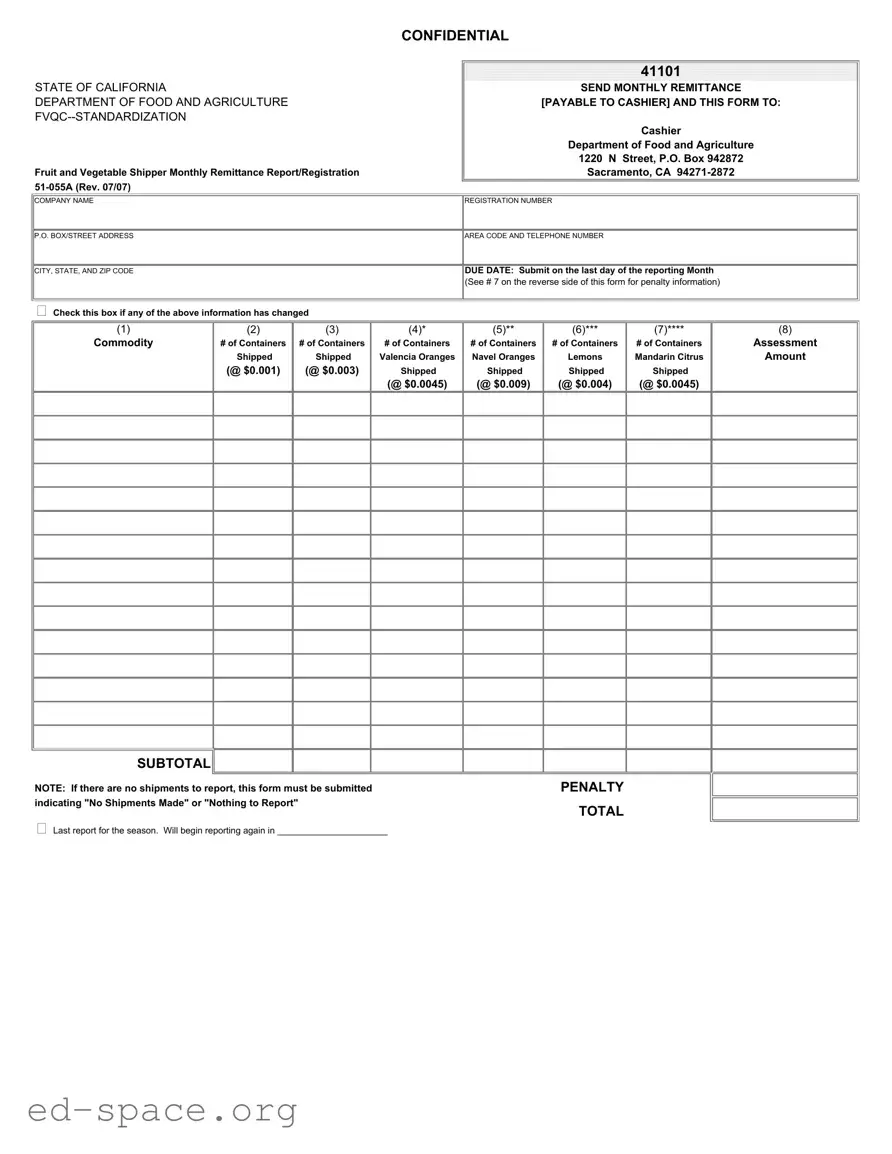
The California 51 055A form is a crucial document for businesses engaged in the shipping of fruits and vegetables within the state. This form, known as the Fruit and Vegetable Shipper Monthly Remittance Report/Registration, must be completed and submitted by the last day of each reporting month. It serves multiple purposes, including the registration of your company with the Department of Food and Agriculture and the reporting of the number of containers shipped for various commodities, such as Valencia oranges, Navel oranges, lemons, and Mandarin citrus. Accurate reporting is essential, as it determines the assessment amounts due based on the quantities shipped. If any of your company's information changes, a simple checkbox on the form allows for easy updates. Furthermore, if there are no shipments to report, you must still submit the form indicating "No Shipments Made" to avoid penalties. The submission process requires sending both the completed form and the monthly remittance payment to the designated cashier in Sacramento, ensuring compliance with state regulations. Understanding the details and requirements of the 51 055A form is vital for maintaining good standing with the state and avoiding unnecessary fines.
Document Preview

CONFIDENTIAL

STATE OF CALIFORNIA

DEPARTMENT OF FOOD AND AGRICULTURE FVQC--STANDARDIZATION

Fruit and Vegetable Shipper Monthly Remittance Report/Registration 51-055A (Rev. 07/07)

41101

SEND MONTHLY REMITTANCE

[PAYABLE TO CASHIER] AND THIS FORM TO:

Cashier

Department of Food and Agriculture

1220 N Street, P.O. Box 942872

Sacramento, CA 94271-2872

COMPANY NAME

P.O. BOX/STREET ADDRESS

CITY, STATE, AND ZIP CODE

REGISTRATION NUMBER

AREA CODE AND TELEPHONE NUMBER

DUE DATE: Submit on the last day of the reporting Month

(See # 7 on the reverse side of this form for penalty information)

Check this box if any of the above information has changed

(1)

Commodity

(2)

(3)

(4)*

# of Containers

# of Containers

# of Containers

Shipped

Shipped

Valencia Oranges

(@ $0.001)

(@ $0.003)

Shipped


(@ $0.0045)

(5)**

(6)***

# of Containers

# of Containers

Navel Oranges

Lemons

Shipped

Shipped

(@ $0.009)

(@ $0.004)

(7)****

#of Containers Mandarin Citrus

Shipped

(@ $0.0045)

(8)

Assessment

Amount

SUBTOTAL

NOTE: If there are no shipments to report, this form must be submitted

PENALTY

indicating "No Shipments Made" or "Nothing to Report"

TOTAL


Last report for the season. Will begin reporting again in ______________________

Form Specifications

Fact Name Description
Form Purpose The California 51 055A form is used for reporting and remitting fees related to the shipment of fruits and vegetables.
Governing Law This form is governed by California Food and Agricultural Code, specifically sections related to the regulation of fruit and vegetable shipments.
Submission Deadline Reports must be submitted by the last day of the reporting month.
Penalty for Late Submission Failure to submit on time may result in penalties, as outlined in the instructions on the reverse side of the form.
Contact Information Completed forms and payments should be sent to the Cashier at the Department of Food and Agriculture in Sacramento.
Company Information Filing requires the company name, address, registration number, and contact phone number.
No Shipments Report If no shipments were made, the form must still be submitted indicating "No Shipments Made" or "Nothing to Report."

California 51 055A: Usage Guidelines

Filling out the California 51 055A form requires careful attention to detail. This form must be submitted monthly, and it is essential to ensure that all information is accurate to avoid penalties. After completing the form, it should be sent to the designated address along with the monthly remittance.

  1. Obtain the California 51 055A form, either online or through the Department of Food and Agriculture.
  2. Fill in your Company Name at the top of the form.
  3. Provide your P.O. Box/Street Address.
  4. Enter your City, State, and Zip Code.
  5. Input your Registration Number.
  6. Include your Area Code and Telephone Number.
  7. Note the Due Date, which is the last day of the reporting month.
  8. If any information has changed, check the box provided.
  9. In the section for commodities, list the number of containers shipped for each type of fruit:
    • Valencia Oranges
    • Navel Oranges
    • Lemons
    • Mandarin Citrus
  10. Calculate the assessment amount for each type of fruit based on the number of containers shipped and the rates provided.
  11. Sum the assessment amounts to get the Subtotal.
  12. If there are no shipments to report, indicate this by writing "No Shipments Made" or "Nothing to Report."
  13. Complete the Total section, including any penalties if applicable.
  14. If this is the last report for the season, indicate when reporting will resume.
  15. Review the form for accuracy before submission.
  16. Send the completed form along with the monthly remittance to the Cashier at the Department of Food and Agriculture, using the address provided.

Your Questions, Answered

What is the California 51 055A form?

The California 51 055A form is a monthly report used by fruit and vegetable shippers in California. It helps the Department of Food and Agriculture keep track of shipments and collect assessments on certain commodities. This form must be submitted even if there are no shipments to report.

Who needs to fill out this form?

Any business that ships fruits and vegetables in California is required to fill out the California 51 055A form. This includes companies that ship Valencia oranges, Navel oranges, lemons, and mandarin citrus. If you are registered with the Department of Food and Agriculture, you need to submit this form monthly.

When is the form due?

The form is due on the last day of the reporting month. It’s important to submit it on time to avoid penalties. If you miss the deadline, you may incur additional fees, so be sure to keep track of your submission dates.

What information do I need to provide on the form?

You will need to provide your company name, address, registration number, and contact information. Additionally, you must report the number of containers shipped for each type of fruit or vegetable you handle. There are specific sections for Valencia oranges, Navel oranges, lemons, and mandarin citrus.

What if I have no shipments to report?

If you have no shipments to report for the month, you still need to submit the form. Simply indicate "No Shipments Made" or "Nothing to Report" on the form. This ensures that the Department of Food and Agriculture is aware of your status for that month.

Where do I send the completed form?

Once you have completed the form, send it along with your monthly remittance to the Cashier at the Department of Food and Agriculture. The address is 1220 N Street, P.O. Box 942872, Sacramento, CA 94271-2872. Make sure to send it to the right place to avoid delays.

What happens if I don't submit the form on time?

If you fail to submit the form by the due date, you may face penalties. The specific penalties are outlined on the reverse side of the form. To avoid these fees, it’s best to stay organized and submit your report on time each month.

Common mistakes

  1. Failing to include the company name and address at the top of the form. This information is crucial for proper identification.

  2. Not providing a registration number. Without this number, the form may not be processed correctly.

  3. Leaving out the due date or submitting the form late. Remember, it must be submitted on the last day of the reporting month.

  4. Not checking the box if any of the information has changed. This could lead to processing delays or errors.

  5. Incorrectly filling in the number of containers shipped. Ensure that all quantities are accurate to avoid penalties.

  6. Forgetting to report zero shipments. Even if there are no shipments, the form must still be submitted indicating "No Shipments Made."

  7. Neglecting to calculate the assessment amount correctly. This is essential for determining the total amount owed.

Documents used along the form

The California 51 055A form is an important document for fruit and vegetable shippers. It helps ensure compliance with state regulations regarding the shipping of produce. Along with this form, there are several other documents that shippers may need to complete. Here’s a brief overview of five commonly used forms and documents that often accompany the California 51 055A form.

  • California 51-055B Form: This form is used for reporting additional information on shipments of fruits and vegetables. It provides a more detailed breakdown of the types and quantities of produce shipped.
  • Sales Invoice: A sales invoice is a document that outlines the sale of goods. It includes details such as the buyer and seller information, item descriptions, quantities, and prices. This document is essential for record-keeping and tax purposes.
  • Shipping Manifest: This document lists all the items being shipped in a particular load. It serves as a receipt for the shipper and helps the receiver verify the contents upon arrival.
  • Certificate of Origin: This certificate verifies the country or region where the goods were produced. It is often required for customs clearance and can help avoid tariffs or other trade barriers.
  • Health Certificate: A health certificate is issued by a veterinarian or agricultural authority. It confirms that the produce meets health and safety standards, ensuring that it is safe for consumption.

These documents play a crucial role in the shipping process, helping to maintain compliance and ensuring smooth transactions. Keeping them organized and accessible can save time and reduce stress when submitting reports and managing shipments.

Similar forms

  • California Form 51-055B: This form is used for reporting the monthly remittance for fruit and vegetable handlers. Like the 51-055A, it requires information about shipments and assessment amounts, ensuring compliance with state regulations.
  • California Form 51-055C: Similar to the 51-055A, this document pertains to fruit and vegetable processors. It collects data on processed goods, allowing for accurate assessment of fees based on the volume processed.
  • California Form 51-055D: This form is utilized by wholesalers to report their monthly shipments. It shares the same structure as the 51-055A, focusing on the number of containers shipped and the corresponding fees.
  • California Form 51-055E: This document is for retailers and requires similar information about sales and shipments of fruits and vegetables. It ensures that all parties in the supply chain report their activities consistently.
  • California Form 51-055F: Used for organic produce, this form captures data related to organic shipments. It mirrors the 51-055A in format and purpose, facilitating the tracking of organic assessments.
  • California Form 51-056: This form is for reporting violations or non-compliance issues. While its focus differs, it is similar in that it requires detailed reporting to the Department of Food and Agriculture.
  • California Form 51-057: This is a certification form for fruit and vegetable quality. It shares the need for accurate reporting and compliance, although it focuses more on quality standards rather than financial assessments.
  • California Form 51-058: This form is for seasonal fruit and vegetable harvesters. It collects information on harvest volume and timing, akin to the 51-055A in its monthly reporting requirement.
  • California Form 51-059: This document is used for reporting import/export activities. It requires similar shipment details, thus maintaining a consistent reporting framework across various activities in the industry.
  • California Form 51-060: This form is for agricultural grants and funding applications. While its purpose is different, it necessitates detailed financial reporting, paralleling the structure of the 51-055A.

Dos and Don'ts

When filling out the California 51 055A form, it is essential to follow specific guidelines to ensure accuracy and compliance. Here is a list of things you should and shouldn't do:

  • Do provide accurate company information, including name and address.
  • Do submit the form by the last day of the reporting month.
  • Do check for any changes in your information and indicate them on the form.
  • Do ensure that all container counts are correctly filled in for each commodity.
  • Do include the assessment amount and subtotal accurately.
  • Don't leave any required fields blank; this may cause delays.
  • Don't forget to send the remittance payment along with the form.
  • Don't submit the form late; penalties may apply.
  • Don't ignore the instruction to report “No Shipments Made” if applicable.
  • Don't use outdated forms; ensure you have the latest version.

By adhering to these guidelines, you can help ensure a smooth reporting process and avoid potential penalties.

Misconceptions

Understanding the California 51 055A form can be challenging due to some common misconceptions. Here are eight of them, clarified for better comprehension.

  1. Only large companies need to file this form. Many believe that only big businesses are required to submit the 51 055A form. In reality, any business that ships fruits and vegetables in California must file this report, regardless of size.
  2. This form is optional if there are no shipments. Some think they can skip filing if they have no shipments to report. However, it is essential to submit the form indicating "No Shipments Made" to avoid penalties.
  3. Penalties only apply to late submissions. While late submissions do incur penalties, failing to report accurately or not submitting at all can also lead to consequences.
  4. The due date is flexible. Many assume they can submit the form at their convenience. The form must be submitted on the last day of the reporting month, and missing this deadline can result in penalties.
  5. Changes to information don’t need to be reported. Some believe that if their company information changes, they can ignore it. In fact, it is crucial to check the box indicating changes and provide updated information to ensure compliance.
  6. All containers are assessed the same rate. There is a misconception that all types of fruit are assessed the same rate on the form. Each type of fruit has a different assessment rate, and it is important to fill in the correct amounts for each category.
  7. Once registered, no further action is needed. Some think that registration is a one-time task. However, businesses must continue to file the form monthly to remain compliant with state regulations.
  8. The form is only for oranges. Many people mistakenly believe that the 51 055A form is solely for Valencia and Navel oranges. It actually covers various citrus fruits, including lemons and mandarins, which must also be reported.

By clearing up these misconceptions, businesses can ensure they stay compliant and avoid unnecessary penalties when dealing with the California 51 055A form.

Key takeaways

When filling out and using the California 51 055A form, it’s essential to follow specific guidelines to ensure compliance and avoid penalties. Here are five key takeaways:

  • Timely Submission: The form must be submitted on the last day of the reporting month. Late submissions can result in penalties, so be sure to mark your calendar.
  • Accurate Information: Fill in all required fields, including your company name, address, and registration number. If any of this information changes, check the designated box to indicate an update.
  • Detail Your Shipments: Clearly list the number of containers shipped for each type of commodity. This includes Valencia oranges, Navel oranges, lemons, and Mandarin citrus. Accurate reporting is crucial for proper assessment amounts.
  • No Shipments: If there were no shipments during the reporting period, you must still submit the form. Indicate "No Shipments Made" or "Nothing to Report" to avoid penalties.
  • Final Reporting: If this is your last report for the season, be sure to indicate when you will begin reporting again. This helps maintain accurate records and ensures smooth operations for the next season.