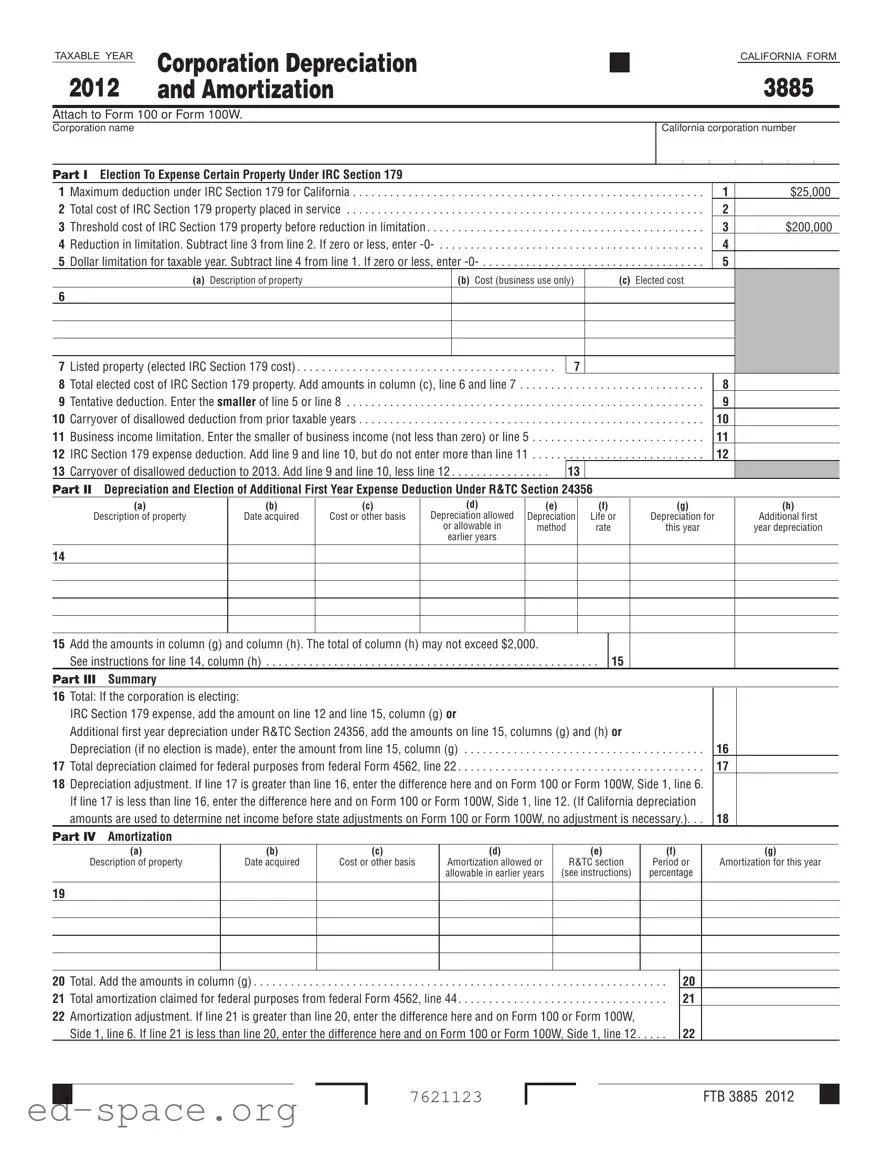
The California Form 3885, titled "Corporation Depreciation and Amortization," serves as a crucial tool for corporations to calculate their depreciation and amortization deductions. This form is essential for corporations, including partnerships and limited liability companies classified as corporations, to report the depreciation of tangible assets and the amortization of intangible assets. Key sections of the form include the election to expense certain property under IRC Section 179, which allows for a maximum deduction of $25,000, provided that the total cost of qualifying property does not exceed $200,000. Additionally, the form guides users through the calculation of depreciation using various methods, such as straight-line and declining balance, while also addressing differences between California and federal tax laws. Amortization of intangible assets is covered as well, with specific instructions for eligible properties and their corresponding R&TC sections. Completing Form 3885 accurately is vital, as it directly impacts the corporation's tax obligations and financial reporting.
TAXABLE YEAR |
Corporation Depreciation |
|
|
|
|
|
|
|
|
|
|
CALIFORNIA FORM |
|||||||
|
|
|
|
|
|
|
|
|
|
|
|
|
|
|
|
|
|
|
|
|
2012 |
and Amortization |
|
|
|
|
|
|
|
|
|
3885 |
|
||||||
|
|
|
|
|
|
|
|
|
|
|
|
|
|
|
|
|
|
||
Attach to Form 100 or Form 100W. |
|
|
|
|
|
|
|
|
|
|
|
|
|
|
|
|
|
||
Corporation name |
|
|
|
|
California corporation number |
||||||||||||||
|
|
|
|
|
|
|
|
|
|
|
|
|
|
|
|
|
|
||
PART I Election To Expense Certain Property Under IRC Section 179 |
|
|
|
|
|
|
|
|
|
|
|
|
|
|
|
|
|
||
1 |
Maximum deduction under IRC Section 179 for California |
. . . . . . . . . . . . . . . . . . . . . . . . . . . . . . . . . . . . . . . . . |
1 |
$25,000 |
|||||||||||||||
2 |
. . . . . . . . . . . . . . . . .Total cost of IRC Section 179 property placed in service |
. . . . . . . . . . . . . . . . . . . . . . . . . . . . . . . . . . . . . . . . . |
2 |
|
|
|
|
|
|
|
|
||||||||
3 |
Threshold cost of IRC Section 179 property before reduction in limitation . . . . |
. . . . . . . . . . . . . . . . . . . . . . . . . . . . . . . . . . . . . . . . . |
3 |
$200,000 |
|||||||||||||||
4 |
. .Reduction in limitation. Subtract line 3 from line 2. If zero or less, enter |
. . . . . . . . . . . . . . . . . . . . . . . . . . . . . . . . . . . . . . . . . |
4 |
|
|
|
|
|
|
|
|
||||||||
5 |
. . . . . . . . . . . . . . . . . . . . . . . . . . . . . . . . . . . .Dollar limitation for taxable year. Subtract line 4 from line 1. If zero or less, enter |
5 |
|
|
|
|
|
|
|
|
|||||||||
|
|
(a) Description of property |
(b) Cost (business use only) |
(c) Elected cost |
|
|
|
|
|
|
|
|
|||||||
6 |
|
|
|
|
|
|
|
|
|
|
|
|
|
|
|
|
|
|
|
|
|
|
|
|
|
|
|
|
|
|
|
|
|
|
|
|
|
|
|
|
|
|
|
|
|
|
|
|
|
|
|
|
|
|
|
|
|
|
|
|
|
|
|
|
|
|
|
|
|
|
|
|
|
|
|
|
|
|
|
7 |
Listed property (elected IRC Section 179 cost) |
7 |
|
|
|
8 |
Total elected cost of IRC Section 179 property. Add amounts in column (c), line 6 and line 7 |
. . . |
. . . . . . . . . . . . . . . . . . . |
8 |
|
9 |
Tentative deduction. Enter the smaller of line 5 or line 8 |
. . . |
. . . . . . . . . . . . . . . . . . . |
9 |
|
10 |
Carryover of disallowed deduction from prior taxable years |
. . . |
. . . . . . . . . . . . . . . . . . . |
10 |
|
11 |
Business income limitation. Enter the smaller of business income (not less than zero) or line 5 |
. . . |
. . . . . . . . . . . . . . . . . . . |
11 |
|
12 |
IRC Section 179 expense deduction. Add line 9 and line 10, but do not enter more than line 11 |
. . . |
. . . . . . . . . . . . . . . . . . . |
12 |
|
13 |
Carryover of disallowed deduction to 2013. Add line 9 and line 10, less line 12 |
13 |
|
|
|
PART II Depreciation and Election of Additional First Year Expense Deduction Under R&TC Section 24356
(a) |
(b) |
(c) |
(d) |
(e) |
(f) |
(g) |
(h) |
Description of property |
Date acquired |
Cost or other basis |
Depreciation allowed |
Depreciation |
Life or |
Depreciation for |
Additional first |
|
|
|
or allowable in |
method |
rate |
this year |
year depreciation |
|
|
|
earlier years |
|
|
|
|
14 |
|
|
|
|
|
|
|
|
|
|
|
|
|
|
|
|
|
|
|
|
|
|
|
|
|
|
|
|
|
|
|
|
|
|
|
|
|
|
|
15Add the amounts in column (g) and column (h). The total of column (h) may not exceed $2,000.
|
See instructions for line 14, column (h) |
15 |
PART III Summary |
|
|
16 |
Total: If the corporation is electing: |
|
|
IRC Section 179 expense, add the amount on line 12 and line 15, column (g) or |
|
|
Additional first year depreciation under R&TC Section 24356, add the amounts on line 15, columns (g) and (h) or |
|
|
Depreciation (if no election is made), enter the amount from line 15, column (g) |
. . . . . . . . . . . . . . . 16 |
17 |
Total depreciation claimed for federal purposes from federal Form 4562, line 22 |
. . . . . . . . . . . . . . . 17 |
18Depreciation adjustment. If line 17 is greater than line 16, enter the difference here and on Form 100 or Form 100W, Side 1, line 6. If line 17 is less than line 16, enter the difference here and on Form 100 or Form 100W, Side 1, line 12. (If California depreciation
amounts are used to determine net income before state adjustments on Form 100 or Form 100W, no adjustment is necessary.). . . 18
PART IV Amortization
(a) |
(b) |
(c) |
(d) |
(e) |
(f) |
(g) |
Description of property |
Date acquired |
Cost or other basis |
Amortization allowed or |
R&TC section |
Period or |
Amortization for this year |
|
|
|
allowable in earlier years |
(see instructions) |
percentage |
|
19
20 |
Total. Add the amounts in column (g) |
20 |
21 |
Total amortization claimed for federal purposes from federal Form 4562, line 44 |
21 |
22 |
Amortization adjustment. If line 21 is greater than line 20, enter the difference here and on Form 100 or Form 100W, |
|
|
Side 1, line 6. If line 21 is less than line 20, enter the difference here and on Form 100 or Form 100W, Side 1, line 12 |
22 |
7621123
FTB 3885 2012

2012 Instructions for Form FTB 3885
Corporation Depreciation and Amortization
References in these instructions are to the Internal Revenue Code (IRC) as of JANUARY 1, 2009, and to the California Revenue and Taxation Code (R&TC).
General Information
In general, for taxable years beginning on or after January 1, 2010, California law conforms to the Internal Revenue Code (IRC) as of January 1, 2009. However, there are continuing differences between California and federal law. When California conforms to federal tax law changes, we do not always adopt all of the changes made at the federal level. For more information, go to ftb.ca.gov and search for conformity. Additional information can be found
in FTB Pub. 1001, Supplemental Guidelines to California Adjustments, the instructions for California Schedule CA (540 or 540NR), and the Business Entity tax booklets.
The instructions provided with California tax forms are a summary of California tax law and are only intended to aid taxpayers in preparing their state income tax returns. We include information that is most useful to the greatest number of taxpayers in the limited space available. It is not possible to include all requirements of the California Revenue and Taxation Code (R&TC) in the tax booklets. Taxpayers should not consider the tax booklets as authoritative law.
A Purpose
Use form FTB 3885, Corporation Depreciation and Amortization, to calculate California depreciation and amortization deduction for corporations, including partnerships and limited liability companies (LLCs) classified as corporations.
S corporations must use Schedule B (100S), S Corporation Depreciation and Amortization.
Depreciation is the annual deduction allowed to recover the cost or other basis of business or income producing property with a determinable useful life of more than one year. Generally, depreciation is used in connection with tangible property.
Amortization is an amount deducted to recover the cost of certain capital expenses over a fixed period. Generally amortization is used for intangible assets.
For amortizing the cost of certified pollution control facilities, use form FTB 3580, Application and Election to Amortize Certified Pollution Control Facility.
B Federal/State Differences
Differences between federal and California laws affect the calculation of depreciation and amortization. The following lists are not intended to be
California law conforms to federal law for the following:
•The sport utility vehicles (SUVs) and minivans built on a truck chassis are included in the definition of trucks and vans when applying the 6,000 pound gross weight limit. See federal Rev. Proc.
•The additional
•The federal Class Life Asset Depreciation Range (ADR) System provisions, which specifies a useful life for various types of property. However, California law does not allow the corporation to choose a depreciation period that varies from the specified asset guideline system.
California law does not conform to federal law for the following:
•The enhanced IRC Section 179 expensing election for assets placed in service in 2010 through 2012 taxable year.
•The
•The IRC Section 613A(d)(4) relating to the exclusion of certain refiners. See R&TC Section 24831.3 for more information.
•The IRC Section 168(k) relating to the 50% bonus depreciation deduction for assets acquired in tax years 2008 through 2012 and placed in service before 2013 (or before 2014 for certain qualifying property). For property acquired and placed in service after September 8, 2010, and before 2012 (before 2013 in the case of certain qualifying property), the bonus depreciation deduction is 100%.
•The additional
•The accelerated recovery period for depreciation of smart meters and smart grid systems.
•The
•The federal special class life for gas station convenience stores and similar structures.
•The depreciation under Modified Accelerated Cost Recovery System (MACRS) for corporations, except to the extent such depreciation is passed through from a partnership or LLC classified as a partnership.
C Depreciation Calculation Methods
Depreciation methods are defined in R&TC Sections 24349 through 24354. Depreciation calculation methods, described in R&TC Section 24349, are as follows:
Declining Balance. Under this method, depreciation is greatest in the first year and smaller in each succeeding year. The property must have a useful life of at least three years. Salvage value is not taken into account in determining the basis of the property, but the property may not be depreciated below a reasonable salvage value.
The amount of depreciation for each year is subtracted from the basis of the property and a uniform rate of up to 200% of the
For example, the annual depreciation allowances for property with an original basis of $100,000 are:
|
|
Declining |
|
|
Remaining |
balance |
Depreciation |
Year |
basis |
rate |
allowance |
First. . . . . . $100,000 |
20% |
$20,000 |
|
Second . . . |
80,000 |
20% |
16,000 |
Third |
64,000 |
20% |
12,800 |
Fourth . . . . |
51,200 |
20% |
10,240 |
remaining in the useful life of the property. Therefore, the numerator changes each year as the life of the property decreases. The denominator of the fraction is the sum of the digits representing the years of useful life. The denominator remains constant every year.
Other Consistent Methods. Other depreciation methods may be used as long as the total accumulated depreciation at the end of any taxable year during the first 2/3 of the useful life of the property is not more than the amount that would have resulted from using the declining balance method.
D Period of Depreciation
Under Cal. Code Regs., tit. 18, section 24349(l), California conforms to the federal useful lives of property.
Use the following information as a guide to determine reasonable periods of useful life for purposes of calculating depreciation. Actual facts and circumstances will determine useful life. However, the figures listed below represent the normal periods of useful life for the types of property listed as shown in IRS Rev. Proc.
•Office furniture, fixtures, machines,
and equipment . . . . . . . . . . . . . . . . . . . . . . 10 yrs.
This category includes furniture and fixtures (that are not structural components of a building) and machines and equipment used in the preparation of paper or data.
Examples include: desks; files; safes; typewriters, accounting, calculating, and data processing machines; communications equipment; and duplicating and copying equipment.
•Computers and peripheral
equipment (printers, etc.) . . . . . . . . . . . . . . . 6 yrs.
•Transportation equipment and
automobiles (including taxis) . . . . . . . . . . . . 3 yrs.
•
Light (unloaded weight less than
13,000 lbs.) . . . . . . . . . . . . . . . . . . . . . . . . . 4 yrs. Heavy (unloaded weight 13,000 lbs.
or more) . . . . . . . . . . . . . . . . . . . . . . . . . . . . 6 yrs.
•Buildings
This category includes the structural shell of a building and all of its integral parts that service normal heating, plumbing, air conditioning, fire prevention and power requirements, and equipment such as elevators and escalators.
Type of building:
Apartments . . . . . . . . . . . . . . . . . . . . . . . . . 40 yrs. Dwellings (including rental residences) . . . 45 yrs. Office buildings. . . . . . . . . . . . . . . . . . . . . . 45 yrs. Warehouses . . . . . . . . . . . . . . . . . . . . . . . . 60 yrs.
EDepreciation Methods to Use
Corporations may use the
|
Maximum |
Property description |
depreciation method |
Real estate acquired 12/31/70 or earlier
New (useful life 3 yrs. or more) . . . . . 200% Declining balance Used (useful life 3 yrs. or more) . . . . . 150% Declining balance
Real estate acquired 1/1/71 or later Residential rental:
New. . . . . . . . . . . . . . . . . . . . . . . . . . 200% Declining balance Used (useful life 20 yrs. or more) . . . 125% Declining balance Used (useful life less than 20 yrs.) . .
FTB 3885 Instructions 2012 Page 1

Commercial and industrial:
New (useful life 3 yrs. or more) . . . . 150% Declining balance Used . . . . . . . . . . . . . . . . . . . . . . . . .
Personal property
New (useful life 3 yrs. or more) . . . . . 200% Declining balance Used (useful life 3 yrs. or more) . . . . . 150% Declining balance
See “Other Consistent Methods” information on page 1.
The Class Life ADR System of depreciation may be used for designated classes of assets placed in service after 1970.
The Guideline Class Life System of depreciation may be used for certain classes of assets placed in service before 1971.
FElection To Expense Certain Property Under IRC
Section 179
For taxable years beginning on or after January 1, 2005, corporations may elect IRC Section 179 to expense part or all of the cost of depreciable tangible property used in the trade or business and certain other property described in federal Publication 946, How to Depreciate Property. To elect IRC Section 179, the corporation must have purchased property, as defined in the IRC Section 179(d)(2), and placed it in service during the taxable year. If the corporation elects this deduction, the corporation must reduce the California depreciable basis by the IRC Section 179 expense. See the instructions for federal Form 4562, Depreciation and Amortization, for more information.
California does not allow IRC Section 179 expense election for
California conforms to the federal changes made to the deduction of business
2005. Exceptions: California does not conform to the federal increase in the deduction for
Limitations. Federal limitation amounts are different than California limitation amounts. For California purposes, the maximum IRC Section 179 expense deduction allowed is $25,000. This amount is reduced if the cost of all IRC Section 179 property placed in service during the taxable year is more than $200,000. The total IRC Section 179 expense deduction cannot exceed the corporation’s business income.
G Amortization
California conforms to the IRC Section 197 amortization of intangibles for taxable years beginning on or after January 1, 1994. Generally, assets that meet the definition under IRC Section 197 are amortized on a
Amortization of the following assets is governed by California law:
Bond premiums |
R&TC 24360 |
– |
24363.5 |
Research expenditures |
R&TC 24365 |
|
|
Reforestation expenses |
R&TC 24372.5 |
|
|
Organizational expenditures |
R&TC 24407 |
– |
24409 |
R&TC 24414 |
|
|
|
Other intangible assets may be amortized if it is approved with reasonable accuracy that the asset has an ascertainable value that diminishes over time and has a limited useful life.
Specific Line Instructions
For properties placed in service during the taxable year, the corporation may complete Part I if the corporation elects to expense qualified property under IRC Section 179, or Part II if the corporation elects additional first year expense deduction for qualified property under R&TC Section 24356. The corporation may only elect IRC Section 179 or the additional first year expense deduction for the same taxable year. The election must be made on a timely filed tax return (including extension). The election may not be revoked except with the Franchise Tax Board‘s consent.
Part II is also used to calculate depreciation for property (with or without the above elections).
Part I Election To Expense Certain Property Under IRC Section 179
Complete Part I if the corporation elects IRC Section 179 expense. Include all assets qualifying for the deduction since the limit applies to all qualifying assets as a group rather than to each asset individually. The total IRC Section 179 expense for property, which the election may be made, is figured on line 5. The amount of IRC Section 179 expense deductions for the taxable year cannot exceed the corporation’s business income on line 11. See
the instructions for federal Form 4562 for more information.
Line 2
Enter the cost of all IRC Section 179 qualified property placed in service during the taxable year including the cost of any listed property. See General Information F, Election To Expense Certain Property Under IRC Section 179, for information regarding qualified property. See line 7 instructions for information regarding listed property.
Line 5
If line 5 is zero, the corporation cannot elect to expense any IRC Section 179 property. Skip line 6 through line 11, enter zero on line 12.
Line 6
Do not include any listed property on line 6. Enter the elected IRC Section 179 cost of listed property on line 7.
Column (a) – Description of property. Enter a brief description of the property the corporation elects to expense.
Column (b) – Cost (business use only). Enter the cost of the property. If the corporation acquired the property through a
Column (c) – Elected cost. Enter the amount the corporation elects to expense. The corporation does not have to expense the entire cost of the property. The corporation can depreciate the amount it does not expense.
Line 7
Use a format similar to federal Form 4562, Part V, line 26 to determine the elected IRC Section 179 cost of listed property. Listed property generally includes the following:
•Passenger automobiles weighing 6,000 pounds or less.
•Any other property used for transportation if the nature of the property lends itself to personal use, such as motorcycles,
•Any property used for entertainment or recreational purposes (such as photographic, phonographic, communication, and video recording equipment).
•Cellular telephones (and other similar telecommunications equipment). Note: California does not conform to the federal exclusion of these
items from being treated as listed property for taxable years beginning on or after January 1, 2010.
•Computers or peripheral equipment.
Exception. Listed property generally does not include:
•Photographic, phonographic, communication, or video equipment used exclusively in the corporation’s trade or business.
•Any computer or peripheral equipment used exclusively at a regular business.
•An ambulance, hearse, or vehicle used for transporting persons or property for hire.
Listed property used 50% or less in business activity does not qualify for the IRC Section 179 expense deduction. For more information regarding listed property, see the instructions for federal Form 4562.
Line 11
The total cost the corporation can deduct is limited to the corporation’s business income. For the purpose of IRC Section 179 election, business income is the net income derived from the corporation’s active trade or business, Form 100 or Form 100W, line 18, before the IRC Section 179 expense deduction (excluding items not derived from a trade or business actively conducted by the corporation).
Part II Depreciation and Election of
Additional First Year Expense
Deduction Under R&TC
Section 24356
Line 14
Corporations may enter each asset separately or group assets into depreciation accounts. Figure the depreciation separately for each asset or group of assets. The basis for depreciation is the cost or other basis reduced by a reasonable salvage value (except when using the declining balance method), additional
If the Guideline Class Life System or Class Life ADR System is used, enter the total amount from the corporation’s schedule showing the computation on form FTB 3885, column (g), and identify as such.
Line 14, Column (h), Additional
Corporations may elect to deduct up to 20% of the cost of “qualifying property” in the year acquired in addition to the regular depreciation deduction. The maximum additional
“Qualifying property” is tangible personal property used in business and having a useful life of at least six years. Land, buildings, and structural components do not qualify. Property converted from personal use, acquired by gift, inheritance, or from related parties also does not qualify.
See R&TC Section 24356 and the applicable regulations for more information.
An election may be made to expense up to 40% of the cost of property described in R&TC Sections 24356.6, 24356.7, and 24356.8.
For more information, get form FTB 3809, Targeted Tax Area Deduction and Credit Summary; form FTB 3805Z, Enterprise Zone Deduction and Credit Summary; or form FTB 3807, Local Agency Military Base Recovery Area Deduction and Credit Summary.
Part IV Amortization
Line 19, Column (e) – R&TC section. Enter the correct R&TC section for the type of amortization. See General Information G, Amortization, for a list of the R&TC sections.
Page 2 FTB 3885 Instructions 2012
| Fact Name | Description |
|---|---|
| Purpose | The California Form 3885 is used by corporations to calculate depreciation and amortization deductions for state tax purposes. |
| Governing Laws | This form is governed by the California Revenue and Taxation Code (R&TC) and conforms to the Internal Revenue Code (IRC) as of January 1, 2009. |
| IRC Section 179 Deduction | Corporations can elect to expense certain property under IRC Section 179, with a maximum deduction of $25,000 for California. |
| Threshold Cost | The threshold cost for IRC Section 179 property before the limitation is $200,000. If exceeded, the deduction may be reduced. |
| Parts of the Form | The form consists of four parts: Election to Expense, Depreciation, Summary, and Amortization. |
| Amortization Period | Assets that qualify for amortization under California law are typically amortized over a period of 15 years. |
| Depreciation Methods | Corporations may use various methods for calculating depreciation, including straight-line and declining balance methods. |
| Listed Property | Specific types of property, such as passenger vehicles and certain equipment, are classified as listed property, which has special rules for deductions. |
| Filing Requirements | Form 3885 must be attached to Form 100 or Form 100W when filing for California state taxes. |
Filling out the California 3885 form is an important step in calculating depreciation and amortization deductions for corporations in California. After completing this form, it will be attached to Form 100 or Form 100W when filing your corporation's tax return. Ensure that all information is accurate to avoid any delays or issues with your tax submission.
What is the purpose of California Form 3885?
California Form 3885 is used by corporations to calculate depreciation and amortization deductions. This form is applicable to partnerships and limited liability companies (LLCs) that are classified as corporations. S corporations must use Schedule B (100S) for their depreciation and amortization needs.
What types of property does Form 3885 cover?
Form 3885 covers both tangible and intangible assets. Tangible assets typically include office furniture, machinery, and equipment, while intangible assets may include organizational expenditures and certain capital expenses. The form helps corporations recover costs over the useful life of these properties.
What is the maximum deduction under IRC Section 179 for California?
The maximum deduction allowed under IRC Section 179 for California is $25,000. However, this amount is reduced if the total cost of qualifying property placed in service during the taxable year exceeds $200,000. The deduction cannot exceed the corporation's business income for the year.
How do corporations elect to expense property under IRC Section 179?
To elect to expense property under IRC Section 179, a corporation must complete Part I of Form 3885. This involves listing all qualifying assets and their costs. The election must be made on a timely filed tax return, including extensions, and cannot be revoked without consent from the Franchise Tax Board.
What are the differences between federal and California depreciation laws?
California law has several differences from federal law regarding depreciation. For instance, California does not conform to certain federal enhancements to IRC Section 179 expensing for assets placed in service in specific years. Additionally, California has different limits for first-year depreciation deductions and does not allow certain types of property, like off-the-shelf computer software, to qualify for the IRC Section 179 expense election.
What methods can be used for calculating depreciation on Form 3885?
Corporations can use various methods for calculating depreciation, including the straight-line method, declining balance method, and sum-of-the-years-digits method. The choice of method may depend on the type of property and its useful life. Each method has specific rules for determining the amount of depreciation to claim.
What is the additional first-year depreciation allowed under California law?
Corporations may elect to take an additional first-year depreciation deduction of up to 20% of the cost of qualifying property, with a maximum of $2,000. Qualifying property must be tangible personal property used in business and have a useful life of at least six years. This additional deduction is in addition to the regular depreciation claimed.
How is amortization handled on Form 3885?
Amortization for intangible assets is calculated on Form 3885 by entering the relevant information in Part IV. Generally, intangible assets are amortized on a straight-line basis over 15 years. Specific R&TC sections should be referenced for different types of amortization, such as organizational expenditures and research expenditures.
Incomplete Information: One common mistake is not filling in all required fields. Ensure that every section of the form is completed, especially those that require specific details about the corporation and the assets involved.
Incorrect Property Classification: Misclassifying property can lead to significant errors. It's essential to accurately categorize property as either IRC Section 179 or additional first-year depreciation to avoid complications.
Failure to Include Listed Property: Some taxpayers forget to list property that qualifies under IRC Section 179. Remember, certain assets, like vehicles and equipment, may need special consideration.
Neglecting the Business Income Limitation: It's crucial to remember that the total deduction cannot exceed the corporation’s business income. Overestimating can lead to disallowed deductions.
Incorrectly Calculating Depreciation: Miscalculating depreciation amounts is a frequent error. Ensure to follow the appropriate methods and guidelines for the type of property being depreciated.
Not Keeping Up with Federal and State Differences: California tax laws may differ from federal laws. Failing to recognize these differences can result in incorrect filings.
Missing Deadlines: Submitting the form late can lead to penalties. Always check the filing deadlines and ensure timely submission to avoid unnecessary complications.
The California Form 3885 is essential for corporations to calculate depreciation and amortization deductions. However, it is often used alongside several other forms and documents that help clarify various tax situations and requirements. Below is a list of ten forms that are commonly associated with the California 3885 form, along with brief descriptions of each.
Understanding these forms can enhance compliance and ensure that corporations maximize their deductions. Each form plays a unique role in the overall tax process, and being familiar with them can simplify tax preparation and filing.
The California Form 3885, which focuses on corporation depreciation and amortization, shares similarities with several other tax-related documents. Each of these forms serves a unique purpose but addresses similar themes of asset management and tax deductions. Below is a list of six documents that are comparable to the California 3885 form:
When filling out the California Form 3885, it is crucial to follow specific guidelines to ensure accuracy and compliance. Here are six important dos and don'ts to consider:
By adhering to these guidelines, you can navigate the complexities of the California 3885 form more effectively, reducing the risk of errors and potential audits.
This form is applicable to all corporations, including smaller entities like partnerships and limited liability companies classified as corporations. It is not limited to large corporations.
The deductions are subject to specific limits. For instance, California has a maximum IRC Section 179 expense deduction of $25,000, which is lower than the federal limit.
Not all assets qualify. For example, off-the-shelf computer software does not qualify for this deduction under California law.
While there are similarities, there are significant differences between California and federal laws regarding depreciation and amortization, which affect how the form is completed.
The election must be made on a timely filed tax return and cannot be revoked without consent from the Franchise Tax Board.
Different types of property may require different depreciation methods. For example, real estate and personal property have distinct guidelines.
Supporting documentation is essential. It helps substantiate the deductions claimed and ensures compliance with California tax regulations.
California law has unique rules that may lead to different depreciation amounts compared to federal calculations. This can affect the overall tax liability.
While tax professionals often handle these forms, business owners and corporate officers should understand the form's implications for their financial reporting and tax obligations.
1. Purpose of the Form: The California Form 3885 is used by corporations to calculate depreciation and amortization deductions. This includes partnerships and LLCs classified as corporations. S corporations must use a different form.
2. Elections and Deductions: Corporations can elect to expense certain property under IRC Section 179. This allows them to deduct part or all of the cost of qualifying property. The maximum deduction is $25,000, but this amount decreases if the total cost of qualifying property exceeds $200,000.
3. Differences Between Federal and State Law: California law has specific differences from federal law regarding depreciation and amortization. For instance, California does not allow the same enhanced IRC Section 179 expensing for certain assets placed in service during specific years.
4. Completing the Form: When filling out Form 3885, corporations must provide detailed information about the property, including descriptions, costs, and any deductions claimed. Accurate reporting is essential to ensure compliance with California tax laws.