The California Form 3581, known as the Tax Deposit Refund and Transfer Request, serves as a crucial tool for taxpayers looking to manage their tax deposits effectively. This form allows individuals and entities to request a refund of all or part of a tax deposit, transfer those deposits to another taxable year, or convert a pending deficiency protest into a claim for a refund. It is essential to provide accurate information, including the type of tax—whether it’s personal income tax, corporate tax, or other applicable fees—and the specific amounts involved. Taxpayers must complete all relevant fields, such as Social Security Numbers (SSNs) or Individual Taxpayer Identification Numbers (ITINs), and indicate the requested action clearly. The form also includes provisions for registered domestic partners, ensuring they are treated equitably under California tax law. Submitting Form 3581 correctly and on time is vital, as it can affect the handling of tax liabilities and any potential refunds. Understanding how to navigate this form can significantly impact your financial obligations and rights regarding tax deposits in California.
TAXABLE YEARCALIFORNIA FORM
|
|
|
|
|
|
|
|
|
|
|
|
|
|
|
|
|
|
Tax Deposit Refund and Transfer Request |
|
|
|
|
|
|
|
|
|
|
|
|
|
|
|
|
|
|
|
|
|
|
|
|
|
|
3581 |
|
|
|
|
|||||||||||||||||||||||||||||||||||||||||||||||||||||||||||||||||||||
|
|
|
|
|
|
|
|
|
|
|
|
|
|
|
|
|
|
|
|
|
|
|
|
|
|
|
|
|
|
|
|
|
|
|
|
|
|
|
|
|
|
|
|
|
|
|
|
|
|
|
|
|
|
|
|
|
|
|
|
|
|
|
|
|
|
|
|
|
|
|
|
|
|
|
|
|
|
|
|
|
|
|
|
|
|
|
|
|
|
|
|
|
|
|
|
|
|
|
|
|
|
|
|
|
|
|
|
|
|
|
|
|
|
|
|
|
|
|
For calendar year ________ or fiscal year beginning month ____ day ____ year ____, and ending month ____ day ____ year ____ . |
|
|
|
|
|
|
|
|
|
|
|
|
|
|
|
|
|
|
|
|
|
|
|
|||||||||||||||||||||||||||||||||||||||||||||||||||||||||||||||||||||||||||||||||||||||||||||||
Name(s) as shown on tax return |
|
|
|
|
|
|
|
|
|
|
|
|
|
|
|
|
|
|
|
|
|
|
|
|
|
|
|
|
|
|
Your SSN or ITIN |
|
|
|
|
|
|
|
|
|
|
|
|
|
|
|
|
|
|
|
|
|
|
|
||||||||||||||||||||||||||||||||||||||||||||||||||||||||||||||||
|
|
|
|
|
|
|
|
|
|
|
|
|
|
|
|
|
|
|
|
|
|
|
|
|
|
|
|
|
|
|
|
|
|
|
|
|
|
|
|
|
|
|
|
|
|
|
|
|
|
|
|
|
|
|
|
|
|
|
|
|
|
|
|
|
|
|
|
|
|
|
|
|
|
|
|
|
|
|
|
- |
|
|
|
|
|
- |
|
|
|
|
|
|
|
|
|
|
|
|
|
|
|
|
|
|
||||||||||||||
|
|
|
|
|
|
|
|
|
|
|
|
|
|
|
|
|
|
|
|
|
|
|
|
|
|
|
|
|
|
|
|
|
|
|
|
|
|
|
|
|
|
|
|
|
|
|
|
|
|
|
|
|
|
|
|
|
|
|
|
|
|
|
|
|
|
|
|
|
|
Spouse’s/RDP’s SSN or ITIN |
||||||||||||||||||||||||||||||||||||||||||||||||
|
|
|
|
|
|
|
|
|
|
|
|
|
|
|
|
|
|
|
|
|
|
|
|
|
|
|
|
|
|
|
|
|
|
|
|
|
|
|
|
|
|
|
|
|
|
|
|
|
|
|
|
|
|
|
|
|
|
|
|
|
|
|
|
|
|
|
|
|
|
|
|
|
|
|
|
- |
|
|
|
|
|
- |
|
|
|
|
|
|
|
|
|
|
|
|
|
|
|
|
|
|
||||||||||||||||||
Address (number and street, suite, room, PO Box, or PMB no.) |
|
|
|
|
|
|
|
|
|
|
|
|
|
|
|
|
|
|
|
|
|
|
|
|
|
|
|
|
|
|
FEIN |
|
|
|
|
|
|
|
|
|
|
|
|
|
|
|
|
|
|
|
|
|
|
|
||||||||||||||||||||||||||||||||||||||||||||||||||||||||||||||||
|
|
|
|
|
|
|
|
|
|
|
|
|
|
|
|
|
|
|
|
|
|
|
|
|
|
|
|
|
|
|
|
|
|
|
|
|
|
|
|
|
|
|
|
|
|
|
|
|
|
|
|
|
|
|
|
|
|
|
|
|
|
|
|
|
|
|
|
|
|
|
|
- |
|
|
|
|
|
|
|
|
|
|
|
|
|
|
|
|
|
|
|
|
|
|
|
|
|
|
|
|
|
|
|
|
|
|
||||||||||||
City |
|
|
|
|
|
|
|
|
|
|
State |
Zip Code |
CA corporation no. |
|
|
|
|
|
|
|
|
|
|
|
|
|
|
|
|
|
|
|
|
|
|
|
||||||||||||||||||||||||||||||||||||||||||||||||||||||||||||||||||||||||||||||||||
|
|
|
|
|
|
|
|
|
|
|
|
|
|
|
|
|
|
|
|
|
|
|
|
|
|
|
|
|
|
|
|
|
|
|
|
|
|
|
|
|
|
|
|
|
|
|
|
|
|
|
|
|
|
|
|
|
|
|
|
|
- |
|
|
|
|
|
|
|
|
|
|
|
|
|
|
|
|
|
|
|
|
|
|
|
|
|
|
|
|
|
|
|
|
|
|
|
|
|
|
|
|
|
|
|
|
|
|
|
|
|
|
|
|
|
|
|
||
|
|
|
|
|
|
|
|
|
|
|
|
|
|
|
|
|
|
|
|
|
|
|
|
|
|
|
|
|
|
|
|
|
|
|
|
|
|
|
|
|
|
|
|
|
|
|
|
|
|
|
|
|
|
|
|
|
|
|
|
|
|
|
|
|
|
|
|
|
|
Secretary of State (SOS) file number |
||||||||||||||||||||||||||||||||||||||||||||||||
|
|
|
|
|
|
|
|
|
|
|
|
|
|
|
|
|
|
|
|
|
|
|
|
|
|
|
|
|
|
|
|
|
|
|
|
|
|
|
|
|
|
|
|
|
|
|
|
|
|
|
|
|
|
|
|
|
|
|
|
|
|
|
|
|
|
|
|
|
|
|
|
|
|
|
|
|
|
|
|
|
|
|
|
|
|
|
|
|
|
|
|
|
|
|
|
|
|
|
|
|
|
|
|
|
|
|
|
|
|
|
|
|
|
|
|
|
|
|
|
|
|
|
|
|
|
|
|
|
|
|
|
|
|
|
|
|
|
|
|
|
|
|
|
|
|
|
|
|
|
|
|
|
|
|
|
|
|
|
|
|
|
|
|
|
|
|
|
|
|
|
|
|
|
|
|
|
|
|
|
|
|
|
|
|
|
|
|
|
|
|
|
|
|
|
|
|
|
|
|
|
|
|
|
|
|
|
|
|
|
|
|
|
|
|
|
|
|
|
|
|
|
|
|
|
|
|
|
|
|
|
|
|
|
|
|
|
|
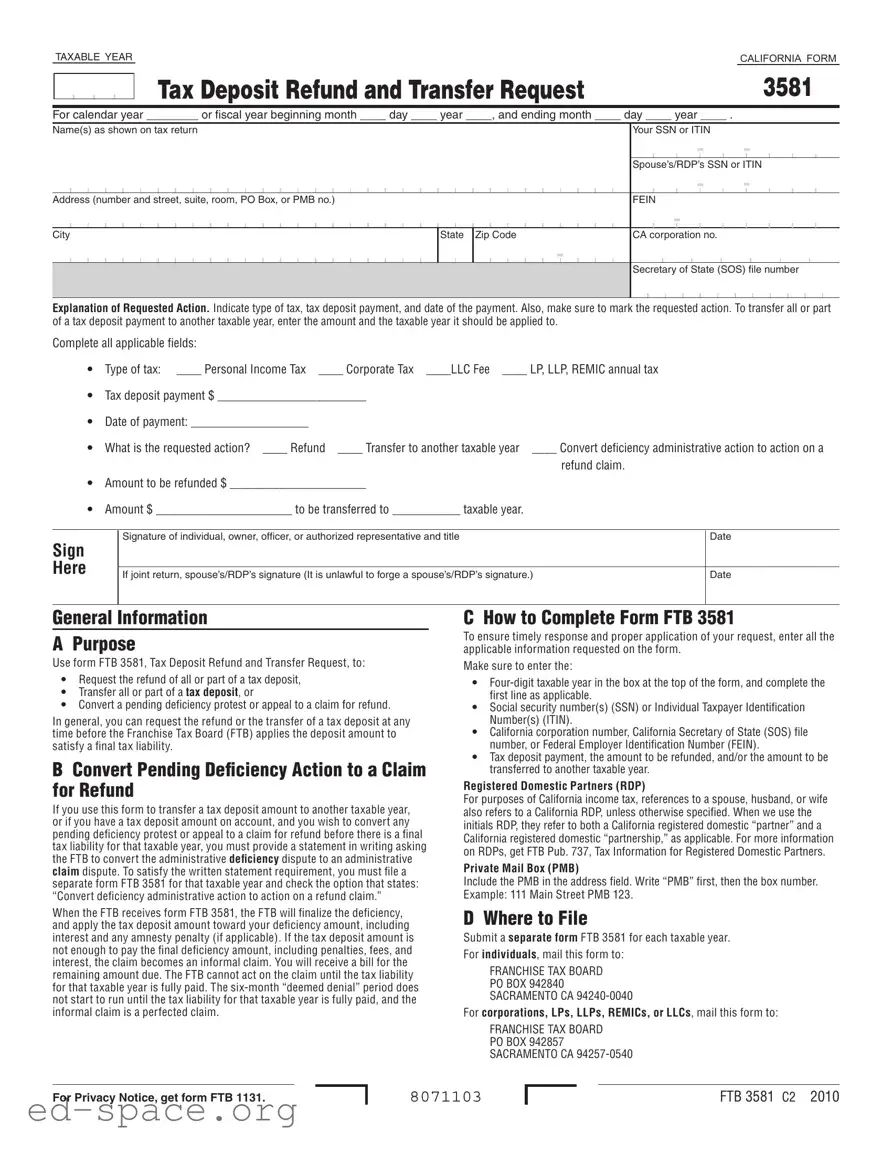
Explanation of Requested Action. Indicate type of tax, tax deposit payment, and date of the payment. Also, make sure to mark the requested action. To transfer all or part of a tax deposit payment to another taxable year, enter the amount and the taxable year it should be applied to.
Complete all applicable fields:
• Type of tax: ____ Personal Income Tax ____ Corporate Tax ____LLC Fee ____ LP, LLP, REMIC annual tax
•Tax deposit payment $ ________________________
•Date of payment: ___________________
• What is the requested action? ____ Refund ____ Transfer to another taxable year ____ Convert deficiency administrative action to action on a
refund claim.
•Amount to be refunded $ ______________________
•Amount $ ______________________ to be transferred to ___________ taxable year.
Sign Here
Signature of individual, owner, officer, or authorized representative and title |
Date |
|
|
If joint return, spouse’s/RDP’s signature (It is unlawful to forge a spouse’s/RDP’s signature.) |
Date |
|
|
General Information
A Purpose
Use form FTB 3581, Tax Deposit Refund and Transfer Request, to:
•Request the refund of all or part of a tax deposit,
•Transfer all or part of a tax deposit, or
•Convert a pending deficiency protest or appeal to a claim for refund.
In general, you can request the refund or the transfer of a tax deposit at any time before the Franchise Tax Board (FTB) applies the deposit amount to satisfy a final tax liability.
BConvert Pending Deficiency Action to a Claim for Refund
If you use this form to transfer a tax deposit amount to another taxable year, or if you have a tax deposit amount on account, and you wish to convert any pending deficiency protest or appeal to a claim for refund before there is a final tax liability for that taxable year, you must provide a statement in writing asking the FTB to convert the administrative deiciency dispute to an administrative claim dispute. To satisfy the written statement requirement, you must file a separate form FTB 3581 for that taxable year and check the option that states: “Convert deficiency administrative action to action on a refund claim.”
When the FTB receives form FTB 3581, the FTB will finalize the deficiency, and apply the tax deposit amount toward your deficiency amount, including interest and any amnesty penalty (if applicable). If the tax deposit amount is not enough to pay the final deficiency amount, including penalties, fees, and interest, the claim becomes an informal claim. You will receive a bill for the remaining amount due. The FTB cannot act on the claim until the tax liability for that taxable year is fully paid. The
C How to Complete Form FTB 3581
To ensure timely response and proper application of your request, enter all the applicable information requested on the form.
Make sure to enter the:
•
•Social security number(s) (SSN) or Individual Taxpayer Identification Number(s) (ITIN).
•California corporation number, California Secretary of State (SOS) file number, or Federal Employer Identification Number (FEIN).
•Tax deposit payment, the amount to be refunded, and/or the amount to be transferred to another taxable year.
Registered Domestic Partners (RDP)
For purposes of California income tax, references to a spouse, husband, or wife also refers to a California RDP, unless otherwise specified. When we use the initials RDP, they refer to both a California registered domestic “partner” and a California registered domestic “partnership,” as applicable. For more information on RDPs, get FTB Pub. 737, Tax Information for Registered Domestic Partners.
Private Mail Box (PMB)
Include the PMB in the address field. Write “PMB” first, then the box number. Example: 111 Main Street PMB 123.
D Where to File
Submit a separate form FTB 3581 for each taxable year.
For individuals, mail this form to:
FRANCHISE TAX BOARD
PO BOX 942840
SACRAMENTO CA
For corporations, LPs, LLPs, REMICs, or LLCs, mail this form to:
FRANCHISE TAX BOARD
PO BOX 942857
SACRAMENTO CA
For Privacy Notice, get form FTB 1131.
8071103
FTB 3581 C2 2010
| Fact Name | Details |
|---|---|
| Purpose | The California Form 3581 is used to request a refund or transfer of a tax deposit. |
| Applicable Taxes | This form can be used for Personal Income Tax, Corporate Tax, LLC Fees, and LP, LLP, REMIC annual tax. |
| Governing Law | California Revenue and Taxation Code governs the use of this form. |
| Submission Requirements | All applicable fields must be completed, including SSN or ITIN, tax deposit amount, and requested action. |
| Filing Locations | Individuals should mail the form to PO Box 942840, Sacramento, CA 94240-0040; corporations to PO Box 942857, Sacramento, CA 94257-0540. |
| Joint Returns | If filing jointly, both spouses or RDPs must sign the form. Forging a signature is illegal. |
Filling out the California 3581 form is a straightforward process that requires careful attention to detail. Once you have completed the form, you will submit it to the Franchise Tax Board (FTB) for processing. Ensure that all necessary information is accurate to avoid delays.
After completing these steps, ensure you mail the form to the appropriate address based on your situation. Individuals should send it to the specified PO Box for individuals, while corporations and other entities have a different address. Double-check that all information is accurate before submitting to avoid any issues.
What is the purpose of the California Form 3581?
The California Form 3581 is used to request a refund or transfer of a tax deposit. You can also convert a pending deficiency protest or appeal into a claim for a refund. This form allows you to manage your tax deposits before they are applied to any final tax liabilities by the Franchise Tax Board (FTB).
How do I complete the California Form 3581?
To complete the form, you need to provide specific information. Start by entering the four-digit taxable year at the top. Include your Social Security Number (SSN) or Individual Taxpayer Identification Number (ITIN), along with any relevant identification numbers such as your California corporation number or Federal Employer Identification Number (FEIN). Clearly state the amount of the tax deposit payment, the amount you wish to refund, and the amount to be transferred to another taxable year. Ensure all fields are filled accurately to avoid delays.
Where do I send the completed Form 3581?
For individuals, mail the completed form to the Franchise Tax Board at PO Box 942840, Sacramento, CA 94240-0040. If you are submitting for a corporation, LP, LLP, REMIC, or LLC, send it to PO Box 942857, Sacramento, CA 94257-0540. Make sure to send a separate form for each taxable year you are addressing.
Can I use Form 3581 to convert a pending deficiency action?
Yes, you can use Form 3581 to convert a pending deficiency protest or appeal into a claim for a refund. To do this, you must check the option on the form that states, “Convert deficiency administrative action to action on a refund claim.” This action must be taken before the FTB applies your tax deposit to any final tax liability.
What happens if my tax deposit is not enough to cover my final deficiency amount?
If your tax deposit does not cover the total amount of your final deficiency, including penalties and interest, your claim will become an informal claim. In this case, you will receive a bill for the remaining amount due. The FTB will not act on your claim until the full tax liability for that taxable year is paid.
Incorrect Tax Year: Failing to accurately enter the four-digit taxable year at the top of the form can lead to processing delays.
Missing Social Security Numbers: Omitting your SSN or ITIN, as well as your spouse’s or RDP’s, can result in rejection of the form.
Incomplete Address Information: Not providing a complete address, including PMB if applicable, can cause issues with correspondence.
Neglecting to Indicate Requested Action: Failing to mark the appropriate action—refund, transfer, or conversion—will lead to confusion and delays.
Incorrect Amounts: Entering incorrect amounts for tax deposits, refunds, or transfers can result in processing errors.
Signature Issues: Not signing the form or failing to include the spouse’s or RDP’s signature when required can render the form invalid.
Missing Supporting Documentation: Failing to provide necessary documentation when converting a deficiency action can lead to denial of the request.
Filing Multiple Years Together: Submitting one form for multiple taxable years instead of separate forms can complicate processing.
Ignoring Submission Instructions: Not following the mailing instructions for individuals or corporations can cause delays in processing.
When dealing with tax matters in California, it's essential to have the right forms and documents at your disposal. The California Form 3581 is a specific request for tax deposit refunds or transfers, but there are several other forms that are often used in conjunction with it. Below is a list of these documents, along with brief descriptions of their purposes.
Having these forms readily available can streamline the process of managing your tax obligations in California. Each form serves a unique purpose and helps ensure that you remain compliant with state tax laws. Understanding their roles can make navigating the tax landscape much easier.
The California Form 3581, Tax Deposit Refund and Transfer Request, serves specific purposes related to tax deposits. Here are six documents that are similar to the California 3581 form, along with a brief explanation of how they relate:
When filling out the California Form 3581, it's important to keep a few best practices in mind. Here’s a list of what you should and shouldn’t do:
By following these guidelines, you can help ensure that your request is processed smoothly and efficiently.
Understanding the California Form 3581 can be challenging. Here are nine common misconceptions about this form, along with clarifications to help you navigate the process effectively.
This form is not limited to refund requests. You can also use it to transfer tax deposits or convert a pending deficiency action to a claim for refund.
Requests must be made before the Franchise Tax Board applies the deposit to a final tax liability. Timing is crucial.
Completing all applicable fields is essential. Missing information can delay processing or lead to rejection.
A separate Form 3581 must be submitted for each taxable year. Consolidating requests is not permitted.
If filing a joint return, both spouses or registered domestic partners must sign the form. Forging a signature is illegal.
Corporations, LLCs, LPs, and other entities can also use this form to manage their tax deposits.
A written request is required to convert a pending deficiency protest to a claim for refund. This must accompany the form.
Filing does not guarantee a refund. The Franchise Tax Board will review the request and determine eligibility based on the information provided.
Currently, the form must be mailed to the appropriate address. Electronic submissions are not accepted.
Clarifying these misconceptions can help ensure a smoother experience when dealing with tax deposits and refunds in California.
When it comes to the California Form 3581, understanding its purpose and how to fill it out correctly is essential for taxpayers. Here are some key takeaways to keep in mind:
By keeping these takeaways in mind, you can navigate the process of filling out and using the California Form 3581 more effectively. Always ensure that your information is accurate and complete to avoid any delays in processing your request.