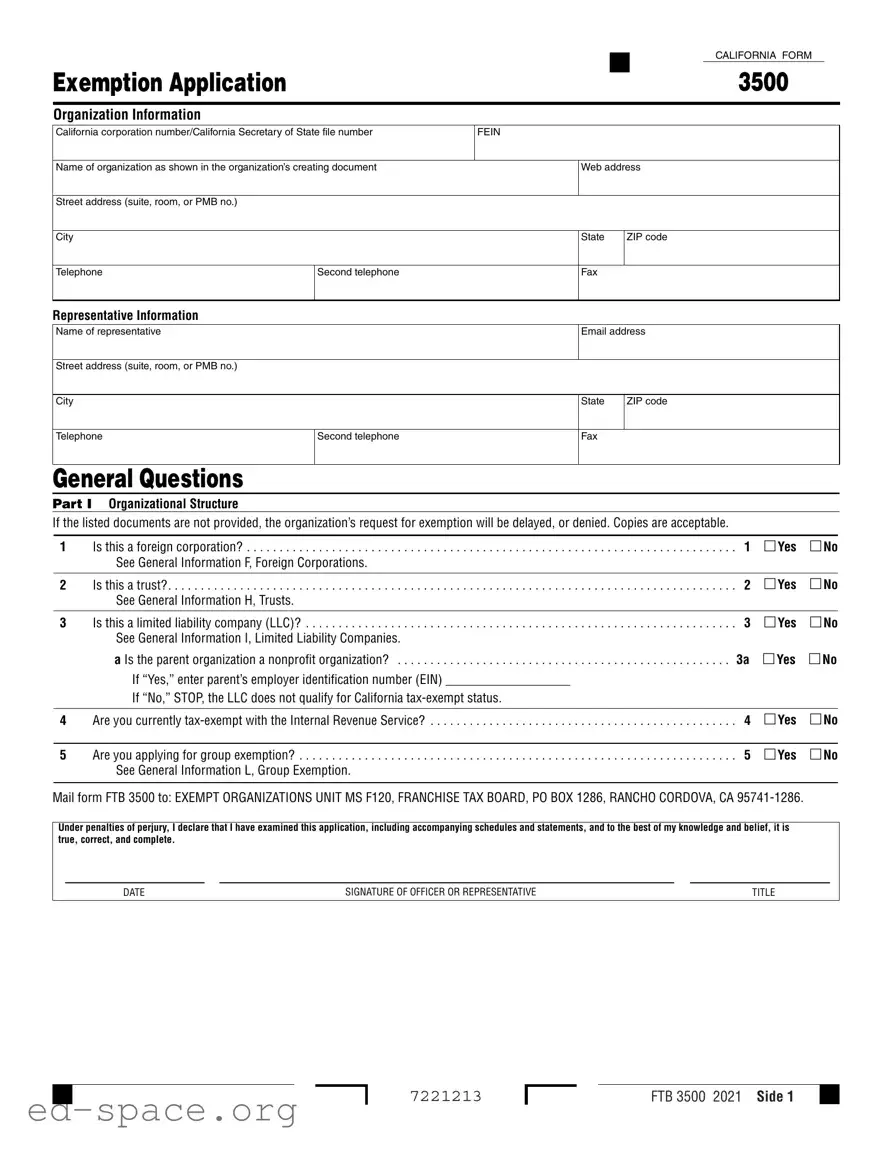
The California 3500 form is a crucial document for organizations seeking tax-exempt status in the state. This form serves as an exemption application and requires detailed information about the organization, including its structure, activities, and financial data. Organizations must provide their California corporation number, FEIN, and contact information, along with details about their representatives. The form includes sections that assess the organizational structure, such as whether the entity is a foreign corporation, trust, or limited liability company. It also prompts organizations to disclose their current tax-exempt status with the IRS and whether they are applying for group exemption. Additionally, applicants must outline their past and planned activities, emphasizing how these efforts align with their exempt purposes. Financial data, including prior filings and compensation for officers and directors, must also be submitted. Ultimately, the California 3500 form is not merely a bureaucratic requirement; it is a pathway for organizations to fulfill their missions while benefiting from tax-exempt status.

|
|
|
|
|
|
|
|
CALIFORNIA FORM |
|
|
|
|
|
|
|
|
|||
Exemption Application |
|
|
|
|
3500 |
|
|||
|
|
|
|
||||||
|
|
|
|
|
|
|
|
|
|
Organization Information |
|
|
|
|
|
|
|
||
California corporation number/California Secretary of State file number |
FEIN |
|
|
|
|
|
|||
|
|
|
|
|
|||||
Name of organization as shown in the organization’s creating document |
|
Web address |
|||||||
|
|
|
|
|
|
|
|
|
|
Street address (suite, room, or PMB no.) |
|
|
|
|
|
|
|
||
|
|
|
|
|
|
|
|||
City |
|
|
|
State |
|
ZIP code |
|||
|
|
|
|
|
|
|
|
|
|
Telephone |
|
Second telephone |
|
Fax |
|
|
|
|
|
|
|
|
|
|
|
|
|
|
|
Representative Information |
|
|
|
|
|
|
|
||
Name of representative |
|
Email address |
|||||||
|
|
|
|
|
|
|
|
||
Street address (suite, room, or PMB no.) |
|
|
|
|
|
|
|
||
|
|
|
|
|
|
|
|||
City |
|
|
|
State |
|
ZIP code |
|||
|
|
|
|
|
|
|
|
|
|
Telephone |
|
Second telephone |
|
Fax |
|
|
|
|
|
|
|
|
|
|
|
|
|
|
|
General Questions |
|
|
|
|
|
|
|
||
Part I |
Organizational Structure |
|
|
|
|
|
|
|
|
If the listed documents are not provided, the organization’s request for exemption will be delayed, or denied . Copies are acceptable .
1 |
.Is this a foreign corporation? |
. . . . . . . . . . . . . . . . . . . . . . . . . . . . . . . . . . . . . . . . . . . . . . . . |
.□. .Yes. . 1 |
□No |
|
|
See General Information F, Foreign Corporations . |
|
|
|
|
2 |
Is this a trust? |
. . . . . . . . . . . . . . . . . . . . . . . . . . . . . . . . . . . . . . . . . . . . . . . . . . 2 |
□Yes |
□No |
|
|
See General Information H, Trusts . |
|
|
|
|
3 |
Is this a limited liability company (LLC)? |
. . . . . . . . . . . . . . . . . . . . . . . . . . . . . . . . . . . . |
.□. Yes. . . |
□. .No |
|
|
See General Information I, Limited Liability Companies . |
|
|
|
|
a Is the parent organization a nonprofit organization? . . . . . . . . . . . . . . . . . . . . . . . . . . . . . . . . . . . . . □. .Yes. . .□. No. . . . . . .
If “Yes,” enter parent’s employer identification number (EIN) ___________________
If “No,” STOP, the LLC does not qualify for California
4 Are you currently
5 Are you applying for group exemption? . . . . . . . . . . . . . . . . . . . . . . . . . . . . . . . . . . . . . . . . . . . . . . . . . . . . . . . . . . . . □. . Yes. . . . □. 5No See General Information L, Group Exemption .
Mail form FTB 3500 to: EXEMPT ORGANIZATIONS UNIT MS F120, FRANCHISE TAX BOARD, PO BOX 1286, RANCHO CORDOVA, CA
Under penalties of perjury, I declare that I have examined this application, including accompanying schedules and statements, and to the best of my knowledge and belief, it is true, correct, and complete.
DATE |
SIGNATURE OF OFFICER OR REPRESENTATIVE |
TITLE |
7221213
FTB 3500 2021 Side 1

|
|
|
|
|
|
|
|
|
|
|
|
|
|
|
|
|
Organization name: __________________________ |
Corp number/CA SOS file number: |
|
|
|
|
|
|
|
|
|
|
|
||||
|
|
|
|
|
|
|
|
|
|
|
|
|
|
|
|
|
Part II Narrative of Activities |
|
|
|
|
|
|
|
|
|
|
|
|
|
|
|
|
|
|
|
|
|
|
|
|
|
|
|
|
|
||||
1 |
Was the organization’s California |
. . . . . . . . . . . . . . . . . . . . . |
. . . . . . . |
. . □. Yes. . |
. |
.□. No. . . . . 1 |
||||||||||
|
If “No,” the organization may qualify to file form FTB 3500A, Submission of Exemption Request . For more information, get form FTB 3500A . |
|
|
|
||||||||||||
|
|
|
|
|
|
|
|
|
|
|
|
|
||||
2 |
Enter the California Revenue and Taxation Code (R&TC) section that best fits the organization’s purpose/activity |
|
|
|
|
|
|
|
|
|
|
|
||||
|
See the Exempt Classification Chart on page 6 |
. . . . . . . . . . . . . . . . . . . . . |
. . R&TC. . . . Section. . . . 23701. . . . |
. . 2 |
||||||||||||
|
|
|
|
|
|
|
|
|
|
|
|
|
||||
3 |
Enter the date the organization formed |
. . . . . . . . . . . . . . . . . . . . . |
. . . . . ./ . |
. . |
. / . . |
. . . . . . 3 |
||||||||||
|
|
|
|
|
|
|
|
|
|
|
|
|
|
|
|
|
|
|
|
|
|
|
|
mm / |
dd |
/ |
|
yyyy |
|||||
4What is the organization’s annual accounting period ending?
(must end on the last day of the calendar or fiscal year) . . . . . . . . . . . . . . . . . . . . . . . . . . . . . . . . . . . . . .4 . . . . . / . . . . . . . . .
mm / dd
5What is the primary purpose of the organization?
|
|
|
|
|
|
|
6 |
Is the organization currently conducting, or plan to conduct activities? |
. 6. . |
□. .Yes. . . □. No |
|||
|
If “Yes,” enter the date the activities began, or will begin . . . . . . . . . . . . . . . . . . . . . . . . . . . . . . . . . . . /. |
. . |
. ./ |
|||
|
mm / |
dd |
|
/ |
yyyy |
|
|
|
|
|
|
|
|
|
|
|
|
|
|
|
Side 2 FTB 3500 2021
7222213

|
|
|
|
Organization name: __________________________ |
Corp number/CA SOS file number: |
||
Part II Narrative of Activities (continued)
7Describe the organization’s past, present, and planned activities below. Do not merely refer to or repeat the language in the organizational document . List each activity separately, in the order of importance based on the relative time and other resources devoted to the activity. Indicate the percentage of time for each activity. Each description should include a:
a Detailed description of the activity, including its purpose and how it furthers the organization’s exempt purpose . b Detailed description of when the activity was or will be initiated .
c Detailed description of where and by whom the activity will be conducted .
7223213
FTB 3500 2021 Side 3

|
|
|
|
Organization name: __________________________ |
Corp number/CA SOS file number: |
||
Part III Financial Data
1a Has the organization filed the Form 199, California Exempt Organization Annual Information Return, for the current
and prior years? |
1a □Yes |
□No |
b Has the organization filed the FTB 199N, California |
. . . □1bYes |
□No |
We will review information reported on previously filed Form 199 to determine exemption eligibility. If the FTB 199Ns were filed or no returns were filed, attach a detailed income and expense statement for the current year and three previous years . If you are not yet active, attach a proposed budget covering the next four years .
Part IV Officers, Directors, and Trustees
1List names, titles, and mailing addresses of all officers, directors, and trustees whether or not compensation is or will be paid . For each person listed, state their total annual compensation, or proposed compensation, for all services to the organization, whether as an officer, employee, or other position . Use actual figures, if available . Enter “none” if no compensation is or will be paid . If additional space is needed, attach a separate sheet .
Name
Title
Mailing Address
Compensation Amount (annual actual or estimated)
2Will any incorporator, founder, board member or other person(s) or entity:
|
a Share any facilities with the organization? |
. . . . . . . . . . . . . . . . . . . . . . . . . . . . . . |
. a. |
. □. Yes. . |
. .□. No |
|||||||
|
b Rent, sell, or transfer property to this organization? |
. . . . . . . . . . . . . . . . . . . . . . . . . . . . . . . . . . . . . . . . . . . . . |
b |
□Yes |
□No |
|||||||
|
c Be compensated for services other than performing as a board member or employee? |
. |
c |
□Yes |
□No |
|||||||
|
|
|
|
|
|
|
|
|
|
|
|
|
Part V |
History |
|
|
|
|
|
|
|
|
|
|
|
|
|
|
|
. . . . . |
||||||||
1 Has the organization been issued any previous California ID number? |
. . . . . . . . . . . . . . . . . . . . . . . . . . . . . . . |
. .□. Yes. . |
. □. .No. |
|||||||||
|
|
|
|
|
|
|
|
|
||||
2 |
Was this organization’s exemption previously revoked by the Internal Revenue Service? |
. □. .Yes. . |
. □. No. . 2 |
|||||||||
|
If “Yes,” enter date revoked |
|||||||||||
|
|
|
|
mm |
/ |
|
dd |
/ |
|
yyyy |
|
|
Part VI |
Fund Raising |
|
|
|
|
|
|
|
|
|
|
|
|
|
|
|
|
|
|
|
|||||
1 |
Does or will the organization participate in |
. . . . . . . . . . . . . . . . . . . . . . . . . . . . . |
. . . . . . |
. |
. |
. .□. .Yes. □. 1No. . |
||||||
|
If “Yes,” check all the |
|
|
|
|
|
|
|
|
|||
|
□ Mail solicitations |
□ Phone solicitations |
|
|
|
|
|
|
|
|
||
|
□ Email solicitations |
□ Accept donations on the organization’s website |
|
|
|
|
|
|
|
|
||
|
□ Personal solicitations |
□ Receive donations from another organization’s website |
|
|
|
|
|
|||||
|
□ Vehicle, boat, plane, or similar donations |
□ Government grant solicitations |
|
|
|
|
|
|
|
|
||
|
□ Foundation grant solicitations |
□ Other - Attach description |
|
|
|
|
|
|
|
|
||
Side 4 FTB 3500 2021
7224213

|
|
|
|
|
|
|
|
|
|
|
|
|
|
|
|
Organization name: __________________________ |
Corp number/CA SOS file number: |
|
|
|
|
|
|
|
|
|
|
||||
|
|
|
|
|
|
|
|
|
|
|
|
|
|
|
|
Part VII Specific Activities |
|
|
|
|
|
|
|
|
|
|
|
|
|
|
|
|
|
|
|
|
|
|
|
|
|
|
|
|
|
||
1 |
Does the organization conduct any gaming activities (bingo, raffles, etc .) . |
. . . . . . . . . . . . . . . . . . . . . . . |
. . . |
. . . . . . . . . |
. |
. . |
. |
. . |
. |
|
1 □Yes □No |
||||
|
|
|
|
|
|
|
|
|
|
|
|
|
|
|
|
2 |
Does the organization lease property from others? |
. . . . . . . . . . . . . . . . . . |
. . |
. . . . . |
. . . |
. |
. |
. |
. |
. . |
|
. . .□. Yes. . . . |
□. . No. 2 |
||
|
If “Yes,” attach copy of lease agreement . |
|
|
|
|
|
|
|
|
|
|
|
|
|
|
|
|
|
|
|
|
|
|
|
|
|
|
|
|
|
|
3 |
Does the organization lease property to others? |
. . . . . . . . . . . . . . . . . . . . . . . |
. |
. |
. |
. |
. |
. |
. . □. Yes. . . |
.□. No |
|||||
|
If “Yes,” attach copy of lease agreement . |
|
|
|
|
|
|
|
|
|
|
|
|
|
|
|
|
|
|
|
|
|
|
|
|
|
|
|
|
|
|
4 |
Does or will the organization publish, sell, or distribute any literature? . . . |
. . . . . . . . . . . . . . . . . . . . . . |
. . . |
. . . . . . |
. . . |
. |
. . |
. |
. . |
. |
. |
4 □Yes |
□No |
||
|
|
|
|
|
|
|
|
|
|
|
|
|
|
|
|
5 |
Does or will the organization own, or have rights in music, literature, tapes, artworks, choreography, scientific discoveries, |
|
|
|
|
|
|
. . □. Yes. . . |
.□. No |
||||||
|
or other intellectual property? |
. . . . . . . . . . . . . . . . . . . . . . . |
. |
. |
. |
. |
. |
. |
|||||||
6Does or will the organization accept contributions of real property, conservation easements, closely held securities, intellectual
property such as patents, trademarks, and copyrights, works of music or art licenses, royalties, automobiles, boats, planes, or
other vehicles, or collectibles of any type? . . . . . . . . . . . . . . . . . . . . . . . . . . . . . . . . . . . . . . . . . . . . . . . . □. Yes. . . .□. No. . . . . . .
7Does or will the organization operate outside of the United States? . . . . . . . . . . . . . . . . . . . . . . . . . . . . . . . . . . . . .□. Yes. . . □. .No. . . . . . .
7225213
FTB 3500 2021 Side 5

Organization name: __________________________ |
Corp number/CA SOS file number: |
Schedule 1
Section A R&TC Section 23701a – Labor, agricultural, or horticultural organization
1 Are any services to be performed for members? . . . . . . . . . . . . . . . . . . . . . . . . . . . . . . . . . . . . . . . . . . . . . . . . . . 1. . .□. Yes. . . . □. . No If “Yes,” explain .
2 |
Is the organization formed as a cooperative? |
|
|
If “Yes,” provide a copy of the federal exemption letter showing exemption under IRC Section 501(c)(5) |
2 □Yes □No |
Section B R&TC Section 23701b – Fraternal societies, orders, or associations, etc. (Lodge system with benefits)
Operating under the lodge system means carrying on activities under a form of organization that comprises local branches called lodges, chapters, or the like, that are largely
1 Is the organization a college fraternity or sorority or a chapter of a college fraternity or sorority? . . . . . . . . . . . . . . . . . . . . . . . 1 □Yes □No
If “Yes,” college fraternities and sororities generally qualify as organizations described in R&TC Section 23701g .
For more information, get FTB Pub 1077, Guidelines for Social and Recreational Organizations . If R&TC Section 23701g appears to apply, do not complete Section B . Go to Section G on Schedule 3, Social and recreational organization .
2Does the organization operate, or plan to operate under the lodge system or for the exclusive benefit of the members of
|
the lodge system? |
. . . . . 2 |
□Yes |
□No |
|
|
|
|
|
|
|
3 |
Is the organization a subordinate of a national or state level organization? |
. . . . 3. |
. □. .Yes. . |
. □. No |
|
|
If “Yes,” attach a certificate signed by the secretary of the parent organization certifying that the subordinate is a duly |
|
|
|
|
|
constituted body operating under the jurisdiction of the parent body. |
|
|
|
|
|
|
|
|
|
|
4 |
Is the organization a parent or grand lodge? |
. . . . . 4 |
□Yes |
□No |
|
|
|
|
|
|
|
5Describe the types of benefits (life, sick, accident, or other benefits) paid, or to be paid, to members .
Section L R&TC Section 23701l – Fraternal beneficiary societies, orders, or associations, etc. (Lodge system with no benefits)
Operating under the lodge system means carrying on activities under a form of organization that comprises local branches (called lodges, chapters, or the like) that are largely
1 Is the organization a college fraternity or sorority, or a chapter of a college fraternity or sorority? . . . . . . . . . . . . . . . 1. . □. .Yes. . . □No
If “Yes,” college fraternities and sororities generally qualify as organizations described in R&TC Section 23701g .
For more information, get FTB Pub 1077, Guidelines for Social and Recreational Organizations . If R&TC Section 23701g appears to apply, do not complete Section L . Go to Section G on Schedule 3, Social and recreational organization .
2Does the organization operate or plan to operate under the lodge system or for the exclusive benefit of the members of
|
a lodge system? |
. . . . . . . . . . . . . . . . . . . . . . . . . . . . . . . . . . . . 2. . |
.□. .Yes. . . |
□No |
|
|
|
|
|
|
|
3 |
Is the organization a subordinate of a national or state level organization? |
. . . . . . . . . . . . . . . . . . . . . . . . . . . 3. |
. □. .Yes. . . □. No |
||
|
|
|
|
|
|
4 |
Is the organization a parent or grand lodge? |
. . . . . . . . . . . . . . . . . . . . . . . . . . . . . . . . . . . . . . . 4 |
□Yes |
□No |
|
Side 6 FTB 3500 2021
7226213

|
|
|
|
Organization name: __________________________ |
Corp number/CA SOS file number: |
||
Schedule 2
Section D R&TC Section 23701d – Religious, charitable, scientific, literary, or educational organization
1Check the box(es) below that best describes the organization .
□ Charitable |
□ Educational |
□ Credit Counseling |
□ Synagogue |
□ School |
□ Testing for public safety |
□ Church |
□ Literary |
□ Hospital, Medical Center |
□ Temple |
□ Scientific |
□ Qualified sports organization |
□ Mosque |
□ Religious |
□ Prevent cruelty to children or animals |
2Has the organization received or expect to receive 10% or more of its assets from any organization or group of affiliated organizations (affiliated through stockholding, common ownership, or otherwise), any individuals, or members of a family
|
group (brother or sister whether whole or half blood, spouse/RDP, ancestor or lineal descendant)? |
2 |
□Yes |
□No |
|
|
|
|
|
3 |
Does the organization attempt to influence legislation? |
3. . . |
□. Yes. . . . |
□. . No |
4Does the organization support or oppose candidates in political campaigns in any way? . . . . . . . . . . . . . . . . . . . . 4. . □. Yes. . . .□. No.
5Does the organization hold, or plan to hold, 10% or more of any class of stock or 10% or more of the total combined
|
voting power of stock in any corporation? |
. 5. . |
.□. .Yes. |
□No |
|
|
|
|
|
|
|
6 |
a |
Does the organization operate as a church, mosque, synagogue, or temple? |
.6a. . |
.□. .Yes |
□No |
|
|
If “Yes,” complete Schedule 2A, Churches . |
|
|
|
|
b |
Is the organization’s main function to provide hospital or medical care? |
6b |
□Yes |
□No |
|
|
If “Yes,” complete Schedule 2B, Hospitals . |
|
|
|
|
c |
Is the organization a credit counseling organization? |
6c |
□Yes |
□No |
|
|
If “Yes,” complete Schedule 2C, Credit Counseling Organizations . |
|
|
|
7227213
FTB 3500 2021 Side 7

Organization name: __________________________ |
Corp number/CA SOS file number: |
Schedule 2A – Churches
Complete Schedule 2A only if the organization answered “Yes” to Specific Section D, Question 6a .
1Check the box that best describes the organization .
|
□Church □Mosque □Synagogue |
□Temple |
|
2 |
Has a place of worship been established? |
. . . . . . . . . . . . . . . . . . . . . . . . . . . . . . . . . . . . . . . . . . . . . . □. Yes. . . .□. No |
|
|
If “Yes,” at what address? Who is the legal owner of the property? Other property use? |
||
|
If “No,” explain where religious services are held . |
||
|
|
|
|
|
|
|
|
|
|
|
|
3 Does the organization have a regular congregation or conduct religious services on a regular basis?. . . . . . . . . . . . . . . . . . . . 3 □Yes □No If “Yes,” how many usually attend the regular worship services? How often are religious services held?
If “No,” explain .
4Explain the background and training of the religious leaders .
5Will income be received from incorporators, ministers, officers, directors, or their families? . . . . . . . . . . . . . . . . . . . . □. Yes. . . .□. No5 If “Yes,” explain, including dollar amounts received .
|
|
|
6 |
Will any founder, member, or officer take a vow of poverty? . . . . . . . . . . . . . . . . . . . . . . . . . . . . . . . . . . . . .□. Yes. . . □. .No |
|
|
If “Yes,” explain . |
|
|
|
|
|
|
|
|
|
|
7Will any founder, member, or officer transfer personal assets to this organization, like a home, automobile, furnishings,
business, or recreational assets, etc ., that will be made available for the personal use of the donors? . . . . . . . . . . . . . . . □. .Yes. . 7□No If “Yes,” explain .
Side 8 FTB 3500 2021
Schedule 2A Churches continued
7228213

|
|
|
|
Organization name: __________________________ |
Corp number/CA SOS file number: |
||
Schedule 2A – Churches (continued)
8Will any founder, member, or officer assign or donate income to the organization that will be used to pay their own personal salary, living allowance, or that will result in any other personal benefit (such as food, medical expenses, clothing,
|
insurance, etc .)? |
8 □Yes □No |
|
If “Yes,” explain . |
|
|
|
|
|
|
|
|
|
|
9 |
Does the organization have a written creed, statement of faith, or summary of beliefs? |
9 □Yes □No |
|
If “Yes,” explain . |
|
|
|
|
|
|
|
|
|
|
10 |
Do the religious leaders conduct baptisms, weddings, funerals, etc .? |
10. . . .□Yes □No |
|
If “Yes,” explain . |
|
|
|
|
|
|
|
|
|
|
11 |
Does the organization ordain, commission, or license ministers or religious leaders? |
11 □Yes □No |
|
If “Yes,” describe . |
|
|
|
|
|
|
|
7229213
FTB 3500 2021 Side 9

Organization name: __________________________ |
Corp number/CA SOS file number: |
Schedule 2B – Hospitals
Complete Schedule 2B only if the organization answered “Yes” to Specific Section D, Question 6b . Attach a statement to explain any answers .
1 |
Are all the doctors in the community eligible for staff privileges? |
1 □Yes □No |
|
If “No,” give the reasons why and explain how the medical staff is selected . |
|
2a Does or will the organization provide medical services to all individuals in the community who can pay for themselves
or have private health insurance? . . . . . . . . . . . . . . . . . . . . . . . . . . . . . . . . . . . . . . . . . . . . . . 2a. . . □. Yes. . . □. .No. . . . . . .
If “No,” explain .
bDoes or will the organization provide medical services to all individuals in the community who participate in
Medicare? . . . . . . . . . . . . . . . . . . . . . . . . . . . . . . . . . . . . . . . . . . . . . . . . . . . . . . . . . . . . . □. Yes. . . .□. No. . . . . . .
If “No,” explain .
3a Does or will the organization require persons covered by Medicare or Medicaid to pay a deposit before receiving
|
|
services? |
3a |
□Yes |
□No |
|
|
If “Yes,” explain . |
|
|
|
|
b Does the same deposit requirement, if any, apply to all other patients? |
3b |
□Yes |
□No |
|
|
|
If “No,” explain . |
|
|
|
4 |
a |
Does or will the organization maintain a |
4a |
□Yes |
□No |
|
|
If “No,” explain why the organization does not maintain a |
|
|
|
|
|
services provided . |
|
|
|
|
b |
Does the organization have a policy on providing emergency services to persons without apparent means to pay? . . . . |
4b. . |
□Yes |
□No |
|
|
If “Yes,” provide a copy of the policy. |
|
|
|
cDoes the organization have any arrangements with police, fire, and voluntary ambulance services for the delivery
|
|
or admission of emergency cases? |
. . . |
.□. Yes. . 4c □No |
|
|
|
If “Yes,” describe the arrangements, including whether they are written or oral agreements . If written, submit copies of |
|
|
|
|
|
all such agreements . |
|
|
|
5 |
a |
Does the organization provide for a portion of the organization’s services and facilities to be used for charity patients? . . . |
5a |
□Yes |
□No |
|
|
If “Yes,” answer question 5b through question 5e . |
|
|
|
|
b |
Explain the organization’s policy regarding charity cases, including how the organization distinguishes between charity |
|
|
|
|
|
care and bad debts . Submit a copy of the written policy. |
|
|
|
|
c |
Provide data on the organization’s past experience in admitting charity patients, including the amounts expended for |
|
|
|
|
|
treating charity care patients and types of services provided to charity care patients . |
|
|
|
|
d |
Describe any arrangements with federal, state, or local governments or government agencies for paying for the cost |
|
|
|
|
|
of treating charity care patients . Submit copies of any written agreements . |
|
|
|
|
e |
Does the organization provide services on a sliding fee schedule depending on financial ability to pay? |
5e |
□Yes |
□No |
|
|
If “Yes,” submit the sliding fee schedule . |
|
|
|
6 |
a |
Does or will the organization carry on a formal program of medical training or medical research? |
6a |
□Yes |
□No |
|
|
If “Yes,” describe such programs, including the type of programs offered, the scope of such programs, and affiliations |
|
|
|
|
|
with other hospitals or medical care providers with which the organization carries on the medical training or research |
|
|
|
|
|
programs . |
|
|
|
|
b |
Does or will the organization carry on a formal program of community education? |
. . . |
.□. Yes6b |
□No |
|
|
If “Yes,” describe such programs, including the type of programs offered, the scope of such programs, and affiliations |
|
|
|
|
|
with other hospitals or medical care providers with which the organization offers community education programs . |
|
|
|
Schedule 2B Hospitals continued
Side 10 FTB 3500 2021
7229213
| Fact Name | Details |
|---|---|
| Purpose | The California 3500 form is used to apply for tax-exempt status for organizations in California. |
| Governing Law | This form is governed by the California Revenue and Taxation Code, specifically Section 23701. |
| Eligibility | Organizations must meet specific criteria to qualify for tax-exempt status, including being a nonprofit or similar entity. |
| Submission Address | Completed forms should be mailed to the Exempt Organizations Unit at the Franchise Tax Board, PO Box 1286, Rancho Cordova, CA 95741-1286. |
| Required Information | Organizations must provide detailed information about their structure, activities, and financial data. |
| Tax-Exempt Status | Organizations must indicate if they are currently tax-exempt with the IRS and if they are applying for group exemption. |
| Penalties | Falsifying information on the form can lead to penalties, including denial of the exemption request. |
| Form Updates | The form is periodically updated, with the latest version being FTB 3500 2021. |
Filling out the California Form 3500 is an important step in the process of applying for tax-exempt status. Once the form is completed, it should be mailed to the appropriate address for review. Ensure that all sections are filled out accurately to avoid any delays or issues with your application.
What is the California Form 3500?
The California Form 3500 is an application used by organizations to request tax-exempt status in California. This form is essential for nonprofits and other qualifying entities that wish to be recognized as exempt from certain state taxes. Completing this form accurately is crucial for the organization to receive the benefits associated with tax exemption.
Who should fill out Form 3500?
Form 3500 should be completed by any organization seeking tax-exempt status in California. This includes corporations, trusts, and limited liability companies (LLCs) that meet the qualifications set forth by the state. It is important that the organization’s representative, who is familiar with its structure and activities, fills out the form to ensure all information is accurate and complete.
What information is required on Form 3500?
The form requires various pieces of information, including the organization’s name, address, and California corporation number or Secretary of State file number. Additionally, details about the organization's activities, financial data, and information about its officers and directors are needed. Providing complete and precise information is vital, as missing details can lead to delays or denial of the exemption request.
How does an organization qualify for tax-exempt status?
To qualify for tax-exempt status, an organization must demonstrate that it operates for a charitable, educational, or similar purpose as defined by California law. It must also show that it does not engage in activities that benefit private interests. The organization must provide a narrative of its activities and may need to supply additional documentation to support its request.
What happens if the organization has previously had its tax-exempt status revoked?
If an organization has had its tax-exempt status revoked, it must disclose this on the form. The organization may need to provide additional information regarding the circumstances of the revocation and demonstrate how it has addressed the issues that led to the revocation. Depending on the situation, the organization may still be able to apply for tax-exempt status again.
Can an organization apply for group exemption using Form 3500?
Yes, an organization can apply for group exemption if it is part of a larger group of organizations that share a common purpose. However, specific criteria must be met, and the organization must indicate this on the form. Group exemptions can simplify the process for organizations that are affiliated with a parent organization that is already recognized as tax-exempt.
What are the consequences of submitting incomplete or inaccurate information?
Submitting incomplete or inaccurate information on Form 3500 can lead to delays in processing the application or even denial of the exemption request. It is essential to review all information carefully before submission. Organizations should ensure that all required documents are included and that the information provided is truthful and complete to avoid complications.
Where should the completed Form 3500 be sent?
Once completed, Form 3500 should be mailed to the Exempt Organizations Unit at the Franchise Tax Board. The address is: MS F120, Franchise Tax Board, PO Box 1286, Rancho Cordova, CA 95741-1286. It is advisable to keep a copy of the submitted form for your records.
Incomplete Information: Many applicants fail to provide all the required details, such as the organization’s name, address, or identification numbers. Missing information can lead to delays or denials.
Incorrect Organizational Structure: Some individuals mistakenly check the wrong boxes regarding the type of organization. Ensure you accurately identify whether it is a corporation, trust, or LLC.
Neglecting to Attach Required Documents: Not including necessary documents can hinder the approval process. Always attach copies of supporting documents to avoid delays.
Misunderstanding Tax-Exempt Status: Applicants often confuse their current tax status with their application for exemption. Clearly indicate if you are currently tax-exempt or applying for exemption.
Failure to Provide Detailed Activity Descriptions: Vague descriptions of activities do not meet the requirements. Provide thorough explanations of past, present, and future activities.
Ignoring Financial Reporting Requirements: Some organizations forget to include their financial data or prior returns. Ensure that you provide accurate financial information as required.
Not Signing the Form: Failing to sign the application can result in automatic rejection. Always ensure that the form is signed and dated by an authorized representative.
When applying for tax-exempt status in California, the California Form 3500 is a crucial document. However, it is often accompanied by other forms and documents that provide additional information about the organization. Here is a list of some commonly used documents alongside the California Form 3500:
Gathering these documents can seem daunting, but they play an essential role in ensuring that your organization is well-prepared for the application process. Each document contributes to a clearer picture of your organization’s purpose, structure, and financial health, ultimately supporting your case for tax-exempt status.
The California Form 3500, which is an application for exemption, shares similarities with several other important documents used in various organizational contexts. Here’s a breakdown of nine documents that resemble the California 3500 form and how they are alike:
Each of these documents plays a crucial role in ensuring that organizations operate within the legal frameworks established by federal and state laws. They require similar information, focusing on organizational structure, purpose, and activities, thus facilitating compliance and transparency.
When completing the California Form 3500, it is important to follow specific guidelines to ensure a smooth application process. Below is a list of things to do and avoid.
This form is not limited to nonprofits. It can also be used by certain trusts and LLCs seeking tax-exempt status in California.
Filing the 3500 form does not guarantee approval. The organization must meet specific criteria to qualify for tax exemption.
Existing organizations that have had their tax-exempt status revoked or are applying for a group exemption must also file the 3500 form.
Copies of required documents are acceptable. Original documents are not necessary, but they must be clear and legible.
There are deadlines for submitting the 3500 form, especially if the organization is seeking retroactive tax-exempt status.
Organizations must provide thorough descriptions of their activities. Vague or incomplete information may lead to delays or denials.
Even inactive organizations must provide a proposed budget for the next four years when filing the form.
While the form is intended for organizations operating in California, it can apply to organizations formed in other states if they operate within California.
Approved organizations must continue to file annual returns and may need to submit additional forms to maintain their tax-exempt status.
Filling out the California Form 3500 is a critical step for organizations seeking tax-exempt status. Here are ten key takeaways to keep in mind:
By adhering to these guidelines, organizations can enhance their chances of successfully obtaining tax-exempt status in California. Attention to detail and thoroughness in documentation are essential.