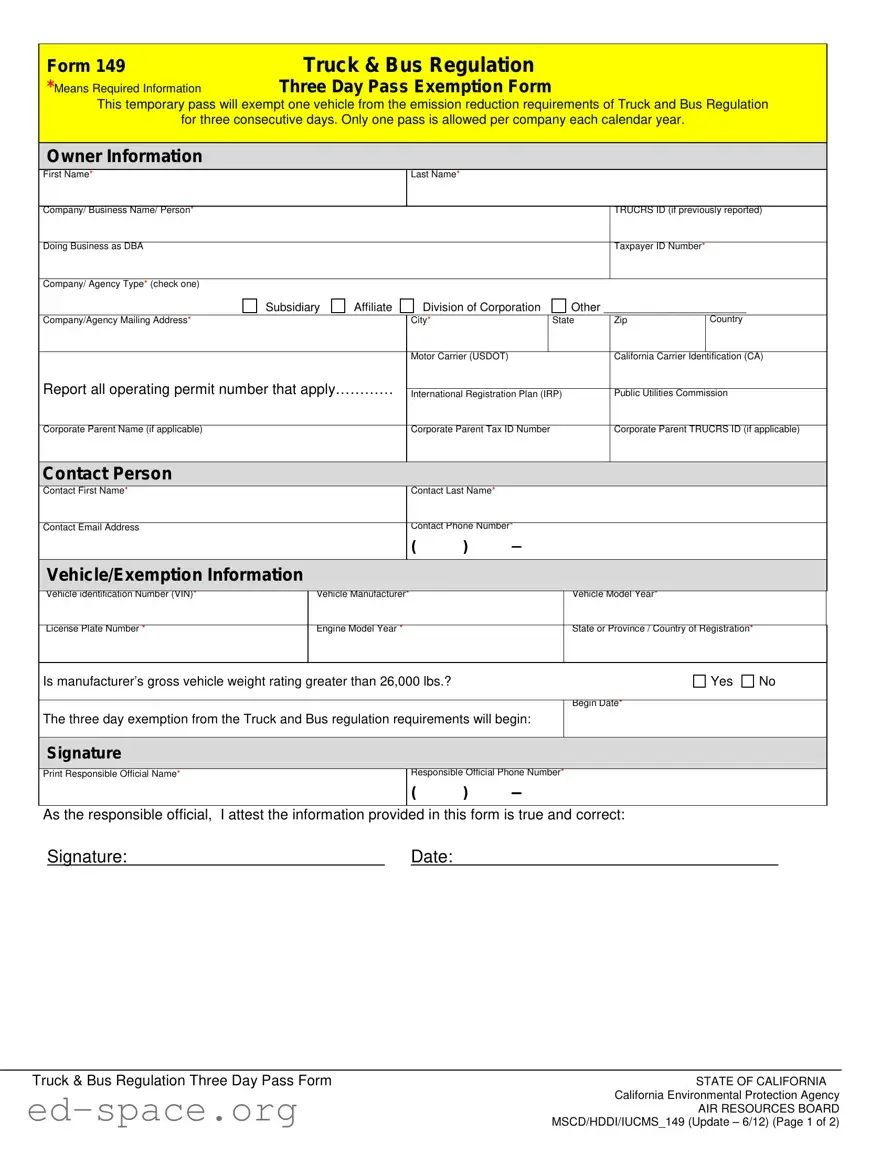
The California 149 form, also known as the Truck and Bus Regulation Three Day Pass Exemption Form, is an important tool for fleet owners needing temporary relief from emission reduction requirements. This form allows a single vehicle to operate in California for three consecutive days without meeting the state's stringent emissions standards. However, it is essential to note that each company is limited to one pass per calendar year. To obtain this pass, fleet owners must provide specific information, including vehicle details, company identification, and a designated start date for the exemption. The process requires submitting the completed form to the California Air Resources Board (ARB) at least three days before the vehicle's planned entry into the state. There are no mileage restrictions during the exemption period, but it is crucial to present a copy of the form upon request from ARB personnel to avoid potential penalties. Understanding when a Three Day Pass is necessary can save time and money, especially for those who need to bring noncompliant vehicles into California temporarily. This article will explore the form's requirements, the application process, and the scenarios in which a Three Day Pass is beneficial.
Form 149 |
Truck & Bus Regulation |
*Means Required Information |
Three Day Pass Exemption Form |
This temporary pass will exempt one vehicle from the emission reduction requirements of Truck and Bus Regulation
for three consecutive days. Only one pass is allowed per company each calendar year.
Owner Information
First Name* |
Last Name* |
|
|
|
|
Company/ Business Name/ Person* |
|
TRUCRS ID (if previously reported) |
|
|
|
Doing Business as DBA |
|
Taxpayer ID Number* |
|
|
|
Company/ Agency Type* (check one) |
|
|
Subsidiary
Affiliate
Division of Corporation
Other ______________________
Company/Agency Mailing Address* |
City* |
State |
Zip |
Country |
|
|
|
|
|
|
Motor Carrier (USDOT) |
|
California Carrier Identification (CA) |
|
Report all operating permit number that apply………… |
|
|
||
International Registration Plan (IRP) |
Public Utilities Commission |
|||
Corporate Parent Name (if applicable)
Corporate Parent Tax ID Number
Corporate Parent TRUCRS ID (if applicable)
Contact Person
Contact First Name*
Contact Email Address
Contact Last Name*
Contact Phone Number*
( ) −
Vehicle/Exemption Information
Vehicle identification Number (VIN)* |
Vehicle Manufacturer* |
Vehicle Model Year* |
|
|
|
License Plate Number * |
Engine Model Year * |
State or Province / Country of Registration* |
|
|
|
Is manufacturer’s gross vehicle weight rating greater than 26,000 lbs.?
Yes
No
The three day exemption from the Truck and Bus regulation requirements will begin:
Begin Date*
Signature
Print Responsible Official Name*
Responsible Official Phone Number*
( ) −
As the responsible official, I attest the information provided in this form is true and correct:
Signature: |
_ Date: |
_ |
||
|
|
|
|
|
Truck & Bus Regulation Three Day Pass Form |
STATE OF CALIFORNIA |
|
California Environmental Protection Agency |
|
AIR RESOURCES BOARD |
|
MSCD/HDDI/IUCMS_149 (Update – 6/12) (Page 1 of 2) |

What is a Three Day Pass?
A Three Day Pass is a temporary permit that allows a fleet owner to operate one vehicle per calendar year in California that does not meet the emission reduction requirements of the Truck and Bus regulation. The three day period begins at 12:00 am on the date you specify on the form.
How do I obtain a Three Day Pass?
You must complete a request form and submit the information to the Air Resources Board (ARB) three days prior to the vehicle entering California. The pass will be granted as long as it is the first request made by the fleet in the calendar year. If the ARB fails to respond by the date of the vehicles planned entry, the vehicle may operate in California for the requested
Mail the Request for the Three Day Pass to:
Truck & Bus Reporting, 5th Floor
PO BOX 2815
California Air Resources Board
Sacramento, CA 95812
You may also fax the form to our office at
Is there a limit on the number of miles I can operate under this pass?
There are no mileage limits for a vehicle operating during the three day period specified in an approved Three Day Pass.
Do I need a Three Day Pass?
If you reported the vehicle as part of your fleet to use the phase in option or flexibility options in the regulation, and your fleet is in compliance, you do not need a three day pass. The following are situations that you should use a three day pass:
•If you reported to use flexibility options but you need to temporarily bring a vehicle into California that you did not report.
•If you are using the model year schedule to comply (not required to report) and you want to temporarily bring a noncompliant truck into California. A summary of the engine model year schedule for heavier trucks is shown below
Engine Model Year Schedule for Heavier Trucks (More than 26,000 lb GVWR)
|
Engine year |
|
|
PM Filter by: |
|
|
2010 Engine by: |
|
|
|
|
|
|
|
|||
|
|
|
|
|
|
|
|
|
|
1993 & Older |
|
|
Not Required |
|
|
January 1, 2015 |
|
|
|
Not Required |
|
January 1, 2016 |
||||
|
|
|
|
|
|
|||
|
|
|
January 1, 2012 |
|
|
January 1, 2020 |
|
|
|
|
January 1, 2013 |
|
January 1, 2021 |
||||
|
|
|
|
|
|
|||
|
|
|
January 1, 2014 |
|
|
January 1, 2022 |
|
|
|
2007 & Newer |
|
Already Equipped |
|
January 1, 2023 |
|||
If your truck has a gross vehicle weight rating (GVWR) between 14,001 and 26,000 pounds your first compliance date is not until January 1, 2015. An overview of the Truck and Bus regulation compliance requirements are available at http://www.arb.ca.gov/msprog/onrdiesel/documents/FSRegSum.pdf.
If you have any questions or need help completing the form, please contact us at
| Fact Name | Details |
|---|---|
| Purpose of Form | The California 149 form is a temporary pass that allows a vehicle to be exempt from the emission reduction requirements of the Truck and Bus Regulation for three consecutive days. |
| Eligibility Limitations | Only one Three Day Pass is permitted per company each calendar year, ensuring that the exemption is not abused. |
| Submission Requirements | The form must be submitted to the California Air Resources Board (ARB) at least three days before the vehicle enters California. Failure to receive a response by the planned entry date allows the vehicle to operate under the exemption. |
| Contact Information | For assistance, individuals can contact the ARB at 866-6DIESEL (866-634-3735) or via email at [email protected]. |
| Governing Law | This form operates under the California Truck and Bus Regulation, as enforced by the California Environmental Protection Agency's Air Resources Board. |
Filling out the California 149 form is a straightforward process. This form is essential for obtaining a temporary exemption from emission reduction requirements for one vehicle in California. It’s important to provide accurate information to ensure the request is processed smoothly.
Once you submit the form, the California Air Resources Board will review your request. If it’s your first request for the calendar year, you should receive a response in time for your vehicle’s entry into California. Keep a copy of the form handy, as you may need to present it during inspections.
What is a Three Day Pass?
A Three Day Pass is a temporary permit that allows a fleet owner to operate one vehicle per calendar year in California that does not meet the emission reduction requirements of the Truck and Bus regulation. The three-day period begins at 12:00 am on the date specified on the form. This pass is designed to provide flexibility for fleet owners who may need to operate non-compliant vehicles for short periods.
How do I obtain a Three Day Pass?
To obtain a Three Day Pass, complete a request form and submit it to the Air Resources Board (ARB) at least three days before the vehicle enters California. The pass will be granted as long as it is the first request made by your fleet in that calendar year. If ARB does not respond by the planned entry date, the vehicle may operate under the requested pass. Ensure to keep a copy of the form handy, as ARB personnel may request to see it. You can mail, fax, or email the request to the ARB.
Is there a limit on the number of miles I can operate under this pass?
No, there are no mileage limits for a vehicle operating during the specified three-day period of an approved Three Day Pass. This allows for maximum flexibility in your operations without the worry of tracking mileage.
Do I need a Three Day Pass?
If you have reported the vehicle as part of your fleet and are in compliance with the phase-in or flexibility options of the regulation, you do not need a Three Day Pass. However, you should use the pass if you need to temporarily bring a vehicle into California that was not reported or if you want to bring a non-compliant truck into the state using the model year schedule.
What are the situations in which I should use a Three Day Pass?
You should consider using a Three Day Pass if you have reported to use flexibility options but need to bring in a vehicle that you did not previously report. Additionally, if you are following the model year schedule for compliance and need to temporarily bring a non-compliant truck into California, a Three Day Pass is necessary.
What is the Engine Model Year Schedule for heavier trucks?
The Engine Model Year Schedule for heavier trucks (those with a gross vehicle weight rating over 26,000 lbs) outlines compliance dates based on the engine year. For example, trucks with engine years from 2007 and newer are already equipped, while those from 1994-1995 are not required until January 1, 2016. This schedule helps fleet owners understand when compliance is necessary.
What if my truck has a GVWR between 14,001 and 26,000 pounds?
If your truck has a gross vehicle weight rating (GVWR) between 14,001 and 26,000 pounds, your first compliance date is not until January 1, 2015. This gives you additional time to prepare for compliance with the Truck and Bus regulation.
Where can I find more information about the Truck and Bus regulation compliance requirements?
For a comprehensive overview of the Truck and Bus regulation compliance requirements, you can visit the California Air Resources Board's website. They provide detailed documents and resources to help fleet owners understand their obligations and options.
Who can I contact for help with the form?
If you have questions or need assistance completing the form, you can reach out to the ARB at 866-6DIESEL (866-634-3735) or by email at [email protected]. They are available to help ensure that you have the correct information and guidance for your needs.
Failing to provide complete owner information. All fields marked with an asterisk (*) are mandatory. Missing any of these can delay processing.
Incorrectly entering the Vehicle Identification Number (VIN). Ensure that the VIN is accurate and matches the vehicle's registration documents.
Neglecting to specify the begin date for the exemption. This date is crucial as it marks the start of the three-day exemption period.
Providing an incorrect or outdated contact number. This can hinder communication between the Air Resources Board (ARB) and the applicant.
Not checking the appropriate company/agency type. This selection impacts the processing of the request and must accurately reflect the applicant’s status.
Omitting the license plate number of the vehicle. This detail is essential for identifying the vehicle associated with the exemption request.
Failing to sign the form. The signature of the responsible official is necessary to validate the information provided.
Submitting the form less than three days before the vehicle’s entry into California. The request must be submitted in advance to ensure approval.
Not keeping a copy of the submitted form. It is important to have documentation in case it is requested by ARB personnel during the three-day period.
The California 149 form, also known as the Truck & Bus Regulation Three Day Pass Exemption Form, is essential for fleet owners looking to operate vehicles that do not meet California's emission reduction requirements for a limited time. Along with this form, several other documents may be required to ensure compliance with state regulations. Here’s a brief overview of those documents.
Understanding these documents can help streamline the process of obtaining a Three Day Pass and ensure compliance with California's Truck and Bus Regulation. Proper documentation not only aids in legal compliance but also supports smooth operations within the state's regulatory framework.
When filling out the California 149 form, it is essential to follow specific guidelines to ensure accuracy and compliance. Below are seven important dos and don'ts to consider:
Understanding the California 149 form can be challenging, and several misconceptions often arise. Here are seven common misunderstandings about this important document:
By addressing these misconceptions, fleet owners can better navigate the requirements of the California 149 form and ensure compliance with the Truck and Bus Regulation.
Key Takeaways for Filling Out and Using the California 149 Form