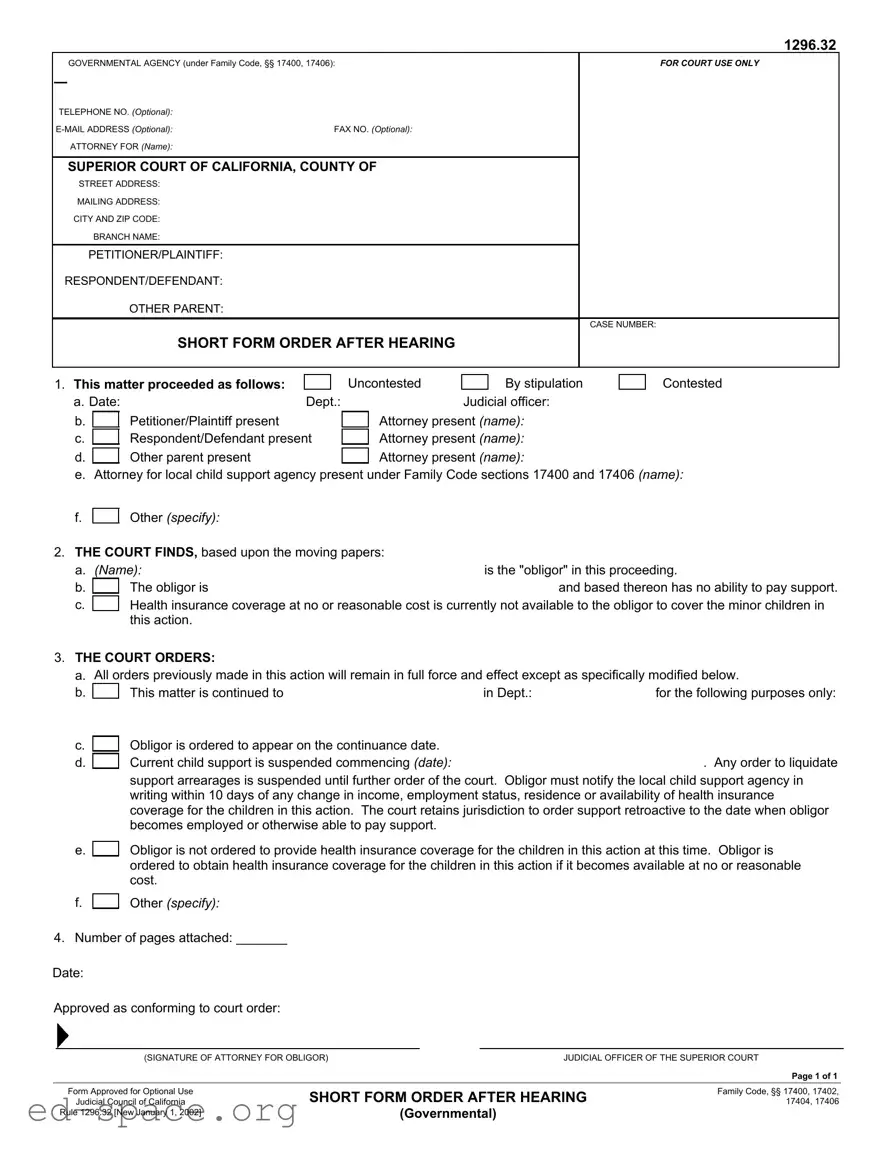
The California 1296 32 form, commonly referred to as the Short Form Order After Hearing, plays a crucial role in family law proceedings, particularly those involving child support matters. This form is utilized by the Superior Court of California and is designed to document the court's findings and orders following a hearing. It outlines essential information such as the identities of the parties involved, including the petitioner, respondent, and any other parents, as well as the case number and court details. The form facilitates the court's determination regarding the obligor's ability to pay child support, taking into account factors like employment status and health insurance coverage for the minor children. Importantly, it specifies whether the support obligations are contested or uncontested and includes provisions for future court appearances, the suspension of current child support, and the requirement for the obligor to notify the local child support agency of any changes in circumstances. Furthermore, the form ensures that all previous orders remain effective unless explicitly modified, thus maintaining continuity in the legal process. By providing a structured approach to documenting these proceedings, the California 1296 32 form serves as a vital tool for both the court and the parties involved in navigating the complexities of family law.
1296.32
GOVERNMENTAL AGENCY (under Family Code, §§ 17400, 17406): |
FOR COURT USE ONLY |
TELEPHONE NO. (Optional):
ATTORNEY FOR (Name):
SUPERIOR COURT OF CALIFORNIA, COUNTY OF
STREET ADDRESS:
MAILING ADDRESS:
CITY AND ZIP CODE:
BRANCH NAME:
PETITIONER/PLAINTIFF:
RESPONDENT/DEFENDANT:
OTHER PARENT:
CASE NUMBER:
SHORT FORM ORDER AFTER HEARING
1. This matter proceeded as follows:
a. Date: |
Dept.: |
||
b. |
|
|
Petitioner/Plaintiff present |
|
|
||
|
Respondent/Defendant present |
||
c. |
|
|
|
|
|
||
d. |
|
|
Other parent present |
Uncontested |
|
By stipulation |
|
Judicial officer: |
|
Attorney present (name):
Attorney present (name):
Attorney present (name):
Contested
e. Attorney for local child support agency present under Family Code sections 17400 and 17406 (name):
f.
Other (specify):
2. THE COURT FINDS, based upon the moving papers:
a. |
(Name): |
is the "obligor" in this proceeding. |
|
b. |
|
The obligor is |
and based thereon has no ability to pay support. |
|
|
|
|
c. |
|
Health insurance coverage at no or reasonable cost is currently not available to the obligor to cover the minor children in |
|
|
|
this action. |
|
3.THE COURT ORDERS:
a. All orders previously made in this action will remain in full force and effect except as specifically modified below.
b.
This matter is continued to |
in Dept.: |
for the following purposes only: |
c.
d.
e.
f.
Obligor is ordered to appear on the continuance date. |
|
Current child support is suspended commencing (date): |
. Any order to liquidate |
support arrearages is suspended until further order of the court. Obligor must notify the local child support agency in writing within 10 days of any change in income, employment status, residence or availability of health insurance coverage for the children in this action. The court retains jurisdiction to order support retroactive to the date when obligor becomes employed or otherwise able to pay support.
Obligor is not ordered to provide health insurance coverage for the children in this action at this time. Obligor is ordered to obtain health insurance coverage for the children in this action if it becomes available at no or reasonable cost.
Other (specify):
4.Number of pages attached: _______
Date:
Approved as conforming to court order:
(SIGNATURE OF ATTORNEY FOR OBLIGOR) |
JUDICIAL OFFICER OF THE SUPERIOR COURT |
||
|
|
|
Page 1 of 1 |
|
|
|
|
Form Approved for Optional Use |
SHORT FORM ORDER AFTER HEARING |
Family Code, §§ 17400, 17402, |
|
Judicial Council of California |
17404, 17406 |
||
Rule 1296.32 [New January 1, 2002] |
|
(Governmental) |
|
| Fact Name | Details |
|---|---|
| Governing Law | The California 1296.32 form is governed by Family Code sections 17400 and 17406. |
| Purpose | This form is used to document court orders related to child support proceedings. |
| Form Type | It is classified as a "Short Form Order After Hearing" for governmental agencies. |
| Optional Information | Telephone number, email address, and fax number are optional fields on the form. |
| Petitioner and Respondent | The form requires identification of the petitioner/plaintiff and the respondent/defendant. |
| Obligor Definition | The term "obligor" refers to the individual responsible for child support payments in the proceeding. |
| Health Insurance Coverage | The court assesses the availability of health insurance for minor children and may order coverage. |
| Notification Requirement | The obligor must inform the local child support agency of any changes in income or employment status within 10 days. |
| Continuance | The form allows for the continuation of the matter to a later date for specific purposes. |
Filling out the California 1296.32 form is an important step in the legal process related to child support matters. After completing the form, it will need to be submitted to the appropriate court. Ensure that all information is accurate and complete to avoid delays.
What is the California 1296 32 form?
The California 1296 32 form, also known as the Short Form Order After Hearing, is used in family law cases. It is specifically designed for situations involving child support and is utilized by the court to document findings and orders made during a hearing. This form ensures that all parties involved understand the court's decisions regarding child support obligations and related matters.
Who uses the California 1296 32 form?
This form is primarily used by the Superior Court of California, along with attorneys representing either the obligor (the person responsible for paying child support) or the local child support agency. It serves as a formal record of the court's findings and orders following a hearing, making it essential for both legal professionals and the parties involved.
What information is required on the form?
The form requires several key pieces of information, including the names of the petitioner, respondent, and other parent, as well as the case number. Additionally, it captures details about the hearing, such as the date, department, and presence of attorneys. The court's findings regarding the obligor's ability to pay support and health insurance coverage are also documented.
What happens if the obligor cannot pay support?
If the court finds that the obligor has no ability to pay support, the current child support payments may be suspended. The court may also suspend any orders to liquidate support arrearages until further notice. This provides some relief to the obligor while ensuring that the court retains jurisdiction to order support retroactively if circumstances change.
What are the obligations of the obligor after the hearing?
The obligor is required to notify the local child support agency in writing within 10 days of any changes in income, employment status, residence, or availability of health insurance for the children. This ensures that the court can adjust support orders as necessary based on the obligor's circumstances.
Is health insurance coverage for the children required?
At the time of the hearing, the obligor may not be ordered to provide health insurance coverage for the children if it is not available at no or reasonable cost. However, if such coverage becomes available, the obligor is ordered to obtain it. This provision helps ensure that children's health needs are met while considering the obligor's financial situation.
What should I do if I have questions about the form?
If you have questions about the California 1296 32 form or its implications, it is advisable to consult with a family law attorney. They can provide guidance specific to your situation and help you understand your rights and obligations under the court's orders.
How can I obtain the California 1296 32 form?
The California 1296 32 form can be obtained from the California Judicial Council's website or directly from your local Superior Court. Ensure that you are using the most current version of the form, as updates may occur. Accessing the form online can simplify the process of filling it out correctly.
Incomplete Information: Failing to fill out all required fields can lead to delays. Ensure all sections, such as names and addresses, are fully completed.
Incorrect Case Number: Providing the wrong case number can cause confusion. Double-check the number to ensure it matches the court documents.
Missing Signatures: Not signing the form can result in it being rejected. Make sure all necessary parties sign where indicated.
Ignoring Deadlines: Submitting the form after the deadline can have serious consequences. Pay attention to all due dates associated with the filing.
Failure to Notify Changes: Not informing the local child support agency of changes in income or health insurance can lead to legal issues. This notification must occur within 10 days.
Improper Formatting: Using incorrect formatting for dates or addresses can create confusion. Follow the specified format closely to avoid errors.
Neglecting to Attach Required Documents: Failing to attach necessary supporting documents can hinder the process. Always check what additional paperwork is needed before submission.
The California 1296.32 form is often accompanied by several other documents that help facilitate legal proceedings related to child support and custody. Below are five common forms and documents that may be used alongside the 1296.32 form.
These documents work together to provide a comprehensive view of the case, ensuring that the court has all necessary information to make informed decisions regarding child support and custody matters. Properly preparing and submitting these forms can help facilitate a smoother legal process.
The California 1296.32 form is a specific document used in family law cases, particularly those involving child support. Several other forms share similarities in purpose or structure. Here’s a look at nine documents that are comparable to the 1296.32 form:
Each of these forms plays a crucial role in family law proceedings, addressing various aspects of child support and related issues. Understanding their similarities can help individuals navigate the legal landscape more effectively.
When filling out the California 1296.32 form, it is essential to follow specific guidelines to ensure accuracy and compliance. Below is a list of things you should and shouldn't do.
Following these guidelines can help avoid delays or complications in your case. It is crucial to act promptly and ensure that everything is in order.
Understanding the California 1296.32 form can be challenging. Here are five common misconceptions about this form:
Being informed about these misconceptions can lead to better understanding and preparation when dealing with the California 1296.32 form.
Here are key takeaways regarding the California 1296.32 form: