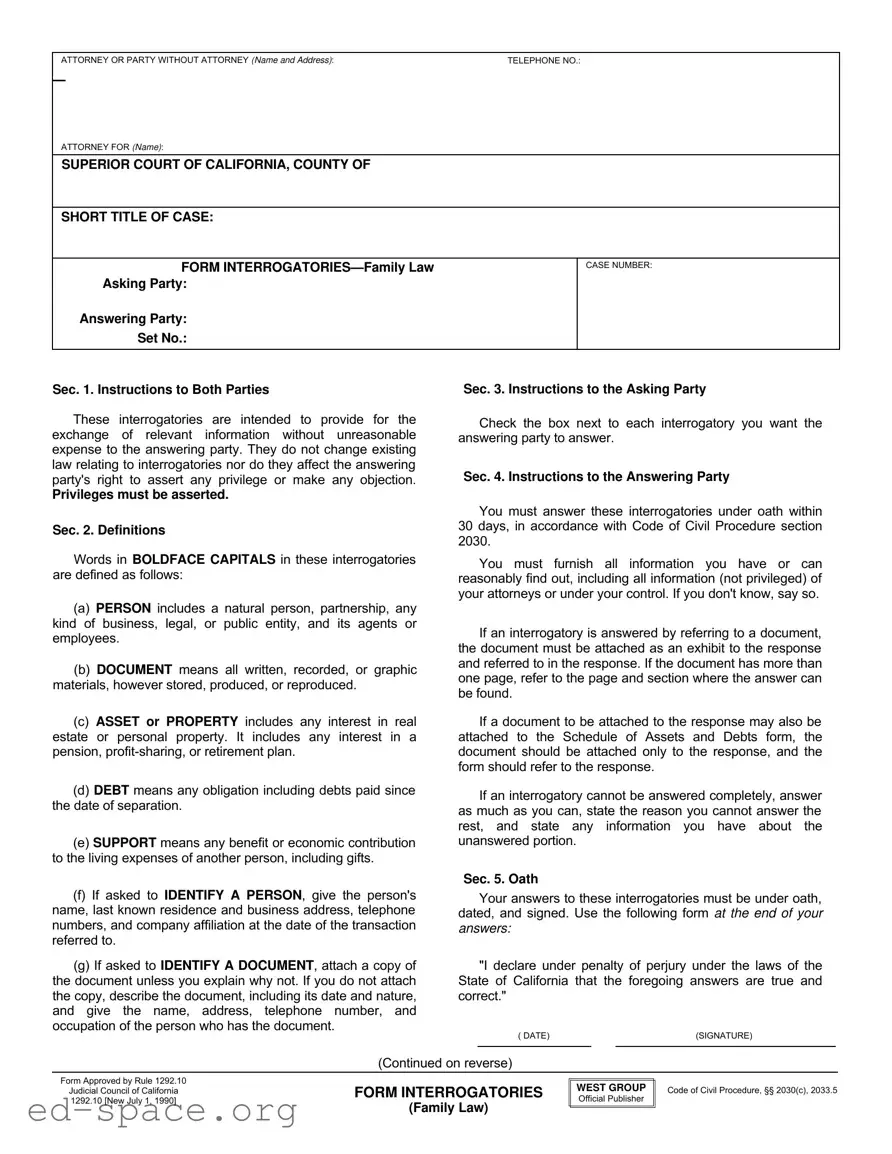
The California 1292 10 form serves as a vital tool in family law proceedings, facilitating the exchange of essential information between parties involved in a case. Designed specifically for interrogatories, this form allows the asking party to request relevant details from the answering party without imposing undue financial burdens. It outlines clear instructions for both sides, ensuring that the process is straightforward and efficient. The form includes sections that define key terms such as "person," "document," and "asset," which helps clarify the expectations for responses. It also emphasizes the importance of providing complete and truthful answers under oath, with a strict deadline of 30 days for submission. By detailing personal history, agreements, income, and support obligations, the form aims to gather comprehensive data necessary for fair resolution in family law matters. Ultimately, the California 1292 10 form plays a crucial role in promoting transparency and accountability during legal proceedings, ensuring that all parties are adequately informed and prepared to navigate the complexities of family law.

ATTORNEY OR PARTY WITHOUT ATTORNEY (Name and Address): |
TELEPHONE NO.: |
ATTORNEY FOR (Name):
SUPERIOR COURT OF CALIFORNIA, COUNTY OF
SHORT TITLE OF CASE:
FORM
Answering Party:
Set No.:
CASE NUMBER:
Sec. 1. Instructions to Both Parties
These interrogatories are intended to provide for the exchange of relevant information without unreasonable expense to the answering party. They do not change existing law relating to interrogatories nor do they affect the answering party's right to assert any privilege or make any objection.
Privileges must be asserted.
Sec. 2. Definitions
Words in BOLDFACE CAPITALS in these interrogatories are defined as follows:
(a)PERSON includes a natural person, partnership, any kind of business, legal, or public entity, and its agents or employees.
(b)DOCUMENT means all written, recorded, or graphic materials, however stored, produced, or reproduced.
(c)ASSET or PROPERTY includes any interest in real estate or personal property. It includes any interest in a pension,
Sec. 3. Instructions to the Asking Party
Check the box next to each interrogatory you want the answering party to answer.
Sec. 4. Instructions to the Answering Party
You must answer these interrogatories under oath within
30 days, in accordance with Code of Civil Procedure section 2030.
You must furnish all information you have or can reasonably find out, including all information (not privileged) of your attorneys or under your control. If you don't know, say so.
If an interrogatory is answered by referring to a document, the document must be attached as an exhibit to the response and referred to in the response. If the document has more than one page, refer to the page and section where the answer can be found.
If a document to be attached to the response may also be attached to the Schedule of Assets and Debts form, the document should be attached only to the response, and the form should refer to the response.
(d)DEBT means any obligation including debts paid since the date of separation.
(e)SUPPORT means any benefit or economic contribution to the living expenses of another person, including gifts.
(f)If asked to IDENTIFY A PERSON, give the person's name, last known residence and business address, telephone numbers, and company affiliation at the date of the transaction referred to.
(g)If asked to IDENTIFY A DOCUMENT, attach a copy of the document unless you explain why not. If you do not attach the copy, describe the document, including its date and nature, and give the name, address, telephone number, and occupation of the person who has the document.
If an interrogatory cannot be answered completely, answer as much as you can, state the reason you cannot answer the rest, and state any information you have about the unanswered portion.
Sec. 5. Oath
Your answers to these interrogatories must be under oath, dated, and signed. Use the following form at the end of your answers:
"I declare under penalty of perjury under the laws of the State of California that the foregoing answers are true and correct."
( DATE) |
(SIGNATURE) |
|
|
|
|
(Continued on reverse)
Form Approved by Rule 1292.10
Judicial Council of California 1292.10 [New July 1, 1990]
FORM INTERROGATORIES
(Family Law)
WEST GROUP
Official Publisher
Code of Civil Procedure, §§ 2030(c), 2033.5

1. Personal History. State your full name, current residence address and work address, social security number, any other names you have used, and the dates between which you used each name.
2. Agreements. Are there any agreements between you and your spouse made before or during your marriage or after your separation that affect the disposition of ASSETS, DEBTS, or SUPPORT in this proceeding? If your answer is yes, for each agreement, state the date made and whether it was written or oral, and attach a copy of the agreement or describe its content.
3. Legal Actions. Are you a party or do you anticipate being a party to any legal or administrative proceeding other than this action? If your answer is yes, state your role and the name, jurisdiction, case number, and a brief description of each proceeding.
4. Persons Sharing Residence. State the name, age, and relationship to you of each person at your present address.
5. Support Provided Others. State the name, age, address, and relationship to you of each PERSON for whom you have provided SUPPORT during the past 12 months and the amount provided per month for each.
6. Support Received for Others. State the name, age, address, and relationship to you of each PERSON for whom you have received SUPPORT during the past twelve months and the amount received per month for each.
7. Current Income. List all income you received during the past 12 months, its source, the basis for its computation, and the total amount received from each. Attach your last three pay check stubs.
8. Other Income. During the past three years have you received cash or other property from any source not identified in 7? If so, list the source, the date, and the nature and value of the property.
9. Tax Returns. Attach copies of all tax returns and schedules filed by or for you in any jurisdiction for the past three calendar years.
10. Schedule of Assets and Debts. Complete the Schedule of Assets and Debts form served with these interrogatories.
11. Separate Property Contentions. State the facts that support your contention an asset or debt is separate property.
12. Property Valuations. Have you had written appraisals or offers to purchase during the past 12 months on any of the assets listed on your completed Schedule of Assets and Debts. If your answer is yes,
IDENTIFY THE DOCUMENT.
13. Property Held by Others. Is there any PROPERTY held by any third party in which you have any interest or over which you have any control? If your answer is yes, indicate whether the property is shown on the Schedule of Assets and Debts completed by you. If it is not, describe and identify each such asset and state its present value and the basis for your valuation, and IDENTIFY THE PERSON holding the asset.
14. Retirement and Other Benefits. Do you have an interest in any disability, retirement, profit sharing, or deferred compensation plan? If your answer is yes, IDENTIFY each plan and provide the name, address, and telephone number of the administrator and custodian of records.
15. Claims of Reimbursement. Do you claim the legal right to be reimbursed for any expenditures of your separate or community property? If your answer is yes, state all supporting facts.
16. Credits. Do you claim reimbursement credits for payments of community debts since the date of separation? If your answer is yes, IDENTIFY the source of payment, the creditor, the date paid, and the amount paid. State whether you have added to the debt since the separation.
17. Insurance. IDENTIFY each health, life, automobile, and disability insurance policy or plan that you now own or that covers you, your children, or your assets. State the policy type, policy number, and name of company. IDENTIFY the agent and give the address.
18. Health. Is there any physical or emotional condition that limits your ability to work? If your answer is yes, state each fact on which you base your answer.
19. Children's Needs. Do you contend your children have any special needs? If so, identify the child with the need, the reason for the need, its cost, and its expected duration.
20. Attorney Fees. State the total amount of attorney fees and costs incurred by you in this proceeding, the amount paid, the source of money paid, and describe the billing arrangements.
21. Gifts. List any gifts you have made without the consent of your spouse in the past 24 months, their value, and the recipients.
1292.10 [New July 1, 1990]
FORM INTERROGATORIES
(Family Law)
WEST GROUP
Official Publisher
Page two
| Fact Name | Description |
|---|---|
| Governing Law | The California 1292.10 form is governed by the Code of Civil Procedure, sections 2030(c) and 2033.5. |
| Purpose | This form facilitates the exchange of relevant information between parties in family law cases. |
| Response Time | The answering party must respond under oath within 30 days of receiving the interrogatories. |
| Definition of Terms | Key terms like PERSON, DOCUMENT, and ASSET are defined in the form to ensure clarity. |
| Attachment Requirement | If a document is referenced in a response, it must be attached as an exhibit to the response. |
| Oath Requirement | All answers must be signed and dated, declaring the truthfulness under penalty of perjury. |
Completing the California 1292 10 form requires careful attention to detail. This form is part of the discovery process in family law cases, facilitating the exchange of information between parties. Below are the steps to fill out the form accurately.
After filling out the form, review it carefully for any errors or omissions. Once confirmed, submit the form as instructed, ensuring that you meet any deadlines set by the court. Keep a copy for your records.
What is the purpose of the California 1292 10 form?
The California 1292 10 form is designed to facilitate the exchange of relevant information between parties involved in family law proceedings. It aims to ensure that both parties can provide necessary details regarding assets, debts, and support without incurring excessive costs. This form does not alter existing laws regarding interrogatories and preserves the right of the answering party to assert any privileges or objections.
How do I fill out the California 1292 10 form?
To complete the form, you must first provide your personal information, including your name, address, and contact details. You will then check the boxes next to each interrogatory that you want the other party to answer. Each interrogatory requires specific information, such as details about agreements, legal actions, and financial support. Make sure to attach any relevant documents as exhibits and ensure your answers are under oath, dated, and signed at the end of the form.
What happens if I do not respond to the interrogatories?
If you fail to respond to the interrogatories within the required 30 days, you may face legal consequences. The asking party could seek a court order compelling you to respond, and you may also be subject to sanctions. It is crucial to provide complete and timely answers to avoid potential penalties and to protect your rights in the proceedings.
Can I assert privileges when responding to the California 1292 10 form?
Yes, you can assert privileges when responding to the interrogatories. If certain information is privileged, such as communications with your attorney, you should clearly state this in your response. It is important to articulate the basis for any privilege claimed, as this will help maintain your rights while complying with the form's requirements.
What should I do if I cannot fully answer an interrogatory?
If you are unable to fully answer an interrogatory, you should respond to the best of your ability. Provide as much information as you can, explain the reasons for any incomplete answers, and include any information you do have about the unanswered portion. This approach demonstrates your good faith effort to comply with the form while protecting your interests.
Failing to provide complete contact information for the attorney or party without attorney. This includes the name, address, and telephone number.
Not checking the box next to each interrogatory that requires an answer. This can lead to incomplete submissions.
Missing the 30-day deadline to answer the interrogatories. Responses must be submitted under oath within this time frame.
Forgetting to attach required documents. If a response refers to a document, that document must be included as an exhibit.
Neglecting to clearly identify any PERSON or DOCUMENT as instructed. Provide full details as requested.
Not stating the reasons for any unanswered interrogatories. If an interrogatory cannot be fully answered, explain why.
Failing to sign and date the responses. All answers must be under oath and include a declaration.
Providing vague or incomplete information about ASSETS, DEBTS, or SUPPORT. Be specific and detailed.
Overlooking the need to identify any RETIREMENT or other benefits. This includes providing details about each plan.
Not keeping copies of submitted forms. Always retain a copy for personal records and future reference.
The California 1292 10 form, often referred to as the Form Interrogatories for Family Law, plays a crucial role in family law cases. It allows parties to exchange relevant information efficiently. Alongside this form, there are several other documents that are commonly used to ensure a comprehensive understanding of the case. Below are four key documents that often accompany the California 1292 10 form.
Understanding these accompanying documents is vital for anyone navigating family law proceedings in California. Each form serves a specific purpose, contributing to a clearer picture of the case and ensuring that all parties are on the same page. By being well-prepared and informed, individuals can approach their legal matters with confidence and clarity.
The California 1292 10 form is a set of interrogatories used in family law cases to gather information from the parties involved. Several other legal documents serve similar purposes in various contexts. Here are ten documents that share similarities with the California 1292 10 form:
When filling out the California 1292 10 form, there are several important dos and don'ts to keep in mind.
Misunderstandings about the California 1292 10 form can lead to confusion during family law proceedings. Here are seven common misconceptions:
Understanding these misconceptions can help parties navigate the family law process more effectively and ensure compliance with legal requirements.
The California 1292.10 form is designed to facilitate the exchange of important information between parties in family law cases. It aims to minimize unnecessary expenses for the responding party.
It is essential for the asking party to check the box next to each interrogatory they wish the answering party to respond to. This ensures clarity and focus on the information needed.
The answering party must provide their responses under oath within 30 days. This requirement underscores the importance of honesty and accuracy in the information provided.
If the answering party is unable to fully answer an interrogatory, they should provide as much information as possible and explain why they cannot complete the answer. This transparency can help maintain trust between parties.
When asked to identify a person or document, the responding party must either attach the document or provide a detailed description, including relevant dates and the individual who possesses the document. This requirement helps in verifying claims.
All responses must be dated and signed, along with a declaration affirming the truthfulness of the information provided. This declaration carries legal weight and emphasizes the seriousness of the responses.
It is important to gather and attach supporting documents, such as tax returns and pay stubs, as required by the interrogatories. These documents substantiate the information provided and strengthen the case.
Understanding the definitions provided in the form is crucial. Terms such as PERSON, DOCUMENT, and ASSET are clearly defined to ensure both parties have a mutual understanding of what is being requested.