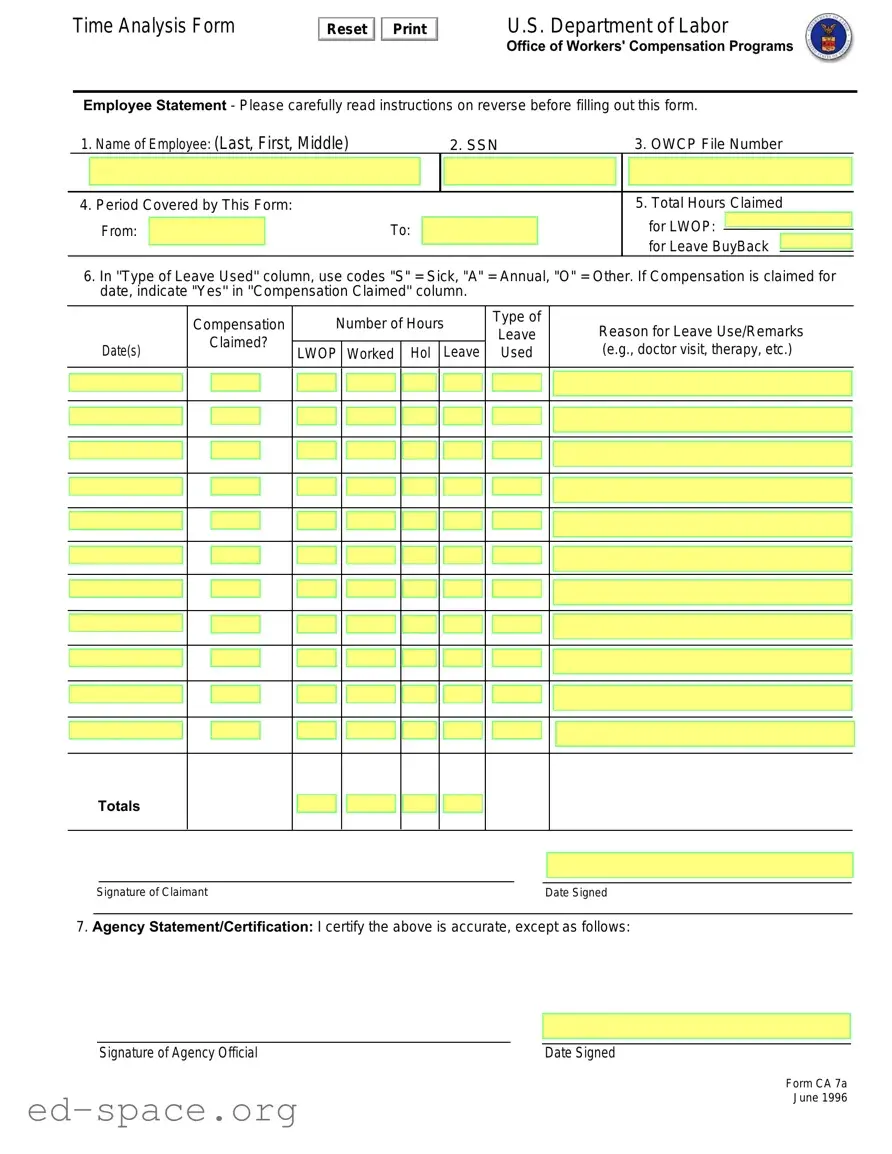
The CA-7A form serves as a critical tool for employees seeking compensation under the Federal Employees' Compensation Act (FECA). This form is specifically designed for individuals claiming compensation for leave without pay (LWOP) and for those wishing to repurchase paid leave. It is essential for employees to accurately complete the form when claiming compensation for multiple consecutive periods of leave, ensuring that all relevant details are included. The form requires basic personal information, such as the employee's name, Social Security number, and OWCP file number, alongside specific dates covering the leave period. Employees must also report the total hours claimed for LWOP, as well as the type of leave utilized—whether sick, annual, or other—using designated codes. Additionally, the form mandates a clear indication of whether compensation is claimed for each date listed, supported by medical evidence where necessary. Finally, the agency's certification is required to verify the accuracy of the information provided, making the CA-7A not just a claim form but a comprehensive record that ensures accountability and clarity in the compensation process.
Time Analysis Form
Reset
U.S. Department of Labor
Office of Workers' Compensation Programs
Employee Statement - Please carefully read instructions on reverse before filling out this form.
1. Name of Employee: (Last, First, Middle) |
|
2. SSN |
|
3. OWCP File Number |
|
|
|
|
|
|
|
4. Period Covered by This Form:
From: |
|
To: |
|
|
|
5. Total Hours Claimed
for LWOP: for Leave BuyBack
6.In ''Type of Leave Used'' column, use codes "S" = Sick, "A" = Annual, "O" = Other. If Compensation is claimed for date, indicate "Yes'' in ''Compensation Claimed'' column.
Date(s)
Compensation
Claimed?
Number of Hours
LWOP Worked Hol Leave
Type of
Leave
Used
Reason for Leave Use/Remarks (e.g., doctor visit, therapy, etc.)
Totals
Signature of Claimant |
Date Signed |
7. Agency Statement/Certification: I certify the above is accurate, except as follows:
Signature of Agency Official |
Date Signed |
Form CA 7a June 1996

Instructions for Completing Form
Time Analysis
General: This form is used when claiming FECA compensation, including repurchase of paid leave. It must be used when claiming compensation for more than one consecutive period of leave.
Instructions for Employee:
Blocks 1, 2, and 3:
Block 4: Indicate beginning and ending dates covered by this form. These must be the same as on Forms
Block 5: If claiming compensation for any dates detailed in block 4, state total number of hours claimed for leave without pay and total number of hours of leave. This should be at least 10 hours unless this is your final claim.
Block 6:
1st Column: |
Show full date. |
2nd Column: |
For each date noted in column 1, state "Y" if you are claiming compensation |
|
for that date and "N'' if you are not. |
3rd, 4th, |
Show the number of hours of LWOP, number of hours worked, paid |
5th and 6th |
|
Columns: |
holiday hours, and number of hours of paid leave. |
7th Column: |
Using the legend provided, indicate the type of leave used. |
8th Column: |
State the reason you were off work. For each date for which compensation |
|
is claimed, there must be medical evidence supporting entitlement. |
Sign and Date Form and Submit to the Appropriate Agency Official.
Instructions for Employing Agency:
Block 7: Verify accuracy of hours and status for each date listed. If challenging entitlement for any date, attempt to resolve discrepancies prior to submitting claim to OWCP. If discrepancy cannot be resolved, indicate the specific basis for the challenge in the space provided.
| Fact Name | Description |
|---|---|
| Purpose | The CA-7A form is used to claim compensation under the Federal Employees' Compensation Act (FECA). It is specifically for reporting leave without pay (LWOP) and leave buyback. |
| Governing Law | This form is governed by the Federal Employees' Compensation Act (FECA) and related regulations. |
| Required Information | Employees must provide their name, Social Security Number, OWCP file number, and the period covered by the claim. |
| Leave Codes | In the "Type of Leave Used" section, employees should use the following codes: "S" for Sick, "A" for Annual, and "O" for Other. |
| Compensation Claim | Employees must indicate if compensation is claimed for specific dates by marking "Yes" or "No" in the appropriate column. |
| Medical Evidence | For each date compensation is claimed, employees need to provide medical evidence to support their entitlement. |
| Submission Process | After completing the form, employees must sign and date it before submitting it to the appropriate agency official for verification. |
Filling out the CA-7A form requires careful attention to detail. Once completed, this form is submitted to the appropriate agency for processing. Ensure that all information is accurate and complete to avoid delays in your claim.
What is the purpose of the CA-7A form?
The CA-7A form is used by employees to claim compensation under the Federal Employees' Compensation Act (FECA). This includes situations where an employee is seeking to repurchase paid leave or when claiming leave without pay (LWOP) for periods of work-related injury or illness. The form helps to document the total hours of leave taken and provides necessary details for the Office of Workers' Compensation Programs (OWCP) to process the claim.
What information do I need to provide on the CA-7A form?
When completing the CA-7A form, you will need to provide your name, Social Security Number (SSN), and OWCP file number. Additionally, you must indicate the period covered by the form, the total hours claimed for leave without pay, and the type of leave used. Each date for which you are claiming compensation must be detailed, including the number of hours worked, hours of leave taken, and the reason for the leave. It is essential to ensure that the information is accurate and corresponds with other forms, such as CA-7 and CA-7b.
How do I indicate the type of leave used on the CA-7A form?
In the "Type of Leave Used" column of the CA-7A form, you should use specific codes to denote the type of leave. The codes are as follows: "S" for Sick leave, "A" for Annual leave, and "O" for Other leave. It is important to use these codes correctly to ensure that your claim is processed without delays.
What should I do if I have discrepancies in my leave records?
If you find discrepancies in your leave records, it is advisable to address them before submitting the CA-7A form. The employing agency is responsible for verifying the accuracy of the hours and status for each date listed. If any issues arise that cannot be resolved, the agency must indicate the specific reasons for the challenge on the form. This proactive approach can help streamline the claims process.
Is medical evidence required when claiming compensation on the CA-7A form?
Yes, medical evidence is required to support your claim for compensation on the CA-7A form. For each date that compensation is claimed, you must provide documentation that verifies your entitlement to the leave. This evidence is crucial for the OWCP to evaluate your claim accurately and ensure that you receive the appropriate benefits.
Neglecting to read the instructions: Many people overlook the importance of reading the instructions on the back of the form. This can lead to incomplete or incorrect submissions.
Incorrectly filling out personal information: Providing inaccurate details in blocks 1, 2, and 3 can cause delays. Ensure your name, Social Security Number, and OWCP file number are correct.
Not aligning dates: The dates in block 4 must match those on Forms CA-7 and CA-7b. Discrepancies can lead to confusion and potential claim denials.
Claiming fewer than 10 hours: If you are claiming compensation, ensure you state at least 10 hours in block 5, unless this is your final claim. Omitting this can result in rejection.
Misusing leave type codes: In block 6, make sure to use the correct codes for leave types. Using "S" for Sick, "A" for Annual, and "O" for Other is crucial for accurate processing.
Failing to indicate compensation claimed: In block 6, remember to mark "Y" for yes or "N" for no regarding compensation claims for each date. Missing this step can lead to misunderstandings.
Not providing medical evidence: For each date you claim compensation, you need medical documentation. Lack of evidence can result in denied claims.
Forgetting to sign and date the form: It might seem simple, but failing to sign and date the form can invalidate your submission. Always double-check before sending it off.
Inaccurate agency certification: The agency statement in block 7 must be accurate. If there are discrepancies, they should be resolved before submission to avoid complications.
Not keeping copies of submitted forms: After submitting the CA-7A form, it's wise to keep a copy for your records. This can be helpful if any questions arise later.
The CA-7A form is a crucial document for employees claiming compensation under the Federal Employees' Compensation Act (FECA). It serves to analyze time off work due to injury or illness, detailing hours of leave without pay and types of leave used. Along with the CA-7A, several other forms and documents are often necessary to support a compensation claim. Each of these documents plays a specific role in ensuring that the claim is complete and accurate.
Each of these forms and documents contributes to a comprehensive understanding of the employee's situation and ensures that all necessary information is available for the processing of the claim. Properly completing and submitting these forms can significantly impact the outcome of a compensation request.
When filling out the CA-7A form, it's important to follow specific guidelines to ensure your claim is processed smoothly. Here are four things you should and shouldn't do:
Understanding the CA-7A form can be challenging, and several misconceptions often arise. Here are four common misunderstandings about this form:
Here are six key takeaways regarding the CA-7A form: