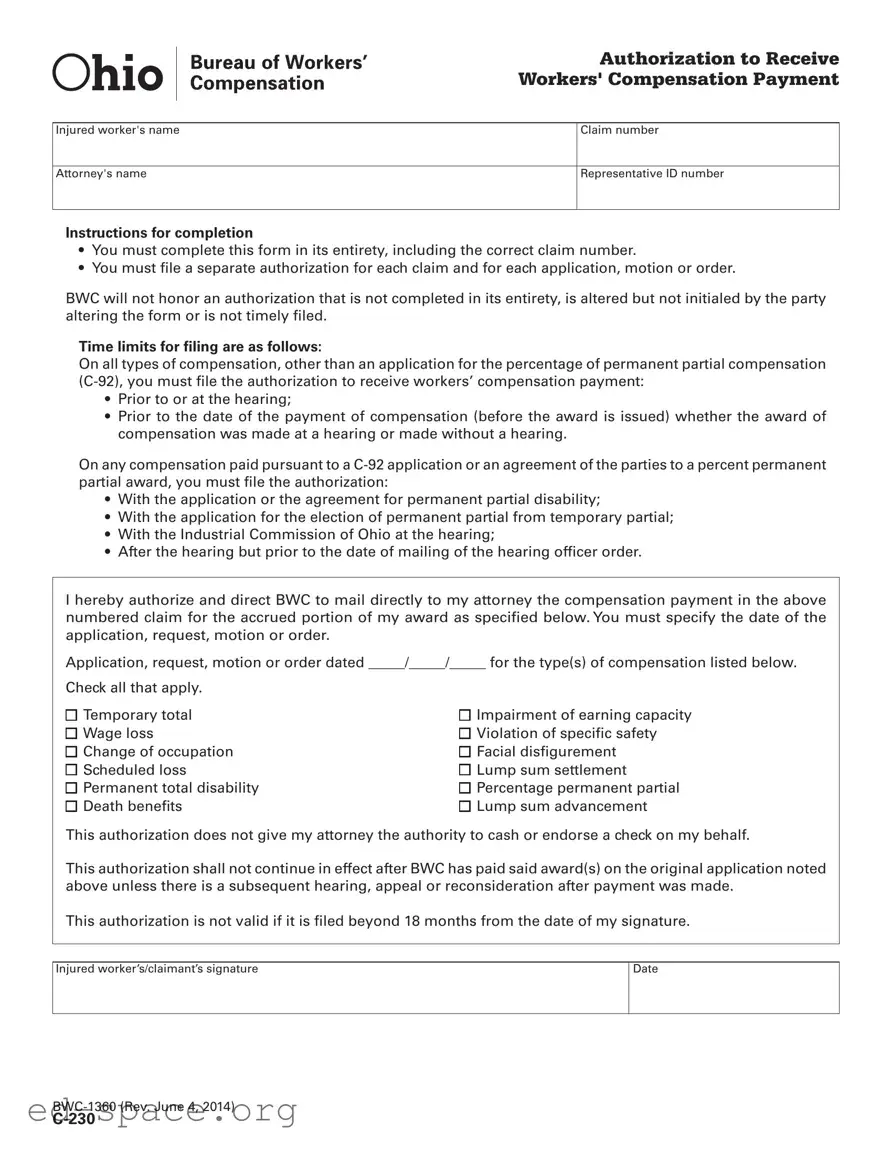
The C 230 Ohio form serves as a crucial document for individuals navigating the workers' compensation system in Ohio. It allows injured workers to authorize their attorneys to receive compensation payments directly from the Bureau of Workers' Compensation (BWC). To ensure the form is valid, it must be completed in full, including the correct claim number, and submitted for each specific claim or application. Timeliness is essential; the form must be filed prior to hearings or payment dates, depending on the type of compensation being requested. Various types of compensation can be specified on the form, including temporary total disability, wage loss, and permanent partial disability, among others. Importantly, the authorization does not grant the attorney the ability to cash or endorse checks on behalf of the injured worker. Once the BWC has processed the payments, the authorization ceases to be effective unless further actions, such as appeals or hearings, are initiated. Additionally, the form is only valid if filed within 18 months from the date of the worker's signature, emphasizing the need for prompt and accurate submission.
Authorization to Receive Workers' Compensation Payment
Injured worker's name
Attorney's name
Claim number
Representative ID number
Instructions for completion
•You must complete this form in its entirety, including the correct claim number.
•You must file a separate authorization for each claim and for each application, motion or order.
BWC will not honor an authorization that is not completed in its entirety, is altered but not initialed by the party altering the form or is not timely filed.
Time limits for filing are as follows:
On all types of compensation, other than an application for the percentage of permanent partial compensation
•Prior to or at the hearing;
•Prior to the date of the payment of compensation (before the award is issued) whether the award of compensation was made at a hearing or made without a hearing.
On any compensation paid pursuant to a
•With the application or the agreement for permanent partial disability;
•With the application for the election of permanent partial from temporary partial;
•With the Industrial Commission of Ohio at the hearing;
•After the hearing but prior to the date of mailing of the hearing officer order.
I hereby authorize and direct BWC to mail directly to my attorney the compensation payment in the above numbered claim for the accrued portion of my award as specified below. You must specify the date of the application, request, motion or order.
Application, request, motion or order dated _____/_____/_____ for the type(s) of compensation listed below.
Check all that apply.
Temporary total |
Impairment of earning capacity |
Wage loss |
Violation of specific safety |
Change of occupation |
Facial disfigurement |
Scheduled loss |
Lump sum settlement |
Permanent total disability |
Percentage permanent partial |
Death benefits |
Lump sum advancement |
This authorization does not give my attorney the authority to cash or endorse a check on my behalf.
This authorization shall not continue in effect after BWC has paid said award(s) on the original application noted above unless there is a subsequent hearing, appeal or reconsideration after payment was made.
This authorization is not valid if it is filed beyond 18 months from the date of my signature.
Injured worker’s/claimant’s signature
Date
| Fact Name | Description |
|---|---|
| Purpose | The C 230 form is used to authorize the Bureau of Workers' Compensation (BWC) to send compensation payments directly to an injured worker's attorney. |
| Required Information | Injured worker's name, attorney's name, claim number, and representative ID number must all be completed for the form to be valid. |
| Filing Requirements | A separate C 230 authorization must be filed for each claim and for each application, motion, or order related to that claim. |
| Time Limits | The form must be filed prior to the hearing or payment date. For C-92 applications, it must be submitted with the application or agreement. |
| Validity Duration | The authorization is valid for 18 months from the date of the injured worker's signature unless further actions are taken. |
| Legal Reference | This form is governed by Ohio Workers' Compensation laws, specifically those pertaining to the administration of claims and payments. |
Completing the C 230 Ohio form requires careful attention to detail. Each section must be filled out accurately to ensure that the authorization is processed without delays. After submission, the form allows for the designated attorney to receive compensation payments on behalf of the injured worker.
What is the purpose of the C 230 Ohio form?
The C 230 Ohio form is used to authorize the Bureau of Workers' Compensation (BWC) to send workers' compensation payments directly to your attorney. This is particularly important for injured workers who want their legal representatives to handle their compensation claims. By completing this form, you ensure that your attorney receives the payment promptly and can assist you in managing your claim effectively.
How do I complete the C 230 form correctly?
To complete the C 230 form, you must fill in all required fields accurately. This includes your name, your attorney's name, and the claim number. It’s crucial to file a separate authorization for each claim and each application, motion, or order. Make sure the form is not altered without initials from the person making changes, and submit it within the specified time limits. Incomplete or improperly filed forms will not be honored by the BWC.
What are the time limits for filing the C 230 form?
The C 230 form must be filed before or at the time of a hearing and before any payment of compensation is issued. For applications related to permanent partial compensation (C-92), the form must accompany the application or agreement. Additionally, it should be filed with the Industrial Commission of Ohio at the hearing or shortly after the hearing, but before the mailing of the hearing officer's order. It’s essential to adhere to these timelines to ensure your attorney can receive the compensation on your behalf.
What types of compensation can I authorize my attorney to receive?
You can authorize your attorney to receive various types of compensation, including temporary total benefits, impairment of earning capacity, wage loss, and violation of specific safety regulations, among others. The form allows you to check all applicable types of compensation that you are entitled to receive. However, it’s important to note that this authorization does not give your attorney the authority to cash or endorse checks on your behalf.
How long is the authorization valid?
The authorization provided through the C 230 form is valid only until the BWC has paid the awarded amounts for the original application. If there are subsequent hearings, appeals, or reconsiderations after the payment, the authorization may still apply. However, it becomes invalid if filed more than 18 months after your signature date. Keep this timeframe in mind to ensure your authorization remains effective.
Incomplete Information: Failing to fill out all required fields can lead to delays. Ensure the injured worker's name, attorney's name, claim number, and representative ID number are all provided.
Missing Separate Authorizations: Each claim requires its own authorization. Do not submit multiple claims on a single form.
Timeliness Issues: Submit the form before the hearing or payment date. Late submissions will not be honored.
Failure to Specify Dates: Always include the date of the application, request, motion, or order. Omitting this information can invalidate the authorization.
Incorrectly Checked Compensation Types: Ensure all applicable compensation types are checked. Missing or incorrect selections can cause complications in processing.
Invalid Signature Timing: The authorization must be filed within 18 months from the date of your signature. Submitting it after this period will render it invalid.
When dealing with workers' compensation claims in Ohio, several forms and documents are commonly used alongside the C 230 Ohio form. Each document plays a crucial role in the claims process, ensuring that all necessary information is properly submitted and processed. Below are some of the key forms you might encounter.
Understanding these forms can simplify the workers' compensation process and help ensure that all necessary steps are taken to secure benefits. Each document serves a unique purpose, and being familiar with them can make navigating the system more manageable.
Filling out the C 230 Ohio form correctly is crucial for ensuring that your workers' compensation payments are processed smoothly. Here’s a list of things you should and shouldn't do when completing this form.
By adhering to these guidelines, you can help ensure that your workers' compensation process goes as smoothly as possible. Remember, attention to detail is key!
Understanding the C 230 Ohio form, which authorizes the receipt of workers' compensation payments, is crucial for injured workers and their legal representatives. However, several misconceptions can lead to confusion and potential issues. Here are nine common misconceptions about this form:
Clarifying these misconceptions can help ensure that injured workers and their attorneys navigate the workers' compensation process more effectively, avoiding unnecessary delays or complications.
When dealing with the C 230 Ohio form, understanding the details can make a significant difference in the process of receiving workers' compensation payments. Here are some key takeaways to keep in mind:
By keeping these points in mind, you can navigate the process more smoothly and ensure that your rights and interests are protected.