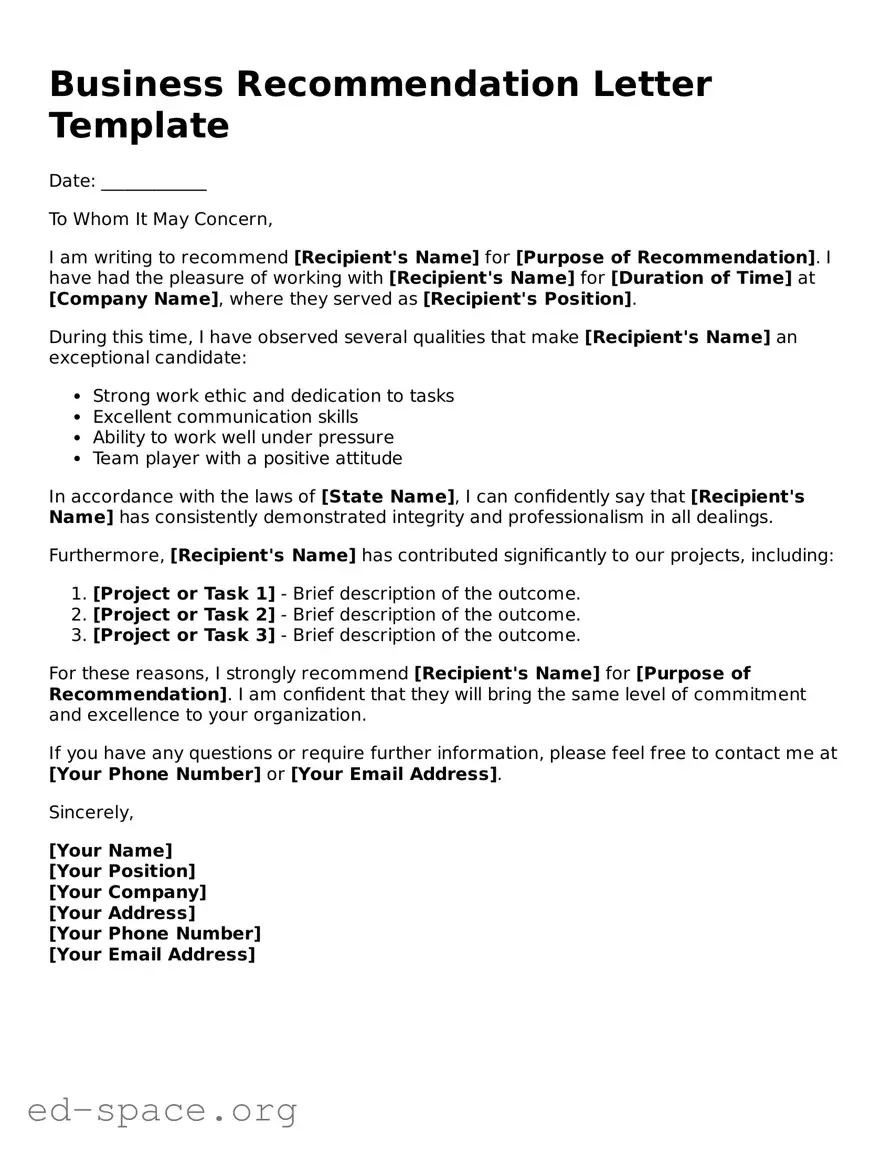
The Business Recommendation Letter form serves as an essential tool for individuals and organizations seeking to establish credibility and trust in professional relationships. This form typically includes sections for the recommender's contact information, the recipient's details, and a clear outline of the relationship between the two parties. It often prompts the recommender to highlight specific skills, achievements, and attributes of the individual or business being recommended. Additionally, the letter may address the context in which the recommendation is made, whether for a job application, partnership, or other business ventures. By providing a structured format, this form ensures that the recommendation is both comprehensive and persuasive, ultimately aiding the recipient in making informed decisions. In essence, the Business Recommendation Letter form not only facilitates communication but also strengthens professional networks by endorsing the capabilities and integrity of individuals and organizations alike.
Business Recommendation Letter Template
Date: ____________
To Whom It May Concern,
I am writing to recommend [Recipient's Name] for [Purpose of Recommendation]. I have had the pleasure of working with [Recipient's Name] for [Duration of Time] at [Company Name], where they served as [Recipient's Position].
During this time, I have observed several qualities that make [Recipient's Name] an exceptional candidate:
In accordance with the laws of [State Name], I can confidently say that [Recipient's Name] has consistently demonstrated integrity and professionalism in all dealings.
Furthermore, [Recipient's Name] has contributed significantly to our projects, including:
For these reasons, I strongly recommend [Recipient's Name] for [Purpose of Recommendation]. I am confident that they will bring the same level of commitment and excellence to your organization.
If you have any questions or require further information, please feel free to contact me at [Your Phone Number] or [Your Email Address].
Sincerely,
[Your Name]
[Your Position]
[Your Company]
[Your Address]
[Your Phone Number]
[Your Email Address]
| Fact Name | Description |
|---|---|
| Purpose | A Business Recommendation Letter serves to endorse a company or individual, highlighting their skills, reliability, and past performance in a professional context. |
| Format | The letter should be formatted in a professional manner, including the sender's and recipient's contact information, a date, a salutation, and a closing signature. |
| Usage | Commonly used in job applications, partnership proposals, or when seeking new clients, this letter can significantly enhance credibility. |
| Governing Law | Business Recommendation Letters are generally governed by the laws of the state in which the business operates, with specific requirements varying by state. |
Filling out the Business Recommendation Letter form is straightforward. Follow these steps carefully to ensure all necessary information is provided accurately.
Once you've completed the form, review it for accuracy and completeness before sending it to the intended recipient.
What is a Business Recommendation Letter?
A Business Recommendation Letter is a formal document that provides a positive endorsement of an individual or a business. It is typically written by someone who has a professional relationship with the person or entity being recommended. This letter can be used for various purposes, such as applying for a job, seeking new clients, or establishing partnerships. The letter highlights the strengths, skills, and accomplishments of the individual or business, helping to build credibility and trust.
Who should write a Business Recommendation Letter?
Ideally, a Business Recommendation Letter should be written by someone who knows the individual or business well and can speak to their qualifications. This could be a former employer, a colleague, a client, or a business partner. The writer should have firsthand experience with the person's work ethic, skills, and achievements. A strong recommendation comes from someone who can provide specific examples and insights into the individual's or business's capabilities.
What should be included in a Business Recommendation Letter?
A well-crafted Business Recommendation Letter should include several key elements. First, it should start with a formal greeting and an introduction that explains the relationship between the writer and the person or business being recommended. Next, the letter should detail the specific qualities, skills, and accomplishments of the individual or business. Concrete examples can make the recommendation more persuasive. Finally, the letter should conclude with a strong endorsement and the writer's contact information for any follow-up questions.
How long should a Business Recommendation Letter be?
Typically, a Business Recommendation Letter should be concise, ideally one page in length. This allows the writer to provide enough detail to support their recommendation without overwhelming the reader. A focused letter that highlights the most relevant points is more likely to be read and appreciated. Clarity and brevity are essential, so the writer should aim to communicate the key messages effectively.
Can a Business Recommendation Letter be used for multiple purposes?
Yes, a Business Recommendation Letter can often be adapted for various purposes. While it is tailored to a specific individual or business, the core strengths and accomplishments highlighted can be relevant in different contexts. However, it is advisable to customize the letter slightly for each situation, ensuring that it addresses the specific requirements or qualities sought by the recipient. This personal touch can enhance the letter's effectiveness.
Incomplete Information: Many individuals fail to provide all necessary details about the business or the individual being recommended. This can lead to confusion and weaken the recommendation.
Vague Descriptions: Using general terms instead of specific examples can dilute the impact of the recommendation. Clear, concrete instances demonstrate the strengths of the business or individual.
Neglecting Formatting: A disorganized or poorly formatted letter can detract from the professionalism of the recommendation. Consistent formatting enhances readability and credibility.
Ignoring the Audience: Not tailoring the letter to the intended recipient can result in a missed opportunity. Understanding the audience's expectations is crucial for a persuasive recommendation.
Failing to Proofread: Spelling and grammatical errors can undermine the letter's effectiveness. Careful proofreading ensures clarity and professionalism.
Overstating Qualifications: Exaggerating abilities or achievements can backfire. Honesty and accuracy build trust and credibility.
Using Clichés: Relying on tired phrases can make the letter sound insincere. Original language captures attention and conveys genuine support.
Not Providing Contact Information: Omitting contact details can hinder follow-up opportunities. Including this information allows the recipient to reach out for further clarification.
A Business Recommendation Letter is an important document that highlights the strengths and qualifications of a business or individual. When preparing this letter, several other forms and documents may be necessary to support the recommendation and provide additional context. Here’s a list of common documents that are often used alongside a Business Recommendation Letter:
Using these documents in conjunction with a Business Recommendation Letter can create a comprehensive picture that highlights the strengths and qualifications of the individual or business being recommended. This additional information can greatly enhance the effectiveness of the recommendation.
When filling out a Business Recommendation Letter form, it's important to keep a few key points in mind. Here’s a helpful list of things you should and shouldn't do:
By following these guidelines, you can create a recommendation letter that is both effective and professional.
When it comes to the Business Recommendation Letter form, several misconceptions can lead to confusion. Understanding these misunderstandings can help you navigate the process more effectively. Below are four common misconceptions:
By addressing these misconceptions, you can better prepare for the process of obtaining a Business Recommendation Letter. Clarity and understanding will help you present your best self.
Filling out and using a Business Recommendation Letter form can be a straightforward process if you keep a few key points in mind. Here are some important takeaways to ensure you create an effective recommendation letter:
By keeping these points in mind, you can create a compelling Business Recommendation Letter that effectively supports the individual or business you are endorsing.