In the competitive landscape of business, safeguarding sensitive information is paramount for entrepreneurs and organizations alike. A Business Plan Confidentiality Agreement serves as a crucial tool in this endeavor, establishing a formal understanding between parties regarding the treatment of proprietary information. This agreement outlines the specific details that must remain confidential, including financial projections, marketing strategies, and operational plans. By clearly defining the scope of confidentiality, it mitigates the risk of unauthorized disclosure that could jeopardize a business's competitive edge. Additionally, the form typically includes provisions for the duration of confidentiality obligations and the consequences of breach, ensuring that all parties are aware of their responsibilities. As businesses seek funding, partnerships, or strategic alliances, the use of this agreement fosters trust and encourages open dialogue, allowing for the exchange of ideas without the fear of exposure. Thus, a well-crafted Business Plan Confidentiality Agreement not only protects intellectual property but also lays the groundwork for successful business relationships.
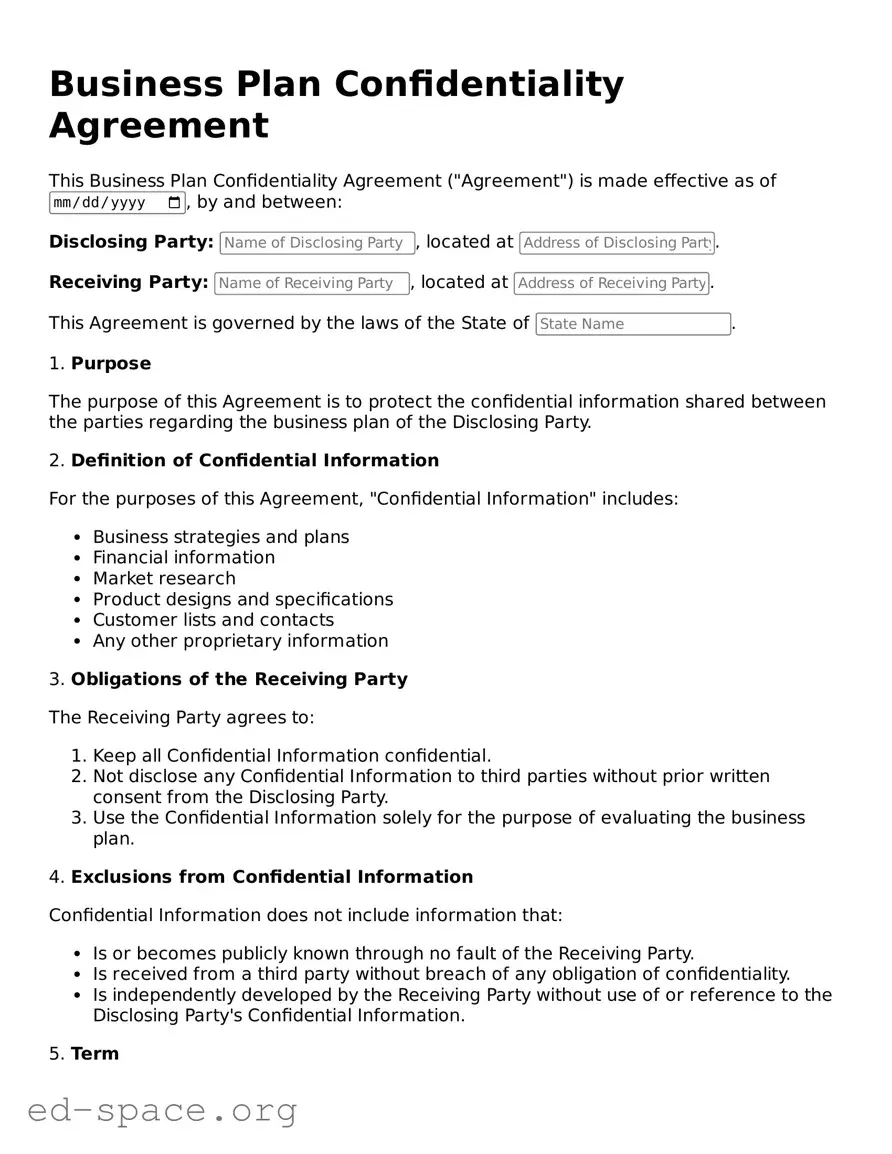
Business Plan Confidentiality Agreement
This Business Plan Confidentiality Agreement ("Agreement") is made effective as of , by and between:
Disclosing Party: , located at .
Receiving Party: , located at .
This Agreement is governed by the laws of the State of .
1. Purpose
The purpose of this Agreement is to protect the confidential information shared between the parties regarding the business plan of the Disclosing Party.
2. Definition of Confidential Information
For the purposes of this Agreement, "Confidential Information" includes:
3. Obligations of the Receiving Party
The Receiving Party agrees to:
4. Exclusions from Confidential Information
Confidential Information does not include information that:
5. Term
This Agreement shall commence on the effective date and continue for a period of unless terminated by either party with written notice.
6. Return of Materials
Upon termination of this Agreement, the Receiving Party agrees to return or destroy all materials containing Confidential Information.
7. Governing Law
This Agreement shall be governed by and construed in accordance with the laws of the State of .
IN WITNESS WHEREOF, the parties hereto have executed this Agreement as of the date first above written.
Disclosing Party Signature: ______________________ Date: ___________
Receiving Party Signature: ______________________ Date: ___________
| Fact Name | Description |
|---|---|
| Purpose | A Business Plan Confidentiality Agreement is designed to protect sensitive business information shared between parties. It ensures that proprietary details remain confidential. |
| Key Components | The agreement typically includes definitions of confidential information, obligations of the receiving party, and the duration of confidentiality. |
| State-Specific Forms | Different states may have specific requirements for these agreements. For instance, California law may impose additional obligations on parties regarding the handling of confidential information. |
| Enforceability | To be enforceable, the agreement must be clear, reasonable, and not overly broad. Courts often look for a balance between protecting business interests and allowing fair competition. |
| Governing Law | The governing law for the agreement may vary by state. For example, New York law often governs contracts related to business transactions in that state. |
Filling out the Business Plan Confidentiality Agreement form is an important step in protecting sensitive information related to your business. Once the form is completed, it can be shared with potential partners or investors to ensure that all parties understand the confidentiality obligations.
What is a Business Plan Confidentiality Agreement?
A Business Plan Confidentiality Agreement is a legal document that protects sensitive information shared between parties. When you share your business plan with potential investors, partners, or advisors, this agreement ensures that they cannot disclose or misuse the information. It helps maintain your competitive edge and safeguards your ideas, strategies, and financial data.
Who should use this agreement?
This agreement is beneficial for entrepreneurs, startups, and established businesses looking to share their business plans. If you are seeking investment or collaboration, having a confidentiality agreement in place is essential. It creates a secure environment for discussing your ideas without fear of them being leaked or copied.
What should be included in the agreement?
A solid Business Plan Confidentiality Agreement should outline several key elements. First, it should define what constitutes confidential information. This may include business strategies, financial projections, and marketing plans. Next, it should specify the obligations of the receiving party, such as how they will protect the information and the duration of the confidentiality. Lastly, it should include any exclusions, such as information that is already public knowledge.
How do I enforce the agreement if it is violated?
If someone breaches the agreement, you have several options. First, try to resolve the issue through communication. If that doesn’t work, you may need to seek legal advice. Depending on the severity of the breach, you could pursue legal action to seek damages or an injunction. It’s important to document any violations and to have a clear understanding of your rights as outlined in the agreement.
Failing to read the entire agreement thoroughly. Many individuals rush through the document, missing crucial clauses that outline their rights and obligations.
Not providing complete contact information. Omitting essential details such as phone numbers or email addresses can lead to communication issues down the line.
Neglecting to date the agreement. Without a date, it becomes difficult to establish when the confidentiality obligations begin and end.
Using vague language. Clear and specific terms are essential. Ambiguities can lead to misunderstandings and disputes regarding what information is protected.
Overlooking the definition of confidential information. Individuals often fail to specify what constitutes confidential information, which can create loopholes.
Not including a duration for confidentiality. Without a specified time frame, the obligations could be interpreted as indefinite, which may not be practical.
Forgetting to discuss the agreement with a legal advisor. Many people assume they understand the implications, but legal counsel can provide valuable insights.
Failing to include exceptions to confidentiality. It is important to clarify situations where disclosure is permissible, such as legal obligations or prior knowledge.
Not keeping a signed copy of the agreement. Retaining a copy is essential for future reference and to ensure that all parties adhere to the terms.
A Business Plan Confidentiality Agreement is crucial for protecting sensitive information shared between parties. However, it is often accompanied by several other documents that serve to further safeguard interests and outline responsibilities. Below are five forms and documents that are commonly used alongside the Business Plan Confidentiality Agreement.
In summary, these documents work together to create a comprehensive framework for protecting sensitive business information. Utilizing them alongside a Business Plan Confidentiality Agreement can significantly enhance the security of your business dealings.
The Business Plan Confidentiality Agreement is an important document that helps protect sensitive information shared between parties. There are several other documents that serve similar purposes in ensuring confidentiality and protecting business interests. Here’s a list of ten documents that are comparable:
Each of these documents plays a crucial role in protecting sensitive information, just like the Business Plan Confidentiality Agreement. Understanding their similarities can help in selecting the right document for your specific needs.
When filling out a Business Plan Confidentiality Agreement form, it’s important to keep certain best practices in mind. Here are four things you should and shouldn't do:
Many individuals and businesses encounter misconceptions regarding the Business Plan Confidentiality Agreement form. Understanding these misconceptions can help in navigating the complexities of confidentiality in business planning. Below is a list of common misunderstandings.
Addressing these misconceptions can lead to better understanding and use of confidentiality agreements in business contexts.
When it comes to protecting your business ideas and plans, a Business Plan Confidentiality Agreement is a vital tool. Here are some key takeaways to consider when filling out and using this form:
By keeping these points in mind, you can effectively use the Business Plan Confidentiality Agreement to safeguard your valuable business information.