Homepage Blank Business Income Worksheet PDF Form
Article Guide

The Business Income Worksheet is an essential tool for business owners seeking to assess their financial exposure over a 12-month period. This worksheet simplifies the process of calculating both business income and extra expenses, providing a clear framework for understanding potential losses. It begins with the evaluation of net income or loss before taxes, followed by a comprehensive listing of all expenses, including payroll, but excluding the cost of goods sold. By combining these figures, the worksheet allows users to determine their expected business income exposure. Additionally, it factors in expected growth and extra expenses that may arise from operating in a temporary location. Key information, such as total gross sales and maximum expected recovery periods, is also required to ensure accurate calculations. Ultimately, the worksheet helps businesses estimate their income and extra expense limits needed to protect against unforeseen disruptions. This proactive approach to financial planning can be crucial for maintaining stability in the face of potential challenges.

Document Preview

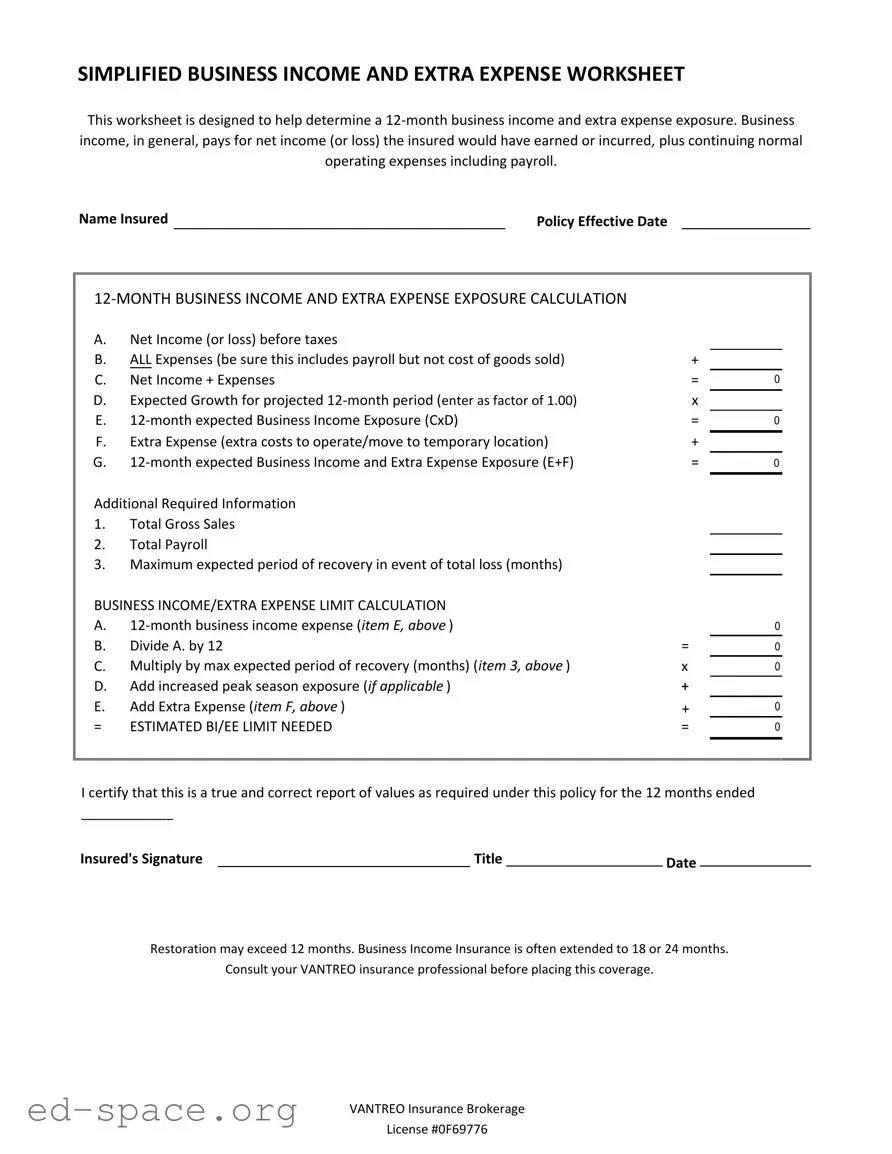
SIMPLIFIED BUSINESS INCOME AND EXTRA EXPENSE WORKSHEET

This worksheet is designed to help determine a 12-month business income and extra expense exposure. Business income, in general, pays for net income (or loss) the insured would have earned or incurred, plus continuing normal operating expenses including payroll.

Name Insured


Policy Effective Date

12-MONTH BUSINESS INCOME AND EXTRA EXPENSE EXPOSURE CALCULATION

A.Net Income (or loss) before taxes

B.

ALL Expenses (be sure this includes payroll but not cost of goods sold)

+


C.

Net Income + Expenses

=

0

D.

Expected Growth for projected 12-month period (enter as factor of 1.00)

x


E.

12-month expected Business Income Exposure (CxD)

=

0

F.

Extra Expense (extra costs to operate/move to temporary location)

+


G.

12-month expected Business Income and Extra Expense Exposure (E+F)

=

0

Additional Required Information

1.Total Gross Sales

2.Total Payroll

3.Maximum expected period of recovery in event of total loss (months)

BUSINESS INCOME/EXTRA EXPENSE LIMIT CALCULATION


A.

12-month business income expense (item E, above )


0

B.

Divide A. by 12

=

0

C.

Multiply by max expected period of recovery (months) (item 3, above )

x

0

D.

Add increased peak season exposure (if applicable )

+


E.

Add Extra Expense (item F, above )

+

0

=

ESTIMATED BI/EE LIMIT NEEDED

=

0

I certify that this is a true and correct report of values as required under this policy for the 12 months ended

____________

Insured's Signature


Title


Date


Restoration may exceed 12 months. Business Income Insurance is often extended to 18 or 24 months.

Consult your VANTREO insurance professional before placing this coverage.

VANTREO Insurance Brokerage

License #0F69776

Form Specifications

Fact Name Description
Purpose of the Worksheet This worksheet assists in determining a 12-month business income and extra expense exposure, providing a clear financial picture for insured businesses.
Components of Calculation The worksheet includes calculations for net income, total expenses, expected growth, and extra expenses, which all contribute to the overall business income exposure.
Required Information Users must provide total gross sales, total payroll, and the maximum expected recovery period in case of a total loss, ensuring comprehensive assessment.
Business Income Insurance Duration Business income insurance can often be extended to cover periods of 18 to 24 months, reflecting the potential for prolonged recovery after a loss.
Consultation Recommendation It is essential to consult with a VANTREO insurance professional prior to finalizing coverage, ensuring that businesses are adequately protected.

Business Income Worksheet: Usage Guidelines

Filling out the Business Income Worksheet form is a straightforward process that requires careful attention to detail. This form helps in calculating the expected business income and extra expenses over a 12-month period. Make sure you have all necessary financial information on hand before you start.

  1. Begin by entering your Name and Insured Policy Effective Date at the top of the form.
  2. For section A, input your Net Income (or loss) before taxes.
  3. In section B, list ALL Expenses, ensuring that this includes payroll but excludes the cost of goods sold.
  4. Calculate the total by adding section A and section B, and enter the result in section C.
  5. In section D, enter the Expected Growth for the projected 12-month period as a factor of 1.00.
  6. Multiply the result in section C by the expected growth factor from section D to find the 12-month expected Business Income Exposure and enter it in section E.
  7. For section F, input any Extra Expense that includes extra costs to operate or move to a temporary location.
  8. Add the results from section E and section F to determine the 12-month expected Business Income and Extra Expense Exposure, and enter it in section G.
  9. Complete the additional required information by providing the Total Gross Sales in section 1.
  10. In section 2, enter the Total Payroll.
  11. For section 3, indicate the Maximum expected period of recovery in the event of a total loss, in months.
  12. For the Business Income/Extra Expense Limit Calculation, enter the result from section E into section A.
  13. Divide the amount in section A by 12 and enter the result in section B.
  14. Multiply the result in section B by the maximum expected period of recovery from section 3 and enter it in section C.
  15. If applicable, add any increased peak season exposure to section D.
  16. In section E, add the extra expense from section F.
  17. Finally, sum all amounts in section E to find the ESTIMATED BI/EE LIMIT NEEDED and enter it in the provided space.
  18. Sign and date the form, certifying that the information is accurate.

Your Questions, Answered

What is the purpose of the Business Income Worksheet?

The Business Income Worksheet is designed to help businesses calculate their expected income and extra expenses over a 12-month period. This form assists in determining the financial impact of potential disruptions to business operations, such as property damage or other unforeseen events. By accurately filling out this worksheet, businesses can better understand their income exposure and prepare for the financial implications of a loss.

What information is required to complete the worksheet?

To complete the Business Income Worksheet, several key pieces of information are necessary. This includes the net income or loss before taxes, all operating expenses (including payroll but excluding the cost of goods sold), and expected growth for the upcoming 12 months. Additionally, businesses must provide total gross sales, total payroll, and the maximum expected recovery period in the event of a total loss. Each of these details contributes to a comprehensive understanding of the business's financial situation.

How is the estimated business income and extra expense limit calculated?

The estimated business income and extra expense limit is calculated using several steps. First, the total expected business income exposure is determined by multiplying the 12-month expected business income (from the worksheet) by the expected growth factor. Next, this figure is divided by 12 to find the monthly average. This average is then multiplied by the maximum expected recovery period in months. Finally, any increased peak season exposure and extra expenses are added to arrive at the estimated limit needed for business income and extra expenses.

Why is it important to consult an insurance professional regarding this worksheet?

Consulting an insurance professional is crucial for ensuring that the coverage aligns with the specific needs of the business. Restoration periods may exceed 12 months, and business income insurance can often be extended to 18 or 24 months. An insurance expert can provide guidance on the appropriate limits and coverage options based on the unique circumstances of the business, helping to mitigate potential financial losses during recovery periods.

Common mistakes

  1. Neglecting to Include All Relevant Income Sources: When filling out the Business Income Worksheet, individuals sometimes overlook additional income sources. It is crucial to consider all revenue streams, not just the primary business operations.

  2. Forgetting to Account for Payroll: Many people mistakenly exclude payroll expenses from their total expenses. Since payroll is a continuing operating expense, it must be included to accurately reflect the business's financial obligations.

  3. Miscalculating Net Income: Errors in calculating net income can lead to significant discrepancies. This figure should represent the business's earnings before taxes and must be carefully verified to ensure accuracy.

  4. Ignoring Expected Growth: Some individuals fail to enter an expected growth factor for the projected 12-month period. This factor is essential for estimating future income accurately and should reflect realistic business growth expectations.

  5. Overlooking Extra Expenses: Extra expenses related to operating or relocating to a temporary location can be easily forgotten. These costs are critical to include, as they can significantly impact the overall financial picture.

  6. Not Specifying the Maximum Expected Period of Recovery: It is important to provide an accurate estimate of the maximum expected recovery period in the event of a total loss. This estimate affects the calculation of business income limits.

  7. Failing to Review the Form Thoroughly: Many individuals do not take the time to review the completed worksheet before submission. A careful review can help catch errors and ensure that all information is accurate and complete.

Documents used along the form

The Business Income Worksheet is a crucial tool for assessing the financial exposure of a business in the event of a loss. Alongside this worksheet, several other forms and documents are commonly utilized to provide a comprehensive understanding of a business's financial situation. Below is a list of these documents, each serving a specific purpose in the overall evaluation process.

  • Profit and Loss Statement: This document summarizes a business's revenues, costs, and expenses over a specific period, typically a month or a year. It helps in understanding the net income or loss, which is essential for filling out the Business Income Worksheet.
  • Balance Sheet: A snapshot of a business's financial position at a specific point in time, this document lists assets, liabilities, and equity. It provides context for the income statement and helps assess the overall financial health of the business.
  • Cash Flow Statement: This statement tracks the flow of cash in and out of a business. It is vital for understanding liquidity and operational efficiency, which can influence business income projections.
  • Sales Forecast: This document estimates future sales based on historical data and market analysis. Accurate sales forecasts are critical for predicting income and determining the necessary coverage limits.
  • Expense Report: This report details all business expenses incurred during a specific period. It is essential for identifying ongoing costs that must be covered in the event of a loss.
  • Business Continuity Plan: This plan outlines how a business will continue operating during and after a disaster. It includes strategies for minimizing downtime and financial loss, which are directly relevant to business income calculations.

Utilizing these documents in conjunction with the Business Income Worksheet enhances the accuracy of financial assessments. Together, they provide a clearer picture of a business's income potential and necessary coverage, ensuring better preparedness for unexpected events.

Similar forms

  • Profit and Loss Statement: This document summarizes a business's revenues and expenses over a specific period. Like the Business Income Worksheet, it helps in assessing the financial health of the business and can inform insurance needs.
  • Cash Flow Statement: This statement tracks the flow of cash in and out of a business. It complements the Business Income Worksheet by providing insights into liquidity, which is crucial for covering ongoing expenses during a loss.
  • Balance Sheet: A snapshot of a company's assets, liabilities, and equity at a specific point in time. While the Business Income Worksheet focuses on income and expenses, the balance sheet provides a broader view of financial stability.
  • Budget Forecast: This document outlines expected revenues and expenses for future periods. Similar to the Business Income Worksheet, it aids in planning for potential business income and expenses over the next year.
  • Tax Returns: Annual tax returns provide a comprehensive overview of a business's income and expenses. They can be used alongside the Business Income Worksheet to validate income figures and assess tax obligations.
  • Insurance Claim Form: When filing for a claim, this form details the loss and the coverage needed. Like the Business Income Worksheet, it emphasizes the importance of accurately reporting business income and expenses to determine the claim amount.
  • Sales Forecast: This document predicts future sales based on historical data and market trends. It aligns with the Business Income Worksheet by estimating potential income, which is vital for insurance calculations.
  • Expense Report: A detailed account of business expenses incurred over a certain period. Similar to the Business Income Worksheet, it helps track ongoing costs that need to be covered during a business interruption.
  • Operating Budget: This outlines the planned revenues and expenses for a specific period, helping businesses manage their finances. It shares similarities with the Business Income Worksheet by focusing on the operational aspect of financial planning.
  • Financial Projections: These are estimates of future income and expenses based on various assumptions. Like the Business Income Worksheet, they play a crucial role in understanding potential business performance and insurance needs.

Dos and Don'ts

When filling out the Business Income Worksheet, it's crucial to ensure accuracy and completeness. Here’s a list of things you should and shouldn’t do:

  • Do provide accurate figures for net income and all expenses.
  • Do include payroll in your expense calculations.
  • Do consider expected growth when projecting your business income for the next 12 months.
  • Do review your worksheet for any errors before submission.
  • Do consult with your insurance professional if you have questions about the form.
  • Don’t forget to include all relevant expenses, not just cost of goods sold.
  • Don’t underestimate your expected growth factor; it can significantly impact your coverage needs.
  • Don’t ignore the extra expenses that may arise from operating or moving to a temporary location.
  • Don’t leave any sections blank; provide as much information as possible.

By following these guidelines, you can help ensure that your Business Income Worksheet is filled out correctly, which will facilitate a smoother insurance process.

Misconceptions

Understanding the Business Income Worksheet can be crucial for business owners seeking to ensure they are adequately covered. However, several misconceptions often arise regarding this form. Here are seven common misunderstandings:

  • The worksheet is only for large businesses. Many believe that only large corporations need to complete this form. In reality, any business, regardless of size, can benefit from accurately reporting their income and expenses.
  • It only considers income. Some think the worksheet focuses solely on income. However, it also takes into account ongoing expenses, including payroll, which are essential for determining the overall financial exposure.
  • All expenses are included automatically. There is a misconception that all expenses will be automatically accounted for. It’s crucial to manually include all relevant expenses, especially payroll, to get an accurate picture of financial exposure.
  • Projected growth is not necessary. Some may overlook the expected growth factor. This projection is important as it helps estimate future income and expenses, ensuring that coverage reflects potential changes in the business.
  • Extra expenses are not important. Many underestimate the significance of extra expenses. These costs can arise during recovery, such as moving to a temporary location, and should be included for a comprehensive assessment.
  • Only past data is relevant. There is a belief that only historical data matters. However, future projections and expected recovery times are equally important for creating a complete financial picture.
  • The worksheet is a one-time task. Some business owners think they only need to fill it out once. In fact, it should be revisited regularly, especially when there are significant changes in the business, to ensure ongoing accuracy and adequacy of coverage.

By clarifying these misconceptions, business owners can better navigate the complexities of the Business Income Worksheet and ensure they are properly protected.

Key takeaways

Filling out the Business Income Worksheet form is an essential step in understanding your business's financial exposure. Here are some key takeaways to keep in mind:

  • Understand the Purpose: This worksheet helps you determine your business income and extra expense exposure over a 12-month period.
  • Calculate Net Income: Begin with your net income or loss before taxes. This figure is crucial for accurate calculations.
  • Include All Expenses: Make sure to list all operating expenses, including payroll. Do not include the cost of goods sold.
  • Project Future Growth: Enter your expected growth as a factor of 1.00 to project your income for the upcoming year.
  • Estimate Extra Expenses: Consider any additional costs that may arise from operating or relocating temporarily during a loss.
  • Gather Required Information: You will need total gross sales, total payroll, and the maximum expected recovery period in months.
  • Calculate Your Limits: Use the worksheet to determine the estimated business income and extra expense limit needed for your coverage.
  • Consult a Professional: It is advisable to discuss your coverage options with a qualified insurance professional to ensure adequate protection.

Completing this worksheet accurately is vital for safeguarding your business against potential income loss. By following these takeaways, you can approach the process with confidence.