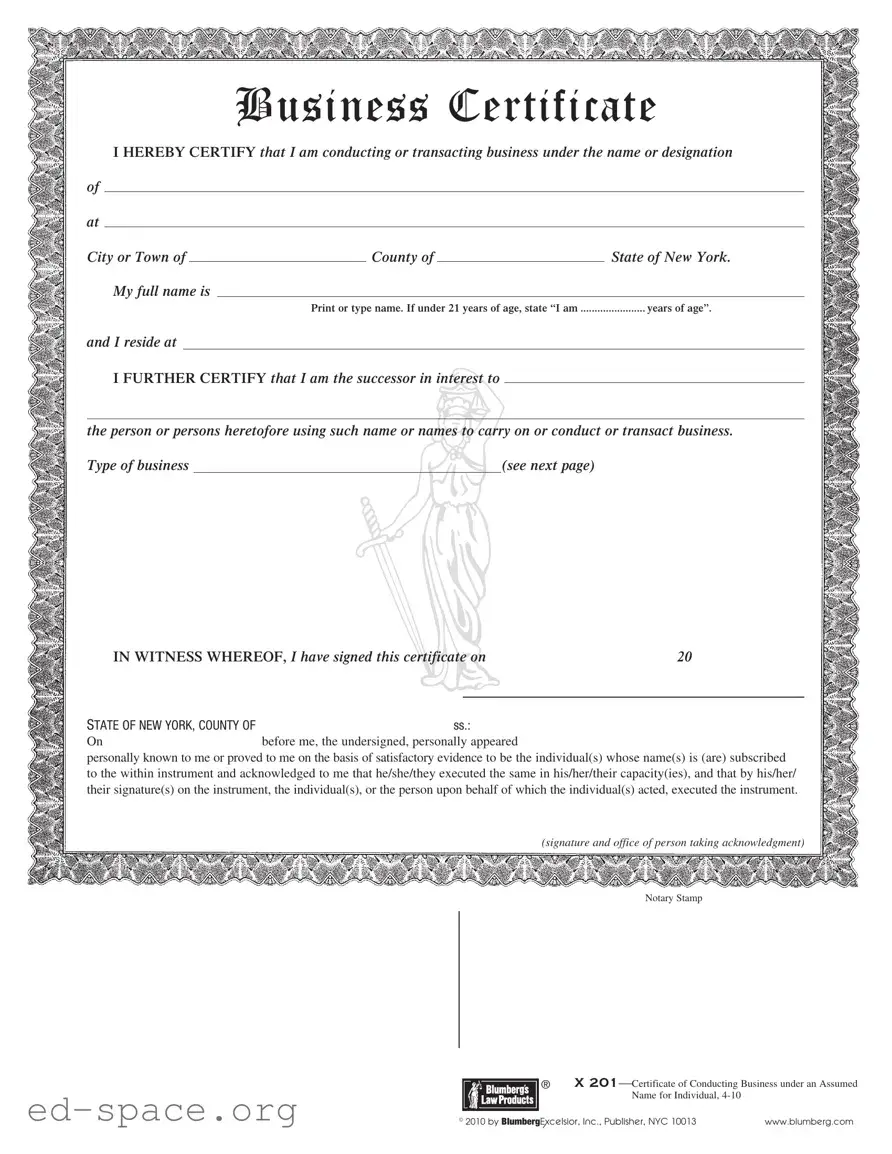
When starting a business in New York, one essential step is completing the Business Certificate form. This document serves as a formal declaration of your intent to conduct business under a specific name. It requires you to provide basic information, including your full name, age, and residential address. If you are taking over an existing business, you must also certify that you are the successor in interest to the previous owner. The form prompts you to specify the type of business you will be operating, which can range from retail trade to professional services. Additionally, it includes a section for notarization, ensuring that the information provided is verified and legally binding. A certified copy of this certificate must be prominently displayed at your business location, allowing for transparency and compliance with local regulations. Understanding the significance of this form is crucial for anyone looking to establish a legitimate business presence in their community.

BUSINESS CERTIFICATE
I HEREBY CERTIFY that I am conducting or transacting business under the name or designation
of at
City or Town ofCounty ofState of New York. My full name is
Print or type name. If under 21 years of age, state “I am |
years of age”. |
and I reside at
I FURTHER CERTIFY that I am the successor in interest to
the person or persons heretofore using such name or names to carry on or conduct or transact business.
Type of business |
|
(see next page) |
IN WITNESS WHEREOF, I have signed this certificate on |
20 |
||
STATE OF NEW YORK, COUNTY OF |
|
|
|
SS.: |
|
||
On |
before me, the undersigned, personally appeared |
|
|
personally known to me or proved to me on the basis of satisfactory evidence to be the individual(s) whose name(s) is (are) subscribed to the within instrument and acknowledged to me that he/she/they executed the same in his/her/their capacity(ies), and that by his/her/ their signature(s) on the instrument, the individual(s), or the person upon behalf of which the individual(s) acted, executed the instrument.
(signature and office of person taking acknowledgment)
Notary Stamp
|
|
® |
X |
|
|
|
|
Name for Individual, |
|
|
|
|
|
|
© 2010 by BlumbergExcelsior, Inc., Publisher, NYC 10013 |
www.blumberg.com |
|||

State of New York |
ss.: |
|
County of |
||
|
||
On |
before me, the undersigned, |
|
personally appeared |
|
personally known to me or proved to me on the basis of satisfac- tory evidence to be the individual(s) whose name(s) is (are) sub- scribed to the within instrument and acknowledged to me that he/ she/they executed the same in his/her/their capacity(ies), and that by his/her/their signature(s) on the instrument, the individual(s), or the person upon behalf of which the individual(s) acted, executed the instrument.
State of |
ss.: |
|
County of |
||
|
||
On |
before me, the undersigned, |
|
personally appeared |
|
personally known to me or proved to me on the basis of satis- factory evidence to be the individual(s) whose name(s) is (are) subscribed to the within instrument and acknowledged to me that he/she/they executed the same in his/her/their capacity(ies), and that by his/her/their signature(s) on the instrument, the individual(s), or the person upon behalf of which the individual(s) acted, executed the instrument.
(signature and office of individual taking acknowledgment) |
(signature and office of individual taking acknowledgment) |
INDEX No.
CERTIFICATE
OF
CONDUCTING BUSINESS UNDER
THE NAME OF
GBL §130.4. A certified copy of the original certificate, or if an amended certificate has been filed, then of the most recent amended certificate filed shall be conspicuously displayed on the premises at each place in which the business for which the same was filed is conducted.
Some counties request the type of business.
Consultant Services |
|
Educational Services |
|
Real Estate Services |
|
Retail Trade |
|
Home Improvement Services |
Wholesale Trade |
Other (state type) |
|
| Fact Name | Details |
|---|---|
| Purpose | The Business Certificate is used to certify that an individual is conducting business under a specific name in New York State. |
| Governing Law | This form is governed by New York General Business Law §130.4. |
| Age Requirement | If the applicant is under 21 years of age, they must state their age on the form. |
| Successor Certification | The applicant must certify that they are the successor in interest to any previous user of the business name. |
| Display Requirement | A certified copy of the Business Certificate must be displayed at each business location. |
Filling out the Business Certificate form is an important step for individuals conducting business under a specific name in New York. This form requires accurate information about the business and the person responsible for it. Once completed, the form will need to be submitted to the appropriate local authority.
What is a Business Certificate form?
A Business Certificate form is a document that certifies you are conducting business under a specific name in New York. It includes your name, the name of your business, and the location where you operate. This form is essential for anyone wanting to legally operate under a name that is different from their personal name.
Who needs to file a Business Certificate?
If you are an individual or a group conducting business under a name that is not your legal name, you need to file a Business Certificate. This applies to sole proprietors, partnerships, and LLCs. It ensures that your business name is officially recognized and protects consumers by providing transparency about who is behind the business.
How do I complete the Business Certificate form?
To complete the form, you will need to provide your full name, the name of your business, and the city and county where you operate. If you are under 21, include your age. You will also need to indicate the type of business you are conducting, such as retail, consulting, or real estate. Finally, the form must be signed and dated, and you may need to have it notarized.
Where do I file the Business Certificate?
You should file the Business Certificate with the county clerk's office in the county where your business is located. Some counties may have specific requirements or additional forms, so it’s a good idea to check with your local office for any details before you go.
Is there a fee for filing the Business Certificate?
Yes, there is typically a fee associated with filing a Business Certificate. The amount can vary by county, so it’s best to contact your local county clerk’s office to find out the exact fee. Be prepared to pay this fee when you submit your form, as it is necessary for processing your application.
Incomplete Information: Failing to provide all required details, such as the full name or business address, can lead to delays or rejection of the application. Ensure every section is filled out completely.
Incorrect Age Declaration: If you are under 21, it is essential to state your age accurately. Omitting this detail or providing incorrect information can raise questions about your eligibility.
Failure to Specify Business Type: Not indicating the type of business being conducted can create confusion. Always select or write down the appropriate category from the provided list.
Signature Issues: The certificate must be signed by the individual completing it. Neglecting to sign or using a signature that does not match the name provided can invalidate the document.
Notary Acknowledgment Errors: The notary public must properly acknowledge the signing of the document. Ensure that the notary's signature and stamp are included; otherwise, the form may not be accepted.
Incorrect County or City Information: Providing the wrong location details can lead to complications. Double-check that the city and county listed match where the business is actually conducted.
Neglecting to Keep a Copy: After filing the certificate, it is crucial to retain a copy for your records. This ensures you have proof of registration should any questions arise in the future.
When starting a business, several forms and documents are essential to ensure compliance with local laws and regulations. The Business Certificate is just one of these documents. Below is a list of other important forms that often accompany the Business Certificate, each serving a unique purpose in the business establishment process.
Understanding these documents and their purposes can help streamline the process of starting a business. Each form plays a vital role in establishing a legal and compliant operation, ensuring a solid foundation for future growth and success.
When filling out the Business Certificate form, it is essential to follow certain guidelines to ensure accuracy and compliance. Below are four important dos and don’ts to keep in mind.
Understanding the Business Certificate form is crucial for anyone looking to conduct business under an assumed name. However, several misconceptions can lead to confusion. Here are six common misunderstandings:
By clarifying these misconceptions, individuals can better navigate the process of filing for a Business Certificate and ensure their business operates smoothly and legally.
When filling out and using the Business Certificate form, consider the following key takeaways: