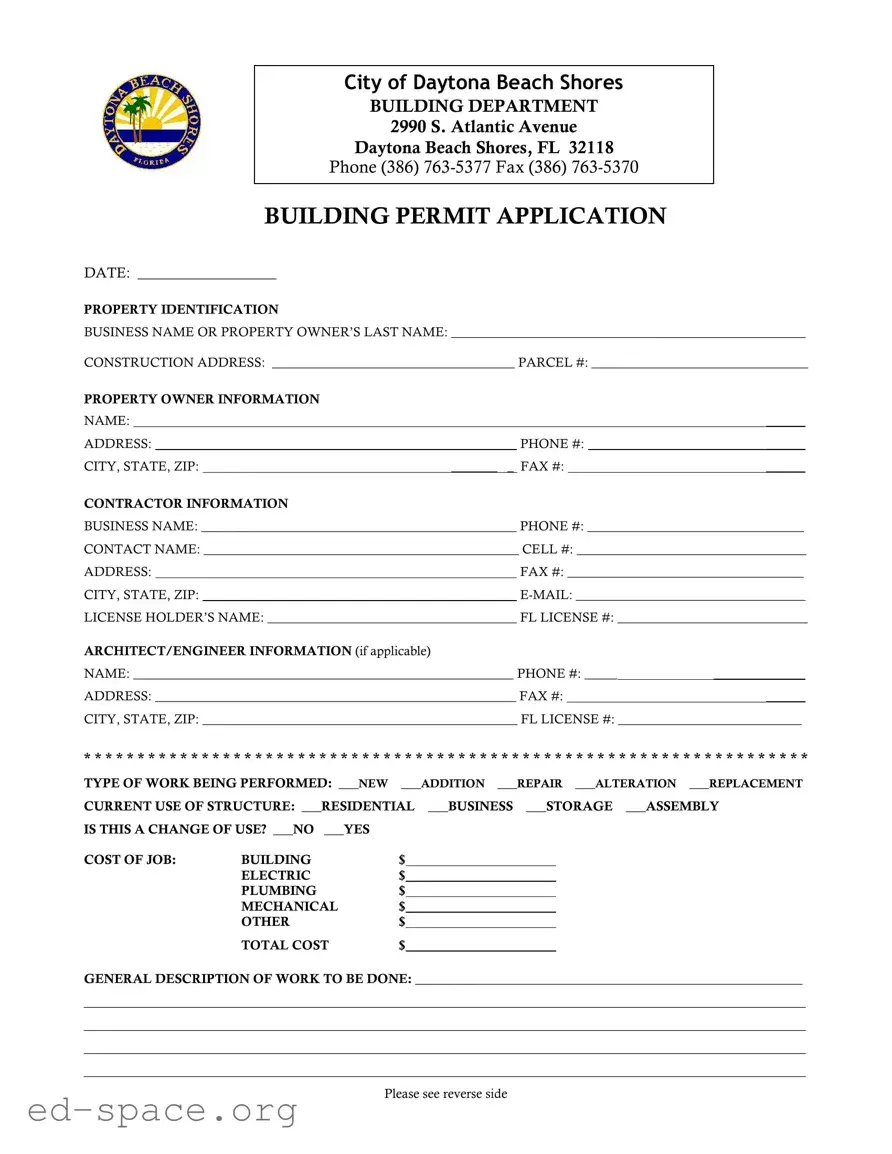
When planning any construction project in Daytona Beach Shores, obtaining a Building Permit is a crucial step. The Building Permit form collects essential information about the property and the nature of the work to be done. It requires details like the property owner's name, contact information, and the construction address. Additionally, it asks for contractor information, including their business name and license number. The form also outlines the type of work being performed, whether it’s new construction, an addition, or a repair. You’ll need to specify the current use of the structure and indicate if there’s a change in use. Understanding the costs associated with the job is important, as you will need to list expenses for various aspects like building, electrical, plumbing, and mechanical work. A general description of the work is also necessary to provide context for the permit request. Both the property owner and contractor must sign the application, affirming that all information is accurate and that no work will begin until the permit is issued. Remember, failing to record a Notice of Commencement can lead to additional expenses, so it’s wise to consult with a lender or attorney if financing is involved. Completing this form accurately ensures compliance with local laws and helps facilitate a smooth construction process.

City of Daytona Beach Shores
BUILDING DEPARTMENT
2990 S. Atlantic Avenue
Daytona Beach Shores, FL 32118
Phone (386)
BUILDING PERMIT APPLICATION
DATE: ___________________
PROPERTY IDENTIFICATION
BUSINESS NAME OR PROPERTY OWNER’S LAST NAME: ______________________________________________________
CONSTRUCTION ADDRESS: _____________________________________ PARCEL #: _________________________________
PROPERTY OWNER INFORMATION |
|
|
|
|
|||
NAME: |
|
|
|
|
______ |
||
ADDRESS: |
|
|
PHONE #: |
______ |
|||
CITY, STATE, ZIP: |
|
_______ _ FAX #: |
______ |
||||
|
|
|
|
|
|
|
|
CONTRACTOR INFORMATION
BUSINESS NAME: ________________________________________________ PHONE #: _________________________________
CONTACT NAME: ________________________________________________ CELL #: ___________________________________
ADDRESS: |
|
FAX #: ____________________________________ |
||||
CITY, STATE, ZIP: |
|
|||||
LICENSE HOLDER’S NAME: ______________________________________ FL LICENSE #: _____________________________ |
||||||
ARCHITECT/ENGINEER INFORMATION (if applicable) |
|
|
|
|
||
NAME: __________________________________________________________ PHONE #: _____ |
______________ |
|
||||
ADDRESS: _______________________________________________________ FAX #: |
|
______ |
|
|||
CITY, STATE, ZIP: ________________________________________________ FL LICENSE #: ____________________________
* * * * * * * * * * * * * * * * * * * * * * * * * * * * * * * * * * * * * * * * * * * * * * * * * * * * * * * * * * * * * * * * * * * *
TYPE OF WORK BEING PERFORMED: ___NEW ___ADDITION ___REPAIR ___ALTERATION ___REPLACEMENT
CURRENT USE OF STRUCTURE: ___RESIDENTIAL ___BUSINESS ___STORAGE ___ASSEMBLY
IS THIS A CHANGE OF USE? ___NO ___YES
COST OF JOB: |
BUILDING |
$ |
|
ELECTRIC |
$ |
|
PLUMBING |
$ |
|
MECHANICAL |
$ |
|
OTHER |
$ |
|
TOTAL COST |
$ |
GENERAL DESCRIPTION OF WORK TO BE DONE: ___________________________________________________________
______________________________________________________________________________________________________________
______________________________________________________________________________________________________________
______________________________________________________________________________________________________________
______________________________________________________________________________________________________________
Please see reverse side

**BOTH OWNER AND CONTRACTOR MUST SIGN APPLICATION**
Application is hereby made to obtain a permit to do the work and installations as indicated. I certify that no work or installation has commenced prior to the issuance of a permit and that all work will be performed to meet the standard of all laws regulating construction in this jurisdiction.
OR ___ THIS IS AN
I understand that a separate permit may be required for ELECTRICAL WORK, PLUMBING, SIGNS, WELLS, POOLS, FURNACES, BOILERS, HEATERS, TANKS, AIR CONDITIONERS, EXTERIOR PAINTING, ETC.
OWNER’S AFFIDAVIT: I certify that all the foregoing information is accurate and that all work will be done in compliance with all applicable laws regulating construction and zoning.
WARNING TO OWNERS: YOUR FAILURE TO RECORD A NOTICE OF COMMENCEMENT MAY RESULT IN YOU PAYING TWICE FOR IMPROVEMENTS TO YOUR PROPERTY. IF YOU INTEND TO OBTAIN FINANCING, CONSULT WITH YOUR LENDER OR AN ATTORNEY BEFORE RECORDING YOUR NOTICE OF COMMENCEMENT.
Any person who prescribes a false statement to a Notary Public is guilty of perjury.
OWNER/AGENT SIGNATURE ________________________________________________ |
|
____ |
||
OWNER/AGENT’S NAME (PRINTED) _____________________________________________________________ |
||||
STATE OF ________________________ |
COUNTY OF _________________ |
|
____ |
|
|
|
|
|
|
Sworn to and subscribed before me this ________ day of ___________________________ 20 _____, by
___________________________________________ who is personally known to me or has produced
_______________________________________ and who did (did not) take an oath.
_________________________________ |
My Commission Expires: |
Notary Public |
|
* * * * * * * * * * * * * * * * * * * * * * * * * * * * * * * * * * * * * * * * * * * * * * * * * * * * * * * * * * * * * * * * * * * * * * * * * * * * * * * * * * * * *
CONTRACTOR’S SIGNATURE ______________________________________________ |
|
|
_____ |
|||
CONTRACTOR’S NAME (PRINTED) __________________________________________ |
|
|
__ __ |
|||
STATE OF ___________________________ |
COUNTY OF ______________________ |
|
________ |
|||
Sworn to and subscribed before me this ________ day of ___________________________ 20 _____, by
___________________________________________ who is personally known to me or has produced
_______________________________________ and who did (did not) take an oath.
____________________________________ |
My Commission Expires: |
Notary Public |
|
************************************************************************************************
SURETY TYPE (For office use only)
______ Current Volusia County Listing Card OR
______ Proof of Liability insurance with the City of Daytona Beach Shores listed as the
______ Proof of Workers’ Compensation Insurance or Exemption
______ Copy of local Business Tax Receipt (from the City the business is based in)
______ State license verified (when required)
Please see reverse side
| Fact Name | Details |
|---|---|
| Location | The Building Department is located at 2990 S. Atlantic Avenue, Daytona Beach Shores, FL 32118. |
| Contact Information | You can reach the Building Department by phone at (386) 763-5377 or by fax at (386) 763-5370. |
| Application Date | The application requires the date to be filled in at the time of submission. |
| Property Identification | Applicants must provide the property identification number, which is essential for processing. |
| Owner Information | The form requires detailed owner information, including name, address, and contact details. |
| Contractor Information | Contractors must provide their business name, contact information, and license number. |
| Type of Work | Applicants must specify the type of work: new construction, addition, repair, alteration, or replacement. |
| Cost of Job | A detailed breakdown of costs for building, electric, plumbing, and mechanical work is required. |
| Owner's Affidavit | The owner must certify that all information is accurate and complies with local laws. |
| After-the-Fact Permit | If work has already begun, an after-the-fact permit can be requested, but additional fees will apply. |
Once you have gathered all necessary information, you are ready to fill out the Building Permit form. Make sure to provide accurate details to avoid any delays in processing your application.
What is a Building Permit and why do I need one?
A Building Permit is an official approval issued by the local government that allows you to begin construction or renovation on a property. It ensures that the proposed work complies with local building codes, zoning laws, and safety regulations. Obtaining a permit helps protect your investment and ensures that the construction is safe and legal. Failing to secure a permit can result in fines or the need to remove unpermitted work.
How do I apply for a Building Permit?
To apply for a Building Permit, you must complete the Building Permit Application form. This form requires information about the property, the owner, and the contractor, as well as details about the type of work being performed. After filling out the application, submit it to the Building Department along with any required documentation and fees. The Building Department will review your application to ensure compliance with local regulations.
What information is required on the Building Permit Application?
The application requires several key pieces of information. This includes the property identification details, the name of the property owner or business, the construction address, and the contractor's information. Additionally, you must specify the type of work being performed, the current use of the structure, and a general description of the work. It is also essential to provide the total cost of the job, which includes building, electrical, plumbing, and mechanical costs.
Can I start construction before receiving my Building Permit?
No, you cannot begin any construction or installation work before receiving your Building Permit. The application includes a certification that states no work will commence until the permit is issued. Starting work without a permit can lead to penalties and may require you to halt construction until compliance is achieved.
What happens if I need to make changes after submitting my application?
If changes are necessary after submitting your application, you should contact the Building Department immediately. Depending on the nature of the changes, you may need to submit a revised application or additional documentation. It is crucial to keep the Building Department informed to ensure that your project remains compliant with local regulations.
What is an “after-the-fact” permit?
An “after-the-fact” permit is required when construction has already begun without the necessary permit. Applying for this type of permit may incur additional fees. It is important to understand that obtaining an after-the-fact permit does not guarantee that the work will be approved. The Building Department will assess whether the completed work meets all applicable codes and regulations.
What are the consequences of not obtaining a Building Permit?
Not obtaining a Building Permit can lead to several serious consequences. These may include fines, orders to stop work, or even the requirement to remove unpermitted structures. Additionally, if you plan to sell your property, unpermitted work can complicate the sale process and may lead to legal issues. Ensuring compliance through proper permitting protects both your investment and your rights as a property owner.
Incomplete Information: Failing to fill in all required fields can delay the processing of your application. Ensure that every section is complete, including property identification and contact details.
Incorrect Parcel Number: Double-check the parcel number. An incorrect number can lead to confusion and potential denial of your permit.
Missing Signatures: Both the owner and contractor must sign the application. Omitting either signature will result in rejection.
Wrong Type of Work Selected: Clearly indicate the type of work being performed. Select only one option from the provided list to avoid ambiguity.
Failure to Specify Cost: Ensure that you provide a total cost for the job. An incomplete cost section may cause delays or additional inquiries.
Ignoring Additional Permits: Be aware that certain projects may require additional permits. Check if your work falls under categories needing separate permits.
Not Consulting with a Professional: If you are unsure about any aspect of the application, consider consulting with a contractor or legal advisor. Avoid unnecessary mistakes.
Neglecting the Notice of Commencement: Failing to record a notice of commencement can lead to financial complications. If financing is involved, consult your lender.
When applying for a building permit, several additional forms and documents may be required to ensure compliance with local regulations. Each of these documents serves a specific purpose and helps streamline the permitting process.
Gathering these documents in advance can help facilitate a smoother application process and ensure compliance with local laws. Always consult with your local building department for specific requirements related to your project.
Construction Contract: Similar to a building permit, a construction contract outlines the agreement between the property owner and the contractor. It details the scope of work, timeline, and costs, ensuring both parties are aligned before any work begins.
Homeowner’s Association (HOA) Approval: Just as a building permit is required for construction, many communities require HOA approval for changes to property. This document ensures that any modifications comply with community standards and regulations.
Zoning Permit: A zoning permit, like a building permit, is necessary to ensure that the intended use of the property aligns with local zoning laws. It helps maintain the character of neighborhoods and ensures compliance with land use regulations.
Environmental Impact Assessment (EIA): An EIA is similar in that it evaluates the potential environmental effects of a proposed project. This document ensures that construction activities do not adversely impact the surrounding environment.
Certificate of Occupancy (CO): After construction is completed, a CO is required to legally occupy the building. This document confirms that the construction meets all building codes and safety regulations, similar to the approval process for a building permit.
Site Plan Approval: Much like a building permit, site plan approval is essential for new developments. It ensures that the proposed layout of structures, parking, and landscaping meets local regulations and planning standards.
Demolition Permit: If a property owner wishes to demolish a structure, a demolition permit is required. This document is similar to a building permit in that it ensures compliance with safety and regulatory standards before work begins.
Renovation Permit: For major renovations, a renovation permit is necessary. This document is akin to a building permit, as it ensures that the planned changes meet safety codes and zoning laws.
Sign Permit: If a business wants to install a sign, a sign permit is often required. This document ensures that the sign complies with local regulations, similar to how a building permit ensures compliance for construction work.
Special Use Permit: In certain cases, a special use permit may be needed for projects that do not conform to standard zoning regulations. Like a building permit, it requires a review process to ensure the proposed use aligns with community standards.
When filling out the Building Permit form, attention to detail is crucial. Here are seven important do's and don'ts to ensure your application is processed smoothly.
Following these guidelines will help you navigate the permit process efficiently and avoid potential delays. Be proactive and thorough in your application to ensure compliance with local regulations.
Understanding the Building Permit form can be challenging. Here are ten common misconceptions that often lead to confusion:
By addressing these misconceptions, property owners and contractors can navigate the building permit process more effectively and avoid unnecessary delays or complications.
When filling out and using the Building Permit form for the City of Daytona Beach Shores, keep the following key takeaways in mind:
Following these guidelines will help ensure a smoother application process and compliance with local regulations.