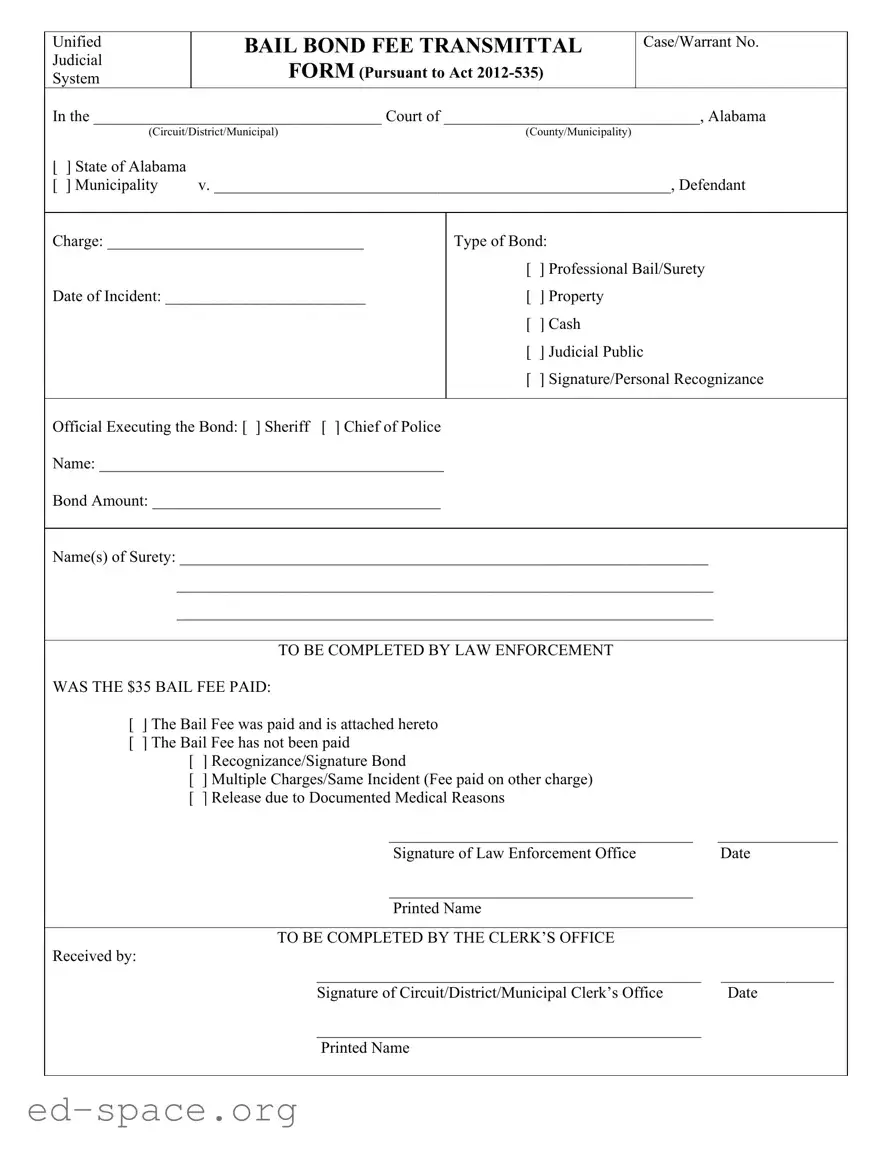
The Bond Release Alabama form plays a crucial role in the bail process within the state’s judicial system. This form is essential for documenting the release of a defendant from custody, ensuring that all necessary information is properly recorded and verified. It includes details such as the case or warrant number, the court in which the case is being heard, and the specific charges against the defendant. The type of bond is clearly indicated, allowing for various options such as professional bail, property, cash, or personal recognizance. Additionally, the form requires the name of the official executing the bond, whether it be a sheriff or chief of police, and the amount of the bond is specified. The responsibilities of law enforcement are also highlighted, including the verification of the payment of the bail fee, which is a critical step in the release process. Furthermore, the form provides sections for the clerk’s office to confirm receipt of the documentation, ensuring that all procedural requirements are met. By understanding the components and significance of this form, individuals can better navigate the complexities of the bail system in Alabama.

Unified
Judicial
System
BAIL BOND FEE TRANSMITTAL
FORM (PURSUANT TO ACT
Case/Warrant No.
In the ____________________________________ Court of ________________________________, Alabama
|
(Circuit/District/Municipal) |
(County/Municipality) |
|
[ |
] State of Alabama |
|
|
[ |
] Municipality |
v. _________________________________________________________, Defendant |
|
Charge: ________________________________
Date of Incident: _________________________
Type of Bond:
[] Professional Bail/Surety
[] Property
[] Cash
[] Judicial Public
[] Signature/Personal Recognizance
Official Executing the Bond: [ ] Sheriff [ ] Chief of Police
Name: ___________________________________________
Bond Amount: ____________________________________
Name(s) of Surety: __________________________________________________________________
___________________________________________________________________
___________________________________________________________________
TO BE COMPLETED BY LAW ENFORCEMENT
WAS THE $35 BAIL FEE PAID:
[ ] The Bail Fee was paid and is attached hereto [ ] The Bail Fee has not been paid
[ ] Recognizance/Signature Bond
[ ] Multiple Charges/Same Incident (Fee paid on other charge) [ ] Release due to Documented Medical Reasons
______________________________________ |
_______________ |
Signature of Law Enforcement Office |
Date |
______________________________________ |
|
Printed Name |
|
|
|
TO BE COMPLETED BY THE CLERK’S OFFICE |
|
Received by: |
|
________________________________________________ |
______________ |
Signature of Circuit/District/Municipal Clerk’s Office |
Date |
________________________________________________ |
|
Printed Name |
|
| Fact Name | Details |
|---|---|
| Form Purpose | The Bond Release Alabama form is used to document the release of a defendant on bail in Alabama courts. |
| Governing Law | This form is governed by Act 2012-535, which outlines the procedures for bail bond fees in Alabama. |
| Types of Bonds | Four types of bonds can be selected: Professional Bail/Surety, Property, Cash, and Judicial Public. |
| Fee Requirement | A $35 bail fee is required, and the form includes a section to confirm if this fee has been paid. |
| Law Enforcement Role | Law enforcement officials must complete part of the form, confirming payment of the bail fee or other conditions for release. |
| Clerk's Office Involvement | The form must be signed and dated by a representative of the Circuit, District, or Municipal Clerk’s Office upon receipt. |
| Defendant Information | The form requires detailed information about the defendant, including name, charge, and date of the incident. |
| Multiple Charges | There is an option to indicate if the release is due to multiple charges stemming from the same incident. |
Completing the Bond Release Alabama form requires attention to detail and accuracy. After filling out the form, it will be submitted to the appropriate court or law enforcement agency for processing. Ensure all information is correct to avoid delays.
What is the Bond Release Alabama form used for?
The Bond Release Alabama form is utilized to document the release of a defendant from custody upon the posting of a bail bond. This form captures essential information regarding the case, the defendant, and the type of bond being used. It is necessary for ensuring that all legal requirements are met when a defendant is released from jail.
What information is required on the form?
The form requires several key pieces of information, including the case or warrant number, the court in which the case is being handled, the defendant's name, the charge, and the date of the incident. Additionally, it asks for details about the bond type, the official executing the bond, the bond amount, and the names of the surety. This comprehensive information helps maintain accurate records within the judicial system.
Who is responsible for completing the form?
What types of bonds can be indicated on the form?
The form allows for several types of bonds to be indicated, including professional bail/surety bonds, property bonds, cash bonds, and judicial public bonds. Additionally, it provides an option for a signature or personal recognizance bond, which allows a defendant to be released based on their promise to appear in court without the need for monetary bail.
What happens if the bail fee is not paid?
If the bail fee is not paid, the form should indicate this status. In such cases, the defendant may remain in custody until the bail fee is settled or an alternative arrangement, such as a recognizance bond, is approved. It is crucial for the law enforcement officer to accurately reflect the payment status to avoid confusion regarding the defendant’s release.
Can the form be used for multiple charges?
Yes, the Bond Release Alabama form can accommodate multiple charges arising from the same incident. If the bail fee has been paid for one charge, this can be noted on the form, allowing for a streamlined process in handling multiple charges. This feature helps ensure that defendants are treated fairly and efficiently within the legal system.
Failing to provide the correct case or warrant number. This number is crucial for identifying the specific legal matter.
Not specifying the correct court type. Ensure you indicate whether it is Circuit, District, or Municipal.
Omitting the defendant's name. This is essential for the bond to be valid.
Incorrectly marking the type of bond. Double-check that you have selected the appropriate option.
Neglecting to include the bond amount. This information is necessary for processing the bond.
Forgetting to indicate whether the bail fee was paid. This can delay the release process.
Not providing the signature of the law enforcement officer. This is a required verification step.
Failing to include the printed name of the officer. This adds clarity and accountability to the form.
Leaving out the signature of the clerk upon receipt. This is important for the official record.
The Bond Release Alabama form is an essential document in the bail process, but it often requires additional forms to ensure proper legal compliance. Below is a list of other forms and documents frequently used alongside the Bond Release Alabama form.
Understanding these documents can help ensure a smoother bail process. Each form plays a vital role in protecting the rights of the defendant and maintaining the integrity of the judicial system.
The Bond Release Alabama form serves a specific purpose within the judicial system, but it shares similarities with several other important documents. Here are four documents that are comparable:
When filling out the Bond Release Alabama form, it is crucial to follow specific guidelines to ensure accuracy and compliance. Here are five important dos and don'ts to consider:
Misconception 1: The Bond Release Alabama form is only for cash bonds.
This form can be used for various types of bonds, including professional bail/surety, property, cash, and judicial public bonds. It's not limited to just one type.
Misconception 2: Completing the form guarantees immediate release.
While the form is a crucial step in the release process, it does not guarantee immediate release. Other factors, such as court schedules and outstanding warrants, can delay the process.
Misconception 3: Only law enforcement can complete the form.
Although law enforcement plays a key role, the form can also be completed by the defendant or their representative. This flexibility helps ensure that the necessary information is provided.
Misconception 4: The $35 bail fee is optional.
The fee is mandatory unless the release is based on recognizance or specific medical reasons. It’s important to confirm payment to avoid complications in the release process.
When filling out and using the Bond Release Alabama form, consider the following key takeaways: