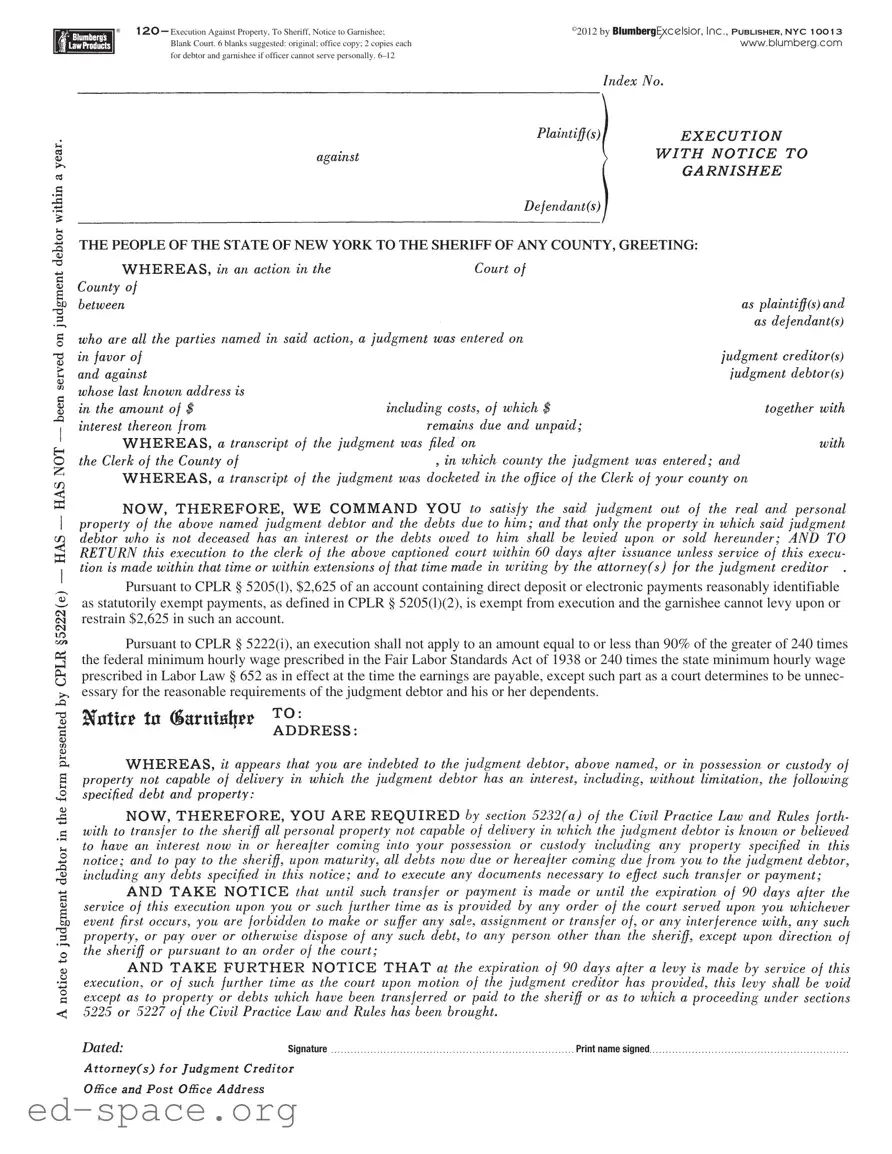
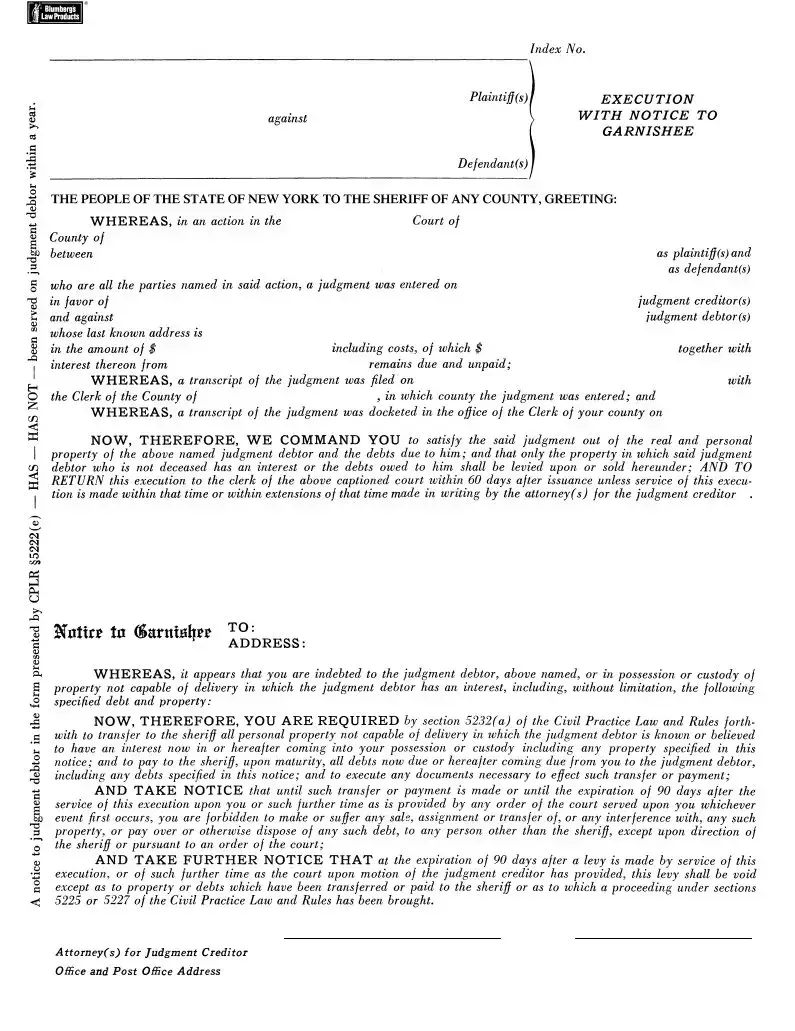
The Blumberg 120 form plays a crucial role in the execution of court judgments related to property. This form is primarily used to notify a sheriff about the execution against a debtor's property and includes a notice to the garnishee, who may hold funds or property belonging to the debtor. It is important to fill out multiple copies of this form: the original for the court, an office copy, and two copies each for both the debtor and the garnishee if the sheriff cannot serve them personally. The form also outlines specific exemptions under New York law, such as the protection of certain amounts in bank accounts from garnishment. For instance, funds that can be identified as exempt payments, up to $2,625, cannot be levied upon. Additionally, the form addresses the limitations on garnishment concerning wages, ensuring that a portion of earnings remains available for the debtor’s essential needs. The Blumberg 120 form requires signatures and provides space for relevant details, including the names and addresses of all parties involved, making it a comprehensive document for executing property judgments.
120 — Execution Against Property, To Sheriff, Notice to Garnishee; |
©2012 by BlumbergExcelsior, Inc., PUBLISHER, NYC 10013 |
Blank Court. 6 blanks suggested: original; office copy; 2 copies each |
www.blumberg.com |
for debtor and garnishee if officer cannot serve personally. |
|
Pursuant to CPLR § 5205(l), $2,625 of an account containing direct deposit or electronic payments reasonably identifiable as statutorily exempt payments, as defined in CPLR § 5205(l)(2), is exempt from execution and the garnishee cannot levy upon or restrain $2,625 in such an account.
Pursuant to CPLR § 5222(i), an execution shall not apply to an amount equal to or less than 90% of the greater of 240 times the federal minimum hourly wage prescribed in the Fair Labor Standards Act of 1938 or 240 times the state minimum hourly wage prescribed in Labor Law § 652 as in effect at the time the earnings are payable, except such part as a court determines to be unnec- essary for the reasonable requirements of the judgment debtor and his or her dependents.
DATED: |
Signature |
Print name signed |

ENDORSEMENT
Please take notice that the following named defendants were not served with a summons herein, viz.:
and that, as to them, the execution must be restricted as below prescribed.
An execution against property shall not be levied upon the sole property of such a defendant, but it may be collected out of real and personal property owned by him jointly with the other defendants who were summoned or with any of them, and out of the real and personal property of the latter or any of them.
Attorney(s) for
Name and Address of Garnishee
Address of Judgment Debtor
Location of Property
INDEX NO.COURTCOUNTY OF
EXECUTION
|
|
|
AGAINST PROPERTY |
|
|
|
|
With Notice to Garnishee |
|
|
|
|
|
|
|
|
|
|
|
|
|
|
LAW OFFICES OF |
|
|
|
|
Plaintiff(s) |
|
|
|
against |
|
|
|
|
|
Defendant(s) |
|
|
|
|
|
|
|
|
|
|
|
Sheriff of any County |
Attorney(s) for |
|||
Levy and collect as within directed |
Office and Post Office Address |
|||
with interest from |
|
|
||
besides your fees, etc. |
Dated and time received |
|||
Sheriff
| Fact Name | Fact Description |
|---|---|
| Form Purpose | The Blumberg 120 form is used for execution against property, allowing a sheriff to levy and collect funds from a debtor's assets. |
| Governing Law | This form operates under New York's Civil Practice Law and Rules (CPLR), specifically sections 5205 and 5222. |
| Exempt Amount | According to CPLR § 5205(l), up to $2,625 in certain accounts is exempt from execution if it consists of identifiable direct deposits. |
| Minimum Wage Consideration | Under CPLR § 5222(i), an execution cannot apply to earnings that are 90% of the greater of 240 times the federal or state minimum wage. |
| Signature Requirement | The form must be signed and printed by the attorney or individual submitting the execution request. |
| Notice to Garnishee | The form includes a notice section that informs the garnishee of the execution and any restrictions related to unserved defendants. |
| Copies Required | It is recommended to prepare the original, an office copy, and two copies each for the debtor and garnishee if personal service is not possible. |
| Endorsement Clause | The form contains an endorsement clause that restricts execution against the sole property of unserved defendants. |
| Filing Information | Users must provide the index number, court, and county information related to the execution against property. |
Filling out the Blumberg 120 form is a crucial step in the execution against property process. This form must be completed accurately to ensure that the appropriate legal actions can be taken. Below are the steps to properly fill out the form.
After completing the form, it is essential to file it with the appropriate court and serve the necessary parties. This will initiate the process of executing against the debtor's property as specified in the form.
What is the Blumberg 120 form?
The Blumberg 120 form is a legal document used in the context of executing a judgment against a debtor's property. It provides a framework for a sheriff to collect a debt owed by a defendant. This form notifies the garnishee, typically a bank or employer, about the execution and outlines the amounts exempt from garnishment.
Who should use the Blumberg 120 form?
This form is primarily used by creditors who have obtained a judgment against a debtor. If a creditor wishes to collect the amount owed through garnishment of the debtor's property or funds, they will need to complete and file this form with the appropriate court.
What information is required on the Blumberg 120 form?
Essential information includes the names and addresses of the plaintiff and defendant, the index number of the case, and details about the garnishee. Additionally, the form requires the sheriff's office to indicate where and when the execution was received.
What are the exemptions mentioned in the Blumberg 120 form?
The form references specific exemptions under New York law. For example, $2,625 from an account containing direct deposits or electronic payments is exempt from execution. Furthermore, it outlines that amounts equal to or less than 90% of a certain wage threshold are also protected from garnishment.
How many copies of the Blumberg 120 form are needed?
It is suggested that six copies of the Blumberg 120 form be prepared. This includes the original for the court, an office copy, and two copies each for the debtor and garnishee. This ensures that all parties involved have the necessary documentation.
What happens if the garnishee cannot be served personally?
If the officer is unable to serve the garnishee personally, the form allows for alternative methods of service. This may include mailing the notice or other means permitted by law, ensuring that the garnishee is still informed of the execution.
What is the role of the sheriff in the execution process?
The sheriff plays a crucial role in executing the judgment. They are responsible for levying the property or funds indicated in the Blumberg 120 form. The sheriff must follow legal procedures to ensure that the execution is conducted fairly and in accordance with the law.
Can the execution be restricted for certain defendants?
Yes, the form allows for restrictions on execution against certain defendants who were not served with a summons. In such cases, the execution cannot be levied on the sole property of those defendants, but it can be collected from jointly owned property with other defendants.
How does one file the Blumberg 120 form?
The completed Blumberg 120 form must be filed with the court where the judgment was obtained. After filing, the creditor must arrange for the sheriff to serve the garnishee and enforce the execution as specified in the form.
Where can I obtain the Blumberg 120 form?
The Blumberg 120 form can be obtained from various legal supply companies, including BlumbergExcelsior, Inc. Additionally, it may be available at local courthouses or online legal resources, ensuring that users have easy access to the necessary documentation.
Incomplete Information: One common mistake is failing to provide all required information. Each section of the Blumberg 120 form must be filled out completely. Omitting details such as the names of the parties involved, the index number, or the address of the judgment debtor can lead to delays or rejections.
Incorrect Signatures: Another frequent error involves signatures. It is essential that the form is signed by the appropriate party. If the signature is missing or if the person signing is not authorized to do so, the form may be deemed invalid.
Failure to Follow Instructions: Many individuals overlook the specific instructions provided with the form. Each section has particular guidelines that must be adhered to. Ignoring these can result in the form being filled out incorrectly, which may lead to complications in the execution process.
Not Keeping Copies: It is crucial to retain copies of the completed form. Some people submit all copies without keeping one for their records. This can create problems if there is a need to reference the original submission later.
Misunderstanding Exemptions: Lastly, misunderstanding the exemptions related to the execution can lead to mistakes. For instance, failing to recognize the exempt amounts from garnishment can result in incorrect claims. It is vital to be aware of the relevant laws to ensure compliance and protect rights.
The Blumberg 120 form is a crucial document used in the execution against property, particularly in garnishment proceedings. When utilizing this form, several other documents may accompany it to ensure a smooth legal process. Below is a list of common forms and documents that are often used alongside the Blumberg 120 form, each serving a specific purpose in the garnishment process.
Each of these documents plays a vital role in the garnishment process. Understanding their functions helps ensure that all legal requirements are met, allowing for a more efficient resolution to the matter at hand.
When filling out the Blumberg 120 form, it's important to follow certain guidelines to ensure accuracy and compliance. Here’s a helpful list of what to do and what to avoid:
Misconceptions about the Blumberg 120 form can lead to confusion and missteps in legal processes. Here are five common misunderstandings:
When filling out and using the Blumberg 120 form, keep these key points in mind:
These takeaways will help ensure that you complete the Blumberg 120 form correctly and understand its implications.