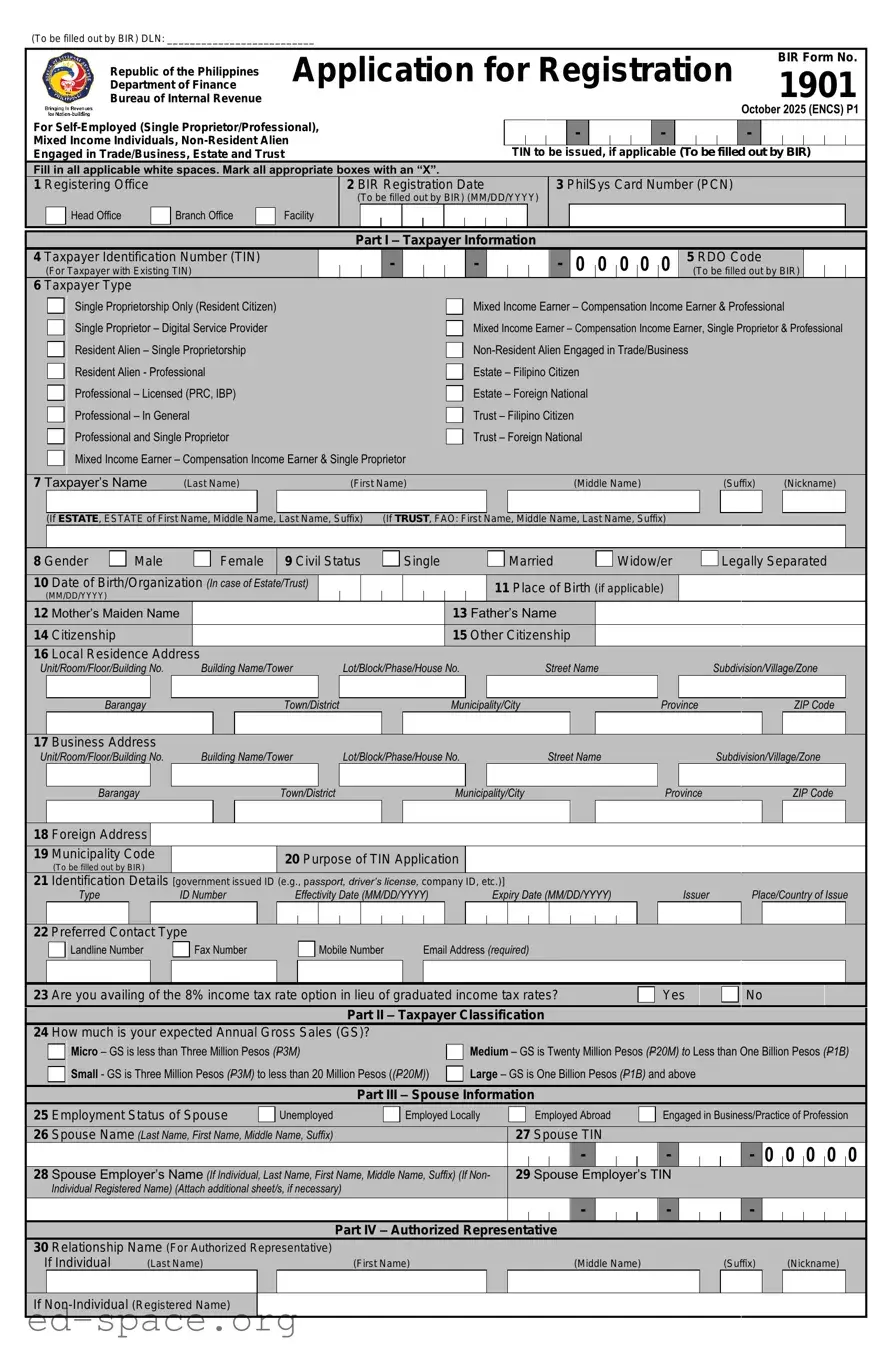
The BIR Form No. 1901 is an essential document for individuals and entities in the Philippines seeking to register for a Tax Identification Number (TIN). This form is specifically designed for a variety of taxpayer types, including self-employed individuals, mixed-income earners, and non-resident aliens engaged in trade or business. It serves as a comprehensive application, requiring detailed information about the taxpayer, such as personal identification details, business addresses, and the nature of their business activities. The form is divided into several parts, each focusing on different aspects of the applicant's information, including taxpayer information, spouse details, and authorized representatives. Furthermore, it outlines the purpose of the TIN application and captures tax types, ensuring that the Bureau of Internal Revenue (BIR) can accurately assess tax liabilities. The form also includes sections for authorized representatives, business information, and payment details, making it a critical component of the registration process. By completing this form accurately, applicants can facilitate their compliance with tax regulations and ensure they are correctly identified within the tax system.
(To be filled out by BIR) DLN: __________________________
Department of Finance |
Application for Registration |
BIR Form No. |
Republic of the Philippines |
|
1901 |
Bureau of Internal Revenue |
|
|
|
|
October 2025 (ENCS) P1 |
For
Mixed Income Individuals,
Engaged in Trade/Business, Estate and Trust
|
|
|
|
- |
|
|
|
|
|
- |
|
|
|
|
|
- |
|
|
|
|
|
|
|
|
|
|
|
|
|
|
|
|
|
|
|
|
|
|
|
|
|
|
|||
|
|
|
|
|
|
|
|
|
|
|
|
|
|
|
|
|
|
|
|
|
|
|
TIN to be issued, if applicable (To be filled out by BIR)
Fill in all applicable white spaces. Mark all appropriate boxes with an “X”.
1 Registering Office
|
|
|
|
|
Head Office |
|
|
|
Branch Office |
|
|
Facility |
2 BIR Registration Date
(To be filled out by BIR) (MM/DD/YYYY)
3 PhilSys Card Number (PCN)
Part I – Taxpayer Information
4 Taxpayer Identification Number (TIN)
(For Taxpayer with Existing TIN)
-
-
-
0 0 0 0 0
5 RDO Code
(To be filled out by BIR)
6 Taxpayer Type
Single Proprietorship Only (Resident Citizen)
Single Proprietor – Digital Service Provider
Resident Alien – Single Proprietorship
Resident Alien - Professional
Professional – Licensed (PRC, IBP)
Professional – In General
Professional and Single Proprietor
Mixed Income Earner – Compensation Income Earner & Single Proprietor
Mixed Income Earner – Compensation Income Earner & Professional
Mixed Income Earner – Compensation Income Earner, Single Proprietor & Professional
Estate – Filipino Citizen
Estate – Foreign National
Trust – Filipino Citizen
Trust – Foreign National
|
|
|
|
|
|
|
|
|
|
|
|
|
|
|
|
|
|
|
|
|
|
|
|
|
|
|
|
|
|
|
|
|
|
|
|
|
|
|
|
|
|
|
|
|
|
|
|
|
|
|
|
|
|
|
|
7 |
Taxpayer’s Name |
(Last Name) |
|
|
|
(First Name) |
|
|
|
|
|
|
|
|
|
|
(Middle Name) |
|
(Suffix) |
|
(Nickname) |
|
|||||||||||||||||||||||||||||||
|
|
|
|
|
|
|
|
|
|
|
|
|
|
|
|
|
|
|
|
|
|
|
|
|
|
|
|
|
|
|
|
|
|
|
|
|
|
|
|
|
|
|
|
|
|
|
|
|
|
|
|
|
|
|
|
|
|
|
(If ESTATE, ESTATE of First Name, Middle Name, Last Name, Suffix) |
(If TRUST, FAO: First Name, Middle Name, Last Name, Suffix) |
|
|
|
|
|
|
|
|
|||||||||||||||||||||||||||||||||||||||||
|
|
|
|
|
|
|
|
|
|
|
|
|
|
|
|
|
|
|
|
|
|
|
|
|
|
|
|
|
|
|
|
|
|
|
|
|
|
|
|
|
|
|
|
|
|
|
|
|
|
|
||||
|
|
8 |
Gender |
|
|
|
|
Male |
|
|
|
|
Female |
|
|
9 Civil Status |
|
|
|
Single |
|
|
|
|
|
|
|
|
Married |
|
|
|
|
Widow/er |
|
|
|
Legally Separated |
|
|
||||||||||||||
|
|
|
|
|
|
|
|
|
|
|
|
|
|
|
|
|
|
|
|
|
|
|
|
|
|
|
|
|
|
|
|
|||||||||||||||||||||||
|
|
|
|
|
|
|
|
|
|
|
|
|
|
|
|
|
|
|
|
|
|
|
|
|
|
|
|
|
|
|
|
|
|
|
|
|
|
|
|
|
|
|
|
|
|
|
|
|
|
|
|
|
|
|
|
10 |
Date of Birth/Organization (In case of Estate/Trust) |
|
|
|
|
|
|
|
|
|
|
|
|
|
|
|
11 Place of Birth (if applicable) |
|
|
|
|
|
|
|
|
|
|
|
|||||||||||||||||||||||||
|
|
|
|
(MM/DD/YYYY) |
|
|
|
|
|
|
|
|
|
|
|
|
|
|
|
|
|
|
|
|
|
|
|
|
|
|
|
|
|
|
|
|
|
|
|
|
|
|
|
|
|
|
|
|
|
|
||||
|
|
12 |
Mother’s Maiden Name |
|
|
|
|
|
|
|
|
|
|
|
|
|
|
|
|
|
|
13 Father’s Name |
|
|
|
|
|
|
|
|
|
|
|
|
|
|
|
|||||||||||||||||
|
|
14 |
Citizenship |
|
|
|
|
|
|
|
|
|
|
|
|
|
|
|
|
|
|
|
|
|
|
15 Other Citizenship |
|
|
|
|
|
|
|
|
|
|
|
|
|
|
|
|||||||||||||
|
|
|
|
|
|
|
|
|
|
|
|
|
|
|
|
|
|
|
|
|
|
|
|
|
|
|
|
|
|
|
|
|
|
|
|
|
|
|
|
|
|
|
|
|
|
|
|
|
|
|
|
|
|
|
16 |
Local Residence Address |
|
|
|
|
|
Unit/Room/Floor/Building No. |
Building Name/Tower |
Lot/Block/Phase/House No. |
Street Name |
|
Subdivision/Village/Zone |
|
|
Barangay |
Town/District |
Municipality/City |
|
Province |
ZIP Code |
17 |
Business Address |
|
|
|
|
|
Unit/Room/Floor/Building No. |
Building Name/Tower |
Lot/Block/Phase/House No. |
Street Name |
|
Subdivision/Village/Zone |
|
|
Barangay |
Town/District |
Municipality/City |
|
Province |
ZIP Code |
18Foreign Address
|
19 Municipality Code |
|
|
20 Purpose of TIN Application |
|
|
|
|
|
|
|
|
|
|
(To be filled out by BIR) |
|
|
|
|
|
|
|
|
|
|
|
21Identification Details [government issued ID (e.g., passport, driver’s license, company ID, etc.)]
|
Type |
|
ID Number |
|
Effectivity Date (MM/DD/YYYY) |
|
Expiry Date (MM/DD/YYYY) |
|
Issuer |
Place/Country of Issue |
||
|
|
|
|
|
|
|
|
|
|
|
|
|
|
|
|
|
|
|
|
|
|
|
|
|
|
|
|
|
|
|
|
|
|
|
|
|
|
|
22 Preferred Contact Type
Landline Number
Fax Number |
|
|
|
Mobile Number |
|
|
Email Address (required) |
|
|
|
|
|
|
|
|
|
|
|
|
|
|
|
|
|
|
|
|
|
|
23 Are you availing of the 8% income tax rate option in lieu of graduated income tax rates? |
Yes |
No |
Part II – Taxpayer Classification
24 How much is your expected Annual Gross Sales (GS)?
|
Micro – GS is less than Three Million Pesos (P3M) |
|
|
|
|
Medium – GS is Twenty Million Pesos (P20M) to Less than One Billion Pesos (P1B) |
|
|
|
|
|
|
|
||
|
|
|
|||||
|
Small - GS is Three Million Pesos (P3M) to less than 20 Million Pesos ((P20M)) |
|
|
|
Large – GS is One Billion Pesos (P1B) and above |
|
|
|
|
|
|
|
|
|
|
|
|
|
Part III – Spouse Information |
|
|
25 |
Employment Status of Spouse |
Unemployed |
Employed Locally |
Employed Abroad |
Engaged in Business/Practice of Profession |
26 |
Spouse Name (Last Name, First Name, Middle Name, Suffix) |
|
27 Spouse TIN |
|
|
|
|
|
|
|
|
|
|
|
|
|
|
|
|
- |
|
|
|
|
|
- |
|
|
|
|
|
- |
|
0 |
|
0 |
|
0 |
|
0 |
|
0 |
|
|
|
|
|
|
|
|
|
|
|
|
|
|
|
|
|
|
|
|
|
|
|
|
|
|
|
|
|
|
|
|
|
||||||||
|
28 |
Spouse Employer’s Name (If Individual, Last Name, First Name, Middle Name, Suffix) (If Non- |
29 Spouse Employer’s TIN |
|
|
|
|
|
|
|
|
|
|
|
|
|
|
|
|
|
||||||||||||||||||
|
|
|
Individual Registered Name) (Attach additional sheet/s, if necessary) |
|
|
|
|
|
|
|
|
|
|
|
|
|
|
|
|
|
|
|
|
|
|
|
|
|
|
|
|
|
||||||
|
|
|
|
|
|
|
|
|
|
|
|
|
|
- |
|
|
|
|
|
- |
|
|
|
|
|
- |
|
|
|
|
|
|
|
|
|
|
|
|
|
|
|
|
|
|
|
|
|
|
|
|
|
|
|
|
|
|
|
|
|
|
|
|
|
|
|
|
|
|
|
|
|
|
|
|
|||
|
|
|
|
|
|
|
Part IV – Authorized Representative |
|
|
|
|
|
|
|
|
|
|
|
|
|
|
|
|
|
|
|
|
|||||||||||
|
30 |
Relationship Name (For Authorized Representative) |
|
|
|
|
|
|
|
|
|
|
|
|
|
|
|
|
|
|
|
|
|
|
|
|
|
|
|
|
|
|
|
|
||||
|
If Individual |
(Last Name) |
(First Name) |
|
|
|
(Middle Name) |
|
|
|
|
|
(Suffix) |
|
(Nickname) |
|
||||||||||||||||||||||
|
|
|
|
|
|
|
|
|
|
|
|
|
|
|
|
|
|
|
|
|
|
|
|
|
|
|
|
|
|
|
|
|
|
|
|
|
|
|
|
|
|
|
|
|
|
|
|
|
|
|
|
|
|
|
|
|
|
|
|
|
|
|
|
|
|
|
|
|
|
|
|
|
|
|
|
|
|
If
| Fact Name | Details |
|---|---|
| Form Title | Application for Registration |
| Form Number | BIR Form No. 1901 |
| Applicable Taxpayers | Self-Employed Individuals, Mixed Income Individuals, Non-Resident Aliens, Estates, and Trusts |
| Governing Law | National Internal Revenue Code, as amended |
| Registration Date | January 2018 |
| Required Information | Taxpayer Information, Spouse Information, Authorized Representative, Business Information |
| Data Privacy Compliance | Consent to process information as per the Data Privacy Act of 2012 (R.A. No. 10173) |
| Documentary Requirements | ID, Mayor's Business Permit, Proof of Payment, and other supporting documents |
Filling out the BIR Form No. 1901 is an important step in the registration process for various taxpayer types, including self-employed individuals and professionals. It's crucial to provide accurate and complete information to avoid any issues later on. Below are the steps to guide you through the process of filling out this form.
After completing the form, ensure that you have all the necessary documents ready for submission, such as identification and proof of payment. Double-check your entries to minimize errors, and then submit the form to the appropriate BIR office. This will set the stage for your official registration and compliance with tax obligations.
What is the BIR Form 1901 used for?
The BIR Form 1901 is an application for registration with the Bureau of Internal Revenue (BIR) in the Philippines. It is primarily intended for self-employed individuals, mixed income earners, non-resident aliens engaged in trade or business, as well as estates and trusts. Completing this form is essential for obtaining a Tax Identification Number (TIN), which is required for tax compliance.
Who needs to fill out the BIR Form 1901?
This form must be filled out by individuals who are self-employed, including single proprietors and professionals. It also applies to mixed income individuals, non-resident aliens who engage in trade or business, and estates or trusts. If you fall into any of these categories, you will need to complete this form to register with the BIR.
What information is required in the taxpayer information section?
The taxpayer information section requires various details such as your PhilSys Number, BIR registration date, Tax Identification Number (TIN), and taxpayer type. You will also need to provide personal information including your name, gender, civil status, date of birth, place of birth, and local residence address. Make sure to fill in all applicable fields accurately.
What is the purpose of the TIN application?
The TIN application is crucial for tax identification purposes. It allows the BIR to track your tax obligations and ensures compliance with tax laws. If you are applying for a TIN for the first time, this form is necessary to establish your tax identity and facilitate the filing of your taxes.
What documents are needed to accompany the BIR Form 1901?
When submitting the BIR Form 1901, you will need to provide several documents. These include a valid identification issued by a government body, a photocopy of your Mayor’s Business Permit, proof of payment for the registration fee, and a final sample of principal receipts or invoices. Additional documents may be required depending on your specific situation, such as a Special Power of Attorney if someone else is filing on your behalf.
How do I know if I qualify for the 8% income tax rate option?
The 8% income tax rate option is available for self-employed individuals and professionals whose gross sales or receipts do not exceed a specified threshold. If you believe you qualify, you can indicate your preference on the form. It's advisable to consult with a tax professional to confirm your eligibility for this option.
Can I authorize someone to submit the BIR Form 1901 on my behalf?
Yes, you can authorize someone to submit the form for you. If you choose to do so, you will need to provide their details in the authorized representative section of the form. Additionally, a Special Power of Attorney may be required to grant them the authority to act on your behalf.
What happens after I submit the BIR Form 1901?
After submitting the form, the BIR will process your application. If everything is in order, you will receive your TIN. This process may take some time, so it’s important to keep a copy of your submission for your records. If there are any issues, the BIR may contact you for clarification or additional information.
What are the penalties for having multiple TINs?
Possessing more than one Tax Identification Number (TIN) is considered a criminal offense under the National Internal Revenue Code. It is crucial to ensure that you only apply for and maintain one TIN to avoid potential legal repercussions. Always verify your TIN status with the BIR if you are unsure.
Failing to complete all applicable sections of the BIR Form 1901. Each blank space should be filled out accurately to avoid delays.
Not marking the appropriate boxes with an “X.” This is essential for indicating the taxpayer type and other relevant options.
Providing incorrect or incomplete Taxpayer Identification Number (TIN). Ensure that the TIN is accurate, as this is crucial for processing.
Neglecting to include the PhilSys Number (PSN) when applicable. This information is important for identification purposes.
Using outdated or incorrect dates in the date fields. All dates must be entered in the MM/DD/YYYY format to ensure clarity.
Omitting the identification details. It is important to provide information about the type of ID and its validity.
Forgetting to provide a preferred contact type. Include a mobile number or email address to facilitate communication.
Not reviewing the entire form for accuracy before submission. Double-check all entries to prevent errors that could lead to processing delays.
When applying for registration with the Bureau of Internal Revenue (BIR) in the Philippines, the BIR Form 1901 is essential. However, several other documents often accompany this form to ensure a smooth registration process. Below is a list of common forms and documents that may be required alongside the BIR Form 1901.
Each of these documents plays a significant role in the registration process with the BIR. Ensuring that they are correctly completed and submitted can facilitate a more efficient and successful registration experience.
When filling out the BIR Form, there are important guidelines to follow. Here’s a list of things you should and shouldn't do:
Misconceptions about the BIR Form 1901 can lead to confusion and errors in the registration process. Here are ten common misconceptions explained:
This form is also applicable to self-employed individuals and professionals, not just businesses. Mixed income earners and non-resident aliens engaged in trade or business must also use this form.
While many fields must be filled out, some sections are only required based on individual circumstances. It is essential to fill in all applicable white spaces and mark appropriate boxes.
Supporting documents such as identification and proof of business registration are necessary. Failure to provide these can delay the processing of your application.
Any changes in personal or business information must be reported to the BIR. This includes changes in address, business type, or taxpayer status.
This form can also be used for updates or amendments to existing registrations. It is not limited to new applicants.
While submitting the form is necessary to apply for a TIN, it does not guarantee that a TIN will be issued. The BIR will review the application before granting a TIN.
Timely submission is crucial. Delays can result in penalties or complications with your tax obligations.
Trusts and estates can also use BIR Form 1901 for registration. This form accommodates various taxpayer types, including foreign nationals.
Corrections can be made, but it may require additional steps or forms to rectify any mistakes after submission.
Payment of the registration fee is mandatory for processing the application. Without this payment, the application will not be completed.
Understanding these misconceptions can help ensure a smoother registration process and compliance with tax regulations.
Filling out the BIR Form No. 1901 is an important step for individuals seeking to register for a Tax Identification Number (TIN) in the Philippines. Here are some key takeaways to consider:
By following these guidelines, you can ensure a smoother registration process with the Bureau of Internal Revenue. Take your time to review the form before submission to avoid any issues.