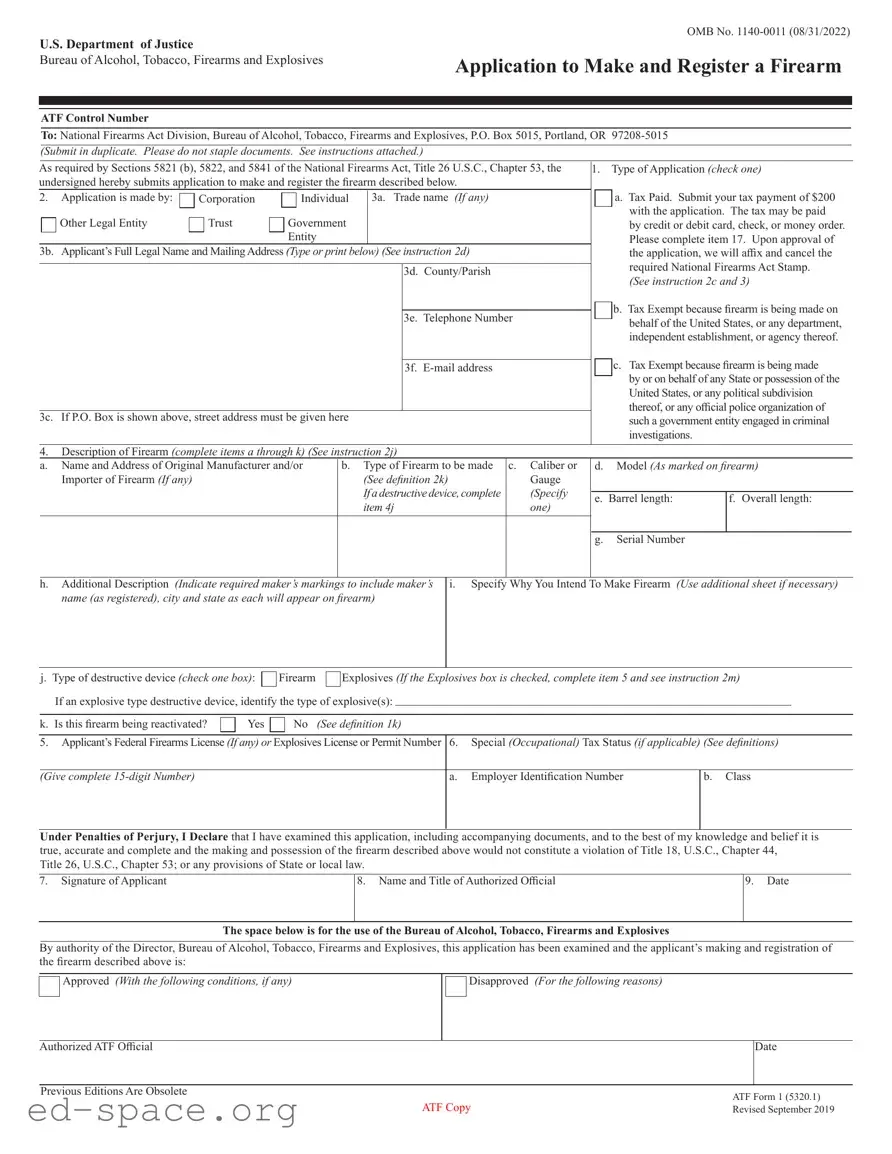
The ATF Form 1, officially known as the Application to Make and Register a Firearm, is a crucial document for anyone looking to create a firearm under the National Firearms Act (NFA). This form serves multiple purposes, including facilitating the registration of newly manufactured firearms and ensuring compliance with federal laws. Applicants must indicate whether they are submitting a tax-paid application, which requires a $200 tax payment, or if they qualify for a tax exemption. The form gathers essential information about the applicant, such as their legal name, address, and type of entity—whether an individual, corporation, or government entity. Additionally, the form requires a detailed description of the firearm, including its type, caliber, and intended purpose. Applicants must also disclose any relevant legal history that could affect their eligibility to possess a firearm. Importantly, the ATF Form 1 must be submitted in duplicate, without staples, and accompanied by a photograph of the applicant. After review, the Bureau of Alcohol, Tobacco, Firearms and Explosives (ATF) will either approve or disapprove the application, and the outcome will be communicated to the applicant. Understanding the nuances of this form is essential for anyone looking to navigate the complexities of firearm registration legally and effectively.
U.S. Department of Justice |
OMB No. |
|
|
Bureau of Alcohol, Tobacco, Firearms and Explosives |
Application to Make and Register a Firearm |
|
ATF Control Number
To: National Firearms Act Division, Bureau of Alcohol, Tobacco, Firearms and Explosives, P.O. Box 5015, Portland, OR
(Submit in duplicate. Please do not staple documents. See instructions attached.)
As required by Sections 5821 (b), 5822, and 5841 of the National Firearms Act, Title 26 U.S.C., Chapter 53, the |
1. |
Type of Application (check one) |
|
||||||||||||||||||||
undersigned hereby submits application to make and register the firearm described below. |
|
|
|
a. Tax Paid. Submit your tax payment of $200 |
|
||||||||||||||||||
2. |
Application is made by: |
|
|
|
Corporation |
|
Individual |
|
3a. Trade name |
(If any) |
|
|
|
|
|||||||||
|
|
|
|
|
|
|
|
|
|
|
|
|
|
|
|
|
|
|
|
|
with the application. The tax may be paid |
|
|
|
|
Other Legal Entity |
|
|
|
|
Trust |
|
Government |
|
|
|
|
|
|
|
|
|
|
||||
|
|
|
|
|
|
|
|
|
|
|
|
|
|
|
|
by credit or debit card, check, or money order. |
|
||||||
|
|
|
|
|
|
|
|
|
Entity |
|
|
|
|
|
|
|
|
|
|
Please complete item 17. Upon approval of |
|
||
|
|
|
|
|
|
|
|
|
|
|
|
|
|
|
|
|
|
|
|
||||
|
3b. |
Applicant’s Full Legal Name and Mailing Address (Type or print below) (See instruction 2d) |
|
|
|
the application, we will affix and cancel the |
|
||||||||||||||||
|
|
|
|
|
|
|
|
|
|
|
|
|
|
|
|
|
|
|
|
|
required National Firearms Act Stamp. |
|
|
|
|
|
|
|
|
|
|
|
|
|
|
|
|
3d. County/Parish |
|
|
|
|
|||||
|
|
|
|
|
|
|
|
|
|
|
|
|
|
|
|
|
(See instruction 2c and 3) |
|
|||||
|
|
|
|
|
|
|
|
|
|
|
|
|
|
|
|
|
|
|
|
|
|
||
|
|
|
|
|
|
|
|
|
|
|
|
|
|
|
|
|
|
|
|
|
b. Tax Exempt because firearm is being made on |
|
|
|
|
|
|
|
|
|
|
|
|
|
|
|
|
|
|
|
|
|
|
|
|
||
|
|
|
|
|
|
|
|
|
|
|
|
|
|
3e. Telephone Number |
|
|
|
|
|||||
|
|
|
|
|
|
|
|
|
|
|
|
|
|
|
|
|
behalf of the United States, or any department, |
|
|||||
|
|
|
|
|
|
|
|
|
|
|
|
|
|
|
|
|
|||||||
|
|
|
|
|
|
|
|
|
|
|
|
|
|
|
|
|
|
|
|
|
|
||
|
|
|
|
|
|
|
|
|
|
|
|
|
|
|
|
|
|
|
|
|
independent establishment, or agency thereof. |
|
|
|
|
|
|
|
|
|
|
|
|
|
|
|
|
|
|
|
|
|
c. Tax Exempt because firearm is being made |
|
|||
|
|
|
|
|
|
|
|
|
|
|
|
|
|
3f. |
|
|
|
|
|||||
|
|
|
|
|
|
|
|
|
|
|
|
|
|
|
|
|
|
|
|
|
by or on behalf of any State or possession of the |
|
|
|
|
|
|
|
|
|
|
|
|
|
|
|
|
|
|
|
|
|
|
|
|
||
|
|
|
|
|
|
|
|
|
|
|
|
|
|
|
|
|
|
|
|
|
United States, or any political subdivision |
|
|
|
|
|
|
|
|
|
|
|
|
|
|
|
|
|
|
|
|
|
|
|
thereof, or any official police organization of |
|
|
|
3c. |
If P.O. Box is shown above, street address must be given here |
|
|
|
|
|
|
|
|
|
such a government entity engaged in criminal |
|
||||||||||
|
|
|
|
|
|
|
|
|
|
|
|
|
|
|
|
|
|
|
|
|
investigations. |
|
|
|
4. |
Description of Firearm (complete items a through k) (See instruction 2j) |
|
|
|
|
|
|
|
|
|||||||||||||
|
a. |
Name and Address of Original Manufacturer and/or |
b. |
Type of Firearm to be made |
c. |
Caliber or |
|
d. |
Model (As marked on firearm) |
|
|||||||||||||
|
|
Importer of Firearm (If any) |
|
|
|
(See definition 2k) |
|
|
Gauge |
|
|
|
|
|
|||||||||
|
|
|
|
|
|
|
|
|
|
|
|
If a destructive device, complete |
|
(Specify |
|
|
|
|
|
||||
|
|
|
|
|
|
|
|
|
|
|
|
|
e. Barrel length: |
f. Overall length: |
|
||||||||
|
|
|
|
|
|
|
|
|
|
|
|
item 4j |
|
|
one) |
|
|
||||||
|
|
|
|
|
|
|
|
|
|
|
|
|
|
|
|
|
|
|
|||||
|
|
|
|
|
|
|
|
|
|
|
|
|
|
|
|
|
|
|
|
|
|
|
|
|
|
|
|
|
|
|
|
|
|
|
|
|
|
|
|
|
|
|
|
g. |
Serial Number |
|
|
|
|
|
|
|
|
|
|
|
|
|
|
|
|
|
|
|
|
|
|
|
|
||
|
h. |
Additional Description |
(Indicate required maker’s markings |
to include maker’s |
|
i. Specify |
Why You Intend To Make Firearm (Use additional sheet if necessary) |
|
|||||||||||||||
|
|
name (as registered), city and state as each will appear on firearm) |
|
|
|
|
|
|
|
|
|
||||||||||||
|
|
|
|
|
|
|
|
|
|
|
|
|
|
|
|
|
|
|
|
|
|
|
|
j. Type of destructive device (check one box): |
|
Firearm |
|
Explosives (If the Explosives box is checked, complete item 5 and see instruction 2m) |
|
|
If an explosive type destructive device, identify the type of explosive(s):
k. Is this firearm being reactivated?
Yes No (See definition 1k)
5. Applicant’s Federal Firearms License (If any) or Explosives License or Permit Number |
6. |
Special (Occupational) Tax Status (if applicable) (See definitions) |
|
(Give complete |
a. |
Employer Identification Number |
b. Class |
Under Penalties of Perjury, I Declare that I have examined this application, including accompanying documents, and to the best of my knowledge and belief it is true, accurate and complete and the making and possession of the firearm described above would not constitute a violation of Title 18, U.S.C., Chapter 44,
Title 26, U.S.C., Chapter 53; or any provisions of State or local law.
7.Signature of Applicant
8.Name and Title of Authorized Official
9.Date
The space below is for the use of the Bureau of Alcohol, Tobacco, Firearms and Explosives
By authority of the Director, Bureau of Alcohol, Tobacco, Firearms and Explosives, this application has been examined and the applicant’s making and registration of the firearm described above is:
|
Approved (With the following conditions, if any) |
|
|
|
Disapproved (For the following reasons) |
|
|
|
|
|
|
|
|||
|
|
|
|
|
|
|
|
|
|
|
|
|
|
|
|
Authorized ATF Official |
|
|
|
|
|
Date |
|
|
|
|
|
|
|
|
|
Previous Editions Are Obsolete |
ATF Copy |
ATF Form 1 (5320.1) |
|||||
|
|
Revised September 2019 |
|||||
MAKER’S CERTIFICATION (not completed by a GOVERNMENT ENTITY)
10. Law Enforcement Notification (See instruction 2l)
Each applicant is to provide notification of the proposed making and possession of the firearm described on this Form 1 by providing a copy of the completed form to the chief law enforcement officer in the agency identified below:
|
|
Agency or Department Name |
Name and Title of Official |
|
|
|
|
|
|
|
|
|
|
|
|
|
|
|
|
Address (Street address or P.O. Box, City, State and Zip Code) to which sent (mailed or delivered) |
|
|
|
|
||
|
|
|
|
|
|
|
|
|
|
|
|
Information for the Chief Law Enforcement Officer |
|
|
12. |
Photograph |
|
|
|
|
|
|
|
|
||
|
|
This form provides notification of the applicant’s intent to make and register a National Firearms Act (NFA) firearm. No action |
|
Affix a 2” x 2” Photograph Here |
||||
|
|
on your part is required. However, should you have information that may disqualify this person from making or possessing a |
|
|||||
|
|
firearm, please contact the NFA Division at (304) |
|
No Stapling. Please Tape |
||||
|
|
15.d. or 15.e. could disqualify a person from acquiring or possessing a firearm. Also, ATF will not approve an application |
|
|
|
Sides of Photo to the Application. |
||
|
|
if the making or possession of the firearm is in violation of State or local law. |
|
|
|
1. Photo must have been taken within the |
||
|
|
Maker’s Questions (complete only when the maker is an individual) |
|
|
|
|||
|
|
|
|
|
|
last year. |
||
|
|
A maker who is an individual must complete this Section. |
|
|
|
2. Photo must have been taken in full face |
||
|
|
|
11. Answer questions 11.a. through 11.h. Answer questions 13, 15, 16 and 17 if applicable. For any “Yes” answer |
|
|
|||
|
|
|
|
|
|
view without a hat or head covering that |
||
|
|
|
the applicant shall provide details on a separate sheet. (See instruction 7c and definitions) |
|
|
|
||
|
|
|
|
|
|
obscures the hair or hairline. |
||
|
|
|
|
|
|
|
|
|
|
|
|
|
Yes |
No |
|
3. |
On back of photograph print full name, |
|
a. Are you under indictment or information in any court for a felony, or any other crime, for which the judge |
|
|
|||||
|
|
|
could imprison you for more than one year? (See definition 1n) |
|
|
|
|
last 4 of SSN. |
|
|
|
|
|
|
|
||
|
|
|
b. Have you ever been convicted in any court for a felony, or any other crime, for which the judge could have |
|
|
|
|
|
|
|
|
imprisoned you for more than one year, even if you received a shorter sentence including probation? (See definition 1n) |
|
|
|
|
|
c. Are you a fugitive from justice? (See definition 1t) |
|
|
|
|
|
|||
|
|
|
|
|
|
|
||
d. Are you an unlawful user of, or addicted to, marijuana or any depressant, stimulant, narcotic drug, or any |
|
|
|
|
||||
|
|
|
other controlled substance? Warning: The use or possession of marijuana remains unlawful under |
|
|
|
|
|
|
|
|
Federal law regardless of whether it has been legalized or decriminalized for medicinal |
|
|
|
|
|
|
|
|
or recreational purposes in the state where you reside. |
|
|
|
|
|
|
|
e. Have you ever been adjudicated as a mental defective OR have you ever been committed to a mental |
|
|
|
|
||
|
|
|
institution? (See definition 1o and 1p) |
|
|
|
|
|
|
|
f. Have you been discharged from the Armed Forces under dishonorable conditions? |
|
|
|
|
||
g.Are you subject to a court order restraining you from harassing, stalking, or threatening your child or an intimate partner or child of such partner? (See definition 1q)
h.Have you ever been convicted in any court of a misdemeanor crime of domestic violence? (See definition 1r)
|
13. Social Security Number: (See instruction 2f) |
|
|
Date of Birth: |
|
|
|
|
|
|
|
|
|
|
|
14a. Ethnicity |
Hispanic or Latino |
14b. Race |
American Indian or Alaska Native |
Black or African American |
White |
||
|
|
Not Hispanic or Latino |
|
Asian |
Native Hawaiian or Other Pacific Islander |
||
15a. Country of Citizenship: (Check/List more than one, if applicable. Nationals of the United States may check U.S.A.) (See definition 1s)
|
|
United States of America |
Other Country/Countries (specify): |
|
|
|
|
|
|
|
|
|
||
|
|
|
|
|
|
|
|
|
|
|
||||
15b. State of Birth |
|
|
15c.Country of Birth |
|
|
|
|
|
|
|||||
|
|
|
|
|
|
|
|
|
|
|
|
|
|
|
|
|
|
|
|
|
|
|
|
|
|
Yes |
No |
||
|
d. |
Have you ever renounced your United States citizenship? |
|
|
|
|
|
|
|
|
|
|||
|
|
|
|
|
|
|
|
|
|
|
|
|
|
|
|
e. |
Are you an alien illegally or unlawfully in the United States? |
|
|
|
|
|
|
|
|
|
|||
|
|
|
|
|
|
|
|
|
|
|
|
|
||
|
f.1. Are you an alien who has been admitted to the United States under a nonimmigrant visa? |
|
|
|
|
|
|
|
|
|
||||
f.2. If “yes”, do you fall within any of the exceptions stated in the instructions? Attach the documentation to the application |
|
|
|
|
|
|
||||||||
N/A |
|
|
|
|
||||||||||
|
|
|
|
|
|
|
|
|
|
|
|
|
||
16. |
If you are an alien, record your |
|
|
|
|
|
|
|
|
|||||
|
|
|
|
|
|
|
|
|
|
|
|
|||
17. |
Have you been issued a Unique Personal Identification Number (UPIN)? (See instruction 2f) |
Yes |
No If yes please list |
|
|
|
|
|
|
|
||||
CERTIFICATION: Under penalties imposed by 18 U.S.C. § 924 and 26 U.S.C. § 5861, I certify that, upon submission of this form to ATF, a completed copy of this form will be directed to the chief law enforcement officer (CLEO) shown in item 10, that the statements, as applicable, contained in this certification, and any attached documents in support thereof, are true and correct to the best of my knowledge and belief. NOTE: See instructions 2.d(2) and 2.d(3) for the items to be completed depending on the type of applicant.
|
Signature of Maker |
|
Date |
|
|
|
|
|
|
|
|
ATF Copy |
|
ATF Form 1 (5320.1) |
|
|
|
Revised September 2019 |
18.Number of Responsible Persons (see definitions) associated with the applicant trust or legal entity
19.Provide the full name (printed or typed) below for each Responsible Person associated with the applicant trust or legal entity (if there are more Responsible Persons than can be listed on the form, attach a separate sheet listing the additional Responsible Person(s)). Please note that a completed Form 5320.23, National Firearms Act (NFA) Responsible Person Questionnaire, must be submitted with the Form 1 application for each Responsible Person.
Full Name |
|
Full Name |
|
|
|
|
|
|
|
|
|
|
|
|
|
|
|
|
|
20.Method of Payment (Check one) (See instruction 2i) (if paying by credit/debit card, complete the sections below)
|
Check (Enclosed) |
Cashier’s Check or |
Visa |
Mastercard |
American |
Discover |
Diners Club |
||
|
|
|
Money Order (Enclosed) |
|
|
Express |
|
|
|
|
|
|
|
|
|
|
|||
Credit/Debit Card Number (No dashes) |
|
Name as Printed on the Credit/Debit Card |
|
Expiration Date (Month & year) |
|||||
|
|
|
|
|
|
|
|
|
|
|
|
Address: |
|
|
|
|
|
|
|
|
Credit/Debit Card |
|
|
|
|
|
|
|
|
|
Billing Address: |
|
|
|
|
|
|
||
|
City: |
|
State: |
|
Zip Code: |
|
|||
|
|
|
|
|
|
|
|
|
|
|
|
|
|
|
|
|
Tax Amount: |
|
|
|
|
|
|
|
|
|
$ |
|
|
I Authorize ATF to Charge my Credit/Debit Card the Above Amount.
Signature of Cardholder |
Date |
Your credit/debit card will be charged the above stated amount upon receipt of your application. The charge will be reflected on your credit/debit card statement. In the event your application is NOT approved, the above amount will be credited to the credit/debit card noted above.
Important Information for Currently Registered Firearms
If you are the current registrant of the firearm described on this form, please note the following information.
Estate Procedures: For procedures regarding the transfer of firearms in an estate resulting from the death of the registrant identified in item 3b, the executor should contact the NFA Division, Bureau of ATF, 244 Needy Road, Martinsburg, WV 25405.
Interstate Movement: If the firearm identified in item 4 is a machinegun,
Change of Description or Address: The registrant shall notify the NFA Division, Bureau of Alcohol, Tobacco, Firearms and Explosives, 244 Needy Road, Martinsburg, WV 25405, in writing, of any change to the description of the firearm in item 4, or any change to the address of the registrant.
Restrictions on Possession: Any restriction (see approval block on face of form) on the possession of the firearm identified in item 4 continues with the further transfer of the firearm.
Persons Prohibited from Possessing Firearms: If the registrant becomes prohibited from possessing a firearm, please contact the NFA Division for procedures on how to dispose of the firearm.
Proof of Registration: A person possessing a firearm registered as required by the NFA shall retain proof of registration which shall be made available to any ATF officer upon request.
Paperwork Reduction Act Notice
This form is in accordance with the Paperwork Reduction Act of 1995. The information you provide is used to establish that the applicant’s making and possession of the firearm would be in conformance with Federal, State, and local law. The data is used as proof of lawful registration of a firearm to the manufacturer. The furnishing of this information is mandatory (26 U.S.C. § 5822).
The estimated average burden associated with this collection of information is 4.0 hours per respondent or recordkeeper, depending on individual circumstances. Comments concerning the accuracy of this burden estimate and suggestion for reducing this burden should be addressed to Reports Management Officer, Information Technology Coordination Staff, Bureau of Alcohol, Tobacco, Firearms and Explosives, Washington, DC 20226.
An agency may not conduct or sponsor, and a person is not required to respond to, a collection of information unless it displays a currently valid OMB control number.
ATF Copy |
ATF Form 1 (5320.1) |
Revised September 2019 |
PrivacyActInformation
1.Authority. Solicitation of this information is made pursuant to the National Firearms Act (26 U.S.C. § § 5821 and 5822). Disclosure of this information by the applicant is mandatory for any person (other than a manufacturer qualified under the National Firearms Act) making a firearm as defined in the National Firearms Act.
2.Purpose. To verify payment of the tax imposed by 26 U.S.C. § 5821; to determine that the making would not be in violation of law; and to effect registration of the firearm.
3.Routine Uses. The information will be used by ATF to make the determinations set forth in paragraph 2. In addition, to effect registration of the firearm, information as to the identification of the firearm, date of registration, and the identification and address of person entitled to possess the firearm will be entered into the National Firearms Registration and Transfer Record. No information obtained from an application, registration, or records required to be submitted by an individual in order to comply with any provision of the National Firearms Act or regulation issued thereunder, shall, except in connection with prosecution or other action for furnishing false information, be used, directly or indirectly, as evidence against that person in any criminal proceeding with respect to a violation of law occurring prior to or concurrently with the filing of the application. The information from this application may only be disclosed to Federal authorities for purposes of prosecution for viola tion of the National Firearms Act.
4.Effects of not Supplying Information Requested. Failure to supply complete information will delay processing and may cause denial of the application.
Definitions/Instructions
1.Definitions.
a.National Firearms Act (NFA). Title 26, United States Code, Chapter 53.
The implementing regulations are found in Title 27, Code of Federal Regulations, Part 479.
b.Gun Control Act (GCA). Title 18, United States Code, Chapter 44.
The implementing regulations are found in Title 27, Code of Federal Regulations, Part 478.
c.Firearm. The term “firearm” means: (1) a shotgun having a barrel or barrels of less than 18 inches in length; (2) a weapon made from a shotgun if such weapon as modified has an overall length of less than 26 inches or a barrel or barrels of less than 18 inches in length; (3) a rifle having a barrel or barrels of less than 16 inches in length; (4) a weapon made from a rifle if such weapon as modified has an overall length of less than 26 inches or a barrel or barrels of less than 16 inches in length; (5) any other weapon, as defined in 26 U.S.C. § 5845(e); (6) a machinegun;
(7) a muffler or a silencer for any firearm whether or not such firearm is included within this definition; and (8) a destructive device,as defined in 26
U.S.C. § 5845 (f).
d.Person. A partnership, company, association, trust, corporation, including each responsible person associated with such an entity; an estate; or an individual.
Section A
e.Responsible Person. In the case of an unlicensed entity, including any trust, partnership, association, company (including any Limited Liability Company (LLC)), or corporation, any individual who possesses, directly or indirectly, the power or authority to direct the management and policies of the trust or entity to receive, possess, ship, transport, deliver, transfer or otherwise dispose of a firearm for, or on behalf of, the trust or legal entity.
Section B
Trust: Those persons with the power or authority to direct the management and policies of the trust includes any person who has the capability to exercise such power and possesses, directly or indirectly, the power or authority under any trust instrument, or under State law, to receive, possess, ship, transport, deliver, transfer, or otherwise dispose of a firearm for, or on behalf of the trust. Examples of who may be considered a responsible person include settlors/grantors, trustees, partners, members, officers, directors, board members, or owners. An example of who may be excluded from this definition of responsible person is the beneficiary of a trust, if the beneficiary does not have the capability to exercise the enumerated powers or authorities.
f.Employer Identification Number (EIN). Required of taxpayer filing special (occupational) tax returns under 27 CFR § 479.35.
g.Special (Occupational) Tax. Required by the NFA to be paid by a
Federal firearms licensee engaged in the business of manufacturing (Class 2), importing (Class 1), or dealing (Class 3) in NFA firearms.
h.Federal Firearms License. A license issued under the provisions of the
GCA to manufacture, import or deal in firearms.
Tobacco, Firearms and Explosives (ATF) authorized to perform any function relating to the administration of the NFA.
j.Make. The term “make”, and the various derivatives of such word, shall include manufacturing (other than by one qualified to engage in such business under the NFA), putting together, altering, any combination of these, or otherwise producing a firearm.
k.Reactivation. The restoration of a registered unserviceable NFA firearm to a functional condition. This action incurs the making tax liability.
l.Unserviceable Firearm. One which is incapable of discharging a shot by means of an explosive and incapable of being readily restored to firing condition. An acceptable method of rendering most firearms unserviceable is to fusion weld the chamber closed and fusion weld the barrel solidly to the frame.
m.Maker. A person applying to make an NFA firearm.
n.Prohibited Person. Generally, 18 U.S.C. § 922 (g) prohibits the shipment, transportation, receipt, or possession in or affecting interstate commerce of a firearm by one who: has been convicted of a misdemeanor or crime of domestic violence; has been convicted of a felony, or any other crime, pun ishable by imprisonment for a term exceeding one year (this does not include State misdemeanors punishable by imprisonment of two years or less); is a fugitive from justice, is an unlawful user of, or addicted to, marijuana or any depressant, stimulant, or narcotic drug, or any other controlled substance; has been adjudicated as a mental defective or has been committed to a mental institution; has been discharged from the
Armed Forces under dishonorable conditions, has renounced his or her
U.S. citizenship; is an alien illegally in the United States or an alien admitted to the United States under a nonimmigrant visa; or is subject to certain restraining orders. Furthermore, Section 922 (n) prohibits the ship ment, transportation, or receipt in or affecting interstate commerce of a firearm by one who is under indictment or information for a felony in any
Federal, State or local court, or any other crime, punishable by imprison ment for a term exceeding one year. An information is a formal accusation of a crime verified by a prosecutor.
EXCEPTION: A person who has been convicted of a felony, or any other crime, for which the judge could have imprisoned the person for more than one year, or who has been convicted of a misdemeanor crime of domestic violence, is not prohibited from purchasing, receiving, or possess ing a firearm if: (1) under the law of the jurisdiction where the conviction occurred, the person has been pardoned, the conviction has been expunged or set aside, or the person has had their civil rights (the right to vote, sit on a jury, and hold public office) taken away and later restored AND (2) the person is not prohibited by the law of the jurisdiction where the conviction occurred from receiving or possessing firearms. Persons subject to this exception should mark “no” in the applicable box.
o.Adjudicated As a Mental Defective. A determination by a court, board, commission, or other lawful authority that a person, as a result of marked subnormal intelligence, or mental illness, incompetency, condition, or disease:
(1) is a danger to himself or to others; or (2) lacks the mental capacity to contract or manage his own affairs. This term shall include; (1) a finding of insanity by a
i. ATF Officer. An officer or employee of the Bureau of Alcohol, |
ATF Form 1 (5320.1) |
|
Revised September 2019 |
| Fact Name | Description | Governing Law(s) |
|---|---|---|
| Application Purpose | The ATF Form 1 is used to apply for the making and registration of a firearm under the National Firearms Act. | 26 U.S.C. § 5821, § 5822 |
| Tax Requirement | A tax of $200 is required for most applications, unless the application is for a firearm being made for a government entity. | 26 U.S.C. § 5821 |
| Notification Requirement | Applicants must notify the chief law enforcement officer in their jurisdiction about their intent to make and possess the firearm. | ATF Regulations |
| Approval Process | The ATF reviews the application to ensure compliance with federal, state, and local laws before granting approval. | 18 U.S.C. § 922, 26 U.S.C. § 5822 |
Filling out the ATF Form 1 is a crucial step for individuals or entities wishing to make and register a firearm. The following steps will guide you through the process of completing the form accurately. Make sure to have all necessary information on hand before you begin.
After completing the form, it is essential to submit it along with any required payment and supporting documents. The ATF will review the application, and upon approval, they will affix and cancel the necessary National Firearms Act Stamp. Keep a copy of the submitted form for your records.
What is the ATF Form 1?
The ATF Form 1, officially known as the Application to Make and Register a Firearm, is a document required by the Bureau of Alcohol, Tobacco, Firearms and Explosives (ATF) for individuals or entities wishing to manufacture a firearm. This form is essential for compliance with the National Firearms Act (NFA). It must be submitted in duplicate and includes various sections that require detailed information about the applicant and the firearm being made.
Who needs to complete the ATF Form 1?
Any individual or entity planning to manufacture a firearm must complete the ATF Form 1. This includes corporations, trusts, and government entities. It is crucial that the applicant provides accurate information to ensure compliance with federal and state laws.
What is the application fee for the ATF Form 1?
The application fee for submitting the ATF Form 1 is $200. This fee is required unless the firearm is being made for a government entity, in which case the application may be tax-exempt. Payment can be made via credit card, debit card, check, or money order.
How long does it take to process the ATF Form 1?
The processing time for the ATF Form 1 can vary. Generally, it may take several months for the application to be reviewed and approved. Factors such as the volume of applications received by the ATF and the completeness of the application can affect processing times.
What information is required on the ATF Form 1?
The form requires various details, including the applicant's full legal name, mailing address, and the description of the firearm to be made. Specific information such as the type, model, caliber, and serial number of the firearm must also be included. Additionally, the applicant must indicate whether the firearm is being made for personal use or for a specific purpose.
What happens after I submit the ATF Form 1?
Once the ATF Form 1 is submitted, the ATF will review the application. If approved, the ATF will issue a National Firearms Act stamp, which must be affixed to the firearm. If the application is disapproved, the applicant will receive a notice detailing the reasons for the denial.
Do I need to notify law enforcement about my application?
Yes, the applicant is required to notify the chief law enforcement officer in their jurisdiction about the intent to make and possess the firearm. This involves providing a copy of the completed ATF Form 1 to the designated law enforcement agency.
Can I appeal if my ATF Form 1 is denied?
If your application is denied, you may have the option to appeal the decision. However, the process for appealing a denial can be complex and may require legal assistance. It is important to carefully review the reasons for denial and consult with a legal expert for guidance on the next steps.
What should I do if my circumstances change after submitting the ATF Form 1?
If there are any changes to the information provided in your application, such as a change of address or modifications to the firearm description, you must notify the ATF immediately. This helps ensure that your application remains accurate and compliant with regulations.
Is there a way to track the status of my ATF Form 1 application?
Currently, the ATF does not provide a formal tracking system for individual applications. However, you may contact the ATF directly to inquire about the status of your application. Be prepared to provide identifying information to assist in the inquiry.
Incomplete Information: Failing to provide all required details can lead to delays or denials. Ensure every section is filled out completely.
Incorrect Payment Method: Using the wrong payment method for the $200 tax can cause your application to be rejected. Double-check the payment options and ensure you follow the instructions precisely.
Missing Signatures: Not signing the application or failing to have the authorized official sign can result in automatic disqualification. Make sure all necessary signatures are present.
Improper Submission: Submitting the form without the required duplicates or stapling the documents can lead to processing issues. Always send in duplicate and avoid stapling.
Incorrect Applicant Type: Selecting the wrong applicant type (individual, corporation, trust, etc.) can complicate the approval process. Carefully review your status before making a selection.
Neglecting to Notify Law Enforcement: Failing to provide a copy of the completed form to the chief law enforcement officer can lead to disapproval. Ensure this notification is completed as required.
Omitting Required Attachments: Not including necessary documents, such as photographs or additional sheets for explanations, can result in your application being delayed or denied. Check the instructions for any required attachments.
The ATF Form 1 is essential for individuals or entities looking to make and register a firearm under the National Firearms Act. However, it is often accompanied by several other forms and documents that are equally important in ensuring compliance with federal regulations. Below is a brief overview of these additional documents.
Each of these documents plays a vital role in the application process for making and registering a firearm. Properly completing and submitting all required forms ensures compliance with federal regulations and helps facilitate a smoother approval process.
When filling out the ATF Form 1, there are several important guidelines to follow. Adhering to these can help ensure your application is processed smoothly. Here’s a list of what you should and shouldn’t do:
Misconceptions about the ATF Form 1 can lead to confusion and potential issues for applicants. Here are four common misunderstandings:
This is not true. While individuals can apply using the ATF Form 1, corporations, trusts, and other legal entities can also submit applications. The form accommodates various types of applicants, ensuring that all entities can register firearms legally.
Many believe that the tax payment is optional, but this is incorrect. A $200 tax is required for each firearm being made, unless specific exemptions apply. Failure to pay the tax can result in the denial of the application.
This misconception overlooks the review process. After submission, the ATF examines each application thoroughly. Approval is not guaranteed, and applicants must comply with all federal, state, and local laws regarding firearms.
Some applicants think they can skip notifying local law enforcement. However, it is a requirement to provide a copy of the completed form to the chief law enforcement officer in the relevant jurisdiction. This step is crucial for transparency and compliance.
Filling out the ATF Form 1 is a crucial step for individuals or entities looking to make and register a firearm under the National Firearms Act. Here are some key takeaways to keep in mind:
By adhering to these guidelines, applicants can navigate the process more smoothly and increase their chances of approval. Understanding the details of the ATF Form 1 is essential for compliance and successful registration.