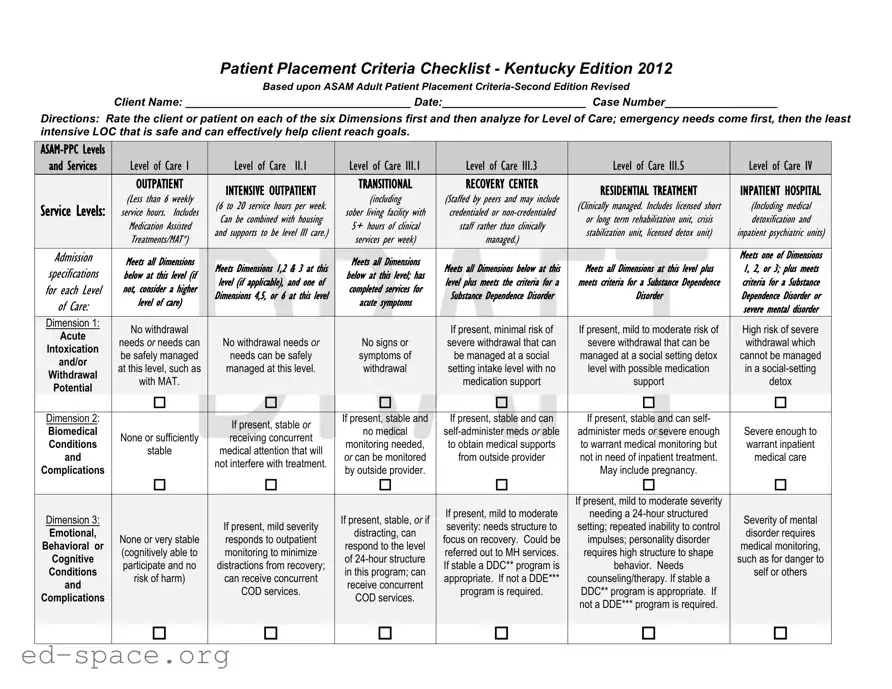
The ASAM Level of Care Cheat Sheet is an essential tool for assessing the treatment needs of individuals struggling with substance use disorders. This form is designed to guide practitioners through a systematic evaluation of a client’s condition across six key dimensions, helping to determine the most appropriate level of care. Each dimension focuses on critical aspects such as withdrawal symptoms, medical conditions, mental health severity, readiness for change, relapse potential, and environmental factors. By rating clients on these dimensions, professionals can prioritize emergency needs and identify the least intensive level of care that is safe and effective for achieving recovery goals. The form outlines various levels of care, ranging from outpatient services to inpatient hospitalization, providing clear criteria for admission at each level. The structured approach ensures that clients receive tailored interventions, whether they require intensive outpatient programs, residential treatment, or inpatient care. Ultimately, this cheat sheet serves as a vital resource for ensuring that individuals receive the appropriate support they need on their path to recovery.

Patient Placement Criteria Checklist - Kentucky Edition 2012
Based upon ASAM Adult Patient Placement
Client Name: ____________________________________ Date:_______________________ Case Number__________________
Directions: Rate the client or patient on each of the six Dimensions first and then analyze for Level of Care; emergency needs come first, then the least intensive LOC that is safe and can effectively help client reach goals.
|
|
|
|
|
|
|
|
|
|
|
|
|
|
|
|
|
|
|
|
|
|
|
|
|
|
|
|
|
|
|
|
|
and Services |
|
|
Level of Care I |
|
|
Level of Care |
II.1 |
|
|
Level of |
Care III.1 |
|
|
Level of |
Care III.3 |
|
|
Level of Care III.5 |
|
|
Level of |
Care IV |
|
|||||||
|
|
|
|
OUTPATIENT |
|
|
|
|
|
|
|
|
TRANSITIONAL |
|
|
RECOVERY CENTER |
|
|
|
|
|
|
|
|
|
|
|||||
|
|
|
|
|
|
INTENSIVE OUTPATIENT |
|
|
|
|
RESIDENTIAL TREATMENT |
|
|
INPATIENT HOSPITAL |
|
||||||||||||||||
|
|
|
|
(Less |
than 6 |
weekly |
|
|
|
|
|
(including |
|
|
(Staffed by peers and may include |
|
|
|
|
|
|||||||||||
|
Service Levels: |
|
|
|
|
(6 to 20 service hours per week. |
|
|
|
|
|
|
|
(Clinically managed. Includes licensed short |
|
|
(Including medical |
|
|||||||||||||
|
|
|
|
|
|
|
|
|
|
|
|
||||||||||||||||||||
|
|
|
service |
hours. |
Includes |
|
|
|
|
sober |
living |
facility with |
|
|
credentialed or |
|
|
|
|
|
|||||||||||
|
|
|
|
|
Can be combined |
with |
housing |
|
|
|
|
or long term |
rehabilitation |
unit, crisis |
|
|
detoxification and |
|
|||||||||||||
|
|
|
|
Medication Assisted |
|
|
|
|
5+ |
hours |
of clinical |
|
|
staff rather |
than clinically |
|
|
|
|
|
|||||||||||
|
|
|
|
|
|
|
|
|
|
|
|
||||||||||||||||||||
|
|
|
|
|
|
and supports to be |
level |
III care.) |
|
|
|
|
|
|
stabilization |
unit, licensed |
detox unit) |
|
|
inpatient psychiatric units) |
|
||||||||||
|
|
|
|
Treatments/MAT*) |
|
|
|
|
services per week) |
|
|
managed.) |
|
|
|
|
|
||||||||||||||
|
|
|
|
|
|
|
|
|
|
|
|
|
|
|
|
|
|
|
|
|
|
|
|
||||||||
|
Admission |
|
|
Meets |
all Dimensions |
|
|
|
|
|
|
|
Meets all |
Dimensions |
|
|
|
|
|
|
|
|
|
|
Meets one of Dimensions |
||||||
|
|
|
|
|
Meets Dimensions 1,2 & 3 at this |
|
|
Meets all Dimensions below at this |
|
Meets all Dimensions at this level plus |
|
1, 2, or 3; plus meets |
|||||||||||||||||||
|
specifications |
|
|
below |
at this |
level (if |
|
|
below |
at this level; has |
|
|
|
||||||||||||||||||
|
for each Level |
|
|
not, consider |
a higher |
|
level (if applicable), |
and one of |
|
completed |
services for |
|
level plus meets |
the criteria for a |
|
meets criteria for a Substance Dependence |
|
criteria for |
a Substance |
||||||||||||
|
|
|
|
Dimensions 4,5, or |
6 at this level |
|
|
Substance Dependence Disorder |
|
|
Disorder |
|
|
|
Dependence |
Disorder or |
|||||||||||||||
|
of Care: |
|
|
level of care) |
|
|
acute symptoms |
|
|
|
|
|
|
||||||||||||||||||
|
|
|
|
|
|
|
|
|
|
|
|
|
|
|
|
|
|
|
|
severe mental disorder |
|||||||||||
|
|
|
|
|
|
|
|
|
|
|
|
|
|
|
|
|
|
|
|
|
|
|
|
|
|
|
|
||||
|
Dimension 1: |
|
|
No withdrawal |
|
|
|
|
|
|
|
|
|
|
|
|
|
If present, minimal risk of |
|
|
If present, mild to moderate risk of |
|
|
High risk of severe |
|
||||||
|
|
|
|
|
|
|
|
|
|
|
|
|
|
|
|
|
|
|
|
|
|||||||||||
|
|
|
|
|
|
|
|
|
|
|
|
|
|
|
|
|
|
|
|
|
|||||||||||
|
Acute |
|
|
|
|
|
|
|
|
|
|
|
|
|
|
|
|
|
|
|
|
||||||||||
|
|
|
needs OR needs can |
|
|
No withdrawal needs OR |
|
|
No signs or |
|
|
severe withdrawal that can |
|
|
severe withdrawal that can be |
|
|
withdrawal which |
|
||||||||||||
|
Intoxication |
|
|
|
|
|
|
|
|
|
|
|
|
|
|||||||||||||||||
|
|
|
be safely managed |
|
|
needs can be safely |
|
|
symptoms of |
|
|
be managed at a social |
|
|
managed at a social setting detox |
|
|
cannot be managed |
|
||||||||||||
|
and/or |
|
|
|
|
|
|
|
|
|
|
|
|
|
|||||||||||||||||
|
|
|
at this level, such as |
|
|
managed at this level. |
|
|
withdrawal |
|
|
setting intake level with no |
|
|
level with possible medication |
|
|
in a |
|
||||||||||||
|
Withdrawal |
|
|
|
|
|
|
|
|
|
|
|
|
|
|||||||||||||||||
|
|
|
|
|
|
|
|
|
|
|
|
|
|
|
|
|
|
|
|
|
|
|
|
|
|
|
|
|
|
|
|
|
|
|
with MAT. |
|
|
|
|
|
|
|
|
|
|
|
|
|
medication support |
|
|
|
support |
|
|
|
detox |
|
|||||
|
Potential |
|
|
|
|
|
|
|
|
|
|
|
|
|
|
|
|
|
|
|
|
|
|
||||||||
|
|
|
|
|
|
|
|
|
|
|
|
|
|
|
|
|
|
|
|
|
|
|
|
|
|
|
|
|
|
|
|
|
|
|
|
|
|
|
|
|
|
|
|
|
|
|
|
|
|
|
|
|
|
|
|
|
|
|
|
|
|
|
|
|
|
|
|
|
|
|
|
|
|
|
|
|
|
|
|
|
|
|
|
|
|
|
|
|
|
||||||
|
Dimension 2: |
|
|
|
|
|
|
|
If present, stable OR |
|
If present, stable and |
|
If present, stable and can |
|
If present, stable and can self- |
|
|
|
|
||||||||||||
|
Biomedical |
|
|
|
|
|
|
|
|
no medical |
|
|
administer meds OR severe enough |
|
Severe enough to |
||||||||||||||||
|
|
|
None or sufficiently |
|
receiving concurrent |
|
|
|
|
||||||||||||||||||||||
|
Conditions |
|
|
|
|
monitoring needed, |
|
to obtain medical supports |
|
to warrant medical monitoring but |
|
warrant inpatient |
|||||||||||||||||||
|
|
|
|
stable |
|
medical attention that will |
|
|
|
|
|||||||||||||||||||||
|
and |
|
|
|
|
|
OR can be monitored |
|
from outside provider |
|
not in need of inpatient treatment. |
|
medical care |
||||||||||||||||||
|
|
|
|
|
|
|
|
not interfere with treatment. |
|
|
|
|
|||||||||||||||||||
|
Complications |
|
|
|
|
|
|
|
|
by outside provider. |
|
|
|
|
|
May include pregnancy. |
|
|
|
|
|||||||||||
|
|
|
|
|
|
|
|
|
|
|
|
|
|
|
|
|
|
|
|
|
|
|
|||||||||
|
|
|
|
|
|
|
|
|
|
|
|
|
|
|
|
|
|
|
|
|
|
|
|
|
|
||||||
|
|
|
|
|
|
|
|
|
|
|
|
|
|
|
|
|
|
|
|
|
|
|
|
If present, mild to moderate severity |
|
|
|
|
|
||
|
Dimension 3: |
|
|
|
|
|
|
|
|
|
|
|
|
|
If present, stable, OR if |
|
|
If present, mild to moderate |
|
|
needing a |
|
|
Severity of mental |
|
||||||
|
|
|
|
|
|
|
|
|
|
|
|
|
|
|
|
|
|
|
|||||||||||||
|
|
|
|
|
|
|
|
|
|
|
|
|
|
|
|
|
|
|
|
|
|
|
|
|
|
||||||
|
|
|
|
|
|
|
|
If present, mild severity |
|
|
|
severity: needs structure to |
|
|
setting; repeated inability to control |
|
|
||||||||||||||
|
Emotional, |
|
|
|
|
|
|
|
|
|
distracting, can |
|
|
|
|
|
|
disorder requires |
|
||||||||||||
|
|
|
None or very stable |
|
|
responds to outpatient |
|
|
|
|
focus on recovery. Could be |
|
|
impulses; personality disorder |
|
|
|
||||||||||||||
|
Behavioral or |
|
|
|
|
|
|
respond to the level |
|
|
|
|
|
|
medical monitoring, |
|
|||||||||||||||
|
|
|
(cognitively able to |
|
|
monitoring to minimize |
|
|
|
|
referred out to MH services. |
|
|
requires high structure to shape |
|
|
|
||||||||||||||
|
Cognitive |
|
|
|
|
|
|
of |
|
|
|
|
|
|
such as for danger to |
|
|||||||||||||||
|
|
|
participate and no |
|
|
distractions from recovery; |
|
|
|
|
If stable a DDC** program is |
|
|
behavior. Needs |
|
|
|
||||||||||||||
|
Conditions |
|
|
|
|
|
|
in this program; can |
|
|
|
|
|
|
self or others |
|
|||||||||||||||
|
|
|
risk of harm) |
|
|
can receive concurrent |
|
|
|
|
appropriate. If not a DDE*** |
|
|
counseling/therapy. If stable a |
|
|
|
||||||||||||||
|
and |
|
|
|
|
|
|
receive concurrent |
|
|
|
|
|
|
|
|
|
||||||||||||||
|
|
|
|
|
|
|
|
COD services. |
|
|
|
|
program is required. |
|
|
DDC** program is appropriate. If |
|
|
|
|
|
||||||||||
|
Complications |
|
|
|
|
|
|
|
|
|
COD services. |
|
|
|
|
|
|
|
|
|
|||||||||||
|
|
|
|
|
|
|
|
|
|
|
|
|
|
|
|
|
|
|
|
not a DDE*** program is required. |
|
|
|
|
|
||||||
|
|
|
|
|
|
|
|
|
|
|
|
|
|
|
|
|
|
|
|
|
|
|
|
|
|
|
|
|
|||
|
|
|
|
|
|
|
|
|
|
|
|
|
|
|
|
|
|
|
|
|
|
|
|
|
|
|
|
|
|
||
|
|
|
|
|
|
|
|
|
|
|
|
|
|
|
|
|
|
|
|
|
|
|
|
|
|
||||||

CLIENT NAME:________________________________________________ DATE: _____________________ CASE NUMBER:________________________ ____
|
|
|
|
|
|
|
|
|
|
|
|
|
|
|
|
|
|
|
|
|
|
|
|
|
|
|
|
|
|
|
|
|
|
|
Level of Care I |
|
|
Level of |
Care |
II.1 |
|
|
Level of |
Care III.1 |
|
|
Level of Care III.3 |
|
|
|
Level of Care III.5 |
|
Level of Care IV |
|
|||||||
|
|
|
|
|
|
|
||||||||||||||||||||||||
|
|
|
|
OUTPATIENT |
|
|
INTENSIVE OUTPATIENT |
|
|
|
Transitional |
|
|
RECOVERY CENTER |
|
|
RESIDENTIAL TREATMENT |
|
INPATIENT HOSPITAL |
|
||||||||||
|
|
|
|
|
|
|
|
|
|
|
|
|
|
|
||||||||||||||||
|
|
|
|
(Less |
than 6 |
weekly |
|
|
(6 to |
20 service hours per |
|
|
|
(including |
|
|
(Staffed by peers and may include |
|
|
|
|
|||||||||
|
|
|
|
|
|
|
|
|
|
|
|
|
(Clinically |
managed. Includes |
licensed short |
|
(Including medical |
|
||||||||||||
|
Service Levels: |
|
|
|
|
|
|
|
|
|
|
|
|
|
|
|
|
|
|
|
|
|
|
|
|
|||||
|
|
|
service |
hours. |
Includes |
|
|
week. Can |
be combined |
|
|
sober |
living |
facility with |
|
|
credentialed or |
|
|
|
|
|||||||||
|
|
|
|
|
|
|
|
|
|
|
or long |
term |
rehabilitation |
unit, crisis |
|
detoxification and |
|
|||||||||||||
|
|
|
|
Medication Assisted |
|
|
with |
housing |
and |
supports |
|
|
5+ |
hours |
of |
clinical |
|
|
staff rather than clinically |
|
|
|
|
|||||||
|
|
|
|
|
|
|
|
|
|
|
|
stabilization |
unit, licensed |
detox unit) |
|
inpatient psychiatric units) |
|
|||||||||||||
|
|
|
|
Treatments/MAT*) |
|
|
to |
be level III |
care.) |
|
|
services per |
week) |
|
|
managed.) |
|
|
|
|
||||||||||
|
|
|
|
|
|
|
|
|
|
|
|
|
|
|
|
|
|
|
||||||||||||
|
|
|
Ready to change and |
|
Has marked difficulty with or |
|
|
Willing to cooperate |
Resistance is high |
Has little awareness & needs |
opposition to treatment, with |
||
|
cooperate at this |
|||||
|
or is ambivalent and |
enough to require |
interventions available only |
dangerous consequences; or there |
||
Dimension 4: |
level, OR externalizes |
|||||
needs motivation, |
structured program, |
at this level to engage & stay |
is high severity in this dimension but |
|||
Readiness to |
problems and needs |
|||||
recovery support, |
but not so high as to |
in recovery. May have |
not others. The client therefore |
|||
Change |
this level of structure, |
|||||
and monitoring |
render outpatient |
external leverage to support |
needs a motivational enhancement |
|||
|
motivation and |
|||||
|
strategies |
treatment ineffective. |
participation. |
program with 24 hour structure. |
||
|
support. |
|||||
|
|
|
|
|
||
|
|
|
|
|
|
|
|
|
|
|
|
|
|
|
|
|
|
Has little awareness & needs |
|
|
|
|
|
|
|
|
|
|
|
Intensification of |
|
|
Client is at high risk |
|
intervention available only at |
|
Has little awareness & needs |
|
|
|
|
|
|
Able to maintain |
|
|
|
|
for imminent relapse |
|
this level to prevent |
|
intervention available only at this |
|
|
|
|
|
|
|
|
|
symptoms despite |
|
|
|
|
|
|
||||
|
Dimension 5: |
|
abstinence and |
|
|
|
|
with dangerous |
|
continued use, with |
|
level to prevent continued use, with |
|
|
||
|
|
|
|
active participation in |
|
|
|
|
|
|
||||||
|
Relapse, |
|
recovery goals or |
|
|
|
|
consequences. Client |
|
dangerous consequences to |
|
dangerous consequences to self or |
|
|
||
|
|
|
|
Outpatient, OR high |
|
|
|
|
|
|
||||||
|
Continued Use or |
|
achieve awareness |
|
|
|
|
needs |
|
self or others. |
|
others. |
|
|
||
|
|
|
|
|
|
|
|
|
|
|||||||
|
|
|
|
likelihood of relapse |
|
|
|
|
|
|
||||||
|
Continued |
|
of a substance use |
|
|
|
|
structure and support |
|
Does not recognize triggers, |
|
Does not recognize triggers, unable |
|
|
||
|
|
|
|
without close |
|
|
|
|
|
|
||||||
|
Problem Potential |
|
problem with minimal |
|
|
|
|
OR needs this support |
|
unable to control use, in |
|
to control use, in danger of relapse |
|
|
||
|
|
|
|
monitoring and |
|
|
|
|
|
|
||||||
|
|
|
|
support |
|
|
|
|
to transition into |
|
danger of relapse without |
|
without close |
|
|
|
|
|
|
|
|
|
support |
|
|
|
|
|
|
||||
|
|
|
|
|
|
|
|
|
community. |
|
close |
|
and structure. |
|
|
|
|
|
|
|
|
|
|
|
|
|
|
|
|
|
|||
|
|
|
|
|
|
|
|
|
|
|
|
and structure. |
|
|
|
|
|
|
|
|
|
|
|
|
|
|
|
|
|
|
|
|
|
|
|
|
|
|
|
|
|
|
|
Has a using, |
|
|
|
|
|
|
|
|
|
|
Supportive recovery |
|
|
Lacks social contacts |
|
|
unsupportive, |
|
Homelessness or lack of |
|
|
|
|
|
|
|
|
|
|
|
|
|
|
|
|
|
||||
|
|
|
|
|
|
|
|
|
|
|
|
|
||||
|
|
|
|
|
|
|
|
|
|
|
|
|
|
|
|
|
|
|
|
|
environment OR |
|
|
or social contacts |
|
|
dangerous, or |
|
|
Environment is dangerous or |
|
|
|
|
Dimension 6: |
|
|
|
|
|
|
|
safe, supportive recovery |
|
|
|
||||
|
|
|
willingness to obtain |
|
|
aren’t conducive to |
|
|
victimizing social |
|
|
unsupportive of recovery and client |
|
|
||
|
Recovery |
|
|
|
|
|
|
|
environment and client |
|
|
|
||||
|
|
|
|
|
|
|
|
|
|
|
||||||
|
|
|
such OR supports |
|
|
recovery, but with |
|
|
network, or lacks a |
|
|
lacks skills to cope outside of highly |
|
|
||
|
Environment |
|
|
|
|
|
|
|
needs |
|
|
|
||||
|
|
|
need professional |
|
|
structure or support, |
|
|
social network, |
|
|
structured |
|
|
||
|
|
|
|
|
|
|
|
|
learn to cope. |
|
|
|
||||
|
|
|
|
interventions. |
|
|
the patient can cope |
|
|
requiring this level of |
|
|
|
|
|
|
|
|
|
|
|
|
|
|
|
|
|
|
|
|
|||
|
|
|
|
|
|
|
|
|
|
|
|
|
|
|
|
|
|
|
|
|
|
|
|
|
|
|
|
|
|
|
|
|
|
|
|
|
|
|
|
|
|
|
|
|
|
|||||
|
|
|
|
|
|
|
|
|
|
|
|
|
|
|
|
|
*Medication Assisted Treatments (MAT) can occur at any level of care and includes methadone, buprenorphine, and medications to control cravings and withdrawal when other criteria are met for level of care. Methadone and Suboxone clinics are generally outpatient, but clients on MAT may sometimes need a higher level of care.
**DDC: Dual Diagnosis Capable Program - has a primary target population of individuals with substance related disorders but also has an expectation and willingness to treat individuals with
referral to concurrent mental health services.
***DDE: Dual Diagnosis Enhanced Program – the program has the combined capacity to treat both mental health and substance related disorders equally.
Rater’s Signature: ____________________________________________________________
Last revision:
| Fact Name | Description |
|---|---|
| Governing Law | The ASAM Level of Care Cheat Sheet for Kentucky is governed by state regulations regarding substance use treatment and mental health services. |
| Purpose | This form serves as a guideline for assessing a patient's placement in appropriate levels of care based on their individual needs. |
| Dimensions | It evaluates patients across six dimensions, which include withdrawal potential, biomedical conditions, emotional and behavioral issues, readiness to change, relapse potential, and recovery environment. |
| Levels of Care | The form outlines six distinct levels of care, ranging from outpatient services to inpatient hospital treatment, each tailored to specific patient needs. |
| Client Information | Essential client details such as name, date, and case number are required for proper documentation and tracking of treatment progress. |
Completing the ASAM Level of Care Cheat Sheet form requires careful attention to detail. Each section assesses different dimensions of the patient's needs and helps determine the most appropriate level of care. Follow these steps to ensure accurate and thorough completion of the form.
What is the purpose of the ASAM Level Of Care Cheat Sheet form?
The ASAM Level Of Care Cheat Sheet form is designed to assist healthcare professionals in assessing the appropriate level of care for patients seeking treatment for substance use disorders. By evaluating various dimensions of a patient's condition, the form helps determine the most suitable treatment options and ensures that individuals receive the necessary support to achieve their recovery goals.
How should a patient be rated on the ASAM Level Of Care Cheat Sheet?
Patients should be rated across six dimensions that reflect their current state and needs. Each dimension addresses different aspects of a patient's health, such as withdrawal symptoms, medical conditions, mental health status, readiness for change, relapse potential, and the recovery environment. After rating each dimension, professionals analyze the scores to determine the most appropriate level of care, prioritizing emergency needs first.
What are the different levels of care outlined in the ASAM Cheat Sheet?
The ASAM Cheat Sheet outlines several levels of care, including: Level I (Outpatient), Level II.1 (Intensive Outpatient), Level III.1 (Transitional Recovery Center), Level III.3 (Residential Treatment), Level III.5 (Intensive Inpatient), and Level IV (Inpatient Hospital). Each level corresponds to varying degrees of service intensity and support, allowing for tailored treatment plans based on individual patient needs.
What factors are considered in Dimension 1 of the assessment?
Dimension 1 focuses on withdrawal needs. Patients are assessed based on the severity of their withdrawal symptoms and the associated risks. If a patient experiences no withdrawal symptoms, they may be rated as stable. Conversely, if they present with severe withdrawal symptoms, a higher level of care may be necessary to ensure their safety and effective management of their condition.
How does Dimension 4 assess a patient's readiness to change?
Dimension 4 evaluates a patient's willingness and motivation to engage in treatment. It considers their level of awareness regarding their substance use issues and the consequences of continued use. Patients who show high resistance to treatment may require more intensive interventions and support to facilitate their participation in recovery programs.
What does Dimension 5 indicate about a patient's relapse potential?
Dimension 5 assesses the likelihood of relapse based on a patient's current behaviors and support systems. It identifies whether the patient recognizes their triggers and whether they have the skills and support necessary to maintain abstinence. Patients at high risk of relapse may need a more structured environment to ensure they receive adequate support and monitoring.
What role does Dimension 6 play in evaluating a patient's recovery environment?
Dimension 6 examines the patient's recovery environment, focusing on the presence of supportive or unsupportive factors that may impact their recovery journey. It considers the availability of social contacts, safety, and access to professional interventions. A stable and supportive recovery environment is crucial for fostering long-term success in treatment.
How can Medication Assisted Treatments (MAT) be integrated into the levels of care?
Medication Assisted Treatments (MAT) can be utilized at any level of care as needed. MAT includes medications such as methadone and buprenorphine, which help manage cravings and withdrawal symptoms. The decision to incorporate MAT into a treatment plan is based on the individual patient's needs and the level of care they are receiving, ensuring comprehensive support throughout their recovery process.
Inaccurate Client Information: Filling out the client's name, date, and case number incorrectly can lead to significant delays in processing. Always double-check these details for accuracy.
Neglecting to Rate All Dimensions: Failing to evaluate all six dimensions can result in an incomplete assessment. Each dimension is crucial for determining the appropriate level of care.
Overlooking Emergency Needs: Prioritizing less urgent needs over emergency ones can compromise the client's safety. Always address emergency needs first.
Misunderstanding Level of Care Criteria: Each level of care has specific criteria. Misinterpreting these can lead to recommending an inappropriate level of care.
Inconsistent Use of Medical Terms: Using different terms or phrases inconsistently can create confusion. Stick to the terminology provided in the cheat sheet for clarity.
Ignoring Client Readiness: Assessing the client's readiness to change is vital. Ignoring this can lead to ineffective treatment recommendations.
Failure to Document Support Needs: Not documenting the client's support environment may overlook crucial factors affecting recovery. Ensure to capture all relevant details.
Assuming Stability: Assuming that a client's condition is stable without proper assessment can be dangerous. Always evaluate the current state of the client thoroughly.
Not Utilizing the Signature Section: Forgetting to include the rater’s signature can invalidate the assessment. Always sign and date the form to confirm its completion.
The ASAM Level of Care Cheat Sheet is a valuable tool for assessing a client's needs and determining the appropriate level of care for substance use treatment. However, several other forms and documents often accompany this cheat sheet to ensure a comprehensive evaluation and treatment plan. Below are four such documents, each serving a unique purpose in the treatment process.
Utilizing these forms alongside the ASAM Level of Care Cheat Sheet enhances the treatment process, providing a holistic view of the patient's needs and facilitating more effective interventions. Each document plays a significant role in guiding the patient toward recovery and ensuring that their treatment is both comprehensive and individualized.
The ASAM Level of Care Cheat Sheet form serves as a crucial tool in assessing the appropriate level of care for individuals with substance use disorders. It shares similarities with various other documents used in clinical settings. Below is a list of nine documents that are comparable to the ASAM Level of Care Cheat Sheet, along with explanations of their similarities.
When filling out the ASAM Level Of Care Cheat Sheet form, consider the following guidelines:
Understanding the ASAM Level of Care Cheat Sheet can be challenging, and several misconceptions often arise. Here are four common misunderstandings:
Many believe that this tool is only applicable for patients with severe substance use disorders. In reality, the ASAM Level of Care Cheat Sheet is designed to assess a range of needs, from mild to severe, helping to determine the appropriate level of care for each individual.
Some think that patients must progress through all levels of care sequentially. However, the ASAM criteria allow for individualized assessments. If a patient requires a higher level of care right away, they can be placed there without going through lower levels first.
There's a common belief that this tool is limited to outpatient settings. In fact, the ASAM Cheat Sheet encompasses various levels of care, including inpatient and residential treatment options, ensuring that all patients receive the most appropriate support based on their unique circumstances.
While it primarily focuses on substance use, the ASAM criteria also consider co-occurring mental health issues. This means that individuals with both substance use and mental health disorders can be accurately assessed and placed in the right level of care.
Filling out and using the ASAM Level of Care Cheat Sheet form can significantly enhance patient care. Here are some key takeaways: