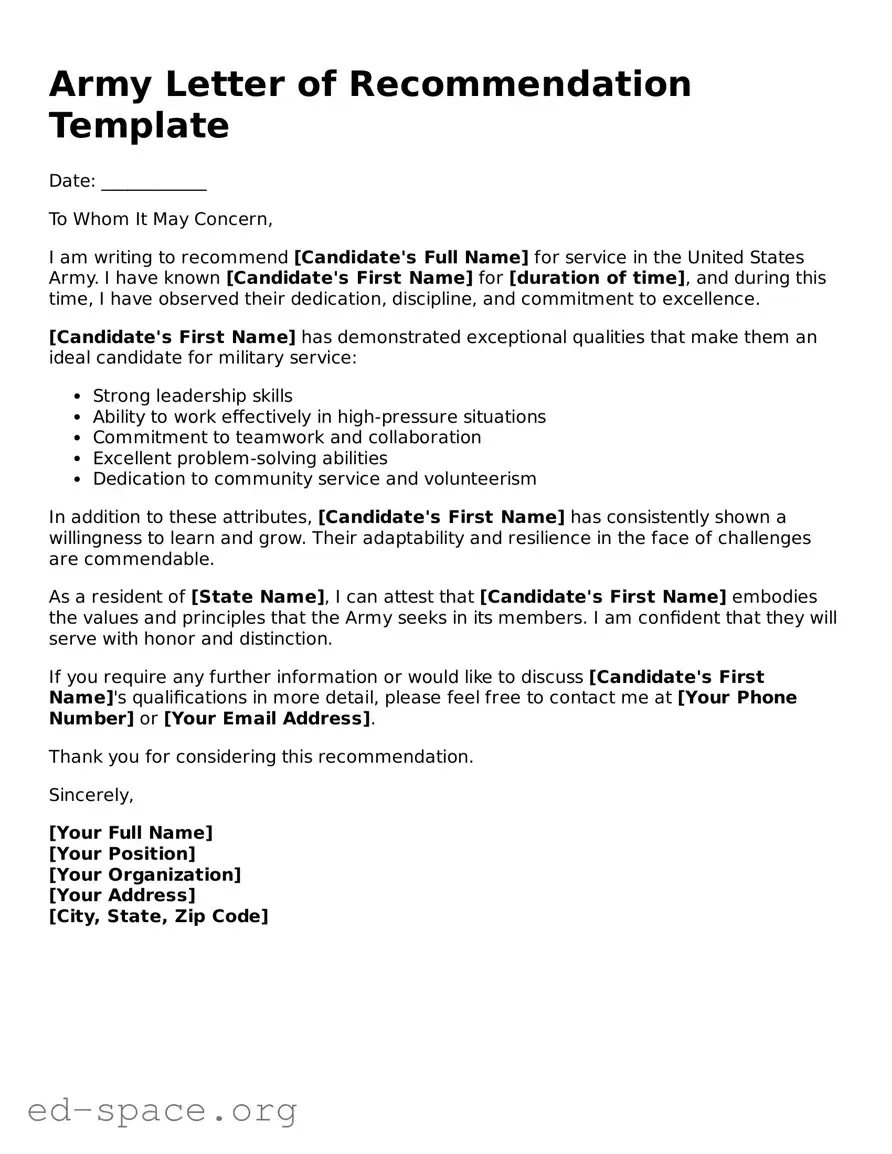
When seeking to advance in their military careers, service members often require a Letter of Recommendation, which plays a crucial role in showcasing their qualifications and character. The Army Letter of Recommendation form is a structured document designed to facilitate this process. It typically includes sections for the recommender's contact information, the service member’s details, and a space for the recommender to articulate their insights and experiences with the individual being recommended. This form is not just a formality; it provides a platform for the recommender to highlight the candidate’s achievements, skills, and potential contributions to the Army. Additionally, it may require specific examples that illustrate the service member's leadership qualities, work ethic, and commitment to the Army's values. By adhering to the guidelines of this form, recommenders can ensure that their letters are both impactful and aligned with the expectations of military evaluations, ultimately aiding the service member in their pursuit of promotions or specialized roles.
Army Letter of Recommendation Template
Date: ____________
To Whom It May Concern,
I am writing to recommend [Candidate's Full Name] for service in the United States Army. I have known [Candidate's First Name] for [duration of time], and during this time, I have observed their dedication, discipline, and commitment to excellence.
[Candidate's First Name] has demonstrated exceptional qualities that make them an ideal candidate for military service:
In addition to these attributes, [Candidate's First Name] has consistently shown a willingness to learn and grow. Their adaptability and resilience in the face of challenges are commendable.
As a resident of [State Name], I can attest that [Candidate's First Name] embodies the values and principles that the Army seeks in its members. I am confident that they will serve with honor and distinction.
If you require any further information or would like to discuss [Candidate's First Name]'s qualifications in more detail, please feel free to contact me at [Your Phone Number] or [Your Email Address].
Thank you for considering this recommendation.
Sincerely,
[Your Full Name]
[Your Position]
[Your Organization]
[Your Address]
[City, State, Zip Code]
| Fact Name | Description |
|---|---|
| Purpose | The Army Letter of Recommendation form is used to provide a formal endorsement for a service member's application for a specific position or program. |
| Format | The form typically requires specific information, including the recommender's details, the applicant's information, and a description of the applicant's qualifications. |
| Submission Process | Once completed, the form must be submitted through the appropriate channels, often requiring signatures from both the recommender and the applicant. |
| State-Specific Forms | Some states may have their own variations of recommendation forms, governed by state laws such as the Uniform Administrative Procedures Act. |
| Confidentiality | Recommendations are generally considered confidential. They are not usually shared with the applicant unless the recommender chooses to do so. |
After obtaining the Army Letter of Recommendation form, you will need to fill it out carefully to ensure that all necessary information is provided. This form is important for showcasing qualifications and character. Follow these steps to complete the form accurately.
Once you have completed the form, review it for accuracy and clarity. Make sure that all information is correct before submitting it to the appropriate authority.
What is the Army Letter of Recommendation form?
The Army Letter of Recommendation form is a document used to provide a formal recommendation for individuals seeking to join the Army or advance within its ranks. This letter highlights the candidate's qualifications, character, and potential contributions to the military. It is typically written by someone who knows the individual well, such as a teacher, employer, or military superior.
Who should write an Army Letter of Recommendation?
Letters of recommendation should ideally come from individuals who can speak to the candidate's skills, work ethic, and character. This could include teachers, coaches, employers, or military personnel who have observed the candidate's performance and behavior. The more relevant the recommender's experience is to the Army, the stronger the letter will be.
What should be included in the Army Letter of Recommendation?
A strong Army Letter of Recommendation should include specific examples of the candidate's achievements, skills, and character traits. It should outline the recommender's relationship with the candidate and provide context for their observations. Additionally, it’s helpful to mention any relevant experiences that demonstrate leadership, teamwork, and commitment to service.
How long should the Army Letter of Recommendation be?
Typically, an Army Letter of Recommendation should be one page long. It should be concise yet comprehensive enough to convey the recommender’s insights about the candidate. A well-structured letter that gets to the point while providing meaningful details is most effective.
Is there a specific format for the Army Letter of Recommendation?
While there is no strict format mandated, a professional tone is essential. The letter should start with the recommender's contact information, followed by the date, and then the recipient's information. A formal greeting should precede the body of the letter, which should be organized into clear paragraphs. Finally, it should conclude with a respectful closing and the recommender’s signature.
Can I submit more than one Army Letter of Recommendation?
Yes, candidates can submit multiple letters of recommendation. In fact, having several letters from different perspectives can provide a more rounded view of the candidate’s abilities and character. However, ensure that each letter adds unique insights rather than repeating the same information.
How important is the Army Letter of Recommendation in the application process?
The Army Letter of Recommendation can play a significant role in the application process. It provides valuable insights that may not be captured in resumes or other application materials. A strong letter can set a candidate apart from others, especially in competitive situations, by showcasing their strengths and suitability for military service.
When should I request an Army Letter of Recommendation?
It’s best to request a letter of recommendation well in advance of any deadlines. This allows the recommender sufficient time to write a thoughtful and comprehensive letter. A good rule of thumb is to ask at least a month before the letter is due. This also gives you time to discuss your goals and provide any necessary information to the recommender.
How do I follow up after requesting an Army Letter of Recommendation?
After requesting a letter, it’s courteous to follow up with a thank-you note expressing your appreciation for the recommender’s time and effort. If you haven’t received the letter as the deadline approaches, a gentle reminder can be appropriate. Always maintain a polite and respectful tone in your communication.
Not including specific examples of the applicant's achievements. Recommendations are more impactful when they highlight concrete accomplishments.
Failing to address the correct rank or position of the applicant. This can lead to confusion about the applicant's qualifications and experiences.
Using vague language. Phrases like "good soldier" don't convey enough information. Instead, use detailed descriptions of the applicant's skills and contributions.
Overlooking the submission deadline. Late submissions can jeopardize the applicant's chances, so it's crucial to be aware of timelines.
Neglecting to proofread the letter. Typos and grammatical errors can undermine the professionalism of the recommendation.
Not personalizing the letter. A generic recommendation does not stand out. Tailor the content to reflect the unique qualities of the applicant.
Including irrelevant information. Stay focused on the applicant’s military-related skills and experiences to maintain relevance.
Forgetting to sign the letter. A signature adds authenticity and shows commitment to the recommendation.
When applying for positions or promotions within the Army, several documents often accompany the Army Letter of Recommendation. Each of these forms serves a specific purpose, helping to paint a complete picture of the candidate's qualifications and character.
In summary, these documents work together to create a robust application package. They showcase not only the candidate's qualifications but also their character and commitment to service. Having these forms prepared and organized can significantly enhance the chances of success in the application process.
When filling out the Army Letter of Recommendation form, it's crucial to be thorough and precise. Here are some important dos and don’ts to keep in mind:
Following these guidelines will help ensure that your recommendation letter is effective and impactful. Take the time to get it right; it could make a significant difference for the candidate.
Understanding the Army Letter of Recommendation form is essential for those involved in military applications or evaluations. However, several misconceptions often arise regarding this form. Below is a list of common misunderstandings, along with clarifications.
Clarifying these misconceptions can lead to more effective recommendations and better outcomes for candidates. Understanding the nuances of the Army Letter of Recommendation form is crucial for both writers and applicants.
When filling out and using the Army Letter of Recommendation form, consider the following key takeaways: