Homepage Free Transfer-on-Death Deed Form for Arkansas
Content Overview

The Arkansas Transfer-on-Death Deed form is an important legal tool for individuals looking to manage the transfer of real property upon their death. This form allows property owners to designate beneficiaries who will receive their property without the need for probate, simplifying the process for loved ones during a difficult time. By completing this deed, property owners can retain full control of their property while they are alive, ensuring that their wishes are honored after their passing. The form must be properly executed and recorded with the county clerk to be effective. Additionally, it’s essential to understand the implications of this deed, including how it interacts with other estate planning documents. Overall, the Transfer-on-Death Deed serves as a straightforward way to facilitate property transfer, providing peace of mind for both the property owner and their beneficiaries.

Document Preview

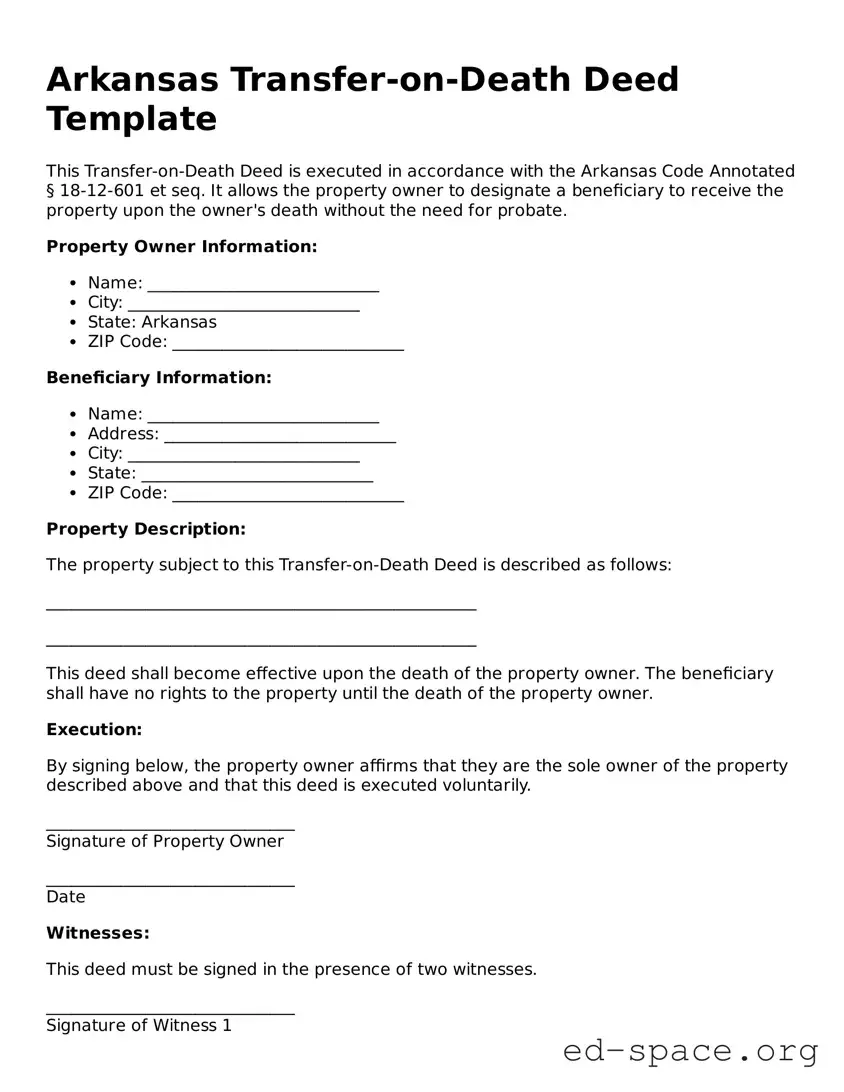
Arkansas Transfer-on-Death Deed Template

This Transfer-on-Death Deed is executed in accordance with the Arkansas Code Annotated § 18-12-601 et seq. It allows the property owner to designate a beneficiary to receive the property upon the owner's death without the need for probate.

Property Owner Information:

  • Name: ____________________________
  • City: ____________________________
  • State: Arkansas
  • ZIP Code: ____________________________

Beneficiary Information:

  • Name: ____________________________
  • Address: ____________________________
  • City: ____________________________
  • State: ____________________________
  • ZIP Code: ____________________________

Property Description:

The property subject to this Transfer-on-Death Deed is described as follows:

____________________________________________________

____________________________________________________

This deed shall become effective upon the death of the property owner. The beneficiary shall have no rights to the property until the death of the property owner.

Execution:

By signing below, the property owner affirms that they are the sole owner of the property described above and that this deed is executed voluntarily.

______________________________
Signature of Property Owner

______________________________
Date

Witnesses:

This deed must be signed in the presence of two witnesses.

______________________________
Signature of Witness 1

______________________________
Date

______________________________
Signature of Witness 2

______________________________
Date

This Transfer-on-Death Deed must be recorded in the county where the property is located to be effective.

PDF Form Details

Fact Name Details
Definition The Transfer-on-Death Deed allows property owners in Arkansas to transfer real estate to designated beneficiaries upon their death without the need for probate.
Governing Law The use of Transfer-on-Death Deeds in Arkansas is governed by Arkansas Code Annotated § 18-12-601 to § 18-12-608.
Execution Requirements The deed must be signed by the property owner in the presence of a notary public and recorded in the county where the property is located.
Revocation A Transfer-on-Death Deed can be revoked by the property owner at any time before their death, through a subsequent deed or written declaration.
Beneficiary Designation Property owners can designate multiple beneficiaries, and the deed allows for the transfer of ownership to occur simultaneously upon the owner's death.

Arkansas Transfer-on-Death Deed: Usage Guidelines

Once the Arkansas Transfer-on-Death Deed form is completed, it must be filed with the county clerk's office in the county where the property is located. Ensure that all information is accurate and that the form is signed in front of a notary public. This step is crucial to ensure that the deed is legally valid and recognized by the state.

  1. Obtain the Arkansas Transfer-on-Death Deed form from a reliable source, such as the Arkansas Secretary of State's website or your local county clerk's office.
  2. Fill in the name of the property owner(s) in the designated section. Ensure that the names match the names on the property title.
  3. Provide the legal description of the property. This can typically be found on the property deed or tax records.
  4. List the name(s) of the beneficiary or beneficiaries who will receive the property upon the owner's death.
  5. Include the address of the beneficiary or beneficiaries to ensure proper identification.
  6. Sign the form in the presence of a notary public. This step is essential for the validity of the deed.
  7. Make copies of the completed and notarized form for your records.
  8. File the original form with the county clerk's office in the county where the property is located. There may be a filing fee, so check with the clerk’s office for details.

Your Questions, Answered

What is a Transfer-on-Death Deed in Arkansas?

A Transfer-on-Death Deed (TODD) in Arkansas is a legal document that allows property owners to designate a beneficiary who will receive their real estate upon the owner's death. This deed enables the property to bypass the probate process, which can be lengthy and costly. By using a TODD, the property automatically transfers to the named beneficiary, simplifying the transition and ensuring that the owner's wishes are honored without unnecessary delays or expenses.

Who can use a Transfer-on-Death Deed?

Any individual who owns real property in Arkansas can use a Transfer-on-Death Deed. This includes homeowners, landowners, and even those with partial ownership in a property. However, it's important to note that all owners must agree to the transfer if the property is co-owned. Additionally, the beneficiary must be a living person or an entity, such as a trust or charity, as the deed cannot be used to transfer property to a deceased person.

How do I create a Transfer-on-Death Deed?

Creating a Transfer-on-Death Deed involves several steps. First, you need to obtain the appropriate form, which can typically be found online or through local legal resources. Next, fill out the form with the necessary information, including the property description and the beneficiary's details. Once completed, the deed must be signed by the property owner in the presence of a notary public. Finally, the deed should be recorded with the county clerk's office where the property is located to ensure it is legally valid and enforceable.

Can I revoke or change a Transfer-on-Death Deed?

Yes, you can revoke or change a Transfer-on-Death Deed at any time while you are still alive. To do this, you must create a new deed that explicitly revokes the previous one or simply file a revocation form with the county clerk’s office. It’s important to ensure that any changes are properly documented and recorded to avoid confusion or disputes in the future. Always consider consulting with a legal professional to ensure that your intentions are clearly expressed and legally binding.

Common mistakes

  1. Incomplete Information: One common mistake is failing to provide all necessary details. This includes not fully listing the names of the beneficiaries or omitting the legal description of the property. Each section must be completed accurately to ensure the deed is valid.

  2. Incorrect Signatures: The deed requires the signatures of the property owner(s). A frequent error is not having all owners sign the document if the property is jointly owned. Additionally, the signatures must be notarized; neglecting this step can invalidate the deed.

  3. Filing Issues: After filling out the form, some individuals forget to file it with the appropriate county clerk's office. It is essential to ensure that the deed is recorded to take effect. Without proper filing, the transfer may not occur as intended.

  4. Not Understanding the Implications: Some people do not fully grasp the implications of a Transfer-on-Death Deed. This deed allows for the transfer of property upon death, but it does not remove the property from the owner's estate for tax purposes. Misunderstanding this can lead to unexpected tax consequences.

Documents used along the form

When preparing a Transfer-on-Death Deed in Arkansas, several other forms and documents may be necessary to ensure a smooth transfer of property. Each of these documents serves a specific purpose and helps clarify the intentions of the property owner.

  • Property Title Document: This document proves ownership of the property being transferred. It includes details such as the legal description of the property and the owner's name.
  • Affidavit of Death: This form is used to confirm the death of the original property owner. It provides necessary information to facilitate the transfer process.
  • Beneficiary Designation Form: This form outlines the individuals or entities that will receive the property upon the owner’s death. It is essential for clarifying the intended recipients.
  • Will: If the property owner has a will, it may include specific instructions regarding the property. While not always required, it can provide additional context for the transfer.
  • Revocation of Transfer-on-Death Deed: If the owner decides to cancel or change the Transfer-on-Death Deed, this document serves to officially revoke the previous deed.
  • Property Tax Records: Maintaining current property tax records is important. These records help verify ownership and any outstanding taxes that may need to be addressed before the transfer.

Having these documents ready can simplify the transfer process and ensure that all legal requirements are met. This preparation can provide peace of mind for both the property owner and the beneficiaries involved.

Similar forms

  • Will: A will outlines how a person's assets will be distributed upon their death. Both documents serve to transfer property but differ in their activation; a will takes effect upon death, while a Transfer-on-Death Deed does so immediately upon the owner's passing.
  • Living Trust: A living trust allows a person to manage their assets during their lifetime and designate beneficiaries for after their death. Both documents provide a way to avoid probate, but a living trust typically requires more management and oversight.
  • Beneficiary Designation Forms: These forms are used for financial accounts and insurance policies to designate who receives benefits upon death. Similar to a Transfer-on-Death Deed, they allow for direct transfer of assets without going through probate.
  • Joint Tenancy Deed: This deed allows two or more people to own property together, with rights of survivorship. Like a Transfer-on-Death Deed, it ensures that ownership passes automatically to the surviving owner(s) upon death.
  • Payable-on-Death Accounts: These accounts allow funds to be transferred to a designated beneficiary upon the account holder's death. Both documents facilitate the transfer of assets directly to beneficiaries without the need for probate.
  • Life Estate Deed: A life estate deed allows a person to retain rights to property during their lifetime while designating a beneficiary for after their death. Both documents provide a way to pass property without probate, but a life estate deed involves more complex rights during the owner’s life.
  • Transfer-on-Death Registration for Securities: This registration allows individuals to designate beneficiaries for stocks and bonds. Similar to a Transfer-on-Death Deed, it ensures the assets pass directly to the beneficiary upon death.
  • Community Property with Right of Survivorship: This form of ownership allows spouses to own property together with rights of survivorship. Like a Transfer-on-Death Deed, it ensures a smooth transfer of ownership upon the death of one spouse.
  • Life Insurance Policies: These policies designate beneficiaries who will receive the death benefit. Both documents provide a mechanism for transferring assets directly to beneficiaries, avoiding probate.
  • Retirement Accounts: Accounts like IRAs and 401(k)s allow account holders to name beneficiaries. Similar to a Transfer-on-Death Deed, they enable the direct transfer of funds upon the account holder's death.

Dos and Don'ts

When filling out the Arkansas Transfer-on-Death Deed form, it is essential to follow specific guidelines to ensure accuracy and legality. Below is a list of five things to do and five things to avoid during this process.

Things to Do:

  • Ensure that the form is filled out completely and accurately.
  • Provide the full legal names of all parties involved, including the property owner and the beneficiaries.
  • Include a clear and detailed description of the property being transferred.
  • Sign the deed in the presence of a notary public to validate the document.
  • File the completed deed with the appropriate county clerk’s office to make it effective.

Things to Avoid:

  • Do not leave any sections of the form blank, as this may lead to complications.
  • Avoid using nicknames or informal names; use legal names only.
  • Do not forget to check for any local requirements that may affect the deed.
  • Refrain from making any alterations to the form after it has been signed and notarized.
  • Do not assume that the deed is effective without proper filing; filing is crucial.

Misconceptions

The Arkansas Transfer-on-Death Deed form is often misunderstood. Below are nine common misconceptions regarding this legal document.

  1. It is the same as a will. Many believe that a Transfer-on-Death Deed functions like a will. However, it specifically allows for the transfer of real property outside of probate upon the owner's death, whereas a will covers all assets and may require probate.
  2. It can be revoked at any time. While it is true that a Transfer-on-Death Deed can be revoked, the process must be followed correctly. A formal revocation must be executed and recorded to be effective.
  3. It applies to all types of property. This deed only applies to real estate. It does not cover personal property, bank accounts, or other assets.
  4. It avoids estate taxes. The Transfer-on-Death Deed does not eliminate estate taxes. The value of the property may still be included in the deceased's estate for tax purposes.
  5. Beneficiaries cannot be changed. Beneficiaries can be changed by executing a new Transfer-on-Death Deed. This flexibility allows property owners to update their wishes as needed.
  6. It requires a lawyer to complete. Although legal assistance can be beneficial, it is not mandatory. Individuals can fill out the form themselves, provided they understand the requirements.
  7. It is only for married couples. This deed can be used by any individual owner of real property, regardless of marital status. Single, married, or divorced individuals can all utilize it.
  8. It is automatically effective upon signing. The deed must be recorded with the appropriate county office to be effective. Signing alone does not transfer ownership.
  9. It eliminates the need for a probate process entirely. While the Transfer-on-Death Deed allows for the transfer of property without probate, other assets may still require probate proceedings, depending on the overall estate.

Understanding these misconceptions can help individuals make informed decisions regarding the Transfer-on-Death Deed in Arkansas.

Key takeaways

When considering the Arkansas Transfer-on-Death Deed form, several key points are essential to understand. This form allows property owners to transfer real estate to beneficiaries upon their death without going through probate.

  • Eligibility: Only individuals who own real property in Arkansas can use this form. It applies to residential and commercial properties.
  • Beneficiaries: Property owners can designate one or more beneficiaries. It is crucial to clearly identify each beneficiary to avoid confusion.
  • Execution: The deed must be signed by the property owner in the presence of a notary public. This step ensures the document is legally valid.
  • Filing: After execution, the deed must be filed with the county clerk’s office where the property is located. This filing is necessary for the transfer to take effect.
  • Revocation: Property owners can revoke the Transfer-on-Death Deed at any time before their death. This can be done by filing a revocation document with the county clerk.
  • Tax Implications: Beneficiaries may be subject to taxes upon the transfer of property. Consulting a tax professional can provide clarity on potential liabilities.

Understanding these points can help ensure a smooth process when using the Transfer-on-Death Deed form in Arkansas.