Navigating the complexities of estate management can be daunting, particularly when it comes to settling the affairs of a loved one who has passed away. In Arkansas, the Small Estate Affidavit form offers a streamlined process for heirs and beneficiaries dealing with estates that fall below a certain value threshold. This form allows individuals to claim property without the need for formal probate proceedings, which can be time-consuming and costly. Typically, the estate must not exceed $100,000 in value, excluding certain assets like real estate. By using the Small Estate Affidavit, heirs can assert their rights to the deceased's assets, ensuring a smoother transition during an emotionally challenging time. It is crucial for individuals to understand the requirements for completing this affidavit, as well as the necessary documentation needed to support their claims. Timeliness is key; filing the affidavit promptly can help avoid potential disputes and delays, allowing families to focus on healing rather than legal complexities.
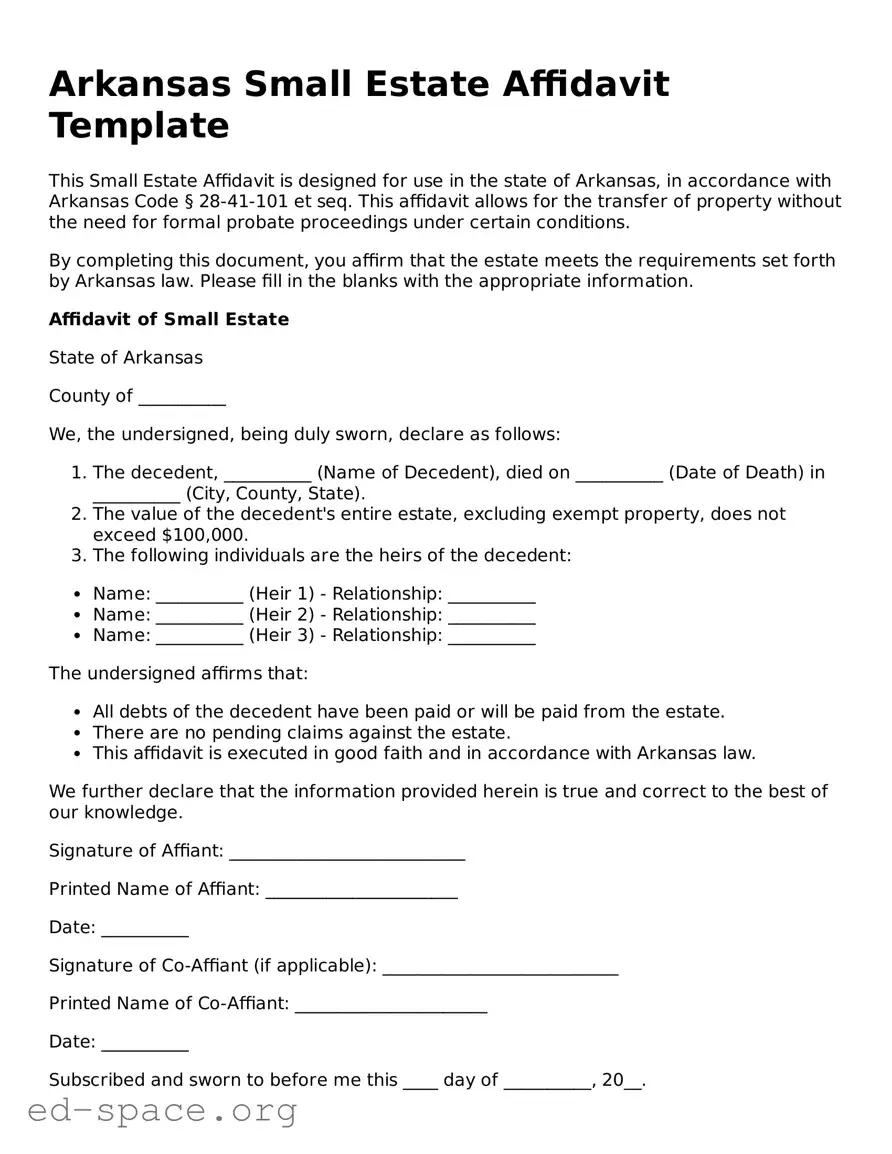
Arkansas Small Estate Affidavit Template
This Small Estate Affidavit is designed for use in the state of Arkansas, in accordance with Arkansas Code § 28-41-101 et seq. This affidavit allows for the transfer of property without the need for formal probate proceedings under certain conditions.
By completing this document, you affirm that the estate meets the requirements set forth by Arkansas law. Please fill in the blanks with the appropriate information.
Affidavit of Small Estate
State of Arkansas
County of __________
We, the undersigned, being duly sworn, declare as follows:
The undersigned affirms that:
We further declare that the information provided herein is true and correct to the best of our knowledge.
Signature of Affiant: ___________________________
Printed Name of Affiant: ______________________
Date: __________
Signature of Co-Affiant (if applicable): ___________________________
Printed Name of Co-Affiant: ______________________
Date: __________
Subscribed and sworn to before me this ____ day of __________, 20__.
Notary Public: ___________________________
My Commission Expires: __________
| Fact Name | Description |
|---|---|
| Purpose | The Arkansas Small Estate Affidavit is used to simplify the transfer of assets for estates valued under a specific threshold. |
| Threshold Amount | As of 2023, the estate must be valued at $100,000 or less, excluding certain types of property. |
| Governing Law | The form is governed by Arkansas Code Annotated § 28-41-101 et seq. |
| Eligibility | Heirs or beneficiaries of the deceased can file the affidavit if they meet the requirements set forth by the law. |
| Required Information | The affidavit must include details about the deceased, the assets, and the heirs. |
| Filing Process | The completed affidavit must be filed with the local probate court for approval. |
| Use of Affidavit | Once approved, the affidavit allows heirs to collect assets without going through formal probate. |
Once you have gathered the necessary information and documents, you can begin filling out the Arkansas Small Estate Affidavit form. This form will help you assert your right to collect the assets of a deceased person without the need for a formal probate process. Follow these steps carefully to ensure that you complete the form correctly.
After completing the form, you will need to submit it to the appropriate court or other entities that manage the deceased's assets. Be prepared to provide any additional documentation that may be requested. Following these steps will help streamline the process of settling the estate.
What is the Arkansas Small Estate Affidavit form?
The Arkansas Small Estate Affidavit form is a legal document that allows individuals to settle the estate of a deceased person without going through the full probate process. This form is typically used when the total value of the deceased's estate is below a certain threshold, making it a simpler and more efficient option for heirs or beneficiaries to claim their inheritance.
Who is eligible to use the Small Estate Affidavit?
To use the Small Estate Affidavit, the estate must meet specific criteria. The total value of the estate, excluding certain exempt property, must be less than $100,000. Additionally, the person filing the affidavit must be an heir or a beneficiary of the estate. It's important to ensure that all debts and taxes owed by the estate are settled before using this form.
How do I complete the Small Estate Affidavit?
Completing the Small Estate Affidavit involves filling out the form with accurate information about the deceased, the estate, and the individuals claiming the assets. You will need to provide details such as the deceased's name, date of death, and a list of assets. After completing the form, it must be signed in front of a notary public. It's advisable to keep copies of the completed affidavit for your records.
Where do I submit the Small Estate Affidavit?
The completed Small Estate Affidavit should be submitted to the probate court in the county where the deceased resided at the time of death. Once filed, the court will review the affidavit. If everything is in order, the court will issue an order allowing the heirs to access the estate's assets without going through a lengthy probate process.
What happens after I submit the Small Estate Affidavit?
After submitting the Small Estate Affidavit, the court will process it. If approved, the court will issue an order confirming the affidavit. This order allows the heirs or beneficiaries to collect the assets of the estate, such as bank accounts or property. It is essential to ensure all required documents are submitted and that the affidavit is filled out correctly to avoid delays.
Incorrectly identifying the decedent. One common mistake is failing to provide the correct name of the deceased person. It's essential to ensure that the name matches the one on the death certificate and any other legal documents.
Omitting necessary information. Many individuals overlook the requirement to include all pertinent details about the estate, such as the value of assets and liabilities. This information is crucial for the affidavit to be considered valid.
Not signing the affidavit. A frequent error is neglecting to sign the affidavit. Without a signature, the document lacks authenticity and cannot be processed.
Failing to provide witness signatures. In Arkansas, the affidavit must be signed by at least two disinterested witnesses. Forgetting this step can lead to delays or rejection of the affidavit.
Incorrectly estimating the value of the estate. Some people may underestimate or overestimate the value of the estate. Accurate valuations are necessary to meet the requirements of the small estate process.
Not filing the affidavit in the correct court. Individuals sometimes file the affidavit in the wrong jurisdiction. It's important to ensure that the affidavit is submitted to the appropriate court in the county where the decedent lived.
Ignoring deadlines. Lastly, many people fail to be aware of the deadlines associated with filing the Small Estate Affidavit. Missing these deadlines can result in complications and additional legal hurdles.
When dealing with the Arkansas Small Estate Affidavit form, it is essential to understand that several other forms and documents may be necessary to ensure a smooth process. These documents help clarify the estate's details and facilitate the transfer of assets. Here is a list of commonly used forms associated with the Small Estate Affidavit.
Gathering these documents can streamline the process and reduce delays. Each form plays a vital role in ensuring that the estate is handled appropriately and in accordance with the law. Taking the time to prepare these documents will facilitate a smoother experience for everyone involved.
The Small Estate Affidavit is a useful legal tool for settling the estates of individuals who have passed away, particularly when their assets fall below a certain threshold. There are several other documents that share similarities with the Small Estate Affidavit. Each serves a unique purpose in estate management but can often be used in comparable situations. Here are six documents that are similar to the Small Estate Affidavit:
Understanding these documents can help individuals navigate the often complex landscape of estate management. Each serves a purpose, and knowing their similarities can aid in making informed decisions during difficult times.
When filling out the Arkansas Small Estate Affidavit form, it's crucial to approach the process with care. This document can simplify the transfer of assets for estates valued below a certain threshold. Here are some important dos and don'ts to keep in mind.
By following these guidelines, you can help ensure a smoother process in managing the estate of a loved one. Remember, accuracy and attention to detail are key in this important task.
Understanding the Arkansas Small Estate Affidavit form can be confusing. Here are ten common misconceptions people have about this form:
While there is a limit on the value of the estate, many people mistakenly think it is lower than it actually is. As of now, the limit is $100,000 for personal property and $25,000 for real property.
It is not necessary for all heirs to agree. However, the person filing the affidavit must be an heir or a representative of the estate.
Some assets, like those held in a trust or certain retirement accounts, cannot be transferred using this affidavit.
While legal advice can be helpful, it is not mandatory to have a lawyer to file the affidavit. Many people handle it on their own.
There is a time limit for filing the affidavit. It should be filed within three years after the death of the individual.
Using the affidavit does not exempt the estate from taxes. The estate may still be subject to state and federal taxes.
Each estate may have unique circumstances. It's important to fill out the form according to the specific situation of the estate.
Even after filing, heirs or interested parties can contest the affidavit if they believe it was improperly filed.
While it is advisable to settle debts, you can still file the affidavit even if some debts remain unpaid.
The affidavit simplifies the process for small estates, but it does not resolve all potential issues related to the estate.
Being aware of these misconceptions can help you navigate the process more effectively. Always consider seeking guidance if you have questions about your specific situation.
When dealing with the Arkansas Small Estate Affidavit form, there are several important points to keep in mind. Here are key takeaways to guide you through the process:
Understanding these points can simplify the process and help avoid potential issues.