The Arkansas Quitclaim Deed form serves as a vital tool for property owners looking to transfer their interest in real estate without the complexities associated with other types of deeds. This form is particularly useful in situations where the granter is uncertain about the title's quality or when the transfer is between family members or close acquaintances. By utilizing a quitclaim deed, the granter relinquishes any claim they may have to the property, but it does not guarantee that the title is free from defects. The simplicity of the form allows for a straightforward transfer process, making it an appealing choice for many individuals. However, it is essential for both parties involved to understand the implications of this type of deed, as it offers no warranties regarding the property’s title. Additionally, the Arkansas Quitclaim Deed must be properly executed and recorded in the county where the property is located to ensure the transfer is legally recognized. Understanding these key aspects can help individuals navigate the property transfer process more effectively, ensuring that their rights and interests are adequately addressed.
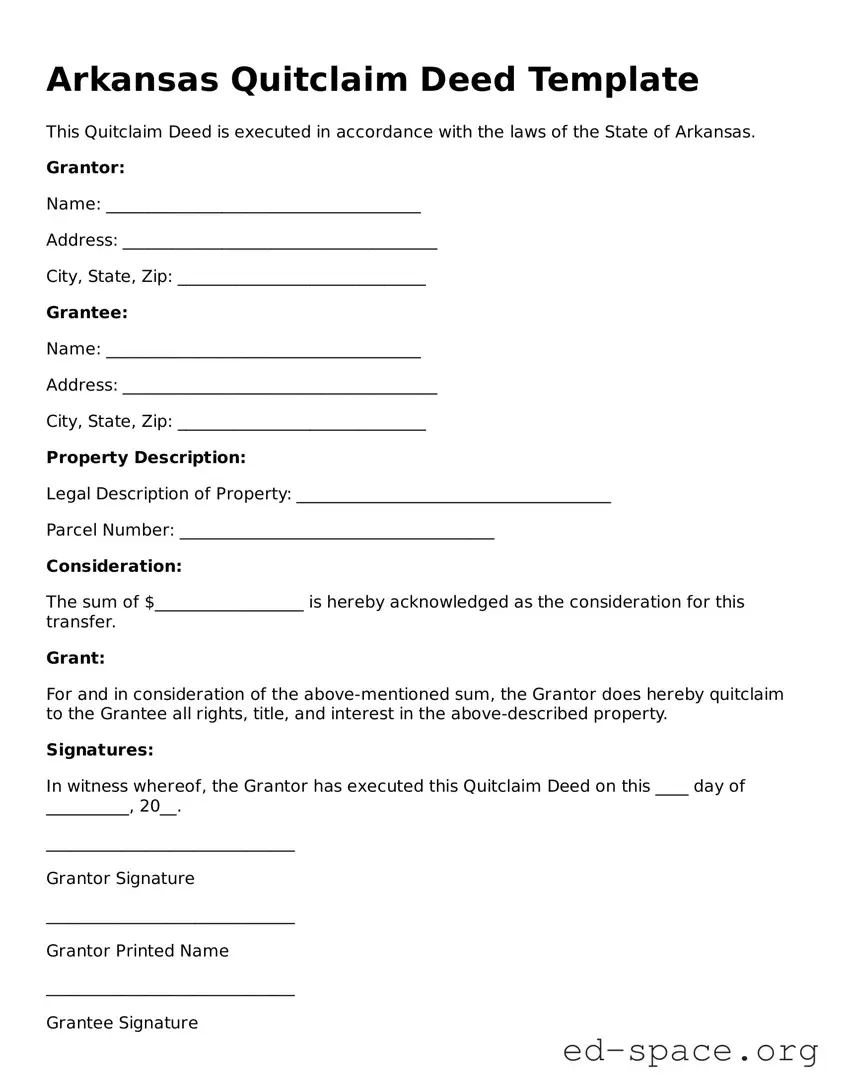
Arkansas Quitclaim Deed Template
This Quitclaim Deed is executed in accordance with the laws of the State of Arkansas.
Grantor:
Name: ______________________________________
Address: ______________________________________
City, State, Zip: ______________________________
Grantee:
Name: ______________________________________
Address: ______________________________________
City, State, Zip: ______________________________
Property Description:
Legal Description of Property: ______________________________________
Parcel Number: ______________________________________
Consideration:
The sum of $__________________ is hereby acknowledged as the consideration for this transfer.
Grant:
For and in consideration of the above-mentioned sum, the Grantor does hereby quitclaim to the Grantee all rights, title, and interest in the above-described property.
Signatures:
In witness whereof, the Grantor has executed this Quitclaim Deed on this ____ day of __________, 20__.
______________________________
Grantor Signature
______________________________
Grantor Printed Name
______________________________
Grantee Signature
______________________________
Grantee Printed Name
Notary Public:
State of Arkansas
County of ____________________
On this ____ day of __________, 20__, before me, a Notary Public, personally appeared ______________________, known to me (or satisfactorily proven) to be the person whose name is subscribed to the within instrument, and acknowledged that he/she executed the same for the purposes therein contained.
In witness whereof, I hereunto set my hand and official seal.
______________________________
Notary Public Signature
My commission expires: ____________________
| Fact Name | Description |
|---|---|
| Definition | A quitclaim deed is a legal document used to transfer ownership of real estate without any warranties. |
| Governing Law | The Arkansas Quitclaim Deed is governed by Arkansas Code Annotated § 18-12-101 et seq. |
| Parties Involved | The form involves a grantor (the person transferring the property) and a grantee (the person receiving the property). |
| No Warranties | Unlike other deeds, a quitclaim deed does not guarantee that the grantor has clear title to the property. |
| Common Uses | Quitclaim deeds are often used between family members, in divorce settlements, or to clear up title issues. |
| Recording | To be effective against third parties, the deed must be recorded with the county clerk’s office. |
| Consideration | While a nominal consideration is often stated, it is not required for the deed to be valid. |
| Signature Requirements | The grantor must sign the deed, and it may need to be notarized to be recorded. |
| Legal Effect | Upon execution and delivery, the property interest transfers immediately to the grantee. |
| Limitations | A quitclaim deed does not extinguish any liens or encumbrances on the property. |
After obtaining the Arkansas Quitclaim Deed form, it is essential to fill it out accurately to ensure that the transfer of property rights is executed properly. Once completed, the form will need to be signed and notarized before being filed with the appropriate county clerk's office.
What is a Quitclaim Deed in Arkansas?
A Quitclaim Deed is a legal document used to transfer ownership of real property from one party to another in Arkansas. Unlike a warranty deed, which guarantees that the grantor has clear title to the property, a quitclaim deed simply conveys whatever interest the grantor has in the property, if any. This type of deed is often used among family members or in situations where the parties know each other well and trust that there are no hidden claims against the property.
When should I use a Quitclaim Deed?
Quitclaim Deeds are commonly used in various situations. For instance, they are ideal for transferring property between family members, such as in cases of divorce or inheritance. They can also be useful for clearing up title issues, such as when a person wants to remove a former spouse's name from a property title. However, because a quitclaim deed does not provide any guarantees about the property’s title, it is not advisable for transactions involving unfamiliar parties or significant financial investments.
How do I complete a Quitclaim Deed in Arkansas?
To complete a Quitclaim Deed in Arkansas, you will need to include specific information. This includes the names of the grantor (the person transferring the property) and the grantee (the person receiving the property), a description of the property, and the date of the transfer. After filling out the form, both parties must sign it in the presence of a notary public. Once notarized, the deed should be filed with the county clerk's office where the property is located to ensure the transfer is recorded publicly.
Is a Quitclaim Deed legally binding?
Yes, a Quitclaim Deed is legally binding once it is properly executed and recorded. The grantor relinquishes any claim they have to the property, and the grantee accepts that claim. However, because the deed does not guarantee that the grantor has valid title, the grantee assumes the risk of any potential claims against the property. It is advisable for grantees to conduct a title search or obtain title insurance to protect against any unforeseen issues.
Are there any fees associated with filing a Quitclaim Deed in Arkansas?
Yes, there are typically fees associated with filing a Quitclaim Deed in Arkansas. These fees can vary by county, but they generally include a recording fee that must be paid to the county clerk’s office at the time of filing. Additionally, if you choose to have the deed prepared by an attorney or a title company, there may be additional service fees involved. It is advisable to check with your local county clerk’s office for the exact fee structure.
Can I revoke a Quitclaim Deed once it is filed?
Once a Quitclaim Deed is filed and recorded, it generally cannot be revoked unilaterally. The transfer of property is considered final. However, if both parties agree, they can execute another legal document, such as a new deed, to reverse the transaction. In some cases, it may be possible to challenge the deed in court, but this typically requires valid legal grounds and can be a complicated process. Consulting with a legal expert is recommended if revocation is being considered.
Failing to include the current date when signing the Quitclaim Deed. This can lead to confusion about when the transfer took place.
Not providing complete legal names of both the grantor (the person transferring the property) and the grantee (the person receiving the property). Full names help avoid disputes later.
Omitting the property description. A precise description, including the lot number and parcel number, is essential for clarity and legal purposes.
Using outdated or incorrect property information. Ensure that all details are current and match public records to avoid complications.
Not having the document witnessed or notarized when required. This step adds a layer of authenticity to the deed.
Neglecting to check for any existing liens or encumbrances on the property. This oversight can lead to unexpected legal issues for the grantee.
Forgetting to provide a consideration amount, even if it's nominal. This amount reflects the value exchanged for the property.
Using unclear or ambiguous language in the transfer clause. Clear language ensures that the intent of the transfer is understood by all parties.
Not filing the Quitclaim Deed with the appropriate county office. Failing to record the deed can leave the property transfer unrecognized legally.
Overlooking the need for legal advice in complex situations. Consulting with a professional can prevent costly mistakes.
A Quitclaim Deed is a crucial document for transferring property ownership in Arkansas. However, it is often accompanied by other forms and documents to ensure a smooth transaction. Below is a list of commonly used documents that may be needed alongside the Quitclaim Deed.
Having these documents prepared and organized can facilitate the property transfer process. Each document serves a specific purpose and helps protect the interests of both the buyer and seller. Always consider consulting with a legal professional to ensure all necessary forms are completed correctly.
When filling out the Arkansas Quitclaim Deed form, it is important to follow certain guidelines to ensure the document is completed correctly. Below is a list of dos and don'ts to help you navigate this process.
By adhering to these guidelines, you can help ensure that your Quitclaim Deed is properly executed and recognized. Taking the time to carefully complete the form can prevent potential issues in the future.
When it comes to understanding the Arkansas Quitclaim Deed form, several misconceptions often arise. It’s important to clarify these to ensure that property transactions proceed smoothly. Here’s a list of common misunderstandings:
Understanding these misconceptions can help individuals navigate property transactions more effectively. Always consult with a legal professional for tailored advice related to specific situations.
Here are some key takeaways about filling out and using the Arkansas Quitclaim Deed form: