Homepage Free Power of Attorney for a Child Form for Arkansas
Content Overview

The Arkansas Power of Attorney for a Child form is a crucial legal document that allows a parent or legal guardian to appoint another adult to make decisions on behalf of their child. This form can be especially important in situations where the parent is unavailable due to travel, illness, or other commitments. By completing this document, the designated adult gains the authority to make decisions regarding the child's education, healthcare, and general welfare. It is essential for parents to understand the scope of this authority, as it can include everything from enrolling the child in school to consenting to medical treatment. The form also specifies the duration of the power granted, ensuring clarity on how long the appointed individual can act on behalf of the child. Properly filling out and executing this form can provide peace of mind for parents, knowing their child will be cared for in their absence.

Document Preview

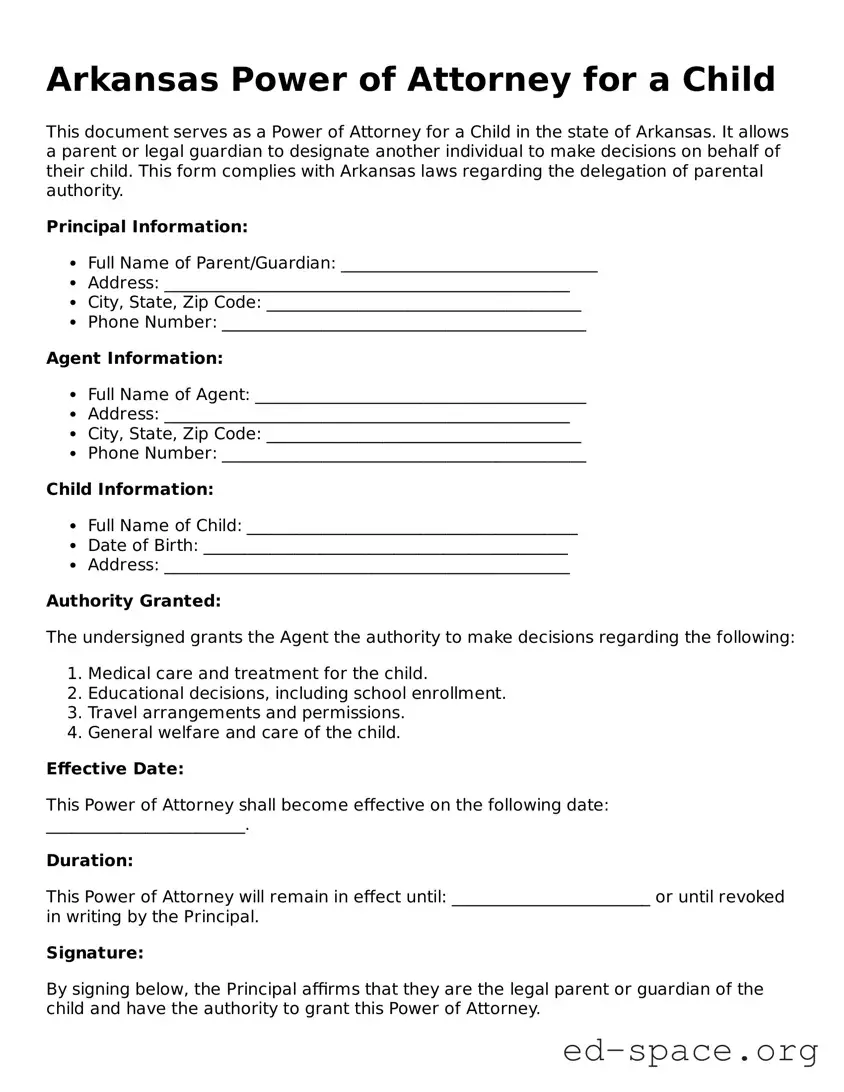
Arkansas Power of Attorney for a Child

This document serves as a Power of Attorney for a Child in the state of Arkansas. It allows a parent or legal guardian to designate another individual to make decisions on behalf of their child. This form complies with Arkansas laws regarding the delegation of parental authority.

Principal Information:

  • Full Name of Parent/Guardian: _______________________________
  • Address: _________________________________________________
  • City, State, Zip Code: ______________________________________
  • Phone Number: ____________________________________________

Agent Information:

  • Full Name of Agent: ________________________________________
  • Address: _________________________________________________
  • City, State, Zip Code: ______________________________________
  • Phone Number: ____________________________________________

Child Information:

  • Full Name of Child: ________________________________________
  • Date of Birth: ____________________________________________
  • Address: _________________________________________________

Authority Granted:

The undersigned grants the Agent the authority to make decisions regarding the following:

  1. Medical care and treatment for the child.
  2. Educational decisions, including school enrollment.
  3. Travel arrangements and permissions.
  4. General welfare and care of the child.

Effective Date:

This Power of Attorney shall become effective on the following date: ________________________.

Duration:

This Power of Attorney will remain in effect until: ________________________ or until revoked in writing by the Principal.

Signature:

By signing below, the Principal affirms that they are the legal parent or guardian of the child and have the authority to grant this Power of Attorney.

Signature of Parent/Guardian: _______________________________

Date: ______________________________________________________

Witness Information:

Witness Name: ____________________________________________

Signature of Witness: ______________________________________

Date: ______________________________________________________

This form should be signed in the presence of a witness to ensure its validity under Arkansas law.

PDF Form Details

Fact Name Details
Definition The Arkansas Power of Attorney for a Child form allows a parent or legal guardian to designate another adult to make decisions on behalf of their child.
Governing Law This form is governed by Arkansas Code Annotated § 9-26-101 et seq., which outlines the legal framework for powers of attorney concerning minors.
Duration The authority granted through this form can remain effective until a specified date or until revoked by the parent or guardian.
Revocation A parent or guardian may revoke the Power of Attorney at any time, provided that the revocation is documented in writing.

Arkansas Power of Attorney for a Child: Usage Guidelines

Filling out the Arkansas Power of Attorney for a Child form is an important step in ensuring that your child's needs are met when you are unable to care for them. This form allows you to designate someone you trust to make decisions on behalf of your child. Follow these steps to complete the form correctly.

  1. Start by downloading the Arkansas Power of Attorney for a Child form from a reliable source.
  2. Read through the entire form to understand what information is required.
  3. Fill in your name as the parent or legal guardian at the top of the form.
  4. Provide your address and contact information to ensure you can be reached if necessary.
  5. Next, enter your child's name and date of birth in the designated sections.
  6. Choose the person you want to appoint as the attorney-in-fact. Write their full name and relationship to your child.
  7. Include the attorney-in-fact’s address and contact information.
  8. Specify the powers you are granting. Check the appropriate boxes or write in any additional powers you wish to include.
  9. Indicate the duration of the power of attorney. You can set a specific end date or state that it lasts until revoked.
  10. Sign and date the form in the designated area. Make sure to do this in front of a notary public.
  11. Have the notary public sign and stamp the form to validate it.
  12. Make copies of the completed form for your records and for the attorney-in-fact.

Your Questions, Answered

What is a Power of Attorney for a Child in Arkansas?

A Power of Attorney for a Child in Arkansas is a legal document that allows a parent or legal guardian to grant authority to another adult to make decisions on behalf of their child. This can include decisions about healthcare, education, and general welfare. It’s particularly useful when a parent is unavailable for an extended period, such as during travel or deployment. The document ensures that the child’s needs are met and that someone trusted is in charge during the parent's absence.

Who can be appointed as an agent under this Power of Attorney?

The agent, or the person you designate to act on behalf of your child, must be an adult. This can be a relative, friend, or any trusted individual. It's important to choose someone who understands your values and is capable of making decisions in the best interest of your child. The selected agent will have the authority to make decisions regarding your child's care, education, and health while you are unavailable.

How long does the Power of Attorney for a Child last?

The duration of the Power of Attorney for a Child can vary based on your specifications. You can set a specific timeframe for how long the document is valid, or it can remain in effect until you revoke it. If no end date is specified, it typically lasts until the child reaches the age of majority, which is 18 in Arkansas. Always ensure that you clearly outline the duration in the document to avoid any confusion.

Do I need to have the Power of Attorney for a Child notarized?

Yes, in Arkansas, the Power of Attorney for a Child must be notarized to be legally binding. This means you will need to sign the document in front of a notary public, who will then verify your identity and witness the signing. Notarization adds an extra layer of security and helps prevent any potential disputes about the authenticity of the document.

Can I revoke the Power of Attorney for a Child once it is established?

Absolutely. You have the right to revoke the Power of Attorney for a Child at any time, as long as you are of sound mind. To do this, you should create a written notice of revocation and provide copies to your agent and any relevant parties, such as schools or healthcare providers. It’s essential to communicate this change clearly to ensure that everyone involved understands that the authority has been revoked.

Common mistakes

  1. Not clearly identifying the child. The form requires the full name, date of birth, and any relevant identification details of the child. Omitting this information can lead to confusion.

  2. Failing to specify the powers granted. It is crucial to clearly outline what decisions the agent can make on behalf of the child, such as medical care or educational decisions.

  3. Neglecting to include the agent's full information. The form must contain the agent's name, address, and contact information to ensure they can be reached when necessary.

  4. Not signing the document in front of a notary. A signature without notarization may render the document invalid. Proper notarization is essential for legal recognition.

  5. Overlooking the need for witnesses. Some situations require witnesses to sign the document alongside the notary. Check local requirements to ensure compliance.

  6. Using outdated forms. Laws can change, and using an old version of the Power of Attorney form can lead to issues. Always use the most current form available.

  7. Not providing copies to relevant parties. After completing the form, it is important to distribute copies to the agent, the child’s school, and healthcare providers as needed.

  8. Failing to review the document for accuracy. Mistakes in names, dates, or other critical information can invalidate the form. A thorough review is necessary.

  9. Ignoring expiration dates. Some Power of Attorney forms have a specified duration. Be aware of when the authority ends and plan accordingly.

Documents used along the form

When creating a Power of Attorney for a Child in Arkansas, several other forms and documents may be necessary to ensure comprehensive legal coverage. Each of these documents serves a specific purpose and can help clarify responsibilities and rights.

  • Child Custody Agreement: This document outlines the custody arrangement between parents or guardians, detailing physical and legal custody rights.
  • Medical Authorization Form: This form grants permission for a designated individual to make medical decisions on behalf of the child in case of emergencies.
  • Travel Consent Form: This document provides consent for a child to travel with someone other than their parents or legal guardians, often required by airlines or other travel entities.
  • School Enrollment Form: This form is necessary for enrolling a child in school and may require proof of guardianship or custody.
  • Emergency Contact Form: This document lists individuals who can be contacted in case of emergencies, ensuring that caregivers have access to important information.
  • Health Insurance Authorization: This form allows the designated caregiver to make claims or decisions regarding the child's health insurance coverage.
  • Visitation Agreement: This document specifies the terms of visitation for non-custodial parents, ensuring that both parties understand their rights and responsibilities.
  • Child Support Agreement: This legal document outlines the financial support obligations of a non-custodial parent, detailing payment amounts and schedules.
  • Affidavit of Guardianship: This sworn statement confirms the relationship between the child and the guardian, which may be necessary for legal or medical purposes.

Having these documents prepared can facilitate smoother transitions and ensure that all parties involved in the care of the child understand their roles and responsibilities. It is advisable to consult with a legal professional to ensure that all necessary forms are correctly completed and filed.

Similar forms

  • General Power of Attorney: This document allows one person to act on behalf of another in a wide range of legal and financial matters. Like the Power of Attorney for a Child, it grants authority to make decisions, but it is not limited to the care of a minor.
  • Medical Power of Attorney: This form specifically authorizes someone to make medical decisions for another person. Similar to the Power of Attorney for a Child, it focuses on the well-being of an individual, particularly in healthcare situations.
  • Guardianship Agreement: This legal document establishes a guardian for a child, giving them the authority to make decisions regarding the child’s welfare. It is similar in purpose but typically involves a court process.
  • Living Will: While primarily focused on end-of-life decisions, a living will can include provisions for the care of dependents. It shares the intent of ensuring that a person’s wishes are honored, similar to the Power of Attorney for a Child.
  • Child Custody Agreement: This document outlines the terms of custody and care for a child following a divorce or separation. Like the Power of Attorney for a Child, it addresses the responsibilities of caretakers.
  • Consent to Medical Treatment: This form allows a designated individual to consent to medical treatment for a child. It parallels the Power of Attorney for a Child by focusing on health-related decisions.
  • Education Power of Attorney: This document permits a designated person to make educational decisions for a child. It shares similarities with the Power of Attorney for a Child in that it grants authority over specific aspects of a child's life.
  • Travel Consent Form: This form allows a child to travel with someone other than their parents. It is similar in that it provides legal authority for caretaking responsibilities during travel.
  • Temporary Guardianship Form: This document grants temporary authority to another person to care for a child. It is similar in function to the Power of Attorney for a Child but is typically used for short-term situations.
  • Authorization for Release of Information: This form allows a designated person to access a child’s educational or medical records. It complements the Power of Attorney for a Child by ensuring that the designated individual can obtain necessary information for the child’s care.

Dos and Don'ts

When filling out the Arkansas Power of Attorney for a Child form, it is important to be careful and thorough. Here are some guidelines to help you navigate the process effectively.

  • Do read the entire form carefully before starting.
  • Do ensure that you have the correct names and addresses for both the child and the agent.
  • Do specify the duration of the power of attorney clearly.
  • Do sign the form in the presence of a notary public.
  • Don't leave any sections blank; incomplete forms may be rejected.
  • Don't forget to discuss the responsibilities with the agent before naming them.
  • Don't use outdated forms; always obtain the latest version.
  • Don't assume that verbal agreements are sufficient; everything should be in writing.

Misconceptions

Understanding the Arkansas Power of Attorney for a Child form is essential for parents and guardians. However, several misconceptions can lead to confusion. Here are seven common misunderstandings about this important legal document:

  1. It is only for emergencies. Many people believe that a Power of Attorney for a Child is only necessary in urgent situations. In reality, it can be useful for various circumstances, such as travel, medical decisions, or temporary custody arrangements.
  2. It gives up parental rights. Some assume that signing a Power of Attorney means they are relinquishing their parental rights. This is not true. The document allows another person to act on your behalf while you retain your legal rights as a parent.
  3. It is a permanent arrangement. A common misconception is that once a Power of Attorney is signed, it cannot be changed or revoked. In fact, you can revoke or modify the document at any time as long as you are of sound mind.
  4. Only lawyers can create this document. While legal assistance can be beneficial, it is not required to create a Power of Attorney for a Child. Parents can draft the document themselves, provided they understand the necessary components.
  5. It is the same as a guardianship. Some confuse a Power of Attorney with guardianship. While both allow someone to make decisions for a child, guardianship is a more permanent legal arrangement, often requiring court approval.
  6. It is only needed for minor children. Many believe this form is only applicable to children under 18. However, it can also be relevant for older teens, especially when they are traveling or living away from home.
  7. It requires notarization. While notarization can add an extra layer of validity, it is not always necessary for a Power of Attorney for a Child in Arkansas. The key is to ensure that the document is signed and dated by the parent or guardian.

By understanding these misconceptions, parents and guardians can make informed decisions about the care and legal representation of their children.

Key takeaways

When filling out and using the Arkansas Power of Attorney for a Child form, it's essential to understand its purpose and requirements. Here are some key takeaways:

  • The Power of Attorney for a Child allows a parent or legal guardian to designate another adult to make decisions on behalf of their child.
  • This form is particularly useful for temporary situations, such as when a parent is traveling or unable to care for the child.
  • It is important to choose a trustworthy individual, as they will have authority over the child’s welfare and decisions.
  • The form should be filled out completely and accurately to avoid any legal complications.
  • Both the parent and the designated agent must sign the document in the presence of a notary public.
  • In Arkansas, the Power of Attorney for a Child does not need to be filed with the court, but it should be kept in a safe place.
  • Parents should provide copies of the signed form to schools, healthcare providers, and anyone else who may need to know about the arrangement.
  • The document can specify the duration of the authority granted to the agent, which can be limited to a specific period or until revoked.
  • Revoking the Power of Attorney can be done at any time, but it should be documented in writing to avoid confusion.
  • Consulting with a legal professional can help clarify any questions about the form or its implications.