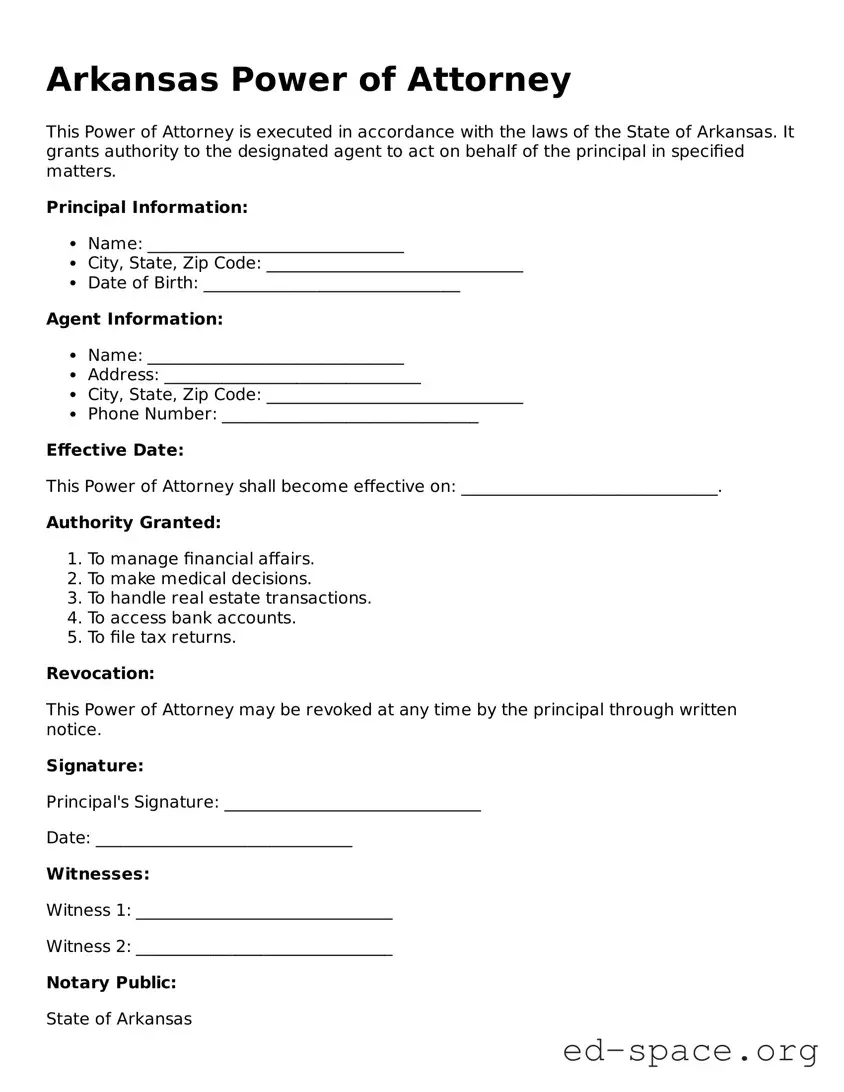
The Arkansas Power of Attorney form is a crucial legal document that empowers individuals to designate someone else to make decisions on their behalf. This form covers various aspects, including financial and healthcare decisions, ensuring that the appointed agent can act in the best interest of the principal. It allows for flexibility, enabling the principal to specify the extent of the agent's authority, whether it be broad or limited. Additionally, the form can be tailored to become effective immediately or only upon the principal's incapacitation. Understanding the nuances of this document is essential for anyone considering appointing an agent, as it plays a vital role in managing personal affairs when one is unable to do so. The Arkansas Power of Attorney form not only provides peace of mind but also safeguards against potential disputes or complications in the future.
Arkansas Power of Attorney
This Power of Attorney is executed in accordance with the laws of the State of Arkansas. It grants authority to the designated agent to act on behalf of the principal in specified matters.
Principal Information:
Agent Information:
Effective Date:
This Power of Attorney shall become effective on: _______________________________.
Authority Granted:
Revocation:
This Power of Attorney may be revoked at any time by the principal through written notice.
Signature:
Principal's Signature: _______________________________
Date: _______________________________
Witnesses:
Witness 1: _______________________________
Witness 2: _______________________________
Notary Public:
State of Arkansas
County of _______________________________
Subscribed and sworn before me on this _____ day of _______________, 20__.
Notary Public Signature: _______________________________
My Commission Expires: _______________________________
| Fact Name | Description |
|---|---|
| Definition | A Power of Attorney (POA) in Arkansas is a legal document that allows one person to authorize another to act on their behalf in legal or financial matters. |
| Types of POA | Arkansas recognizes several types of POA, including durable, springing, and limited powers of attorney. |
| Durable POA | A durable POA remains in effect even if the principal becomes incapacitated, ensuring continuous management of their affairs. |
| Springing POA | A springing POA only becomes effective upon the occurrence of a specified event, typically the incapacitation of the principal. |
| Governing Laws | The Arkansas Power of Attorney Act, specifically Arkansas Code Annotated § 28-68-101 et seq., governs the creation and use of POAs in the state. |
| Signing Requirements | The principal must sign the POA in the presence of a notary public for it to be valid in Arkansas. |
| Revocation | A principal can revoke a Power of Attorney at any time, as long as they are mentally competent to do so. |
| Agent's Authority | The agent’s authority can be broad or limited, depending on what the principal specifies in the document. |
| Legal Advice | It is recommended to seek legal advice when drafting a Power of Attorney to ensure it meets all necessary requirements and adequately reflects the principal's wishes. |
Filling out the Arkansas Power of Attorney form is a straightforward process that requires careful attention to detail. Once completed, the form will empower your designated agent to act on your behalf in specified matters. This document must be filled out accurately to ensure it is legally binding and effective.
After completing these steps, ensure that your agent understands their responsibilities and the scope of the authority granted. It's also wise to review the document periodically, especially if your circumstances change.
What is a Power of Attorney in Arkansas?
A Power of Attorney (POA) in Arkansas is a legal document that allows one person (the "principal") to give another person (the "agent" or "attorney-in-fact") the authority to act on their behalf. This can include making financial decisions, handling legal matters, or managing healthcare decisions, depending on the type of POA established.
What types of Power of Attorney are available in Arkansas?
In Arkansas, there are several types of Power of Attorney. The most common include the General Power of Attorney, which grants broad powers to the agent, and the Limited Power of Attorney, which restricts the agent's authority to specific tasks or situations. Additionally, there is a Durable Power of Attorney, which remains effective even if the principal becomes incapacitated, and a Medical Power of Attorney, which specifically allows the agent to make healthcare decisions for the principal.
How do I create a Power of Attorney in Arkansas?
To create a Power of Attorney in Arkansas, you need to fill out the appropriate form, which can be obtained from various sources, including legal websites or office supply stores. The document must clearly state the powers granted to the agent and be signed by the principal in the presence of a notary public. It’s also advisable to have witnesses present during the signing process, although it is not a legal requirement.
Does a Power of Attorney need to be notarized in Arkansas?
Yes, a Power of Attorney must be notarized in Arkansas to be legally valid. This means that the principal must sign the document in front of a notary public, who will then affix their seal. This step helps to verify the identity of the principal and ensures that the document is executed properly.
Can I revoke a Power of Attorney in Arkansas?
Yes, you can revoke a Power of Attorney in Arkansas at any time, as long as you are mentally competent. To revoke it, you should create a written document stating that you are revoking the previous POA. It's important to notify the agent and any institutions or individuals who were relying on the original POA to avoid any confusion.
What happens if the principal becomes incapacitated?
If the principal becomes incapacitated, a Durable Power of Attorney remains effective, allowing the agent to continue making decisions on behalf of the principal. If a non-durable POA was established, it would become void upon the principal’s incapacitation. This highlights the importance of choosing the right type of POA based on your needs and circumstances.
Can I use a Power of Attorney from another state in Arkansas?
Generally, a Power of Attorney from another state can be used in Arkansas, but it’s important to ensure that it complies with Arkansas laws. Some institutions may have their own requirements or may request that you use an Arkansas-specific form. It’s wise to check with the relevant parties to confirm acceptance before relying on an out-of-state POA.
Not Specifying the Powers Granted: It is essential to clearly outline the specific powers being granted to the agent. Failing to do this may lead to confusion or limit the agent's ability to act on behalf of the principal.
Inadequate Identification of the Agent: The form requires the full name and address of the agent. Omitting any part of this information can result in complications when the agent attempts to exercise their authority.
Not Signing the Document Correctly: The principal must sign the Power of Attorney form in the presence of a notary public. If this step is overlooked, the document may not be considered valid.
Failing to Review State-Specific Requirements: Each state may have unique requirements for Power of Attorney forms. Not being aware of Arkansas's specific regulations can lead to errors that affect the document's validity.
When considering a Power of Attorney in Arkansas, it's essential to understand that this document often works in conjunction with several other forms and documents. Each of these plays a significant role in ensuring that your wishes are honored and that your affairs are managed effectively. Below is a list of common documents that may accompany a Power of Attorney.
Understanding these documents can empower you to make informed decisions about your future and the management of your affairs. By preparing the necessary forms, you can ensure that your wishes are respected and that your loved ones have the guidance they need during challenging times.
The Power of Attorney (POA) form grants someone the authority to act on another person's behalf. Several other legal documents serve similar purposes. Here are eight documents that share similarities with a Power of Attorney:
When filling out the Arkansas Power of Attorney form, it's important to be careful and precise. Here are some essential do's and don'ts to guide you through the process:
Understanding the Arkansas Power of Attorney form is crucial for effective planning. Here are six common misconceptions about this important document:
Many believe that a Power of Attorney is solely for financial decisions. In reality, it can also cover health care decisions, depending on the type of Power of Attorney created.
Some think that a Power of Attorney is permanent. However, it can be revoked or modified at any time as long as the principal is competent.
People often assume that a Power of Attorney is effective immediately upon signing. In fact, it can be set to activate only under certain conditions, such as incapacitation.
While most adults can serve as an agent, there are restrictions. For instance, individuals who are not of sound mind or who are convicted felons may not qualify.
Many think only seniors need a Power of Attorney. However, anyone can benefit from having this document, especially in case of unexpected events or emergencies.
Some believe that a Power of Attorney can be valid without any witnesses or notarization. In Arkansas, certain types of Powers of Attorney do require notarization to be legally binding.
Being informed about these misconceptions can help individuals make better decisions regarding their Power of Attorney needs.
When considering the Arkansas Power of Attorney form, understanding its implications and requirements is crucial. Below are key takeaways to keep in mind: