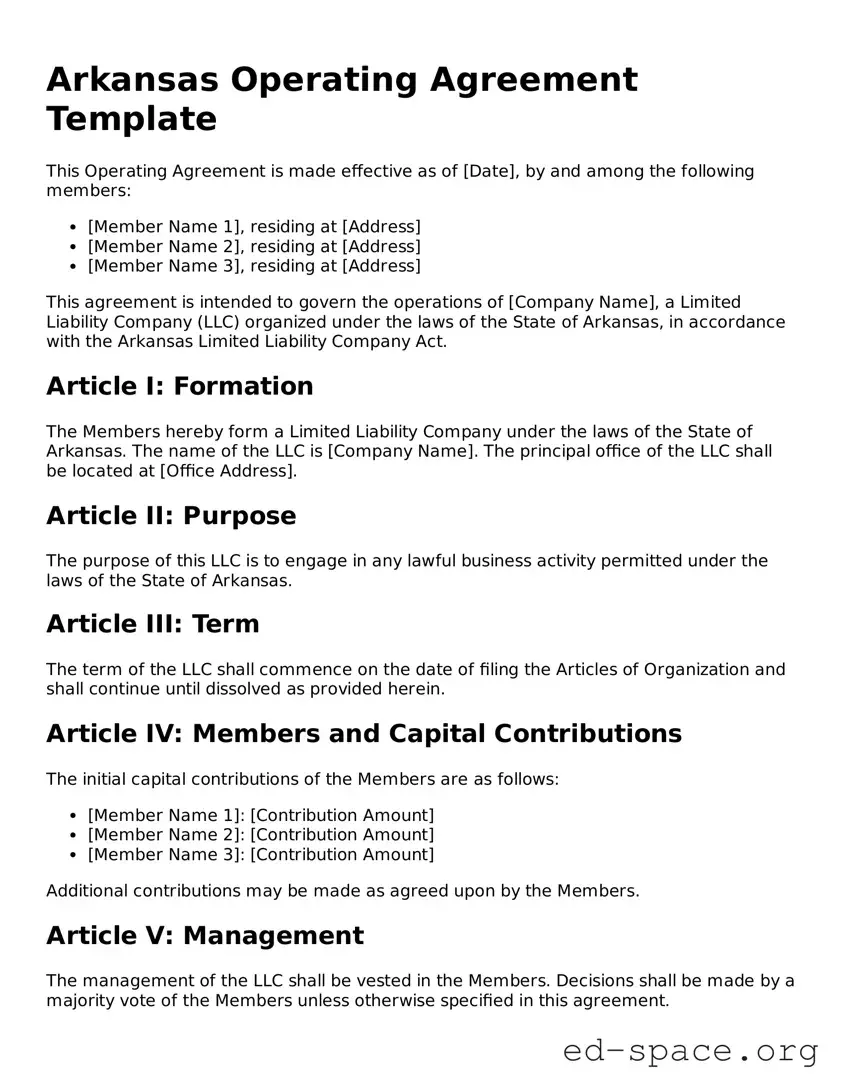
The Arkansas Operating Agreement form plays a crucial role in the establishment and management of limited liability companies (LLCs) in the state. This document outlines the internal workings of the LLC, including the rights and responsibilities of its members. Key aspects include the distribution of profits and losses, management structure, and procedures for adding or removing members. Furthermore, it addresses decision-making processes and outlines how disputes will be resolved. By clearly defining these elements, the Operating Agreement helps prevent misunderstandings and conflicts among members, ensuring a smoother operation of the business. It is essential for both new and existing LLCs to have a well-drafted Operating Agreement to protect their interests and provide a framework for future growth.
Arkansas Operating Agreement Template
This Operating Agreement is made effective as of [Date], by and among the following members:
This agreement is intended to govern the operations of [Company Name], a Limited Liability Company (LLC) organized under the laws of the State of Arkansas, in accordance with the Arkansas Limited Liability Company Act.
Article I: Formation
The Members hereby form a Limited Liability Company under the laws of the State of Arkansas. The name of the LLC is [Company Name]. The principal office of the LLC shall be located at [Office Address].
Article II: Purpose
The purpose of this LLC is to engage in any lawful business activity permitted under the laws of the State of Arkansas.
Article III: Term
The term of the LLC shall commence on the date of filing the Articles of Organization and shall continue until dissolved as provided herein.
Article IV: Members and Capital Contributions
The initial capital contributions of the Members are as follows:
Additional contributions may be made as agreed upon by the Members.
Article V: Management
The management of the LLC shall be vested in the Members. Decisions shall be made by a majority vote of the Members unless otherwise specified in this agreement.
Article VI: Distributions
Distributions of profits and losses shall be allocated to the Members in proportion to their respective ownership interests in the LLC.
Article VII: Indemnification
The LLC shall indemnify any Member or Manager against any and all expenses and liabilities incurred in connection with the LLC, except in cases of willful misconduct or gross negligence.
Article VIII: Amendments
This Operating Agreement may be amended only by a written agreement signed by all Members.
Article IX: Governing Law
This Agreement shall be governed by and construed in accordance with the laws of the State of Arkansas.
IN WITNESS WHEREOF, the Members have executed this Operating Agreement as of the date first above written.
_________________________
[Member Name 1]
_________________________
[Member Name 2]
_________________________
[Member Name 3]
| Fact Name | Description |
|---|---|
| Purpose | The Arkansas Operating Agreement outlines the management structure and operating procedures for a limited liability company (LLC). |
| Governing Law | This agreement is governed by the Arkansas Limited Liability Company Act. |
| Members | All members of the LLC should be included in the agreement to ensure clarity in ownership and responsibilities. |
| Management Structure | The agreement can specify whether the LLC will be member-managed or manager-managed. |
| Capital Contributions | It is essential to outline each member's capital contributions and how profits and losses will be distributed. |
| Amendments | The Operating Agreement should include procedures for making amendments to the agreement in the future. |
| Dispute Resolution | Provisions for resolving disputes among members can be included to prevent conflicts. |
| Duration | The agreement can specify the duration of the LLC, whether it is perpetual or has a set end date. |
| Compliance | Having an Operating Agreement is not legally required in Arkansas, but it is highly recommended for clarity and legal protection. |
| Signatures | All members should sign the agreement to validate it and ensure mutual consent to the terms outlined. |
Filling out the Arkansas Operating Agreement form is an important step in establishing the legal framework for your business. Once you have completed the form, you will be better prepared to operate your business in compliance with state regulations and to protect the interests of all members involved.
After completing these steps, keep a copy of the signed Operating Agreement in a safe place. You may also want to provide copies to all members for their records. This document will serve as a vital reference point as your business grows and evolves.
What is an Arkansas Operating Agreement?
An Arkansas Operating Agreement is a legal document that outlines the management structure and operating procedures of a Limited Liability Company (LLC) in Arkansas. It serves as a guideline for how the business will be run and helps protect the owners' personal assets by establishing the LLC as a separate legal entity.
Is an Operating Agreement required in Arkansas?
Who should draft the Operating Agreement?
The Operating Agreement can be drafted by the members of the LLC or a legal professional. It is important that the document reflects the specific needs and agreements of the members. Seeking legal advice can ensure that all necessary provisions are included and that the agreement complies with state laws.
What should be included in the Operating Agreement?
Key elements to include in the Operating Agreement are the names of the members, the percentage of ownership for each member, the management structure, procedures for adding or removing members, and how profits and losses will be distributed. Additionally, it should outline the process for resolving disputes among members.
Can the Operating Agreement be changed?
Yes, the Operating Agreement can be amended if all members agree to the changes. It is important to document any amendments in writing to ensure clarity and avoid future disputes. Keeping a record of all changes is essential for the integrity of the agreement.
How does the Operating Agreement affect personal liability?
The Operating Agreement helps reinforce the limited liability protection provided to LLC members. By clearly outlining the structure and operations of the business, it helps demonstrate that the LLC is a separate entity. This distinction can protect members' personal assets from being used to satisfy business debts or legal judgments.
Where should the Operating Agreement be kept?
The Operating Agreement should be stored in a safe and accessible location. It is advisable to keep a copy with other important business documents, such as the Articles of Organization. Members should also have access to the agreement to refer to it when necessary.
What happens if there is no Operating Agreement?
If an LLC does not have an Operating Agreement, it will be governed by the default rules set forth by Arkansas law. These rules may not align with the members' intentions or business practices. This can lead to confusion and disputes among members, as well as potential challenges in managing the LLC effectively.
Failing to include all members of the LLC. It’s essential to list every member involved in the business to ensure proper ownership representation.
Not specifying the management structure. Clearly stating whether the LLC will be member-managed or manager-managed helps avoid confusion down the line.
Leaving out the purpose of the LLC. The operating agreement should outline the business's purpose to provide clarity for all members.
Inadequate detail on profit and loss distribution. Members should understand how profits and losses will be allocated to prevent disputes.
Neglecting to address decision-making processes. It’s important to specify how decisions will be made and what constitutes a quorum for meetings.
Omitting provisions for adding or removing members. Having a clear process for these changes can prevent complications in the future.
Forgetting to include a buy-sell agreement. This provision helps manage the transfer of ownership interests among members.
Not considering dispute resolution methods. Including a plan for resolving conflicts can save time and resources later on.
Using vague language throughout the document. Clarity is crucial; ambiguous terms can lead to misunderstandings.
Failing to review and update the agreement regularly. As the business evolves, so should the operating agreement to reflect current practices and membership.
When establishing a business in Arkansas, particularly a limited liability company (LLC), several key documents work in tandem with the Arkansas Operating Agreement. These documents help clarify the structure and operations of the LLC, ensuring compliance with state regulations. Below is a list of commonly used forms and documents that complement the Operating Agreement.
Utilizing these documents alongside the Arkansas Operating Agreement can help ensure a well-organized and legally compliant business structure. Each document plays a vital role in establishing the framework for your LLC's operations and governance.
When filling out the Arkansas Operating Agreement form, it's important to be thorough and accurate. Here’s a list of things you should and shouldn't do:
Understanding the Arkansas Operating Agreement form is crucial for anyone involved in business partnerships or limited liability companies (LLCs) in the state. However, several misconceptions can lead to confusion. Here are ten common misconceptions about the Arkansas Operating Agreement form:
By addressing these misconceptions, individuals and businesses can better understand the importance and functionality of the Arkansas Operating Agreement form.
When filling out and using the Arkansas Operating Agreement form, consider the following key takeaways: