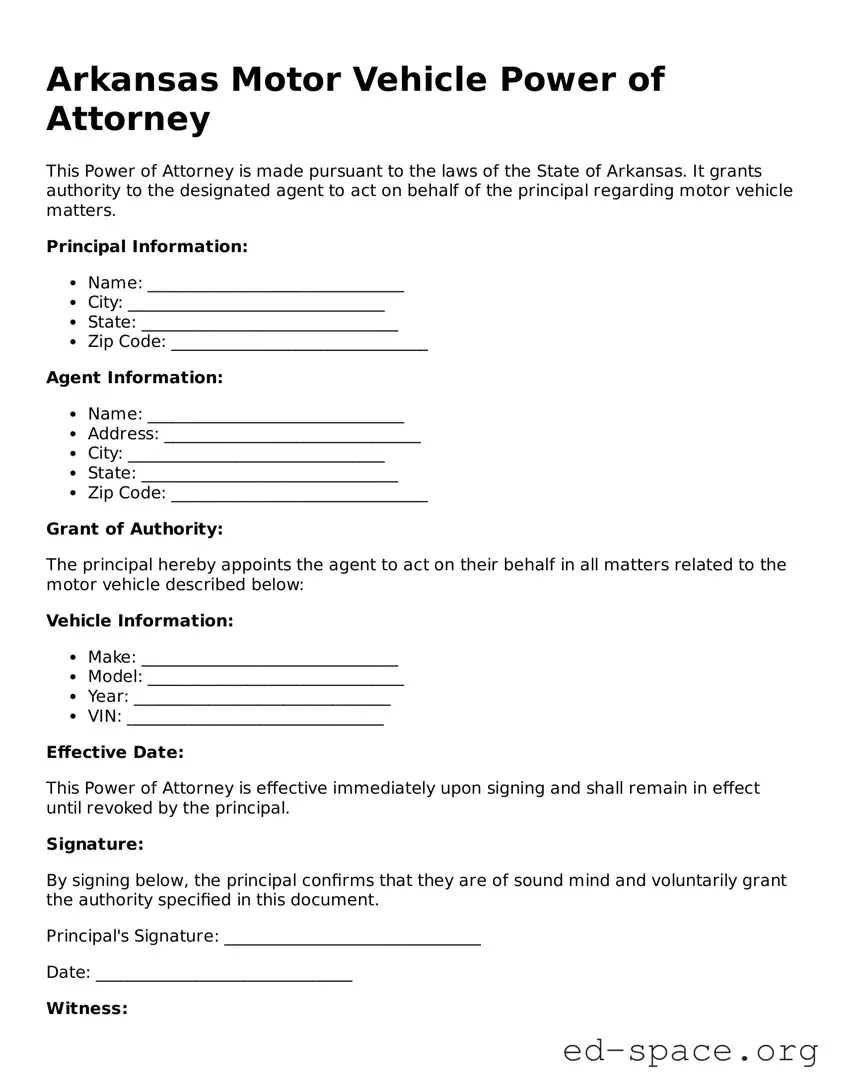
In Arkansas, the Motor Vehicle Power of Attorney form serves as a vital tool for individuals seeking to delegate authority related to their vehicle transactions. This legal document empowers a designated agent to act on behalf of the vehicle owner, facilitating essential tasks such as signing titles, transferring ownership, and registering vehicles. Whether you are unable to attend a transaction in person due to health issues, travel commitments, or other obligations, this form ensures that your interests are protected and that your vehicle-related matters are handled efficiently. The process of completing the form is straightforward, but it is crucial to ensure that all necessary information is accurately provided to avoid complications. Understanding the implications of granting power of attorney is essential, as it involves entrusting another person with significant responsibilities regarding your vehicle. By taking the time to familiarize yourself with this form, you can make informed decisions that will safeguard your interests while ensuring that your vehicle transactions proceed smoothly.
Arkansas Motor Vehicle Power of Attorney
This Power of Attorney is made pursuant to the laws of the State of Arkansas. It grants authority to the designated agent to act on behalf of the principal regarding motor vehicle matters.
Principal Information:
Agent Information:
Grant of Authority:
The principal hereby appoints the agent to act on their behalf in all matters related to the motor vehicle described below:
Vehicle Information:
Effective Date:
This Power of Attorney is effective immediately upon signing and shall remain in effect until revoked by the principal.
Signature:
By signing below, the principal confirms that they are of sound mind and voluntarily grant the authority specified in this document.
Principal's Signature: _______________________________
Date: _______________________________
Witness:
Witness Name: _______________________________
Witness Signature: _______________________________
Date: _______________________________
| Fact Name | Description |
|---|---|
| Purpose | The Arkansas Motor Vehicle Power of Attorney form allows an individual to appoint someone else to handle vehicle-related transactions on their behalf. |
| Governing Law | This form is governed by the Arkansas Code Annotated, specifically Title 27, Chapter 14. |
| Principal | The person granting the power is known as the principal. |
| Agent | The individual receiving the authority is called the agent or attorney-in-fact. |
| Vehicle Transactions | Authorized transactions include title transfers, registration, and obtaining a duplicate title. |
| Signature Requirement | The principal must sign the form to make it valid. |
| Notarization | While notarization is not mandatory, it is recommended to enhance the form's credibility. |
| Revocation | The principal can revoke the power of attorney at any time, provided they notify the agent. |
| Duration | This power remains effective until revoked by the principal or until the principal's death. |
| Form Availability | The form can typically be obtained from the Arkansas Department of Finance and Administration or online. |
Once you have the Arkansas Motor Vehicle Power of Attorney form, you can begin filling it out. Ensure that you have all the necessary information ready, such as the details of the vehicle and the person you are designating as your attorney-in-fact. Follow these steps to complete the form accurately.
What is the Arkansas Motor Vehicle Power of Attorney form?
The Arkansas Motor Vehicle Power of Attorney form is a legal document that allows one person (the principal) to authorize another person (the agent) to act on their behalf regarding motor vehicle transactions. This can include signing documents, transferring titles, and handling registration matters.
Why would someone need a Motor Vehicle Power of Attorney?
Individuals may need this form for various reasons. For instance, if someone is unable to attend a vehicle transaction due to illness, travel, or other commitments, they can designate an agent to handle the necessary paperwork. This helps ensure that important transactions are not delayed.
Who can be designated as an agent?
Any competent adult can be designated as an agent in the Arkansas Motor Vehicle Power of Attorney. This could be a family member, friend, or a trusted associate. It is essential that the agent is someone the principal trusts to handle their affairs responsibly.
How is the Motor Vehicle Power of Attorney form completed?
The form must be filled out with the principal's information, the agent's details, and a description of the powers being granted. It’s important to be clear and specific about what the agent is authorized to do. Once completed, the principal must sign the document, and it may need to be notarized depending on the circumstances.
Is notarization required for the form?
While notarization is not always required, it is highly recommended. Having the document notarized adds an extra layer of validity and can help prevent disputes regarding the authenticity of the signatures. Some institutions may require notarization before they accept the Power of Attorney.
Can the Motor Vehicle Power of Attorney be revoked?
Yes, the principal can revoke the Power of Attorney at any time, as long as they are competent to do so. To revoke it, the principal should provide a written notice to the agent and any relevant institutions, such as the Department of Motor Vehicles. This ensures that all parties are aware of the change.
How long is the Power of Attorney valid?
The validity of the Arkansas Motor Vehicle Power of Attorney typically lasts until the principal revokes it or until the specific transaction is completed. However, it’s wise to check the form for any expiration clauses or conditions that may affect its duration.
What types of transactions can be handled with this Power of Attorney?
This form can be used for a variety of motor vehicle transactions, including transferring ownership, applying for title certificates, registering vehicles, and handling any related paperwork. The specific powers granted should be clearly outlined in the document.
Are there any limitations on the agent's authority?
Yes, the principal can specify limitations within the Power of Attorney. For example, they may restrict the agent to only certain transactions or require that the agent consult them before taking specific actions. It’s crucial to clearly state any limitations to avoid misunderstandings.
Where can I obtain the Arkansas Motor Vehicle Power of Attorney form?
The form can typically be obtained from the Arkansas Department of Finance and Administration's website or at local DMV offices. It is important to ensure that you are using the most current version of the form to comply with state regulations.
Failing to provide complete information about the principal, including their full name, address, and contact details.
Neglecting to include the name and contact information of the designated agent, which can lead to confusion about who is authorized to act on behalf of the principal.
Omitting the specific powers granted to the agent, which may result in limitations on the agent's ability to perform necessary tasks.
Not signing the document in the appropriate section, which can render the form invalid.
Forgetting to date the form, as this information is crucial for establishing the validity of the Power of Attorney.
Using outdated versions of the form, which may not comply with current state requirements.
Failing to have the form notarized, if required, which can lead to challenges in its acceptance by third parties.
Not providing copies of the completed form to all relevant parties, including the agent and any institutions that may need it.
Misunderstanding the scope of authority granted, which can lead to disputes or misuse of the Power of Attorney.
Neglecting to review the form for errors before submission, which can result in delays or complications in processing.
When dealing with motor vehicle transactions in Arkansas, the Motor Vehicle Power of Attorney form is just one piece of the puzzle. Several other documents may be necessary to ensure a smooth process. Understanding these documents can help you navigate the complexities of vehicle ownership and transfer.
Each of these documents plays a critical role in the process of buying, selling, or transferring a vehicle in Arkansas. Familiarity with them not only streamlines the transaction but also helps avoid potential legal complications down the road.
The Motor Vehicle Power of Attorney form allows an individual to authorize someone else to handle specific tasks related to their vehicle. This document shares similarities with several other legal forms that empower individuals to delegate authority. Here are four such documents:
When filling out the Arkansas Motor Vehicle Power of Attorney form, consider the following guidelines:
When it comes to the Arkansas Motor Vehicle Power of Attorney form, several misconceptions can lead to confusion. Understanding these misconceptions can help individuals navigate the process more effectively.
Many people believe that a Motor Vehicle Power of Attorney is solely for the purpose of selling a vehicle. While it can certainly be used for that, it also allows someone to handle various tasks related to vehicle ownership, such as transferring titles, registering vehicles, or even obtaining license plates.
Another common belief is that only the actual owner of the vehicle can fill out and sign this form. In reality, if the owner is unable to be present due to circumstances such as illness or being out of state, they can designate another individual to act on their behalf, provided that proper authorization is given.
Some individuals think that notarization is a requirement for the Motor Vehicle Power of Attorney to be valid. While notarization can add an extra layer of authenticity, it is not always necessary. The form can be valid as long as it is signed by the vehicle owner and meets the state's requirements.
Many assume that once a power of attorney is granted, it remains in effect indefinitely. However, this is not the case. The vehicle owner can revoke the power of attorney at any time, and the authority granted will automatically terminate upon the owner’s death or if the owner becomes incapacitated.
Lastly, some believe that the Motor Vehicle Power of Attorney form can only be accessed online. While it is indeed available for download, individuals can also obtain physical copies at local Department of Motor Vehicle (DMV) offices or other authorized locations.
When filling out and using the Arkansas Motor Vehicle Power of Attorney form, there are several important points to keep in mind. Here are key takeaways to ensure a smooth process:
By following these key points, you can effectively utilize the Arkansas Motor Vehicle Power of Attorney form and streamline the management of your vehicle-related matters.