In the state of Arkansas, the Medical Power of Attorney form serves as a vital tool for individuals seeking to ensure their healthcare preferences are respected when they are unable to communicate their wishes. This legal document allows a person, known as the principal, to designate a trusted individual, referred to as the agent, to make medical decisions on their behalf. It covers a wide range of healthcare choices, from routine medical treatments to end-of-life care options. By clearly outlining the principal's preferences, the form helps to alleviate the burden on family members during difficult times, ensuring that decisions reflect the principal's values and desires. Additionally, the Arkansas Medical Power of Attorney can include specific instructions regarding the types of medical interventions the principal wishes to accept or decline, providing clarity and direction to healthcare providers. Understanding the importance of this form is crucial for anyone looking to take proactive steps in managing their health care decisions and ensuring their voice is heard, even when they cannot speak for themselves.
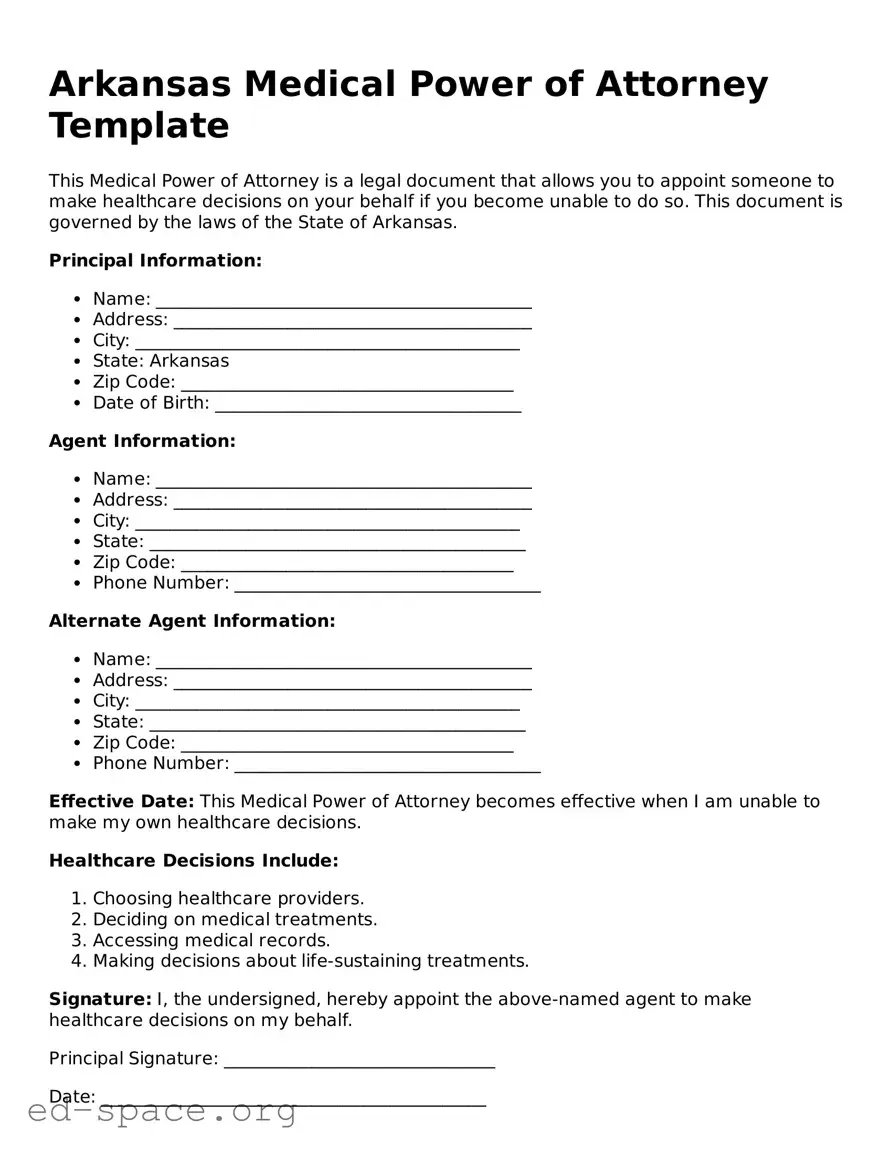
Arkansas Medical Power of Attorney Template
This Medical Power of Attorney is a legal document that allows you to appoint someone to make healthcare decisions on your behalf if you become unable to do so. This document is governed by the laws of the State of Arkansas.
Principal Information:
Agent Information:
Alternate Agent Information:
Effective Date: This Medical Power of Attorney becomes effective when I am unable to make my own healthcare decisions.
Healthcare Decisions Include:
Signature: I, the undersigned, hereby appoint the above-named agent to make healthcare decisions on my behalf.
Principal Signature: _______________________________
Date: ____________________________________________
Witnesses:
This document must be signed in the presence of two witnesses who are not related to the principal or the agent.
This Medical Power of Attorney is valid under Arkansas law. Ensure that all information is filled out completely and accurately.
| Fact Name | Details |
|---|---|
| Definition | The Arkansas Medical Power of Attorney form allows an individual to designate someone to make healthcare decisions on their behalf if they become incapacitated. |
| Governing Law | The form is governed by the Arkansas Code Annotated, specifically under Title 20, Chapter 13, which outlines the laws related to health care decisions. |
| Requirements | The form must be signed by the principal in the presence of two witnesses or a notary public to be valid. |
| Revocation | The principal can revoke the Medical Power of Attorney at any time, as long as they are competent to do so. |
Filling out the Arkansas Medical Power of Attorney form is a straightforward process that allows you to designate someone to make medical decisions on your behalf if you become unable to do so. It’s important to ensure that the form is completed accurately to reflect your wishes clearly.
What is a Medical Power of Attorney in Arkansas?
A Medical Power of Attorney is a legal document that allows you to appoint someone to make medical decisions on your behalf if you become unable to do so. This person, known as your agent or proxy, will have the authority to discuss your medical treatment, make choices about your care, and communicate with healthcare providers. It's an important tool for ensuring your wishes are respected during times when you might not be able to express them yourself.
Who can be appointed as my agent?
You can choose anyone to be your agent, as long as they are at least 18 years old and capable of making decisions. Many people choose a trusted family member or close friend. It’s important that this person understands your values and wishes regarding medical treatment. You can also appoint a different agent for specific situations if you wish.
How do I create a Medical Power of Attorney in Arkansas?
Creating a Medical Power of Attorney in Arkansas involves filling out a specific form that outlines your wishes and appoints your agent. You can find templates online or through legal resources. After completing the form, you need to sign it in front of a notary public or two witnesses who are not related to you and do not stand to gain from your estate. This ensures that your document is legally valid.
Can I change or revoke my Medical Power of Attorney?
Yes, you can change or revoke your Medical Power of Attorney at any time, as long as you are mentally competent. To revoke it, you can simply create a new document that states your intention to revoke the previous one, or you can destroy the original document. Make sure to inform your agent and any healthcare providers about the change to avoid confusion.
What happens if I don’t have a Medical Power of Attorney?
If you do not have a Medical Power of Attorney and become unable to make decisions for yourself, your family may have to go through a legal process to appoint a guardian or conservator. This can be time-consuming and may not reflect your personal wishes. Having a Medical Power of Attorney in place helps ensure that your preferences are followed without unnecessary delays or complications.
Not clearly identifying the principal. It is essential to provide the full name and address of the person granting the power of attorney.
Failing to specify the agent's name. The individual chosen to make medical decisions must be named explicitly.
Neglecting to include alternate agents. If the primary agent is unavailable, having a backup can prevent confusion.
Overlooking the date of signing. A signature without a date can lead to questions about the document's validity.
Not signing in front of witnesses. Arkansas law requires that the form be signed in the presence of two witnesses or a notary.
Using outdated forms. Always ensure the form is the most current version to comply with state laws.
Failing to review the document after completion. Errors can go unnoticed without a careful review.
Not discussing the wishes with the agent. Clear communication about medical preferences is crucial for effective decision-making.
Ignoring state-specific requirements. Each state has unique laws governing medical powers of attorney, and Arkansas is no exception.
Forgetting to store the document safely. Keeping the document in an accessible yet secure location ensures it can be found when needed.
When setting up a Medical Power of Attorney in Arkansas, there are several other documents that can be useful. Each of these forms plays a significant role in ensuring that your healthcare wishes are honored. Here’s a list of common forms you might consider using alongside the Medical Power of Attorney.
Having these documents in place can provide peace of mind. They ensure that your healthcare and personal wishes are respected, no matter what happens. Always consider consulting with a professional to ensure these documents meet your specific needs.
When filling out the Arkansas Medical Power of Attorney form, it is important to follow certain guidelines to ensure the document is valid and effective. Below is a list of things to do and avoid during this process.
Understanding the Arkansas Medical Power of Attorney form can be challenging, and several misconceptions often arise. Here are six common misunderstandings about this important document:
Many people believe that a Medical Power of Attorney is only relevant when a person is near death. In reality, this form allows an individual to designate someone to make healthcare decisions on their behalf whenever they are unable to do so, not just at the end of life.
While notarization can add an extra layer of authenticity, it is not a requirement for the Arkansas Medical Power of Attorney to be valid. The form must be signed by the principal and witnessed by two individuals who are not related to the principal.
Although individuals have the freedom to choose their agent, there are restrictions. The appointed agent must be at least 18 years old and cannot be the principal’s healthcare provider or an employee of the healthcare provider unless they are related.
Some people think that a Medical Power of Attorney can completely override their personal wishes. However, the appointed agent is expected to act in accordance with the principal’s known wishes and values, even if those wishes are not formally documented.
Many assume that once a Medical Power of Attorney is created, it cannot be changed. In fact, the principal can revoke or update the document at any time, as long as they are mentally competent to do so.
While both documents deal with healthcare decisions, they serve different purposes. A Living Will outlines specific medical treatments a person does or does not want in certain situations, whereas a Medical Power of Attorney designates someone to make decisions on behalf of the principal.
Filling out and using the Arkansas Medical Power of Attorney form is an important step in ensuring your healthcare preferences are respected. Here are key takeaways to consider:
Taking these steps can help ensure that your healthcare decisions are honored, providing peace of mind for you and your loved ones.