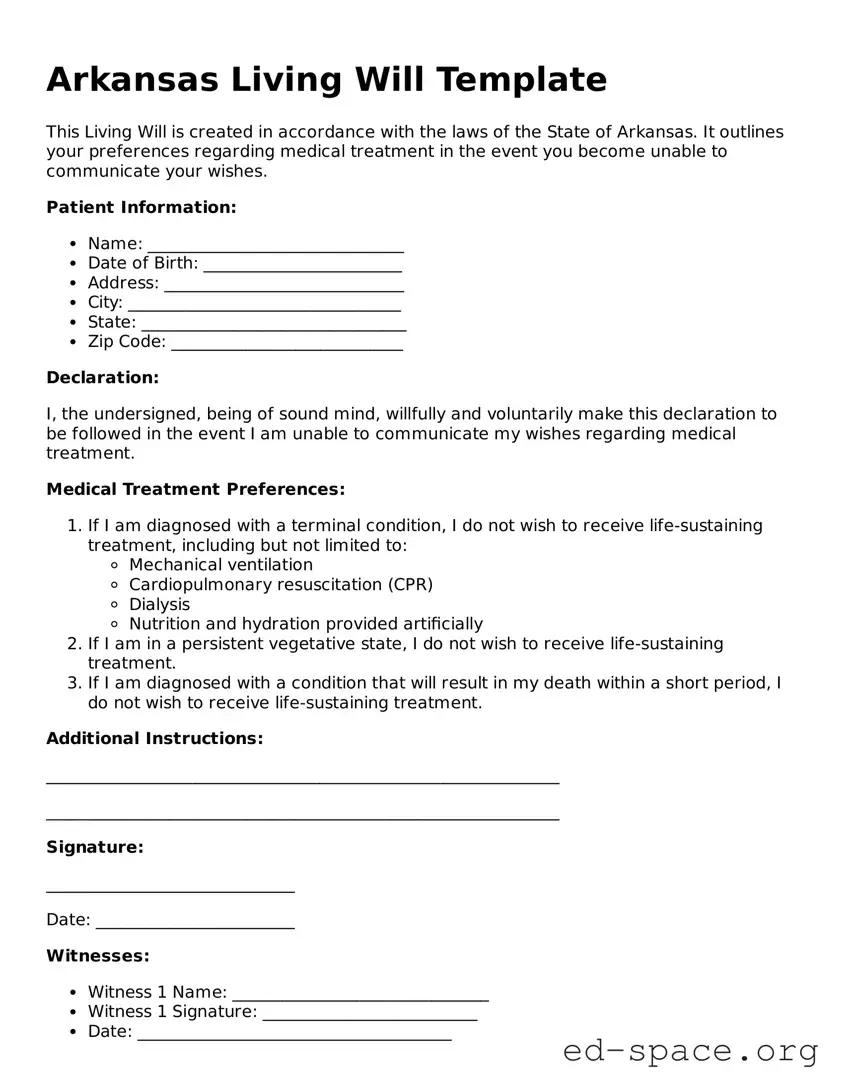
In the realm of healthcare decision-making, the Arkansas Living Will form serves as a vital tool for individuals seeking to express their wishes regarding medical treatment in the event they become unable to communicate their preferences. This document allows individuals to outline their desires concerning life-sustaining treatments, such as resuscitation and artificial nutrition, ensuring that their values and beliefs guide medical decisions when they can no longer advocate for themselves. By completing this form, individuals can relieve their loved ones from the burden of making difficult choices during emotionally charged moments. It is important to note that the Arkansas Living Will is distinct from other advance directives, such as a durable power of attorney for healthcare, as it specifically focuses on end-of-life care. Furthermore, the form must be signed in the presence of two witnesses or a notary public to ensure its validity, thereby providing a clear framework for healthcare providers to follow. Understanding the nuances of this document can empower individuals to take control of their medical futures while fostering open conversations with family and healthcare professionals.
Arkansas Living Will Template
This Living Will is created in accordance with the laws of the State of Arkansas. It outlines your preferences regarding medical treatment in the event you become unable to communicate your wishes.
Patient Information:
Declaration:
I, the undersigned, being of sound mind, willfully and voluntarily make this declaration to be followed in the event I am unable to communicate my wishes regarding medical treatment.
Medical Treatment Preferences:
Additional Instructions:
______________________________________________________________
______________________________________________________________
Signature:
______________________________
Date: ________________________
Witnesses:
This Living Will is valid only if signed by the individual and witnessed by two adults who are not related to the individual or beneficiaries under this declaration.
| Fact Name | Details |
|---|---|
| Definition | A Living Will is a legal document that outlines a person's wishes regarding medical treatment in case they become unable to communicate those wishes themselves. |
| Governing Law | The Arkansas Living Will is governed by the Arkansas Code Annotated, Title 20, Chapter 17. |
| Eligibility | Any adult resident of Arkansas can create a Living Will, provided they are of sound mind. |
| Witness Requirements | The document must be signed in the presence of two witnesses who are not related to the individual or beneficiaries. |
| Revocation | A Living Will can be revoked at any time by the individual, either verbally or in writing. |
| Healthcare Provider Obligations | Healthcare providers must follow the directives outlined in the Living Will, provided they are aware of its existence. |
| Durability | The Arkansas Living Will remains effective until revoked by the individual or until the individual passes away. |
| Additional Documents | Individuals may also consider creating a Durable Power of Attorney for Healthcare to appoint someone to make medical decisions on their behalf. |
Filling out the Arkansas Living Will form is an important step in making your healthcare wishes known. Once completed, this document can guide your loved ones and medical providers in making decisions about your care if you are unable to communicate your preferences.
What is a Living Will in Arkansas?
A Living Will is a legal document that allows individuals to express their wishes regarding medical treatment in situations where they are unable to communicate their preferences. This typically occurs when a person is terminally ill or in a persistent vegetative state. By creating a Living Will, you can ensure that your healthcare preferences are respected, even if you cannot speak for yourself.
Who can create a Living Will in Arkansas?
In Arkansas, any adult who is at least 18 years old and of sound mind can create a Living Will. This means you should be able to understand the nature and consequences of your decisions regarding medical treatment. It is essential to reflect on your values and beliefs before drafting this important document.
What should be included in an Arkansas Living Will?
Your Living Will should clearly outline your preferences for medical treatments, including life-sustaining measures such as resuscitation, mechanical ventilation, and artificial nutrition. You may also specify any conditions under which you would or would not want certain treatments. Be as specific as possible to avoid confusion among your loved ones and healthcare providers.
Do I need witnesses or a notary to sign my Living Will?
Yes, in Arkansas, you must sign your Living Will in the presence of two witnesses or have it notarized. The witnesses cannot be related to you by blood or marriage, nor can they be individuals who would inherit from your estate. This requirement helps to ensure that your wishes are genuine and not influenced by others.
Can I change or revoke my Living Will once it is created?
Absolutely. You have the right to change or revoke your Living Will at any time, as long as you are mentally competent. To make changes, you can create a new Living Will that clearly states your updated preferences. It is also a good idea to inform your healthcare providers and loved ones about any changes you make.
How does a Living Will differ from a Durable Power of Attorney for Healthcare?
A Living Will specifically addresses your wishes regarding medical treatment, while a Durable Power of Attorney for Healthcare appoints someone to make medical decisions on your behalf if you are unable to do so. Both documents can work together to ensure your healthcare preferences are honored, but they serve different purposes.
Where should I keep my Living Will?
Store your Living Will in a safe but accessible place. It is wise to give copies to your healthcare provider, family members, and anyone you designate as your healthcare agent. Make sure that those close to you know where to find the document in case it is needed in an emergency.
Is a Living Will recognized in other states?
While a Living Will created in Arkansas is valid within the state, other states may have different requirements or forms. If you travel or relocate, it’s advisable to check the laws of the new state regarding Living Wills. You may want to create a new Living Will that complies with the laws of that state to ensure your wishes are honored.
Not understanding the purpose of a Living Will. Many individuals fill out the form without fully grasping its intent, which is to outline their wishes regarding medical treatment in the event they become incapacitated.
Failing to discuss wishes with family. Open communication with family members about preferences can prevent confusion and conflict during difficult times.
Not being specific enough. Vague language can lead to misinterpretations. It's important to clearly state preferences regarding specific medical procedures and treatments.
Overlooking the importance of signatures. The form must be signed by the individual and may also require witnesses or notarization, depending on state requirements.
Using outdated forms. Laws can change, and using an old version of the Living Will form may not reflect current legal standards.
Neglecting to review and update the document regularly. Life circumstances change, and it’s essential to revisit the Living Will periodically to ensure it still aligns with current wishes.
Not providing copies to relevant parties. After completing the form, it’s crucial to share copies with family members, healthcare providers, and anyone else involved in medical decision-making.
Assuming that a Living Will covers all medical decisions. It’s important to understand that a Living Will typically addresses specific situations and may not encompass all possible medical scenarios.
Ignoring state-specific requirements. Each state, including Arkansas, has its own regulations regarding Living Wills. Familiarity with these rules is essential for the document to be valid.
A Living Will is an important document that outlines an individual's preferences regarding medical treatment in situations where they may be unable to communicate their wishes. In addition to a Living Will, there are several other documents that can complement this directive, ensuring that your healthcare choices are honored. Below is a list of commonly used forms and documents that individuals may consider alongside the Arkansas Living Will form.
Considering these documents can help ensure that your healthcare preferences are respected and followed. Each form serves a unique purpose, and together they create a robust plan for your medical care in times of need.
A Living Will is an important document that outlines your wishes regarding medical treatment in case you become unable to communicate them yourself. It serves as a guide for healthcare providers and loved ones. Several other documents share similar purposes or functions. Here’s a list of nine documents that are comparable to a Living Will:
Each of these documents plays a vital role in ensuring that your healthcare preferences are respected, especially during critical times. Understanding their similarities and differences can empower you to make informed decisions about your future care.
When completing the Arkansas Living Will form, it is essential to approach the task with care and consideration. Below are some important guidelines to follow, as well as common pitfalls to avoid.
Things You Should Do:
Things You Shouldn't Do:
By following these guidelines, you can ensure that your Living Will accurately reflects your wishes and provides clarity for your loved ones during difficult times.
Understanding the Arkansas Living Will form is crucial for anyone looking to make their healthcare wishes known. However, several misconceptions often cloud the process. Here are four common misunderstandings:
A Living Will specifically addresses healthcare decisions, particularly regarding end-of-life care, while a Last Will and Testament deals with the distribution of assets after death.
While legal assistance can be helpful, Arkansas law allows individuals to create a Living Will without a lawyer. It is essential, however, to follow state guidelines to ensure the document is valid.
A Living Will can guide healthcare decisions in various situations, not just terminal illness. It can also address situations where a person is in a persistent vegetative state or unable to communicate their wishes.
Individuals can modify or revoke their Living Will at any time, as long as they are mentally competent. It is important to communicate any changes to healthcare providers and family members.
Filling out and using the Arkansas Living Will form is an important step in ensuring that your healthcare wishes are respected in the event that you cannot communicate them yourself. Here are some key takeaways to consider: