Creating a Last Will and Testament is a crucial step in ensuring that your wishes are honored after you pass away. In Arkansas, this legal document outlines how your assets will be distributed, who will care for your minor children, and who will execute your estate. The form is designed to be straightforward, allowing individuals to specify their desires clearly. It typically includes sections for naming beneficiaries, appointing an executor, and detailing funeral arrangements. Additionally, the Arkansas Last Will and Testament form requires the signatures of witnesses to validate its authenticity, ensuring that your intentions are upheld. Understanding the importance of this document can provide peace of mind, knowing that your loved ones will be taken care of according to your wishes.
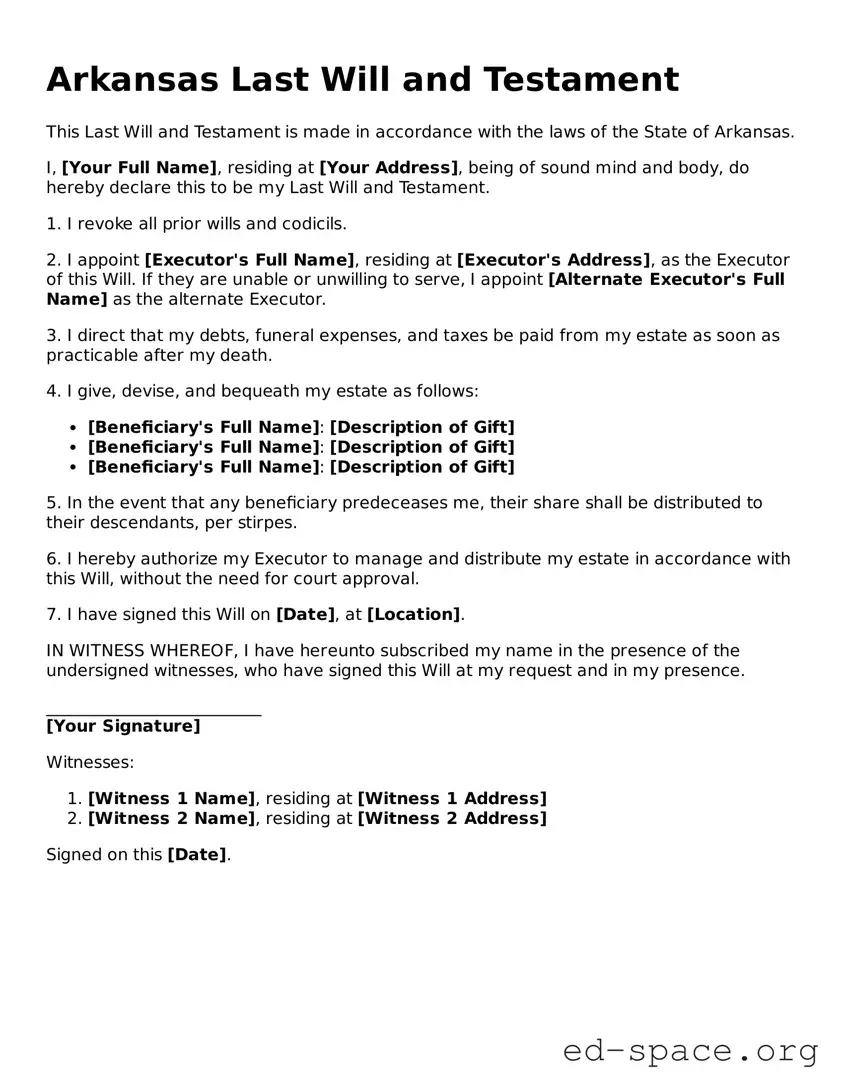
Arkansas Last Will and Testament
This Last Will and Testament is made in accordance with the laws of the State of Arkansas.
I, [Your Full Name], residing at [Your Address], being of sound mind and body, do hereby declare this to be my Last Will and Testament.
1. I revoke all prior wills and codicils.
2. I appoint [Executor's Full Name], residing at [Executor's Address], as the Executor of this Will. If they are unable or unwilling to serve, I appoint [Alternate Executor's Full Name] as the alternate Executor.
3. I direct that my debts, funeral expenses, and taxes be paid from my estate as soon as practicable after my death.
4. I give, devise, and bequeath my estate as follows:
5. In the event that any beneficiary predeceases me, their share shall be distributed to their descendants, per stirpes.
6. I hereby authorize my Executor to manage and distribute my estate in accordance with this Will, without the need for court approval.
7. I have signed this Will on [Date], at [Location].
IN WITNESS WHEREOF, I have hereunto subscribed my name in the presence of the undersigned witnesses, who have signed this Will at my request and in my presence.
__________________________
[Your Signature]
Witnesses:
Signed on this [Date].
| Fact Name | Details |
|---|---|
| Governing Law | The Arkansas Last Will and Testament form is governed by the Arkansas Code, Title 28, Chapter 40. |
| Signature Requirement | The will must be signed by the testator and witnessed by at least two individuals who are present at the same time. |
| Age Requirement | The testator must be at least 18 years old to create a valid will in Arkansas. |
| Revocation | A Last Will and Testament can be revoked by the testator at any time, as long as they are competent to do so. |
Completing the Arkansas Last Will and Testament form is an important step in ensuring that your wishes are honored after your passing. After filling out the form, it is advisable to have it reviewed by a legal professional to confirm that it meets all necessary requirements and accurately reflects your intentions.
After completing the form, ensure that it is stored in a safe place, and consider discussing your wishes with your loved ones. This can help avoid confusion or disputes in the future.
What is a Last Will and Testament in Arkansas?
A Last Will and Testament is a legal document that outlines how a person's assets and affairs should be handled after their death. In Arkansas, this document allows individuals to specify who will inherit their property, appoint guardians for minor children, and designate an executor to manage the estate. It is essential for ensuring that a person's wishes are honored and can help avoid disputes among heirs.
Who can create a Last Will and Testament in Arkansas?
In Arkansas, any individual who is at least 18 years old and of sound mind can create a Last Will and Testament. This means the person must understand the nature of the document and its implications. Minors, individuals under guardianship, or those deemed mentally incompetent cannot create a valid will.
Are there specific requirements for a Last Will and Testament in Arkansas?
Yes, Arkansas law requires that a Last Will and Testament be in writing, either typed or handwritten. The document must be signed by the testator (the person making the will) in the presence of at least two witnesses. These witnesses must also sign the will, affirming that they observed the testator sign the document. The will does not need to be notarized, but doing so can provide additional legal protection.
Can I change or revoke my Last Will and Testament in Arkansas?
Yes, individuals can change or revoke their Last Will and Testament at any time while they are alive and of sound mind. To make changes, a person can create a new will or add a codicil, which is an amendment to the existing will. Revocation can occur by destroying the document or by creating a new will that explicitly states the previous will is revoked.
What happens if I die without a will in Arkansas?
If an individual dies without a will, they are considered to have died intestate. In this case, Arkansas law dictates how the deceased's assets will be distributed. Typically, assets will be divided among surviving relatives according to a predetermined order of priority, which may not align with the deceased's wishes. This can lead to complications and disputes among family members.
Can I use a template for my Last Will and Testament in Arkansas?
While templates for Last Will and Testament forms are widely available, it is crucial to ensure that any template used complies with Arkansas laws. Using a template can simplify the process, but individuals should carefully review the document to ensure it accurately reflects their wishes. Consulting with an attorney may be beneficial to ensure the will is valid and enforceable.
What is the role of an executor in a Last Will and Testament?
The executor is the person appointed in the will to manage the deceased's estate after their death. This role includes gathering assets, paying debts and taxes, and distributing the remaining assets to beneficiaries as specified in the will. The executor has a fiduciary duty to act in the best interest of the estate and its beneficiaries and must follow legal procedures throughout the process.
Is it necessary to have a lawyer to create a Last Will and Testament in Arkansas?
While it is not legally required to have a lawyer to create a Last Will and Testament in Arkansas, consulting with one can be beneficial. An attorney can provide guidance on state laws, help ensure the will is valid, and offer advice on specific circumstances, such as complex family situations or significant assets. Legal assistance can help avoid potential issues and ensure that the document accurately reflects the testator's wishes.
Not being clear about beneficiaries. It's crucial to specify who will inherit your assets. Vague language can lead to confusion and disputes among family members.
Forgetting to sign the document. A will must be signed by the person creating it. Without a signature, the will may not be considered valid.
Neglecting to have witnesses. In Arkansas, at least two witnesses must sign the will. Their signatures confirm that you were of sound mind when creating the document.
Not updating the will after major life events. Changes such as marriage, divorce, or the birth of children should prompt a review and potential update of your will.
Failing to include a residuary clause. This clause explains what happens to any assets not specifically mentioned in the will, ensuring nothing is left unaccounted for.
Overlooking state-specific requirements. Each state has its own laws regarding wills. Familiarizing yourself with Arkansas laws is essential to ensure your will is valid.
Using outdated forms. Legal forms can change over time. Always ensure you are using the most current version of the Arkansas Last Will and Testament form.
When preparing a Last Will and Testament in Arkansas, several other forms and documents may be necessary to ensure that all aspects of estate planning are adequately addressed. Each document serves a specific purpose, contributing to a comprehensive estate plan that reflects the individual's wishes and provides clarity for heirs.
Each of these documents plays a critical role in the estate planning process. Together, they help ensure that an individual's wishes are honored, their loved ones are taken care of, and the management of their estate is handled smoothly and efficiently.
The Last Will and Testament is a crucial document for individuals wishing to outline their wishes regarding the distribution of their assets after their passing. However, several other documents serve similar purposes in estate planning and asset management. Here are seven documents that share similarities with a Last Will and Testament:
When preparing your Last Will and Testament in Arkansas, it’s important to follow certain guidelines to ensure your wishes are clearly expressed. Here’s a helpful list of what you should and shouldn’t do:
By following these guidelines, you can create a clear and effective Last Will and Testament that reflects your wishes and provides peace of mind for you and your loved ones.
Understanding the Arkansas Last Will and Testament form is crucial for ensuring that your wishes are respected after your passing. However, several misconceptions can lead to confusion and potentially serious issues. Here are eight common misconceptions:
This is false. Everyone can benefit from having a will, regardless of their financial situation. A will helps ensure that your assets are distributed according to your wishes.
Many people believe that wills are only for the elderly. In reality, unexpected events can happen at any age, making it essential for adults of all ages to have a will in place.
While some states recognize oral wills, Arkansas does not. A written document is necessary for a will to be considered valid.
This misconception is misleading. A will can be amended or revoked at any time, as long as the person creating the will is of sound mind.
In Arkansas, handwritten wills, also known as holographic wills, can be valid if they meet certain criteria. However, it is advisable to follow the formal requirements to avoid disputes.
This is not always the case. Without a will, state laws dictate asset distribution, which may not align with your wishes.
In Arkansas, at least two witnesses are required to validate a will. Failing to have witnesses can render the will invalid.
While a will outlines your wishes, it does not prevent your estate from going through probate. However, proper planning can help streamline the process.
Addressing these misconceptions is vital for effective estate planning. Taking the time to understand the requirements and implications of a Last Will and Testament can help ensure that your intentions are honored and that your loved ones are cared for according to your wishes.
When filling out and using the Arkansas Last Will and Testament form, it is important to consider several key points to ensure that the document is valid and meets the individual's needs.
By adhering to these guidelines, individuals can create a more effective and legally sound Last Will and Testament in Arkansas.